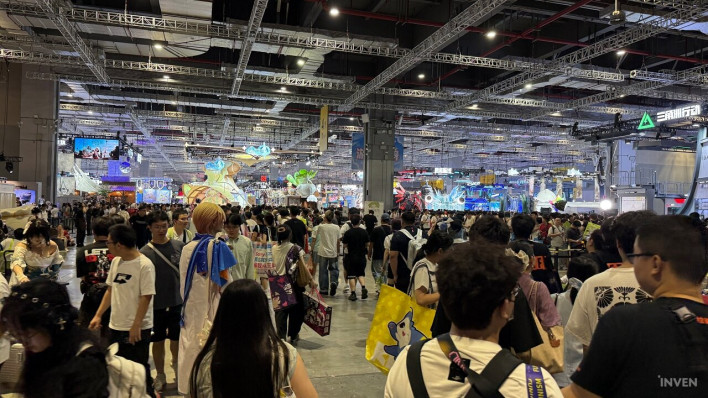
'Bilibili World,' hosted by China's largest subculture platform Bilibili, has reached its 10th anniversary. While it began as an event for Chinese subculture enthusiasts, it has evolved into a comprehensive entertainment festival that attracts global IP and brands, extending far beyond China. With 170 participating companies—130 of which are game-related—the event has become impossible for the gaming industry to ignore, regardless of its subculture roots.
The event drew approximately 400k visitors over its three-day run from the 10th to the 12nd, demonstrating a crowd-pulling power that rivals world-class game shows. Notably, this year marked the first time tickets were sold directly to attendees from over 190 countries and regions. Previously, foreigners faced complex authentication processes unique to Chinese platforms to purchase tickets; now, they can do so simply by verifying their passports. As a result, the share of international visitors using passports to purchase tickets rose from 13% to 18% last year, signaling the event's growth into a truly international affair.
As is well known through the case of the 'ISBN' (game license), the Chinese market is highly restrictive. Without a license, a game cannot be released, and applications must be made through local partners or subsidiaries. Most information is similarly siloed; distribution is limited to domestic Chinese platforms, and accessing them often requires a Chinese phone number or bank account. While services like WeChat Pay and Alipay have gradually opened to foreigners since the pandemic, and exhibition requirements have eased slightly, China remains difficult to navigate. Beyond the language barrier, simply opening the gates to the system is a challenge.
However, Bilibili World has boldly opened its doors. While hurdles like language barriers remain, the event is no longer so daunting that one would hesitate to participate. Consequently, games that have yet to receive a license have naturally found a space to integrate and gauge the reactions of local Chinese users. For instance, NEOWIZ's 'Brown Dust 2,' despite lacking a license, received a positive response from users this year, just as it did last year. While it could not feature the bold VIP events seen at the Taipei Game Show, the team demonstrated a willingness to test the waters and adjust their approach based on what is permissible in Chinese offline events.
The event also serves as one of the few stages where international figures can engage with the public. At ChinaJoy, for example, it is rare to see foreign developers or international stakeholders on the main stage. Bilibili World, however, has been providing such opportunities for years. Over that time, it has hosted major titles like 'Cyberpunk 2077' and 'Death Stranding 2,' and even welcomed Marvel Studios head Kevin Feige to share new updates. It has effectively become a must-attend venue for global companies targeting the Chinese market.
Furthermore, as an event originally intended for Chinese subculture users, it is an excellent place to observe local trends and developments. While major Chinese game companies have pursued simultaneous global releases, they do not represent the entirety of the Chinese gaming industry. Looking back, most of China's prominent subculture developers—such as HoYoverse, KURO GAMES, and Hypergryph—were mere doujin circles or small startups just a decade ago. They achieved success domestically, used that growth as a foundation to challenge the global market, and successfully scaled to their current size.
Of course, in an era where it is increasingly difficult for 'dragons to rise from small streams' and headhunting has become fierce, it is harder to find the next generation of rising stars. Instead, as the fandom for domestic Chinese IP has grown, there has been a visible trend toward expanding popular local IP into various formats.
When thinking of Chinese IP, one might recall cases based on classics like 'Black Myth: Wukong' or 'Nezha.' However, the domestic IP showcased at Bilibili World took a different approach, focusing more actively on media franchises involving Chinese webtoons, web novels, and 3D animation. 'Lord of the Mysteries,' which gained acclaim for its Cthulhu Mythos-inspired transcendental entities, mystery, and steampunk world-building, was featured not only at its publisher's booth but also at hardware booths like Razer, signaling steady preparation for IP expansion. Other examples of media franchising were also common, such as the announcement of a 3D animation based on the oriental fantasy web novel 'Mu Shen Ji' and the new open-world game 'Bringer,' currently being developed by a 3D animation studio using its own IP. As such, the event has firmly established itself as a comprehensive entertainment festival, with participation from related platforms and competitors.
The prominence of domestic Chinese IP also reflects the lingering effects of the 'Han-Il-Ryeong' (restrictions on Korean content) that have persisted since late last year. 'BanG Dream!', which previously participated on a large scale via the Bushiroad booth, was limited to only the game serviced through Bilibili after its Roselia concert in Shanghai was canceled last year. 'Detective Conan,' which had been criticized in media reports, was nowhere to be seen. While Japanese IP has not been completely blocked, the cautious atmosphere makes the impact of these restrictions palpable.
For a foreigner, being able to observe such on-site atmosphere and read the trends is extremely difficult in China. This is due not only to poor accessibility but also to a lack of proactive improvement in these areas. While the massive domestic market has reduced the perceived need for openness, there is also a strong resistance to foreign influence disrupting the status quo. Consequently, the market has been kept closed, either by blocking access entirely or requiring local partners. Naturally, this has favored the status quo and made new entry difficult. Although there have been slight efforts to change this since the end of the pandemic, many events remain strictly for the domestic market.
As such, Bilibili—which is struggling to evolve from China's representative subculture platform into a comprehensive entertainment platform—and the 'Bilibili World' event they host will only become more important. It has established itself as a venue where companies can meet users before entering China and, more importantly, gain a relatively natural understanding of the flow of the Chinese market.

Sort by:
Comments :0