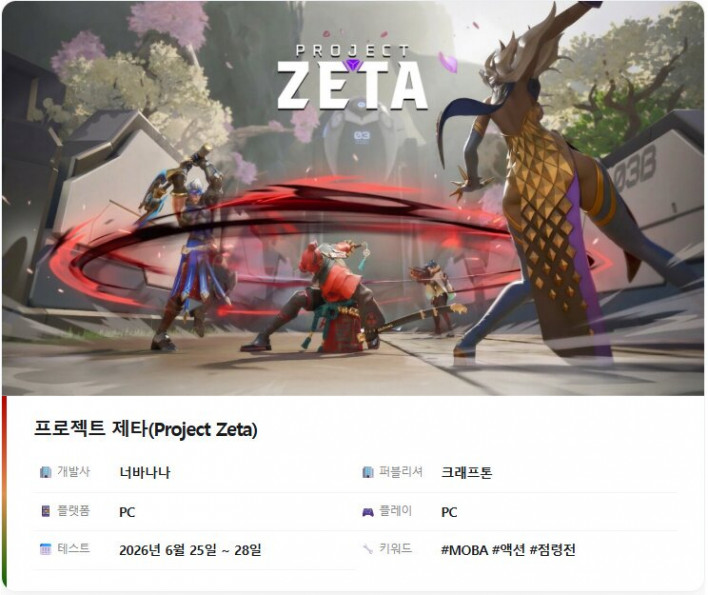
From the 25th to the 28th, KRAFTON held a global playtest for 'Project ZETA,' a new action MOBA currently in development by 5minlab (Nervana Studio). The studio, led by CEO Kim Nam-seok and composed of veterans from the industry and the 'Eternal Return' development team, previously showcased a highly strategic side of the MOBA genre during the first playtest in March.
Returning three months later after incorporating user feedback, 'Project ZETA' retains its core rules, which demand complex strategy. However, the developers have overhauled significant portions of the game to make its vision more intuitive and to boost the fun factor through more frequent combat.
Changes That Make the Hybrid of MOBA, Capture Point, and CTF More Intuitive
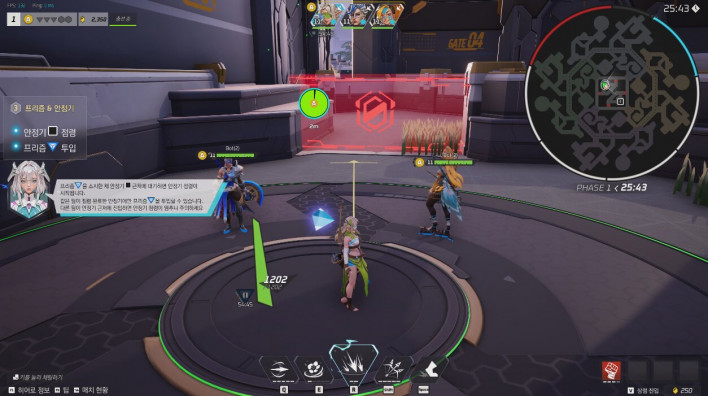
As revealed in the previous playtest, 'Project ZETA' is a complex hybrid of several genres. It follows a MOBA structure in that players start as level 1 characters, engage in PVPVE to level up, gather resources, equip items, and pursue strategic objectives. It incorporates Capture the Flag (CTF) elements, as players must defeat Prism Bosses and transport Prisms to designated zones, and capture-point mechanics, as they must hold those zones for a set time to score.
Since these core rules remained largely unchanged, the challenge for 'Project ZETA' was to present them to users more logically. In the previous test, even after completing the tutorial, many teammates would focus solely on scouting, ignoring objectives like capturing points or defeating bosses, leading to one-sided games where early gaps were impossible to close. Furthermore, the game's tempo was slow at the start but accelerated abruptly once all zones opened, leaving many players unable to adapt and causing teams to drift apart.
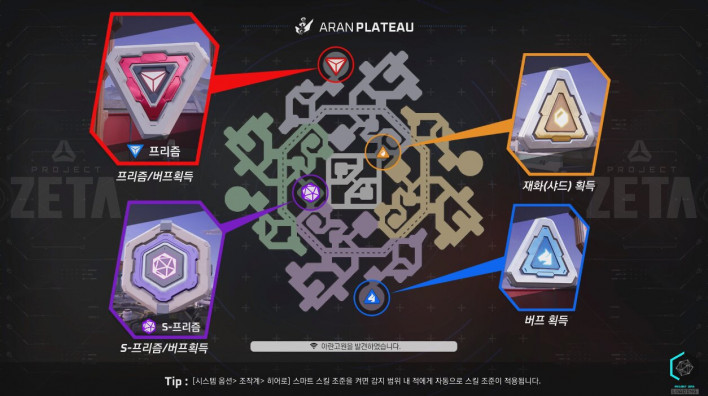
Seemingly aware of these issues, the latest test for 'Project Zeta' features a complete overhaul of team counts and map structure. While the previous test involved 15 players across five teams of three, this version has been reduced to four teams. The map, previously designed as a concentric circle structure divided into three zones, has been reshaped into a diamond-like layout, scaled down, and stripped of its zones.
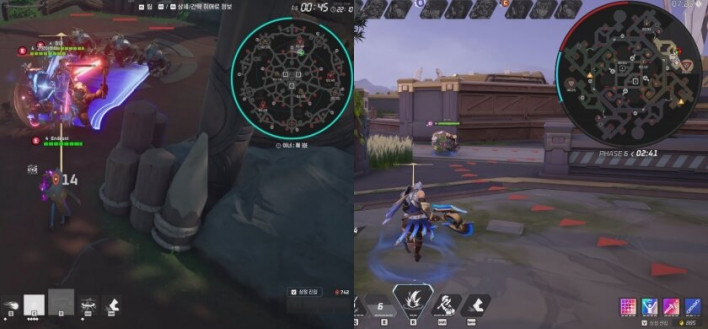

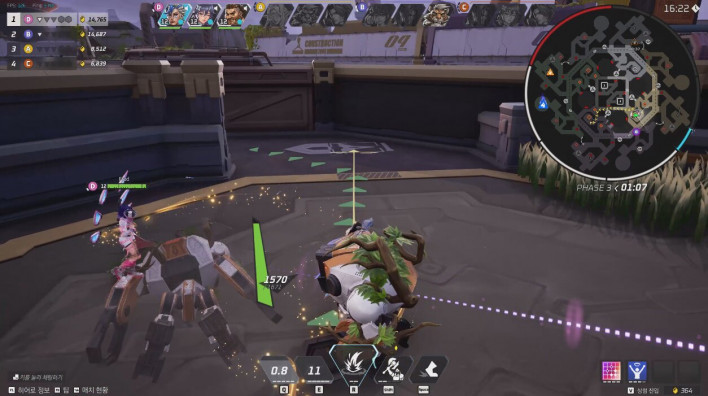
As someone familiar with the previous test, these changes felt awkward at first. The old three-stage zone opening seemed designed to guide players through a sequence of farming, Prism Boss hunting, and capture-point battles. However, the long travel distances and heavy reliance on portals made the intended path difficult to understand intuitively. To shorten travel times, the map was scaled down, and the areas where Prism Bosses and Buff Bosses appear were limited to four zones. Additionally, the game now displays paths to major areas on the mini-map and the main map, helping beginners understand the flow more intuitively.
The effect was significant. Previously, there were many areas where the primary scoring objective—the Prism Boss—would appear; now, the number of locations is reduced and paths are marked, greatly decreasing early-game confusion. Furthermore, the central capture zone now uses gates instead of portals, shifting the dynamic from players being defenseless after teleporting to intense psychological warfare and skirmishes at the doorways.


Refinements made following the last test have made the complex strategic depth and psychological warfare unique to 'Project Zeta' more intuitive. The game’s core appeal lies in intensifying tension by layering CTF (Capture the Flag) and objective-capture mechanics onto the familiar tug-of-war over key objectives and terrain that players already know from MOBAs like League of Legends. While there was previously a steep learning curve to reach that point, removing some of those barriers now allows players to experience the excitement of the late game much more directly.
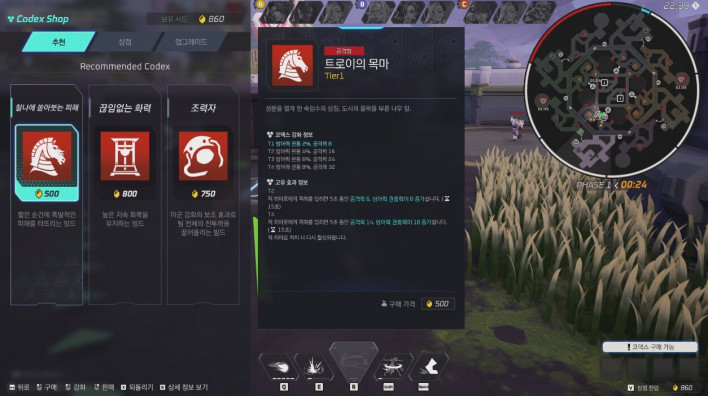
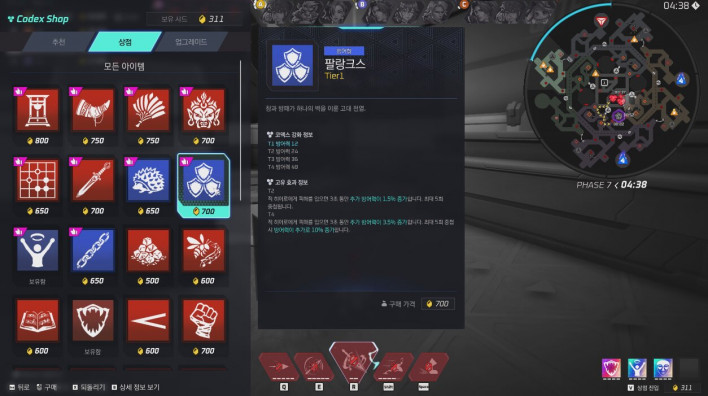
The developers also addressed some shortcomings in the settings. The decision to simplify the complex rules by purchasing and upgrading 'Codex' cards instead of combining sub-items was a good move. However, the previous test suffered from limited options, which severely restricted build paths. This test significantly expanded the variety of Codex cards, allowing for more experimentation with builds. While this introduced a new learning curve, the addition of recommended items and builds helped mitigate the issue.
The Taste of More Intense Teamfights Through Frequent Combat and Farming
MOBA games are defined by their ability to condense the fun of growth through farming, the depth of character settings, and the intensity of PVP. It is not just about fighting; it is about using strategy to create growth gaps to win before the fight even starts, or using cooperation and terrain advantages to pull off a comeback even when behind.
There have been many attempts to add the thrill of action to this strategic PVP and farming-heavy genre by moving from a quarter-view to a TPS perspective. Most have failed. A major reason is that the skill gap in aiming and movement control becomes much more apparent in a back-view perspective. Players familiar with quarter-view MOBAs who lack precise aim often find it stressful when their physical execution cannot keep up with their theoretical knowledge.

'Project ZETA' boldly removed jumping and manual aiming, allowing anyone to land basic attacks as long as the enemy is in the right direction and range. However, to keep the thrill of dodging skills and counterattacking, they added long-cooldown dashes and evasive maneuvers, adding a layer of variability for potential comebacks.

While this lowered the barrier to entry, it created issues with game tempo. Because the game uses a TPS camera, players expect a certain pace, but the game only slightly accelerated the tempo of a quarter-view MOBA, leaving empty gaps in the action. In particular, the character movement speed was not very fast, and the long cooldown on dashes made long travel segments feel tedious.
To minimize this downtime, 'Project ZETA' increased the density of the map by reducing its scale and adding more side paths and monster spawn areas. To exaggerate slightly, monsters were visible almost everywhere you looked, and bushes for ambush plays were scattered throughout. This made farming a natural part of movement and increased the frequency of skirmishes initiated by hiding in paths to catch farming enemies off guard.
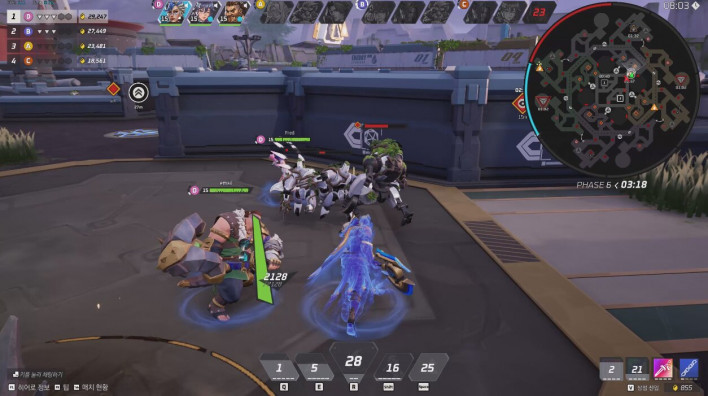
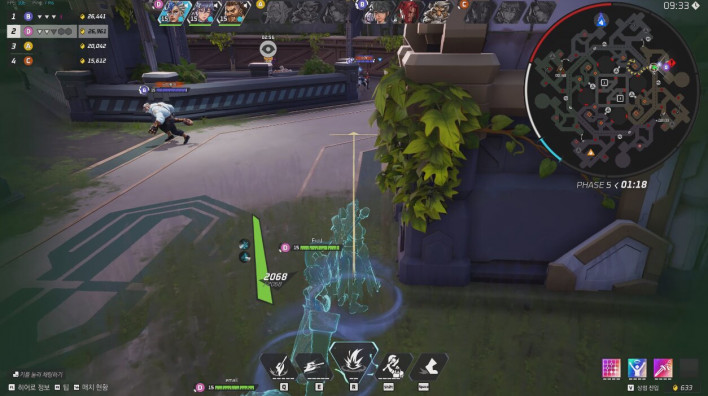
Notably, this test removed shared rankings; if Prism scores are tied, the ranking is decided by the total amount of 'Shards'—currency earned by killing monsters or players. This increased attempts to turn the tide through combat. Previously, if you couldn't get Prisms, you might give up, but now there is a chance to catch up by killing opponents or farming while they are dead. Furthermore, unlike the multi-stage Prism rules, Shards provide immediate, intuitive feedback, allowing even inexperienced players to jump into the fray. This acted as a driving force for intense late-game battles, preventing the game from becoming stale once rankings stabilized.

It was also notable that the developers implemented various measures to prevent players from simply 'sniping' the Prism after someone else defeats the boss. If you defeat a Prism Boss three times, you gain a buff that executes enemies below a certain health threshold. This forces players to take risks to defeat the boss if they want to secure first place. Alternatively, players can hunt Buff Bosses to accumulate buffs or aim for a big play during the late-game battle for the Prime Boss, 'Master Nazan.

'Project ZETA' Moves Closer to a Unique Position, but Stress Management Remains a Challenge
Beyond these major changes, 'Project ZETA' refined many details, including the UI. Health bars were moved to the center and given special effects to make it easier for players to track their status during intense combat. The previously vague role classifications were clearly divided into four types—Warrior, Marksman, Assassin, and Mage—on the selection screen, helping teammates immediately gauge their roles and synergies. Additionally, detailed controls and option settings for each character were added to further improve user convenience.
After one round of testing and feedback, 'Project ZETA' has moved closer to its goal of reducing the stress associated with both MOBA and TPS genres while maximizing the strategic fun of team play. However, as it is still in testing, there were discrepancies between theory and practice. While the rules were made easier to understand and the game was reorganized around intuitive combat, the situation for teams other than the first-place team remains a challenge. Although the game now ends as soon as the first-place team earns 5 points in the final phase, if the first-place team scores overwhelmingly fast, the remaining teams are still forced to play through the full 24 minutes and 8 phases to determine second place.

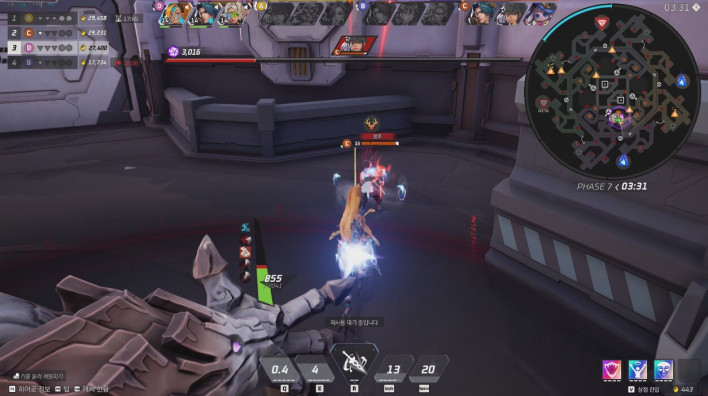
As the famous quote from former StarCraft pro and current poker player Hong Jin-ho goes, second place is indeed an achievement. However, whether that resonates with gamers is another matter. Most recent free-for-all games are either extraction shooters or battle royales, and battle royales are notorious for the stark difference in feeling between winning and losing. 'Project ZETA' leans closer to a battle royale than an extraction game. There is no way to 'extract' early with small gains; you are stuck in the match until the end, trying to maximize your score regardless of the outcome.
Of course, the thrill of escaping in first place is indescribable. But there is only one first-place team. The other three teams must spend the remaining time aiming for second place if the winner leaves early, and the longer that process takes, the easier it is for lower-ranked teams to get exhausted. At least now, with the ability to catch up by collecting Shards, there is some fun in fighting for second place. However, casual players are unlikely to want to stick with a game they know they cannot win.
In this test, where early surrender was slightly more lenient, many fourth-place teams surrendered and left without hesitation. This disrupted the strategies of mid-tier teams that were preparing to ambush lower-ranked teams to get a shot at the leaders. If the second and third-place teams are evenly matched, intense battles ensue, but if there is a gap, the waiting time is quite stressful.
Nevertheless, 'Project ZETA' seems to be gradually revealing its unique charm through this test. When team compositions are well-balanced and matchmaking works, the complex fun is hard to describe. I felt the thrill of a MOBA multiple times: standing off over an objective, waiting for a tank or bruiser to find an opening, or landing a CC skill to trigger a winning teamfight. There was also a clear thrill in reading the opponent's movement to destroy a Prism and escape quietly while others were busy fighting.
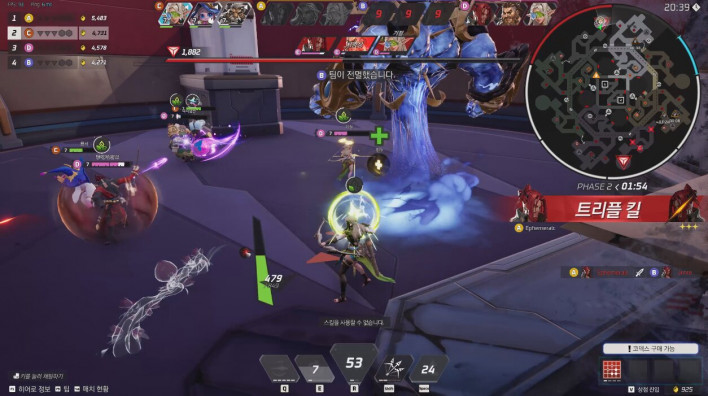

Since the game is now conveying that fun more clearly, the developers need to consider ways to reduce the stress felt when things don't go as planned. To put it bluntly, 'Project ZETA' seems to assume that players will always be desperately fighting to climb the rankings, much like in esports.
However, most casual games do not play out that way. There are often matches where the gap is so wide that motivation is lost early, or players move passively because they don't know what to do in a disadvantageous situation. As seen in other games, there are more players than expected who will troll or use abusive language to ruin the match when things go wrong. Since this test is global and broad, I hope that with more diverse user data and feedback, the next version of 'Project ZETA' will be able to deliver its fun more consistently and stably.

Sort by:
Comments :0