For a young man who majored in urban planning, entering the game industry was driven by a single, simple resolution: "Let's do what I love." He began his career as a level designer at Redduck, followed by stints at Nexon GT and NC, before joining Nexon Korea. Over the years, he has contributed to game development from various perspectives, starting with level design and moving into system design and development strategy research.
He left the company early last year. The timing was perfect: his thirst for creating his own games converged with the growing conviction that the AI technologies he had been studying were finally "ready to be integrated" into his work.
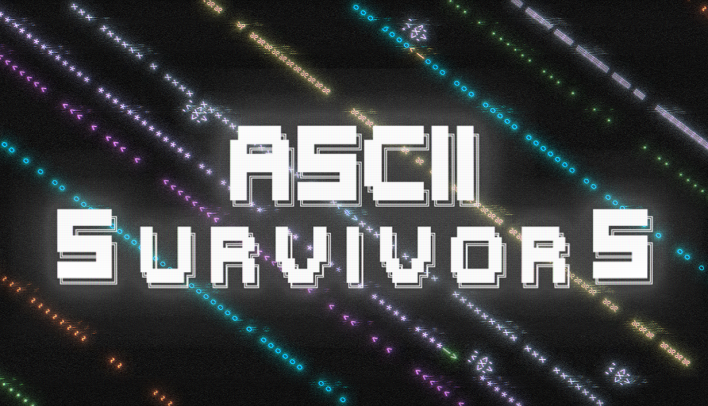
The result is 'ASCII Survivors.' Combining the 'Vampire Survivors' genre with visuals composed entirely of ASCII characters, the game sounds like a nonsensical concept on paper. The monsters, bullets, and explosions are all just text characters. It started from what he calls a "crazy idea": the thought that perhaps you could convey everything using only character codes.
INVEN met with developer Kim Ju-seok near Jeongja Station in Seongnam on May 12. Our 70-minute conversation spanned his career, the practical applications and limitations of AI, the complexities of the labeling debate, and survival strategies for indie developers. This is not a tale of a successful indie developer’s triumph; it is a candid account of leaving a major company to build and launch a game alone, and what he learned along the way.
Did your major in 'Urban Planning' help with 'Level Design'?
Could you start by introducing yourself and your career background?
"My name is Kim Ju-seok, and I currently operate as a sole proprietor under the name 'Indigo Vortex.' I have about 12 years of experience in the game industry. My first company was Redduck, where I started as a level designer. Afterward, I spent time at Nexon GT and NC, and worked at Nexon Korea for quite a long time.
Although I started in level design, I have participated in game development from various angles, including system design and development strategy research. I even served as an interviewer for new hires at Nexon Korea for a while.
I briefly moved to Nexon Games, but I eventually decided to venture out on my own because I wanted to pursue more experiments and research. That sounds a bit pretentious now that I say it out loud (laughs), but that was the general flow of things.
I heard your background in urban planning was very helpful in making games. How so?
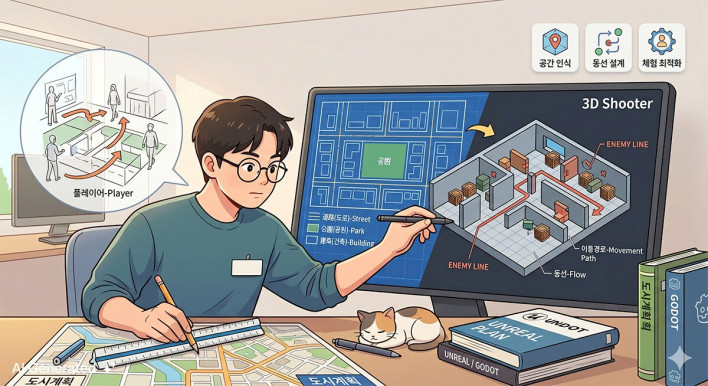
"Urban planning is a discipline that deals with space. When I was creating maps as a level designer, the instincts I developed during my studies naturally came into play whenever I thought about how people perceive space or how they navigate through it. At the same time, while building those maps, I also discovered how those concepts could be translated into a game environment. In a sense, I’ve learned how to approach spatial design in game development by applying what I learned from real-world spaces across my experiences at various companies.
I think many people are unfamiliar with the role of a level designer. Even I don't fully grasp the concept. Could you explain it?
"In Korea, because we are so exposed to RPGs, there were even jokes like, "Is level design about designing how to level up a character."
In games, a 'level' (sometimes referred to as a map, mission, or stage) refers to all the space available for a player to complete their objectives. To elaborate, the term 'level,' which originally described the height of terrain in miniature games, expanded to include the concept of dungeon depth and abstract notions like difficulty stages, eventually becoming a general term for units of game space. I think the term 'map design' was actually used more often than 'level design' in Korea in the past.
Ultimately, in one sentence, it is the job of designing the space itself based on 'what activities a player performs in a space, and what experiences they gain through those activities.'
Given how rare level design experience is, you could likely join any company you wanted. Why did you choose to go solo?
"I think I enjoyed the process of game development itself, from experiencing various aspects of completing a game to handling commercial goals. As I conducted personal research into AI, I couldn't help but think about deeply integrating it into the existing development process. Ultimately, I wanted to leave and test those ideas through my own research and challenges.
'ASCII Survivors' built with 'Godot Engine' and 'ASCII Code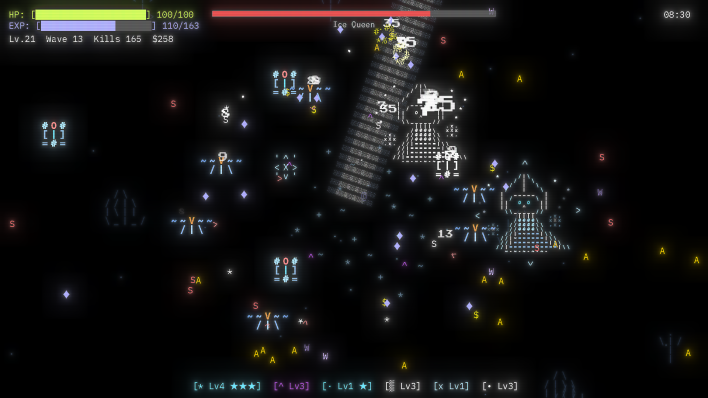
"'ASCII Survivors,' which I recently launched on Steam, is a Vampire Survivors-style game where most of the visuals and expressions are composed of ASCII code. The entire screen is just flying characters. It's actually hard to tell which character is your own (laughs), but the goal is to survive in that environment. I included a basic 10-minute survival mode, an endless mode, and challenge modes, and even the weapons and enemies are all made of ASCII code.
The idea came to me while I was playing and analyzing various 'Survivor-like' games on mobile and PC. At some point, I thought, 'Couldn't I do this with ASCII code?' I've always liked old-school roguelikes, so ASCII visuals came to mind naturally. When I looked, I realized there weren't any ASCII-based Survivor-likes. So I thought, 'I want to experiment anyway, so let's just do it.' I started with that 'crazy idea' that I could show everything using only character codes (laughs).
Is there a specific reason you chose the Godot Engine for development?
"I've used Unreal Engine for most of my career. Since this was an early-stage, experimental project, I wanted to try something else. People in my circle who work with open-source software have been saying for a while that "Godot is the future." One of the most famous recent games made in Godot is 'Slay the Spire 2.' With that in mind, and wanting to experiment with integrating AI into development, I chose Godot.
How was the Godot Engine after using it yourself, compared to Unreal.
"Asking me to rate it might be sensitive (laughs). Considering I've primarily used Unreal, I'd give it a 80-90 out of 100. Its strengths are clear. It felt lightweight when I was studying it, and once I started using it in earnest, I found development to be much lighter and more agile than I expected. I think it's a fantastic engine for 2D games. Being open-source, access to plugins and source code is free, and the engine code itself is clear, making it great for deep dives.
The downside is that there aren't many references yet. There were many times when I couldn't find answers, so I often had to dig through the code myself. While it has some shortcomings compared to Unreal in 3D, it's not impossible to use. Overall, I think it's an engine with plenty of room for growth, and if you're a beginner, it's definitely worth considering as an option.
Do you plan to keep using the Godot Engine?
"For those who want to keep making 2D games or want to build games lightly, I think Godot is a great option. My perception of Godot has improved significantly through this experience, and there's a high chance I'll use it again.
AI and Game Development: Usage, Limitations, and the Labeling Debate
You mentioned you left because you saw the advancement of AI. How did you actually use AI in this development?
"I've been studying artificial neural networks consistently since they started gaining traction. I felt it had reached a point where I could consider not just using AI within the game, but integrating it into the game development process itself.
The core benefit this time was increasing development speed and iteration efficiency. It was also incredibly helpful in quickly testing various hypotheses and establishing new ones during the design process.
A concrete example is sound design. Since the game has a terminal-like visual style, I thought 8-bit sound would fit well. I used AI to build a tool that could simulate the specific type of 8-bit sound I wanted. I used that tool to create the base sounds, then edited and refined them to get the mood I wanted. I loved that I could build the exact tool I needed.
Are there any negative aspects or things you felt you had to be careful about while using AI?
"Ultimately, game content must deliver fun and experience. If you leave everything to AI, you end up with a result generated without any creator's intent or direction. So, I thought the most important thing was to first design "what not to leave to AI." Designing the overall experience—what I want to show people, what kind of fun I want to provide, and how to handle those decisions—is ultimately the creator's job.
From that perspective, the ability to design game rules, optimize gameplay, and make technical judgments is even more important in the AI era. No matter how good AI is, it needs to be backed by experience and technical judgment. Also, since there are such diverse views on using AI in resource production, that was something I thought about a lot during development.
Regarding the sound work, didn't using an AI-made tool lead to labeling issues? I heard you mentioned it on the store page.
"That's right. Ultimately, I was the one who built the tool, adjusted it, and edited the results. But because I used an AI-created tool, some might perceive it as AI-generated. It's a very sensitive topic, so I thought about it a lot, but I eventually stated on the store page, "Some sounds were created using AI-assisted tools." I didn't think there was any need to hide it or pretend otherwise from the start.
I think there's ambiguity in labeling something as 'made with AI.' Using AI output as-is is indisputable. But if I modified that result by 10%, 20%, or even almost entirely, is it still 'made with AI'? Could you share more of your thoughts on the labeling issue?
"Steam is currently encouraging developers to disclose AI usage, but for now, we are following the policy guidelines of various governments and platforms. I had an experience that showed me how AI is perceived. I sent a message to a moderator on a Reddit channel to see if I could promote my game. I asked, "I didn't use generative AI, but I used AI to build a tool to create sound assets. Is this considered AI content?" They drew a hard line, saying, "If AI was involved in any way, it's not a fit for our channel." It made me realize that even if you aren't using generative AI directly, people are drawing clear lines regarding AI.
Ultimately, this issue comes down to how the consumer perceives it. Some users are fine with AI usage if the quality is good, while others don't want it involved at all. It's a very difficult issue to draw a hard line on.
What are your thoughts on the view that AI threatens the jobs of game developers? How much fear do developers actually feel?
"I can't easily speak for everyone, but it's not unreasonable to feel fear. AI is, after all, a tool, and developers are being threatened by that very tool.
Consumers have sharp instincts; there's a clear distinction between feeling, "Isn't this just lazily made by AI?" and "It's AI, but it's really well-made!" or even "Wait, this was AI?" Along with the fear of losing jobs to AI, I feel there's a fundamental anxiety about how to make a living in the future.
I also have many thoughts when I get help from AI to collect data. I assume developers have similar concerns?
"Exactly, it feels similar. The reason it's hard to say whether this is right or wrong is that on one hand, it increases productivity, so why not use it? On the other hand, people see it not as a productivity issue, but as a threat to jobs.
It's very difficult for me to predict whether this is positive or negative. People working in companies are having various experiences depending on their company's stance, and since some job postings even mention AI, I don't think it's unreasonable for game developers to feel that "AI is taking our jobs."
AAA vs. Indie: Industry Polarization and Indie Survival Strategies
There is an analysis that the game industry is polarizing into AAA blockbusters and indie games. As an industry insider and indie developer, how do you see this phenomenon?
"Since there is a clear consumer demand for quality and scale, the axis of large-scale game development will continue to exist. At the same time, as development accessibility improves and channels to promote games diversify, the increase in indie and small-scale development is a natural result. However, I don't think the mid-sized tier has disappeared; rather, the environment now allows small groups to create games that were once considered mid-sized, blurring the lines with indie.
Ultimately, if you're making a game for commercial purposes, you can't ignore costs. Marketing is structured so that the more you invest, the deeper and wider the reach. No matter how well you use AI, there are limits. Consequently, indie developers are forced to polarize: either hone their craft so sharply that fans form a community around it, or create large-scale games that claim to have 'everything for everyone.
Another important thing is that forming a fan-based development community in advance has become a survival strategy for indies. It's about building a consensus beforehand, like, "If it's a game made by that developer, I'll play it." Since simple festival or Indie Pass participation also costs money, saving costs while building a fandom is becoming a key strategy.
Are you saying it ultimately depends on consumer choice?
"That's highly likely. No matter how good a game is, it only has value if it reaches someone, and the process of reaching them costs money. This is the so-called marketing domain, and in this area, the more capital you have, the wider the channels you can reach. As a result, companies stuck in the middle find it hard to recoup costs, and the cost of promotion is higher than in the past. It's a structure that inevitably leads to polarization.
I do see it as a positive change that platforms where you can play games lightly are emerging, slowly increasing the channels for small games to be discovered. I know there are places in Korea attempting similar things.
After Launching 'ASCII Survivors'
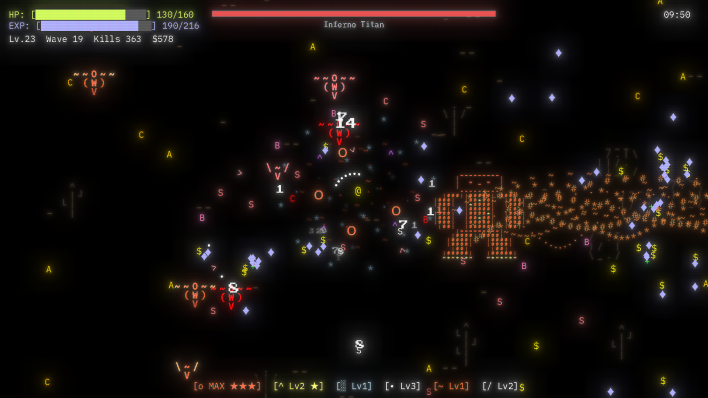
How long was the development period?
"The pure development period was about two months. To be precise, it was about 1.5 months, but there were various circumstances. Including the process of launching on Steam, it took about three months in total.
How satisfied are you after the launch?
"Honestly, this project was more of an experiment than a focus on sales or promotion. It was a process of verifying the things I thought about when I left: 'How can I integrate AI into development?' and 'How can I increase development speed while maintaining my direction?' From that perspective, I'm quite satisfied. It's true that resource production speed was much faster than a typical game because of the ASCII visuals, and the time spent agonizing over things was reduced significantly. In that sense, I think I verified to some extent how to handle AI to increase speed while maintaining my direction.
Looking at the reactions from Steam curators and streamers, many were surprised by the lack of graphics but commented that "you can still feel the essential fun of a Survivor-like" and "it has its own unique sense despite the ASCII visuals." Even if it doesn't sell many copies, confirming that people appreciate a well-made game even with ASCII visuals was meaningful. Honestly, I sometimes think it would have been better to include graphics if I had the environment to make a game of this level (laughs), but being able to conduct this experiment on my own was very significant to me.
Any words for those who might play the game after seeing this interview?
"If you actually buy and play it, I can only say thank you. I also hope that through this game, I can convey something to those who want to start solo development or those who think, 'Maybe I could do this too.' While making this game, I hoped that even with ASCII visuals, I could leave a small impression on fans of Survivor-likes that 'there was this unique game.' Even if it doesn't sell a lot (laughs), that feeling remains the same.
To Those Dreaming of Solo Development, and What's Next
Any tips for those dreaming of solo game development?
"In many cases, you can't help but dream of a big hit while making a game, but I think you shouldn't forget 'what you want to convey.' As development accessibility has improved, it seems easy to lose sight of the essence of making games. We live in an era where AI can make a game look plausible. But if you change your perspective, I think it's actually an environment and opportunity to focus more deeply on what you want to convey than in the past. If we've reached a level where we can make a complete game with ASCII visuals, it means we are now in a situation where we can spend more time and thought on 'what story I want to tell people' rather than worrying about tool barriers. I hope you can think of it that way. It's a bit funny to say this when my game hasn't even sold well (laughs).
Do you have plans for your next project?
"Of course, I have the thought that next time I should go with proper visuals, not ASCII. I'm already continuing a few experiments. What I felt was important in this project is that the environment now allows me to completely break and experiment with game rules. The speed of that experimentation is the biggest change for me. I'm also in the middle of discussing various things about AI with game artists. Nothing is confirmed for what's next, but I'm preparing in various ways.
Any final words?
"Although this project fell short of showing dramatic results, regardless of success or failure, I was able to conduct many experiments in the development process in a short time. I think it served as an opportunity to prepare more thoroughly for when I make the next game or do something else.
I'm also personally continuing my research on AI models, and I don't think AI will dramatically replace creators. Someone will always use AI to maximize their creativity to express something. We are in a transitional period. It's an era where technology develops faster than ever, and while speed brings chaos, it has also been an opportunity for me to think more about what I want to look toward in the future. Thank you for the great conversation.