The roguelite genre has quietly become one of the most common tags on Steam. Every week, dozens of new titles emerge, all following the same 'die and start over' formula. While this has lowered the barrier to entry, it has also made it easy for players to dismiss them as 'just another one of those games.' Ultimately, survival in this genre isn't about randomness itself, but how tightly and cleverly a system supports that randomness.
'Cinderia' is another challenger attempting to pass through that narrow gate. Developed by the Shanghai-based indie studio MyACG Studio and published by NPC Entertainment, the game launched into Steam Early Access on March 30. In a kingdom turned to ash on the night the witch's flame consumed the world, the player takes on the role of one of the few survivors who can absorb corrupted black magic without losing their sanity, uncovering the truth behind the world's collapse. While the dark fantasy setting is somewhat familiar, the game opts to scatter the narrative across the environment, artifacts, and interactions rather than explaining it directly, allowing players to piece the story together themselves.
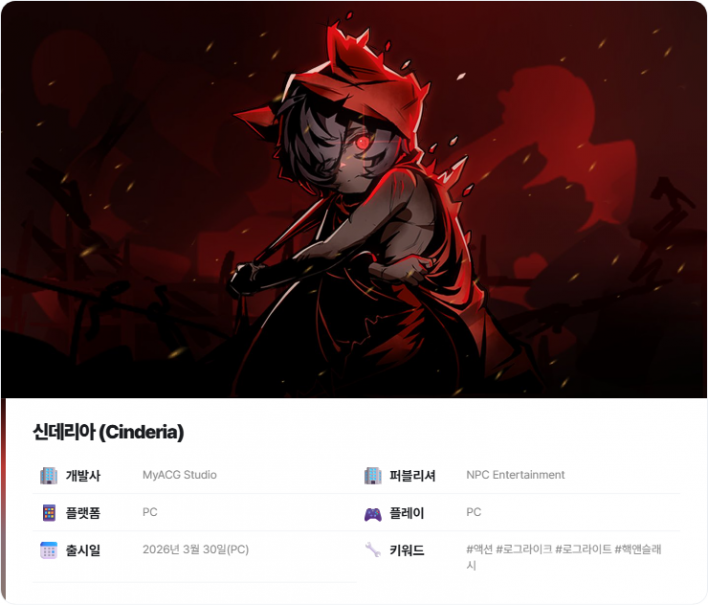
Four Heroes, Vast Builds
The core of 'Cinderia' lies in its vast build combinations. As of the current Early Access version, there are four playable characters. The default assassin, 'Lu,' focuses on melee combat using daggers; the ranged character, 'Rivet,' controls the flow of battle from the rear using cannons and turrets; and the Druid-concept character, 'Uma,' fights alongside summoned animals. With the addition of the ice-attribute knight 'Isdara'—who was revamped in this update—the game offers a total of four distinct combat styles.
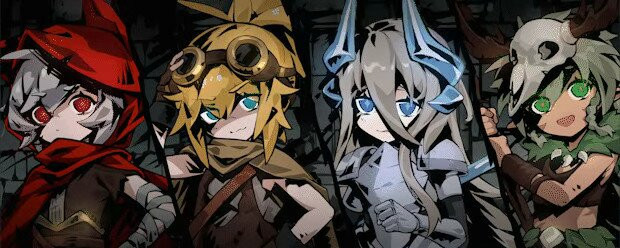
Isdara, in particular, underwent a major rework in the recent update. Previously, the playstyle was more defensive, waiting for enemy attacks to block with a shield and counter; now, it is much more natural to dive into enemy lines with dashes and apply constant pressure. The resource system has been restructured into a 'Defense' system that is consumed when blocking and regenerates automatically while idle. This allows for significantly different growth paths within a single character, ranging from builds that aim for explosive damage via 'Just Guards' to dash-oriented builds or ice-attribute crowd control builds.

All characters, including Isdara, possess numerous unique skills, and even after repeated playthroughs, players will encounter new ones. While I haven't counted them myself, the developers state that each character has a pool of over 180 skills, complemented by more than 130 types of equipment. This suggests that the number of possible combinations is virtually infinite, and the 'build diversity'—the hallmark of the roguelite genre—is exceptionally satisfying.
What makes it even more interesting is that these elements don't function in isolation. 'Cinderia' centers on a structure where players freely fuse Cursed Embers (passive skills), Magic cards (active skills), and equipment to create entirely different combat styles for every run. For instance, with the ranged specialist 'Rivet,' the same cannon skill can be used as an offensive tool for direct firing, or as a tactical tool where the cannon is deployed like a summon. In essence, each character hides multiple distinct identities.
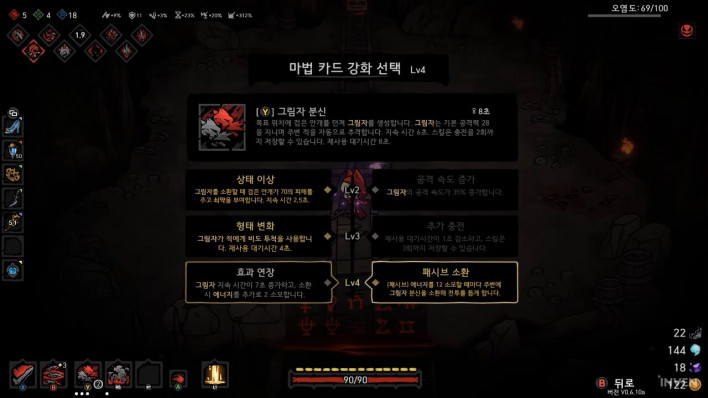



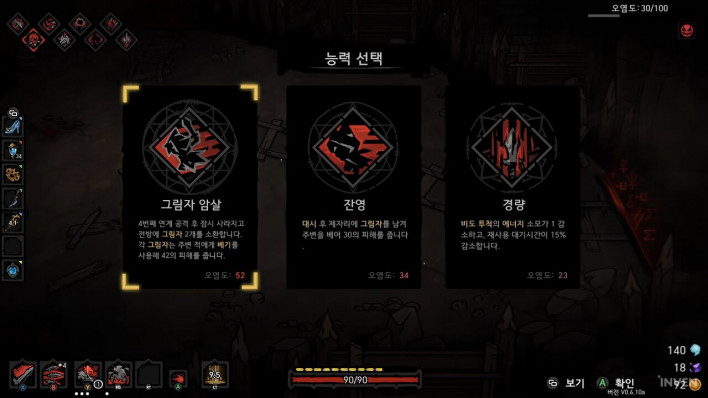
The reward design, characteristic of the roguelite genre, also stands out. Choosing more powerful abilities increases 'Contamination,' and if this value exceeds a threshold, a permanent curse penalty is applied for that run. This means players cannot simply pick the strongest options; they must constantly judge whether the current run can handle the cost. This structure captures not only the 'power of a completed build' but also the 'tension that lasts until the end.'
There are shortcomings, but the pace of improvement is faster
However, as it is still in the early stages of Early Access, there are some points that leave something to be desired. The most noticeable is the system requirements. The minimum specs listed on the Steam page are an Intel i5-12600KF, GTX 1060 6GB, and 16GB of RAM—not exactly light requirements for a 2D-based roguelite. Early on, there were instances of stuttering during long play sessions. However, this has been largely resolved through recent updates that fixed various issues.

In terms of content volume, especially world-building, the game is closer to 'showing potential' than being a 'finished product.' The developers have stated that communication with the community is their most important development philosophy and have consistently added various content since the Early Access launch. They plan to add multiplayer modes, new playable characters, diverse monsters and bosses, endgame challenge content, and expand the main story and world-building in the future.
As the developers themselves have announced an Early Access period of about one year, it is true that while the combat framework and build system of 'Cinderia' are already quite polished, it feels too early to fully experience the world.

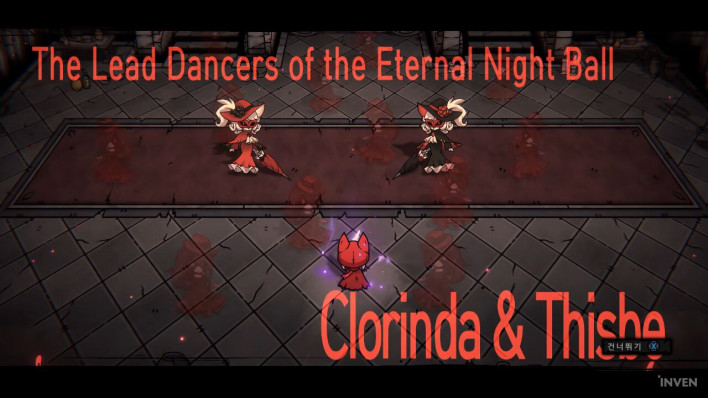
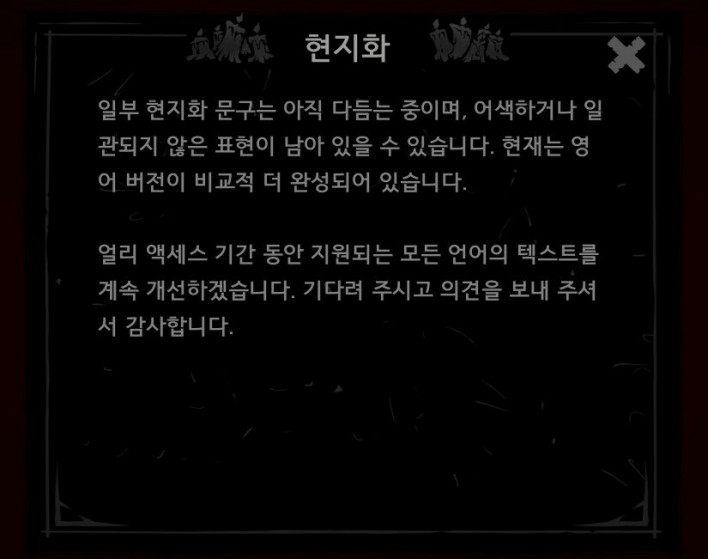
Translation and localization also need improvement. While the game supports interfaces in 11 languages, including Korean, so there is no major hindrance to playing, there are clear areas for improvement, such as awkward terminology in some text or certain boss names appearing in English. However, the developer is well aware of these issues and has expressed their commitment to localization through the Early Access notice that pops up when starting the game, so there is plenty of room for improvement in the official release version.
A Kingdom of Ash Racing Toward Completion
Even considering these typical Early Access shortcomings, the level of polish 'Cinderia' displays is significant. Looking at Steam reviews alone, the overall cumulative rating is 'Very Positive,' and the positive ratio from overseas is even higher. Given that the 'feel' and action are excellent, and the 'fun of combining builds'—the foundation of a roguelite—is substantial, it has already passed the test for the genre. Among users familiar with Hades-like roguelites, there is even talk that it 'has potential worth keeping an eye on.
Most impressive is the sense that each character offers an entirely different game experience. Even in the same stage against the same enemies, the rhythm of combat changes depending on which character and build you bring. The phrase 'offers a different experience every run,' often touted by the roguelite genre, does not feel like an exaggeration in 'Cinderia.'

'Cinderia' is still a game in the making. However, the two most important pillars of this genre—the satisfaction of combat and the freedom of builds—already show considerable polish at this Early Access stage. The relatively high system requirements and the yet-to-be-filled narrative are problems that time will likely solve.
If you are a gamer who enjoys fast-paced action roguelites and seeks the fun of experimenting with completely different builds for each character, 'Cinderia' is worth keeping an eye on now. Although the kingdom of ash has not yet fully revealed itself, I believe 'Cinderia' already possesses much of the charm that only the roguelite genre can provide.

Sort by:
Comments :0