"Where are you from?"
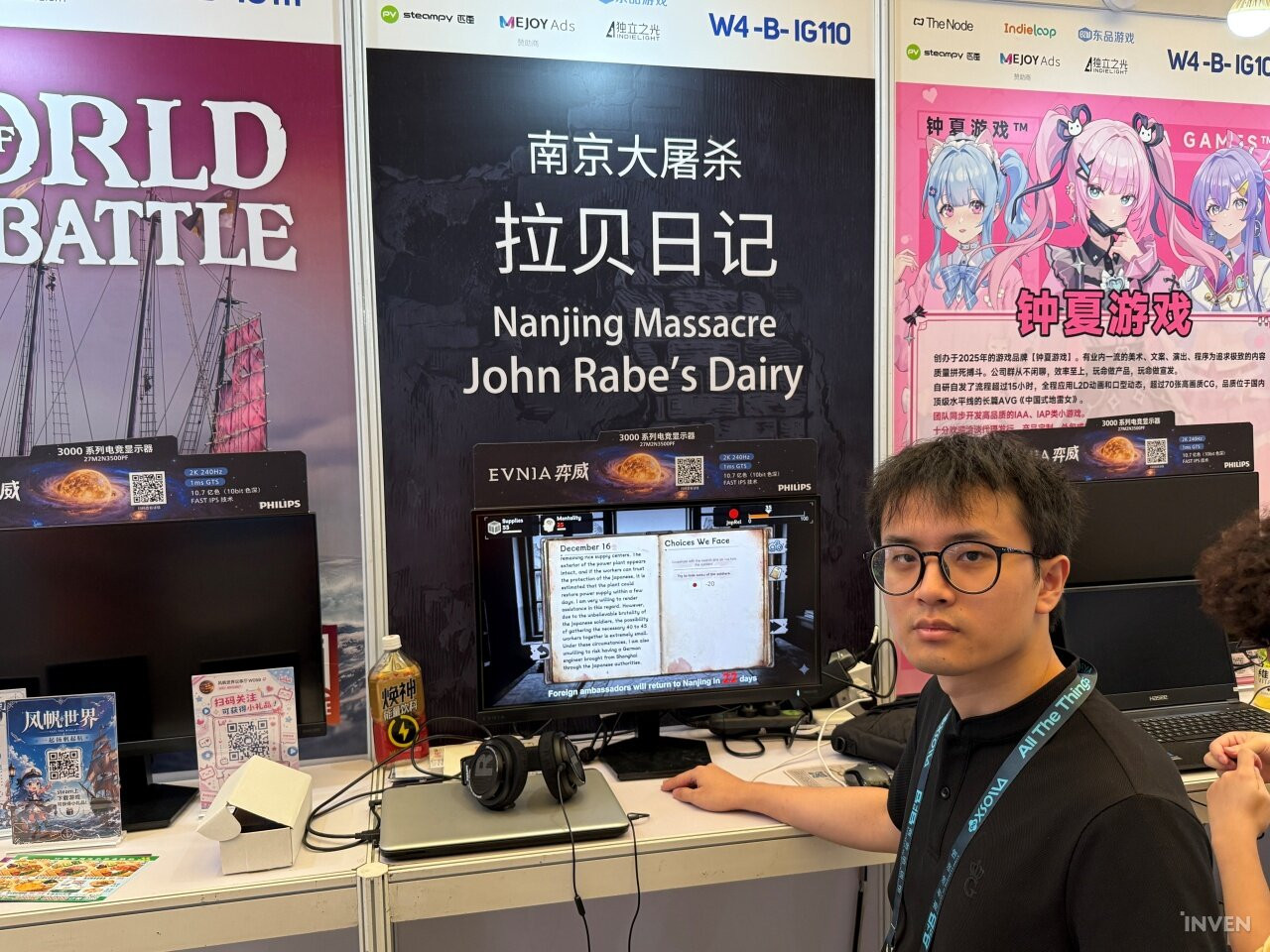
It was the final day of the ChinaJoy B2B exhibition. I was wandering through the B2B indie zone, which I hadn't yet had a chance to explore, and was about to leave for my next appointment when a developer suddenly asked me that question in somewhat broken English. I answered 'Korean' without much thought, and he immediately gestured for me to come over to his booth. On a small table barely large enough for a laptop, the Chinese characters '南京' (Nanjing) caught my eye. Next to them were the simplified characters for 'Great Massacre.' Even without knowing the characters, it was immediately clear what the subject was: below them, the English phrase 'Nanjing Massacre' was written, followed by the subtitle 'John Rabe's Diary.'
John Rabe was a man who sought to prevent atrocities by establishing an international safety zone before the Japanese military occupied Nanjing. Even after the city fell, he actively helped Chinese civilians find refuge, saving the lives of hundreds of thousands. However, as a member of the Nazi Party, he faced significant hardship upon returning home, including arrest by the Gestapo for aiding an enemy nation, and later, detention by Soviet and British forces after the war. Although he was eventually cleared of charges through the intervention of Siemens headquarters, he died of a stroke in Berlin in 1950. In 1997, with the consent of his surviving family, he was reburied in Nanjing, and the house where his family lived during their time in the city has since been designated as the John Rabe and International Safety Zone Memorial Hall. His personal diaries have also been published in Korea under the title 'John Rabe: The Good Man of Nanking'.
The developer, who identified himself as Asyer, explained that he and a friend who studied programming began developing the game to raise awareness of the horrors of the Nanjing Massacre and the humanitarian efforts of John Rabe. Initially, he had drawn inspiration from 60 Seconds! to create a similar style of game, but after Sanae Takaichi, a Liberal Democratic Party leader who has consistently denied the Nanjing Massacre, was appointed as a Japanese cabinet minister, he decided to change direction last February after much deliberation.
"Seeing people deny a historical fact where so many died made me realize I needed to convey that history clearly," he said. "That's why I chose a pure text-based interactive format; I wanted players to experience John Rabe's good deeds and his inner turmoil, and to hope that they would not forget history." True to his words, Nanjing Massacre: John Rabe's Diary consisted entirely of text, save for images roughly depicting the streets of Nanjing at the time.
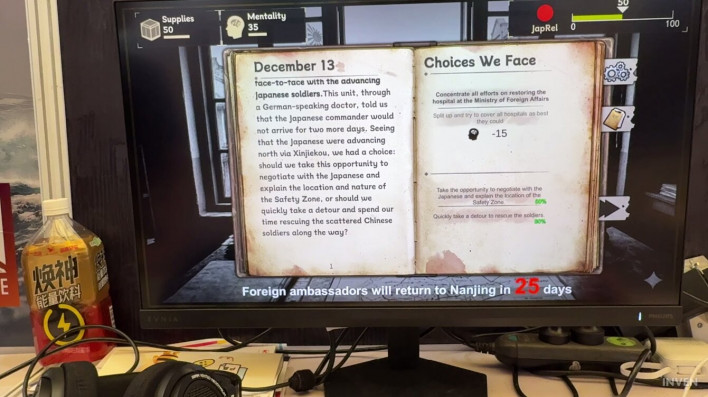
The game begins in November 1937, just before the Japanese military captured Nanjing, at the moment John Rabe established the international safety zone to block their atrocities. The demo covers the first two weeks of the six-week event, incorporating random incidents to enhance immersion. It was designed to show the uncertainty of the time, rather than presenting the player as an observer who already knows the historical outcome.
He added that while the game's text quotes the original logs almost verbatim, the entries were sometimes vague or fragmented due to the urgency of the situation. To address this, he used research materials such as American historian Iris Chang's The Rape of Nanking to provide choices that vividly depict the situation, guiding players to experience the mindset of John Rabe as he struggled to save as many people as possible. In the game, your relationship with the Japanese military, your supplies, and your mental state change based on your choices; the process of trying to keep these from hitting zero naturally leads you to read the text more carefully.
The logs I browsed were not something to be taken lightly. Even with my limited English, I was immediately struck by the tragic plight of people struggling to survive amidst the brutal atrocities of the Japanese military, and the difficult choices one must make to maintain the safety zone. Although there were no images, the need to read the text closely had the effect of making me imagine those scenes even more vividly.
While I expected the shock of a terrible ending to be significant, he noted that the game is not designed to emphasize 'Game Over.' Even if your stats hit zero, a time-loop system called 'Turning the Historical Record' allows you to return to the current day or previous nodes to try again, ensuring players don't get frustrated and can stay immersed in the narrative. At the same time, beyond the 'historical' ending that coldly illuminates the facts, he has prepared a 'hidden ending' where war criminals receive their due judgment if certain difficult conditions are met, leaving room for a sense of historical reward.
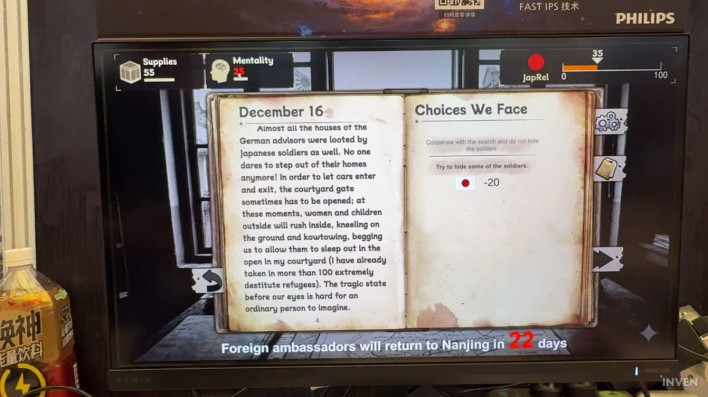
Although he managed to create a demo, development was not smooth. The process of boldly discarding the initial, more entertainment-focused management demo and pivoting to a pure text-based interactive format was difficult. Nevertheless, he continued the project with the sole purpose of spreading historical awareness, and after passing the review by the Shanghai Municipal Administration of Press and Publication, he was able to make it to ChinaJoy 2026.
His biggest concern now is balancing historical fact with the fun of a game. He worries that his sincerity in wanting to share history through John Rabe's diary might give players the impression that the game lacks 'gameplay.' To increase immersion, he is looking into various options like sound design, voice acting, and multi-language support, though as an indie team, he faces financial and technical hurdles. However, with the help of friends and acquaintances, he has completed an English demo and is looking for a partner who shares his vision to help spread the tragic history of the Nanjing Massacre to the world. He expressed his ambition to not only release the game on multiple platforms once completed but also to provide it for free to museums and schools, sharing historical facts to raise awareness and prevent such tragedies from recurring.
Because our meeting was scheduled on short notice, it was difficult to have a deeper conversation. Furthermore, he was not fluent in English. He had to communicate with foreigners using a translator to get his message across. The last sentence he typed into the translator was this.
"Korea and China share a past of suffering under Japanese imperialism. Please do not forget history. I pray for peace for everyone. I hope that war and massacres will never happen in this world again."

Sort by:
Comments :0