KONAMI has shared its strategy for reviving the 'SILENT HILL' series, which has spanned over 25 years, along with insights into its global development know-how.
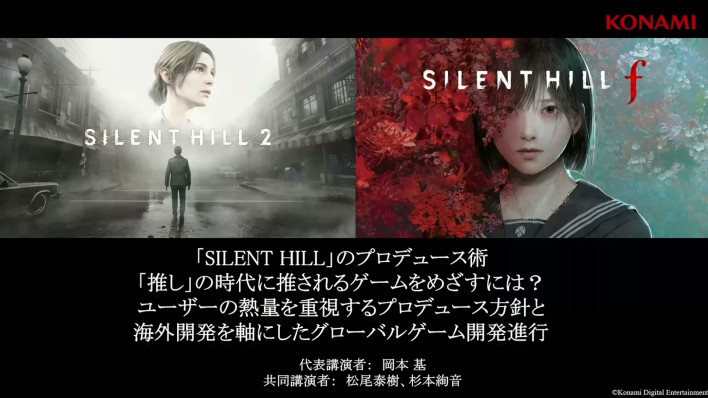
Today (the 22nd) at CEDEC 2026 in Japan, KONAMI’s General Producer Motoi Okamoto, Assistant Producer Taiki Matsuo, and Producer Assistant Ayane Sugimoto held a lecture titled, 'The Art of Producing 'SILENT HILL' – How to Aim for a Game That Gets Chosen in the Era of 'Fandom'.'
The lecture introduced how the team revived the 25-year-old 'SILENT HILL' series and the strategies adopted to sustain the franchise within a global development environment.
Targeting the global market, which accounts for the majority of the series' revenue, the development team utilized objective metrics and processes from the planning stage. They also actively incorporated the perspectives of younger developers to modernize the series' unique charm. They noted that following the announcement of new titles in 2022, the consecutive successes and critical acclaim of 'SILENT HILL 2' in 2024 and 'SILENT HILL f' in 2025 have solidified the successful revival of the IP.
Furthermore, the presentation highlighted communication strategies that fostered seamless collaboration with overseas studios. It also touched upon producing techniques that encouraged 'fandom' and ecosystem building through logical review methods and meticulous user communication design.
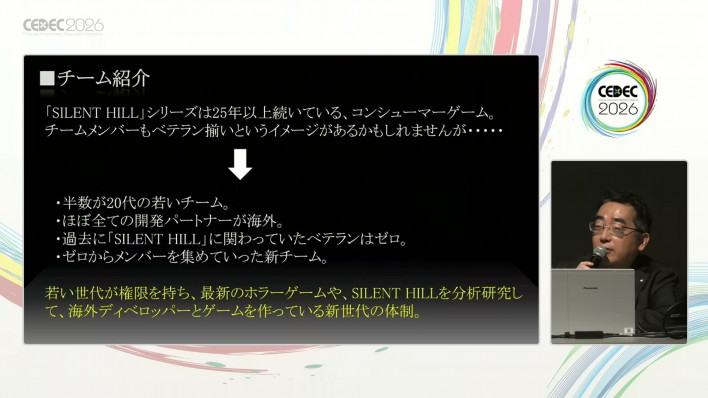
The three speakers first explained the team's composition. While 'SILENT HILL' is a console series with a long history, they revealed that over half of the current team members are in their 20s. While veterans who worked on past series exist within the company, they are not part of the current team. This is the result of building a team from scratch after Producer Okamoto joined. Development partners are also mostly overseas studios, including NeoBards (Taiwan), Bloober Team (Poland), Annapurna (USA), and No Code (Scotland).
Of the 15 team members, only about 20% are native English speakers, while the remaining 80% do not speak English. Consequently, they communicate with North American and European studios in English, and with Asian studios in Japanese via interpreters. They explained that meetings requiring interpretation take two to three times longer than those conducted solely in Japanese, necessitating efficient meeting management. However, they actively utilized machine translation for text-based communication to ensure that non-English-speaking members could participate.
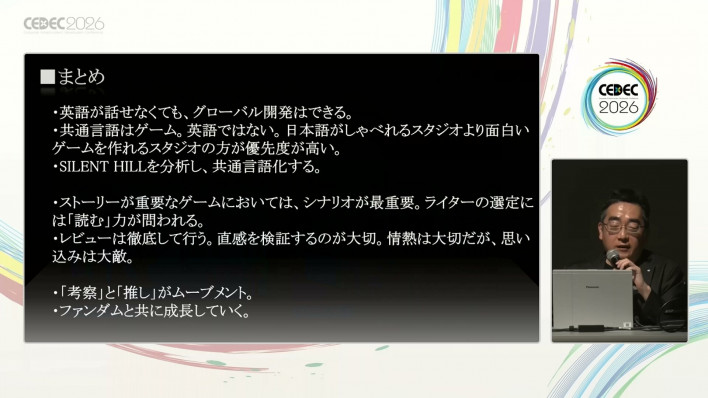
Producer Okamoto emphasized that "global development does not presuppose English proficiency." His point is that the ability to create a great game is more important than language, and since there are far more overseas companies than Japanese ones, there is no need to limit one's options due to language barriers. In his view, rather than ruling out collaboration with foreign firms from the start because of a lack of English skills, it is better to play the games they have created and judge for yourself. He noted that the series team actually includes new members who have only ever worked with overseas studios and are uninfluenced by Japanese development styles; for them, global collaboration is quite natural. Okamoto added that because the team is young, they are not bound by traditional Japanese development practices, which has actually made it easier for them to adapt to working with international developers.
Narrowing the Identity, Proving Sincerity
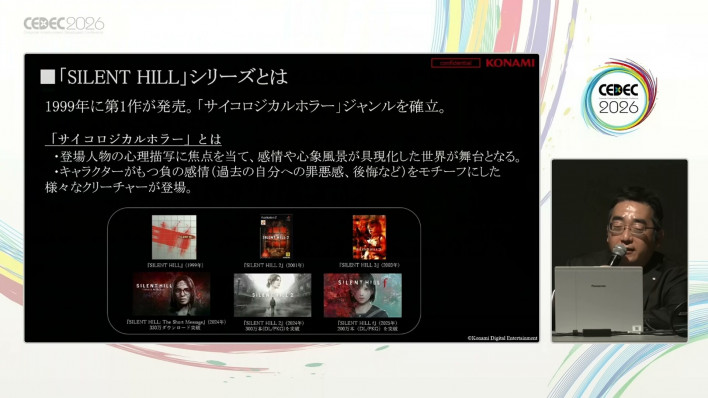
Producer Okamoto then explained how the 'SILENT HILL' IP was redefined. Establishing the 'psychological horror' genre with its first title in 1999, 'SILENT HILL' is characterized by projecting characters' psyches and traumas onto the world. Within the dual structure of the 'fog world' and the 'otherworld,' the appearance of creatures changes based on the trauma of the character observing them. This distinguishes it from physical horror, where creatures appear in the same form to everyone.
The series went on hiatus for about 10 years after 2012's 'Book of Memories' before announcing its revival through the 'SILENT HILL Transmission' broadcast. Following 'SILENT HILL 2' in 2024 and 'SILENT HILL f' in 2025, 'SILENT HILL: Townfall' is scheduled for release in 2026.
Producer Okamoto recalled 2019, when they were preparing for the revival, as a time "overflowing with indie horror games." With many works already inspired by 'SILENT HILL,' he judged that simply releasing a remake would not be enough to differentiate the series. Therefore, they intentionally narrowed the definition of the series to clearly establish its identity as 'psychological horror' and began with a remake of 'SILENT HILL 2,' the title with the highest level of perfection.
In this process, they established 'story guidelines' based on user surveys from five countries worldwide, defining psychological horror, the fog/otherworld, and creatures, and compiled these into an internal bible. He noted that they placed particular weight on depicting 'intrinsic reactions'—emotions stemming from within, such as trauma, self-esteem, beliefs, and existential feelings—rather than relationships with others.
Producer Okamoto said they needed to show sincerity to restore user trust, which had been damaged by past cancellations. Thus, they chose to secure the budget for three titles—including new entries and spin-offs—simultaneously, rather than just for the 'SILENT HILL 2' remake. He pointed out that many in the industry today use 'test-run remakes,' where they release a remaster or remake first to gauge user reaction before deciding on future projects, and noted that users quickly catch on to that attitude. Believing that trust could not be regained through insincere attempts, they chose to secure the budget for all three titles at once.
Defying expectations was also part of the strategy. A prime example is the release of 'SILENT HILL f,' set in Japan, contrary to the expectation that the town of Silent Hill would again be the setting. Producer Okamoto said that betraying user expectations in a positive way and announcing new titles at unexpected times is a way to keep stimulating user emotions and maintain interest in the series.
'SILENT HILL 2', a Standard Created with Overseas Studios
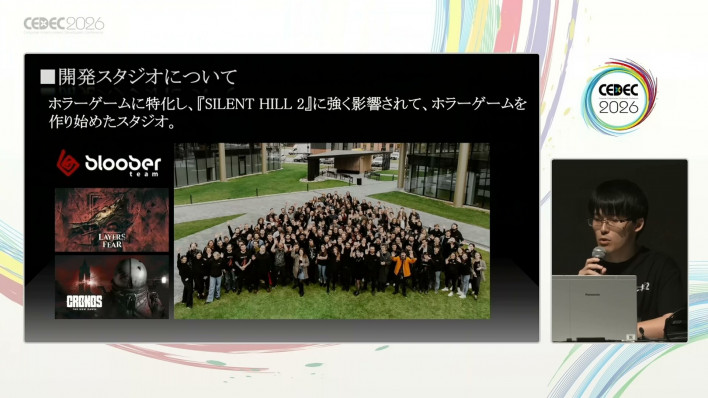
Producer Matsuo introduced the case of the 'SILENT HILL 2' remake with Poland's Bloober Team. He cited 'standardization of development' as a key feature of overseas development. This involves confirming core elements through game design documents in the early stages and going through a 'vertical slice' phase—where segments are produced with near-final quality—to ensure both companies agree on quality standards first. He stated that this experience was applied to subsequent collaborations with studios in Taiwan and Scotland.
Work was also done to create a common language for the IP. Since a significant portion (about 90%) of 'SILENT HILL' revenue comes from overseas, the appeal of the IP was already well-understood by overseas developers. KONAMI also created a bible analyzing global user awareness and past works to share with development partners. By having both sides confirm what each location symbolized in the story, they were able to stay within the core framework during the review process.
They handled the 7–8 hour time difference through text-based communication centered on chat tools. Due to the nature of remakes, KONAMI also took on the role of 'traffic controller,' coordinating opinions from original creators—such as the original creature designer—with the developer's schedule. For QA, they selected a firm in Japan to accumulate know-how, and to ease the burden on the developer, the QA firm handled tool- and language-related tasks.
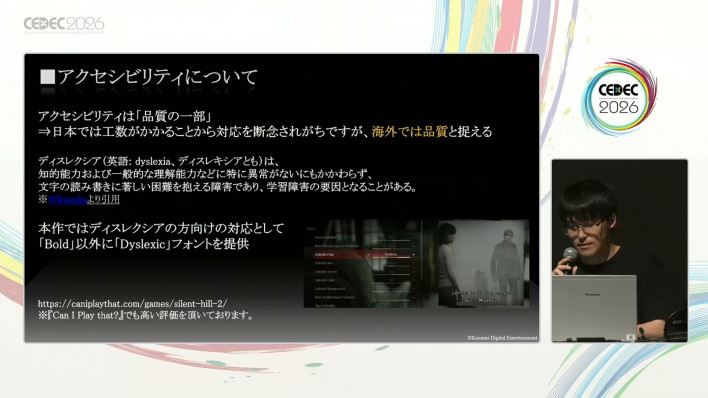
Producer Matsuo mentioned 'accessibility' as an insight gained through overseas development. While it is often pushed to the back burner in Japan due to the high labor cost, it is considered a part of quality overseas. In fact, the game made headlines for including a high-contrast mode, which is rare for a horror game, and provided a dedicated font separate from bold text for users with dyslexia.
On the other hand, there were differences of opinion regarding quality standards before release. While KONAMI wanted to ensure a certain level of quality by the time the first master was submitted, the developer's stance was to implement the bare minimum, submit the master, and then supplement it with a Day 1 patch. Localization was handled directly by KONAMI to implement the series' first Japanese voice acting, and any schedule delays caused by this were addressed by the company bearing some of the costs in the process of coordinating with external partners. Producer Matsuo added that the most important thing in global development is 'concise and clear communication,' noting that beating around the bush makes communication difficult when combined with time differences.
'f', Set in Japan, and Communication with the Fandom
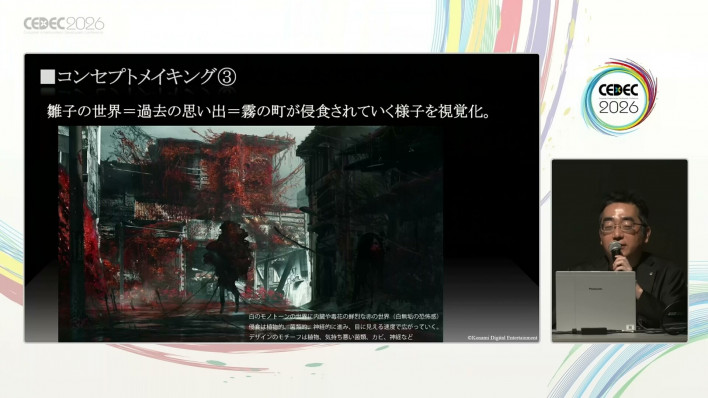
Producer Okamoto also revealed the background for setting 'SILENT HILL f' in Japan. He diagnosed the cause of the decline in the series' revenue as fatigue from the same setting and story, and redefined Silent Hill as a 'phenomenon' that could occur anywhere in the world, rather than a specific city. After focusing on horror themes in the Asian region, they decided on Japan to align with their identity as a Japanese company.
The scenario was written by 'Ryukishi07,' known for Japanese horror works. Producer Okamoto expressed his philosophy that one must read a significant number (over half) of an author's works before commissioning them, and mentioned that he encourages the scenario team to read extensively (100–200 books per year). The theme set by Ryukishi07 was the horror of viewing outdated values surrounding marriage through the eyes of a modern woman, which was also reflected in the creature design. In terms of gameplay, he stated that action elements were strengthened to increase the contrast between horror and combat.
Producer Assistant Sugimoto stated that to ensure the direction did not drift in a structure where the scenario writer was Japanese and the developer was Taiwanese, the scenario writer, illustrator, concept art company, developer, and KONAMI gathered from the beginning to establish the framework for the world-building and game design. After the volume of scenarios and cutscenes increased significantly due to the introduction of multiple endings, the three parties—the Taiwanese developer, Ryukishi07, and KONAMI—spent about half a year on coordination.
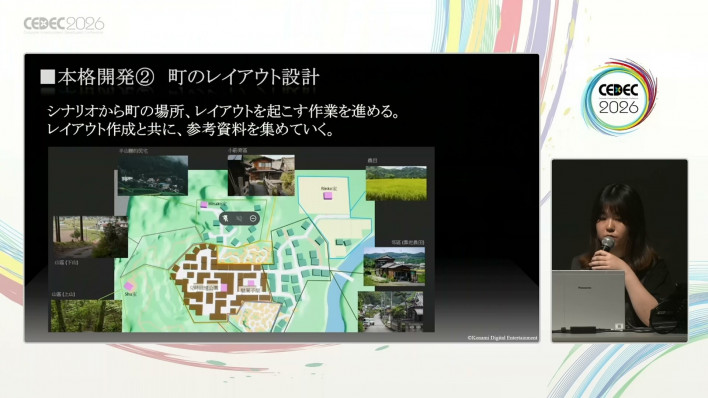
Work was also done to reduce ambiguity stemming from cultural differences. They collected actual materials and photos from Gifu Prefecture, Japan, in the 1960s to build a consensus with the development team on the "feel" of the place, and provided detailed direction on nuances that are familiar to Japanese users but unfamiliar to overseas developers, such as the placement of chopsticks and spoons on a dining table. In addition, they conducted casting with reference to the writers' opinions and personally visited the tourism association of Kaneyama-cho, Gifu Prefecture—the motif for the background—to explain their intentions and seek cooperation for filming and recording ambient sounds.
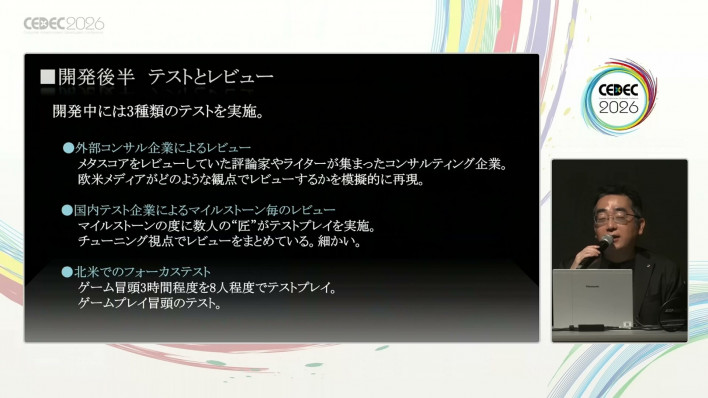
In the latter half of development, they went through a process of verifying the producer's judgment through mock evaluations based on former Metacritic reviewers via an external consulting firm, sprint-by-sprint playtests by the internal QA team, and monitoring of North American users. Producer Okamoto pointed out that it is dangerous to push through solely on a producer's personal intuition.
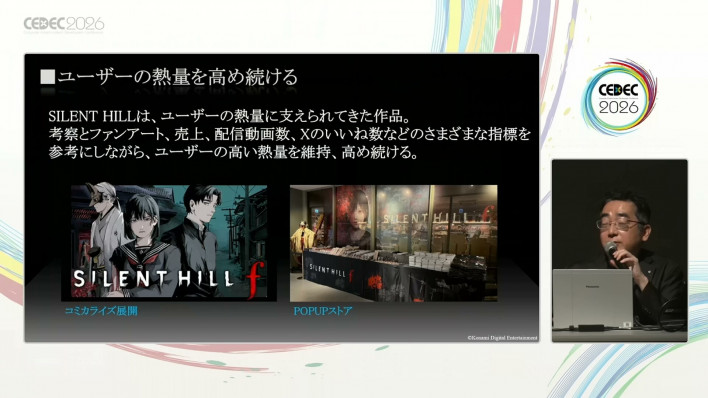
Finally, Producer Okamoto defined modern entertainment as an era of 'contemplation' and 'fandom,' stating that the ambiguity and detailed settings unique to 'SILENT HILL' are elements that stimulate users' desire for analysis. He explained that the PV release method, which increased the amount of information in stages, and the story structure, where the truth is revealed over multiple playthroughs, led to numerous fan creations. He concluded the lecture by stating that they are continuously providing topics for the fandom through IF-scenario illustrations, character birthday illustrations, pop-up stores, and comic adaptations.

Sort by:
Comments :0