A month has passed since Sony announced it would stop producing PlayStation (PS) discs, but the controversy shows no signs of fading. An online petition demanding the reversal of the decision has surpassed 280k signatures, and voices of concern are emerging from developers, the retail industry, and even the political sphere.
Dan Houser, co-founder of Rockstar Games, also weighed in on the physical game controversy. Houser, who left Rockstar in 2020 to found Absurd Ventures, said in an IGN interview at San Diego Comic-Con, "If people want it, I think companies should provide it [discs]." He added that while digital releases have been useful for fixing game issues and improving quality, the physical option remains important.
At the heart of the debate lies a fundamental question: Will you still be able to keep the games you bought once discs are gone.
What Changes When Discs Disappear: From Ownership to Licensing
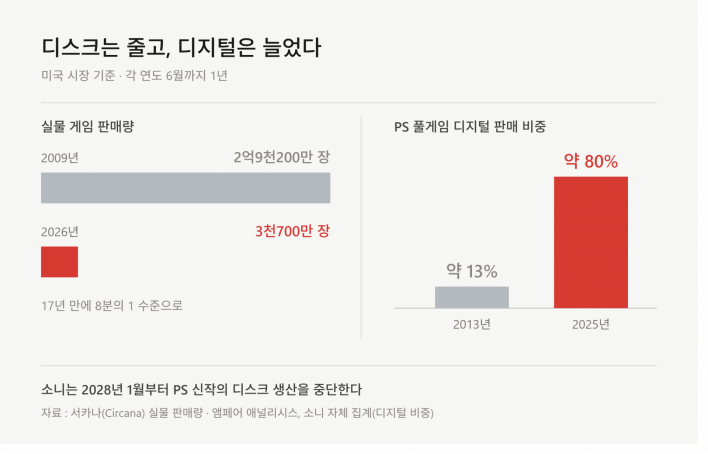
On the 1st, Sony announced that it would cease disc production for new PS console titles starting in January 2028. Moving forward, new releases will be sold exclusively in digital form via the PS Store and retailers. Games released before January 2028 will remain unaffected. This marks the first instance of a major console manufacturer completely halting disc releases for new titles on its platform.
Sony cited shifting consumer preferences as the reason. According to its internal data, digital sales account for over 80% of full-game sales on PS4 and PS5—a complete reversal from the sub-10% figures seen before the PS4 launch. Data from market research firm Circana shows that U.S. consumer spending on new physical games has dropped to $1.6 billion over the last 12 months, just one-seventh of the 2009 peak of $11.5 billion.
The issue is not the sales volume, but the nature of the purchase. When you buy a disc, you possess a physical object. You can resell it, lend it, and play it without an internet connection. Digital purchases, however, are closer to a usage license tied to an account. Even after paying, you need an active account and server verification to redownload or run the game. If the store closes or the account is suspended, that access is severed. This concern intensified when Sony announced the closure of the PS3 and PS Vita stores on the same day it announced the disc discontinuation.
Discs vs. Digital: Who Wins and Who Loses

The beneficiaries of the digital transition are clear. Distribution costs vanish as there is no inventory or returns to manage. It is also advantageous for post-launch quality control, as patches and hotfixes can be deployed immediately—a point Houser highlighted in his interview. As distribution margins are removed, profit margins for platforms and publishers rise. Sony’s ability to retain more revenue from direct store sales has been consistently cited as a backdrop for this decision. Removing the disc drive also creates room to lower hardware production costs.
Game developers also shed production burdens. Pressing, packaging, and logistics are costly, and small-batch releases are a strain on indie developers due to minimum order quantities. Larian Studios noted that producing the physical edition of 'Baldur's Gate 3' was a significant expense. Recently, most physical editions are produced with a 'day-one patch' in mind, meaning the data on the disc often does not match the actual playable game. Sales figures also favor digital; according to Circana, only seven PS titles sold more than 100k physical copies in the U.S. this year.
Conversely, buyers face numerous disadvantages. What a digital buyer receives is not ownership, but a usage license tied to an account and server. If a store closes or a licensing agreement expires, the game can vanish from one's library. Without the possibility of used sales or rentals, price competition weakens. Critics argue that once the 'lowest price' path provided by the physical market disappears, the MSRP becomes the only price.
Accessibility remains a concern. In regions with slow internet or expensive data plans, a disc is a more practical choice than downloading files exceeding 100GB. In terms of preservation, physical media remains independent of servers. Retailers, meanwhile, lose the physical goods they can sell.
When weighing the pros and cons, the balance tilts in one direction: cost savings and improved margins go to platforms, publishers, and developers, while ownership, used-market access, and price competition are sacrificed by buyers and retailers. This is why the backlash erupted from gamers first.
Backlash Against Disc Discontinuation: 280k Petitioners and PSN Outage
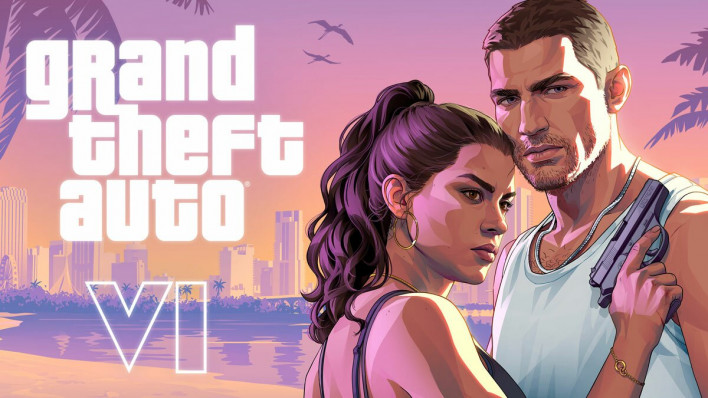
The fuse for the backlash was 'GTA6'. Protests were already mounting after it was revealed that the physical edition would contain only a download code instead of a disc. With frustration already building over the fact that buying physical copies still tied games to an account, Sony’s announcement that it would stop making discs altogether was perceived as the final alternative disappearing.
Within four days of Sony's announcement, the online petition demanding a reversal exceeded 120k signatures, surpassing 280k by the middle of this month. PS official social media posts were flooded with protest comments, and some posts were even appended with 'Community Notes' explaining the terms of digital purchases. Cancellations of PS Plus subscriptions followed. Users who felt that petitions and comments were unlikely to pressure Sony directly chose to target the company's revenue streams.
A PlayStation server outage on the 24th brought these fears to life. Account logins and store access were blocked, and even digital games that users typically played without an internet connection failed to launch. Because the console verifies usage rights with the server every time a game is run, the games would not open when the server failed to respond. The outage lasted over six hours, with reports flooding the tracking site DownDetector from North America, Europe, and Asia. While a connection to an Amazon Web Services (AWS) outage on the same day was suggested, it was never confirmed. Sony did not disclose the cause.
Disc Controversy Spreads: From Developers to Politics

The development community has reacted negatively to the discontinuation of discs. At an Italian film festival, director Hideo Kojima remarked, "I grew up with physical media, so it is truly sad." He expressed concern over a future where games are no longer accessible, noting that while downloaded games at least leave data on a hard drive, that too disappears with a shift toward streaming. Michael Douse, Director of Publishing at Larian Studios—the developer of 'Baldur's Gate 3'—wrote that the news was "genuinely heartbreaking." Billy Basso, developer of 'Animal Well,' stated that a physical release had been a source of motivation throughout development, adding, "It kills my motivation to develop for the platform."
Movements to preserve physical media during the remaining time have also emerged. Lost in Cult, a publisher specializing in physical editions, expressed deep regret as a company dedicated to preservation. Chinese indie publisher Astrolabe Games issued a statement declaring that it would release all its qualifying titles as PS5 physical editions until January 2028.
Retail industry reactions are mixed. The Entertainment Retailers Association (ERA) in the UK issued a public statement, calling it a decision where "corporate convenience trumps consumer choice." CEO Kim Bayley stated that discs can be shared with family, resold, collected, and played decades later, whereas download licenses offer no such freedom. The ERA noted that the UK physical game market was worth £300 million last year, and one-quarter of gamers under 25 use discs. They also cited data showing that 45% of physical games sold in the UK last year were for PS4/PS5.
GameStop CEO Ryan Cohen said in a Bloomberg interview on the 16th that it was "irrelevant." Game software now accounts for less than 12% of GameStop's total revenue, with collectibles like cards and figures now making up more than half. This implies that GameStop has little to lose even if discs disappear.
Those involved in game preservation raised a different issue. The director of the Video Game History Foundation (VGHF), a U.S. non-profit, said, "Expecting a museum to download 'GTA6' and hope it runs in 50 years is not a preservation strategy," calling for industry-wide legal preservation measures. While discs are not a perfect solution, they argue that if even discs disappear, there will be no legitimate means left to preserve games.
In Mexico, politicians have stepped in. Representatives Iris Reyes and Senator Luis Donaldo Colosio announced they would report Sony to their national competition authority, arguing that Sony is acting as both referee and player within its own ecosystem.
Low Chance of Disc Return, Competitors Remain the Variable

Despite the fierce backlash, many say the digital transition is an unstoppable trend. Ubisoft CEO Yves Guillemot said during an earnings call on the 22nd, citing the PC market, that "digital transformation has grown the market." He diagnosed that while there are pros and cons, it will not significantly shake the industry. Niko Partners analyst Daniel Ahmad noted Apple’s removal of CD drives from laptops in 2008, writing, "There were many complaints at the time, but no one cares now." Ahmad added that the focus of the discussion should shift to consumer rights and the scope that licenses should guarantee. Some suggest that if Sony had announced a disc-to-digital conversion program or drive options for next-gen consoles, the backlash would not have been this severe.
The possibility of regulatory intervention has also dimmed. European Union Consumer Protection Commissioner Michael McGrath stated, "As long as consumer rights are protected, companies are free to provide games and services in the manner they choose," explaining that it falls under the realm of commercial and contractual freedom.
Market observers now largely expect the decision to stand. Game market analyst Serkan Toto told IGN, "Sony will not reverse this decision." He assessed that while there are subscription cancellations, the scale is not enough to trigger a business review. Sony’s largest disc production facility is already preparing to pivot to optical component manufacturing.
The remaining question is the choice of competitors. While there is speculation that Microsoft might remove the drive from its next-gen hardware, there is no official stance. Reports that it is preparing a feature to convert discs to digital licenses remain unconfirmed. Nintendo is maintaining game card releases for the Switch 2. Circana analyst Mat Piscatella believes Nintendo has no reason to change its plans in response to Sony’s decision.


Sort by:
Comments :0