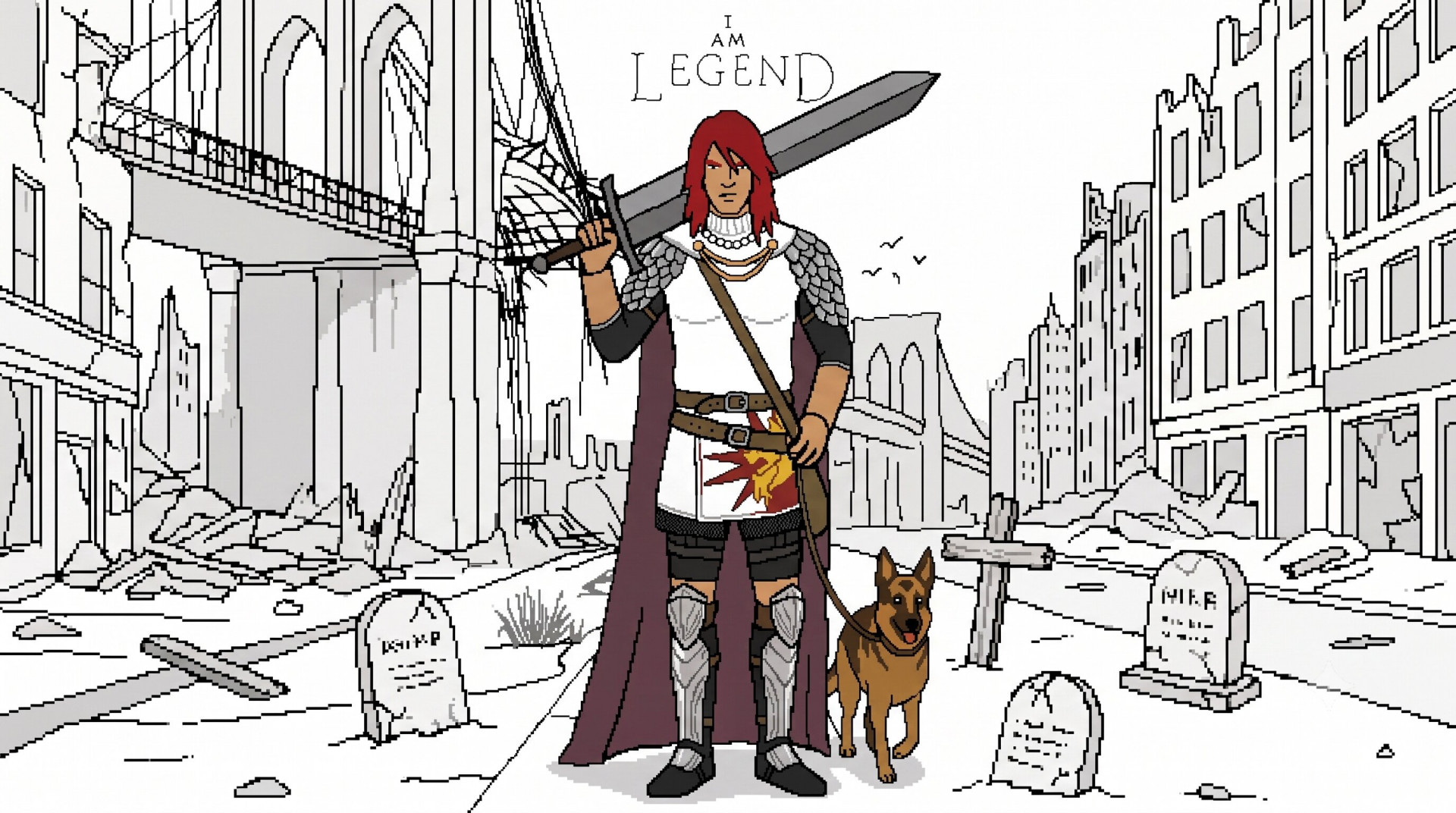
The protagonist of the movie 'I Am Legend' is a man surviving alone in an empty Manhattan. His secret to survival is not superhuman strength. He wakes up at the same time every day to exercise, hunt, research vaccines, and return home to lock the doors before sunset. That daily routine, never skipped, is what kept him alive for three years. Survival is not a stroke of luck, but a daily routine. That is the reality of survival depicted in the film.
Survival in the gaming world is no different. The first day of a launch is always a festival. Login queues stretch into the tens of thousands, communities are flooded with posts showing off rare items, and rumors about who went to which server or guild circulate in real-time. After about a month, strategies are refined, market prices stabilize, and the game settles. Then, around the third month, it becomes strangely quiet. Leveling slows down, content becomes a chore, and there is no promise of the next update. Suppressed frustrations surface, and the festival atmosphere quickly turns into a funeral.
Every year, games that are essentially on life support line up like soldiers in a drill. When INVEN analyzed the top 10 revenue retention periods for 20 major new mobile MMORPGs released in Korea between 2024 and 2026, about half never even made it into the top 10. Many of those that did were pushed out of the rankings within two or three months, and only a handful of new titles lasted more than four months. The point of collapse is uncannily similar: around the three-month mark, when the content prepared for launch runs dry. It is not necessarily because there is a major problem with the game, but because growth slows down and there is nothing left to do. That is exactly where the concurrent user graph dips and players start packing their bags.
The situation is no different across the sea in the 'global' market. According to Steam data analysis revealed at the NDC last June, nearly half of the 20k games released on Steam over the past year did not receive a single review. Two out of three users did not change their main game even after a week, and 87% of users focused on only one or two games. No matter how many new games are poured out, people eventually return to the games they were already playing. The problem is that becoming that 'game they were already playing' is a hundred times harder than making it onto the first-week leaderboard.
In the first half of 2026, one name held onto that spot as the 'game they were already playing.' Lineage Classic in Internet cafes and Lineage M on mobile both sat at the top. This is often summarized as 'IP power.' Because the name carries weight, because the fandom is deep. It is a convenient explanation, but if you lay out the update lists for both games from the first half of the year, it becomes clear how lazy that explanation is.
Lineage M has overhauled six classes one after another over the past two years. Class reboots returned every quarter, with weekly patches, new servers, and reboot world transfers filling the gaps. The 9th-anniversary major update was not a special event, but just another cycle in that rhythm. From a player's perspective, it means that just as the reason to log in began to fade, a new reason arrived. Before one festival ended, the schedule for the next was already posted.
The same goes for Lineage Classic. It may appear as though it simply rode the recent retro trend, but the February launch was not the end. Just one month after launch, in March, Heine Harbor opened, and in April, Valakas awakened in the Flame Dragon's Nest. In June, the snowy Oren region opened, and on the evening of the 21st, the first Siege War took place simultaneously at Kent Castle, Orc Fortress, and Windwood Castle. The hegemony of the server was decided in an hour. Efforts to remove elements that disrupt the game also continued throughout that period. The 'Clean Campaign,' which discloses sanction details every month, was not an event—it was a routine. A subscription game is not a game that just collects the first payment. It is a structure that must prove every month why players should pay again next month. If they had stopped at just releasing a 20-year-old design, Lineage Classic's third month would have been no different from other new releases.
People often read cause and effect backward. It did not survive because the IP was strong. The IP remained alive because there was a constant plan to keep users engaged. A strong IP is a result, not a cause. The market proves this. Even with the same genre, a famous IP, similar content, and flashy slogans, those that fell behind in management priorities saw their revenue decline over the same period. A signboard does not shine because of age. It shines because of the hands that polish it.
Of course, that effort comes at a price. Running major updates every quarter means grinding down development and operations staff, and the frustration of users that has built up where content supply meets the revenue model is a long-standing shadow of this IP. Keeping a game alive is not free. However, the cold, hard revenue charts show what happens to games that do not pay that price.
In the second half of the year, new titles will continue to throw their hats into the ring. Some will be tested in that market where 20k games are poured out every year. The question to ask them is not about graphics or first-week rankings. It is whether they can host the next festival in the third month when the first one ends. Lineage is a game that has been answering that question for 20 years, and for nine years. It did not survive because it was strong; it became strong while surviving. Whether in an empty Manhattan or in a gaming world where 20k titles are released annually, the rule of survival is the same: There is no luck.

Sort by:
Comments :0