
You are buying the same user twice. 90% of users acquired through paid advertising leave a game within 30 days, and then you spend more money to bring them back.
Lee Ji-yeon, Head of Korea and Japan at RZR, described this cycle as a 'Leaking Bucket' during her presentation at 'MGS WEEK 2026,' held on the 21st at the Westin Josun Seoul in Gangnam District. The problem, she explained, is pouring users in through the front door while leaving the back door wide open. In fact, over the past year, User Acquisition (UA) costs have risen by 12% and the cost per acquisition has jumped by 26%, yet user growth has stalled at just 2%. Essentially, companies are spending more for the same campaign results.
RZR is a demand-side platform (DSP) for mobile advertising. It uses an automated system to deliver ads to a target audience, covering three key areas: user acquisition (UA), retargeting (RT) to bring back churned users, and connected TV (CTV) advertising for internet-enabled devices like smart TVs and set-top boxes. The company, formerly known as Aarki—a DSP specializing in retargeting—rebranded this past March. During the presentation, the general manager argued that these three functions should not be operated in silos but integrated into a single system, supporting this claim with data and internal case studies.
The Problem is the 'Back Door'
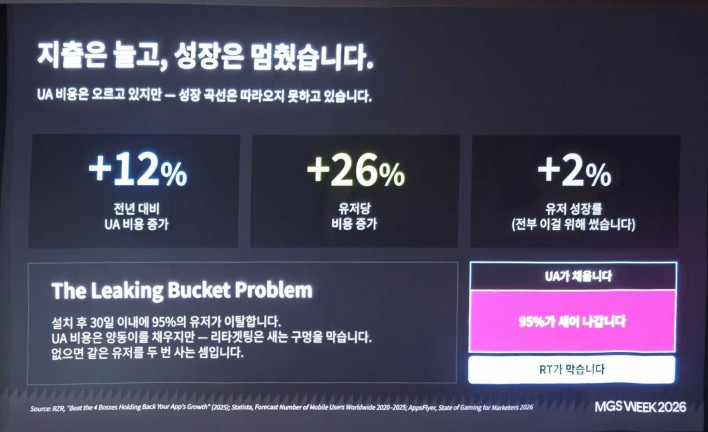
The first thing to collapse is user retention. Lee pointed out that over 90% of users leave a game within 30 days of installation. If you cannot retain users at the back door, you end up paying more to re-acquire the same users through UA campaigns. "Without retargeting, you are essentially buying the same user twice," Lee said.
The proposed solution is to have a single team manage both UA and retargeting. According to RZR, integrating these two campaigns accelerated optimization speeds by 30%. Because user behavior data is already captured during the UA process, there is no need to restart the learning process from scratch when identifying targets for retargeting. The company stated that compared to separate operations, integrated campaigns saw a 20% increase in Long-Term Value (LTV), while the LTV of re-engaged users doubled and the Cost Per Acquisition (CPA) for iOS retargeting dropped by 5 to 8 times.
By adding CTV to this mix, RZR has unified the five-stage journey—Awareness (CTV) → Installation (UA) → Churn Detection → Re-engagement (Retargeting)—into one system. At the heart of this flow is the 'Audience Builder' tool, unveiled for the first time at the event.
"Not All Churned Paying Users Are the Same"
The 'Audience Builder' was the highlight of Lee's presentation. Retargeting campaigns typically target 'churned paying users,' but Lee argued that treating this group as a monolith is a waste of resources.
Within the same 'churned paying user' category, you have a user who spent $5 and has been inactive for 80 days, mixed with a user who spent $2000 (approx. KRW 2.96 million) and has been absent for only 6 days. The former is likely gone for good, making re-acquisition costly, while the latter is a 'high-value user in the process of churning,' where every day lost is a direct financial hit. Yet, traditional methods apply the same ad spend, creative, and priority to both.
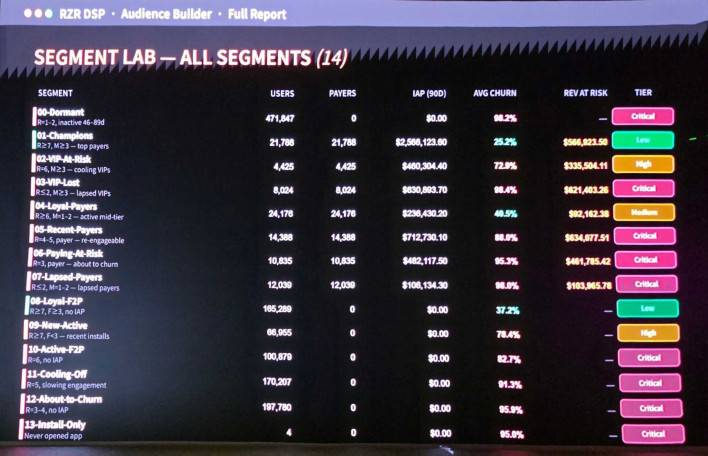
'Audience Builder' scores every user and assigns a 'value' to each group before a single dollar is spent. By multiplying the number of users by their individual spending and churn probability, it calculates 'at-risk revenue'—the amount that will be lost if no action is taken. This calculation happens in three steps: 'Player Pulse' to categorize users based on recent activity, 'Churn Radar' to rank them by churn risk and match them to monetary values, and 'Activate' to select the target groups for campaigns.
In a demo, RZR divided the entire user base into 10 groups based on churn risk and then consolidated them into three tiers. Groups 1-3, with low churn probability, were excluded from ads (suppression); budget was concentrated on groups 4-7, who are uncertain to return but have high recovery value; and groups 8-10, who have already churned deeply, were abandoned. The demo screen showed total at-risk revenue of $2.8 million (approx. KRW 4.1 billion).
Furthermore, in the 'Segment Lab,' which categorizes users into 14 distinct groups, the 'Recent Payer' group was classified as the top priority ('Critical') because their $710k in payments combined with a 88% churn probability put $630k (approximately ₩930 million) of revenue at risk. "If you're going to run a retargeting campaign, you should start with groups like this," the General Manager explained. "The idea is to identify where the risks are before you spend any money."
"Look at 60 days, not just one"
When discussing the three areas, Lee challenged the current evaluation criteria for UA. Many advertisers look only at the Return on Ad Spend (ROAS) on the first day (D1) and shift budgets within two to three weeks.
In RZR's own case study, the Day 1 (D1) retention rate was 7%, which was actually lower than competing campaigns (9–10%). However, the company noted that by Day 60 (D60), this figure flipped to 75%, roughly 1.9 times the competitor average (33–48%). "The initial learning phase is a bit slower because the model is learning to identify high-value users who actually generate revenue," the General Manager said. "You shouldn't look at D1; you need to look at what happens afterward."
Regarding retargeting, the General Manager addressed the common question: "Aren't you just spending money on users who would have come back on their own?" As a company that started in retargeting, RZR explained that the key is proper 'suppression' to avoid wasting ad spend on users who would return regardless. They added that they utilize their own 'Household Graph' to ensure they don't lose track of the same user even if they switch devices.
Finally, regarding CTV, she emphasized that it is measured as performance-based advertising, not just brand awareness. According to RZR, they directly secure deterministic signals (ACR) that identify what is playing on a TV screen at the device level, allowing them to track the entire flow from TV exposure to mobile installation and re-engagement. Lee cited a partnership with LG Ads as evidence, stating they receive LG TV viewing and gameplay data as first-party data to target households precisely. However, it should be noted that this is RZR's claim, and much of the performance data is based on their own internal metrics.
Lee cited Rovio's 'Angry Birds 2' as a prime example. Starting with a small budget in Android retargeting, they became the #1 partner, then expanded sequentially to iOS retargeting, iOS UA, and CTV. In iOS UA, they reached the #1 partner spot within four months, exceeding their D7 goal by 6.5%, and in CTV, they surpassed their D7 goal by 120%. "The point is not the ranking itself, but that performance does not drop as channels increase; rather, they boost each other," Lee said.
Lee concluded her presentation by saying, "Growth is not the sum of channels, but a single system. It is a system operated by one team, with one identity."


Sort by:
Comments :0