What could have motivated the first human to ever eat a pufferfish? This fish, which contains a toxin 1200 times more potent than cyanide, was likely placed on a dinner table with a 50/50 chance of survival. But what I’m really curious about is the second person. Even after watching the first person die, what was going through their mind when they brought that same fish to their lips.
In 'Subnautica 2,' you are essentially alone, so you won't be the second person to eat a pufferfish. However, you can certainly be the first to try anything else. I caught a floating fish and accidentally pressed the 'eat' button, only to find that my health actually decreased because the planet's organic matter was incompatible with my digestive system.
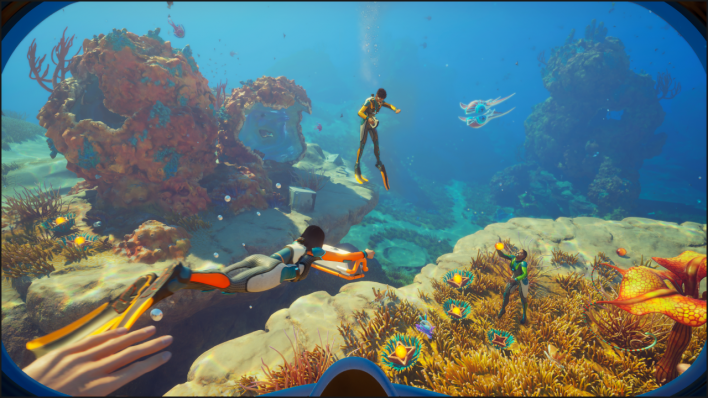
That’s right. To survive on this alien water planet, you must adapt even your digestive organs through genetic modification. Having spent about ten hours with 'Subnautica 2' ahead of its May 15 early access launch, I found it to be a sea that is as perilously dangerous as it is dazzlingly beautiful.
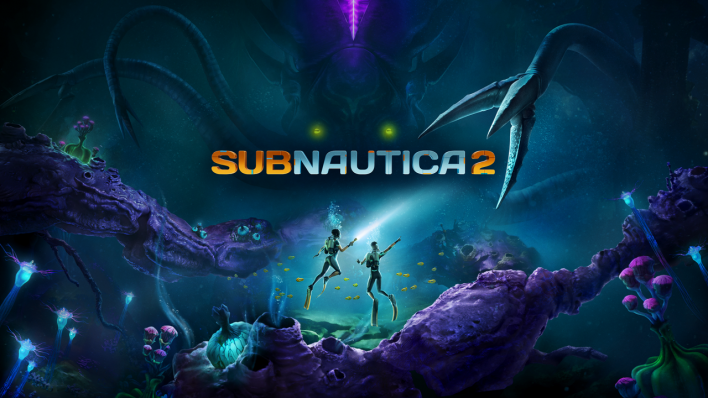
A Desolate Sea, A Trembling First Step

The player is a colonist contracted by the mega-corporation Alterra, who crash-lands while heading toward a land of hope called 'Jejura' (not Jeju Island). Surviving among the wreckage of a massive spacecraft, the protagonist is left alone on an entirely new planet with only a few survival supplies from a life pod. Like the protagonist, the player knows nothing about this planet. The process of wandering through the vast, desolate sea to find something—anything—captures that sense of isolation just as well as the previous game.
This planet is not an environment where humans can easily live. The atmospheric pressure is different from Earth's, making breathing impossible, and the sea is teeming with hostile alien life. However, the player is no ordinary human; by coming into contact with alien life forms called 'Feather Jellyfish,' you unlock genetic factors one by one to adapt to the planet's ecosystem. This system, which the developers call 'BioMod' in interviews, is a device that intuitively shows the player's adaptation process while serving to gradually expand explorable areas in terms of gameplay.

The tutorial flow of adapting to the planet's high-pressure atmosphere helps you quickly learn the world-building, and it provides the motivation to keep searching for 'Feather Jellyfish' while exploring on your own. Our friendly AI, NoA, kindly informs you of nearby Feather Jellyfish locations, but finding your way in a sea glowing blue in every direction is difficult. Plus, there is no map, so the early stages truly feel like a desperate struggle for survival.
Fortunately, the survival system in 'Subnautica 2' is not overly punishing. You don't need to sleep, and there's no need to manage bodily functions. You can find drinking water by catching water snails crawling on the ground, and once you find enough Feather Jellyfish near your life pod, you can soon start consuming small fish. The only thing that won't let you rest is the hunger and thirst gauges that tick down constantly.
Beautiful by Day, Terrifying by Night


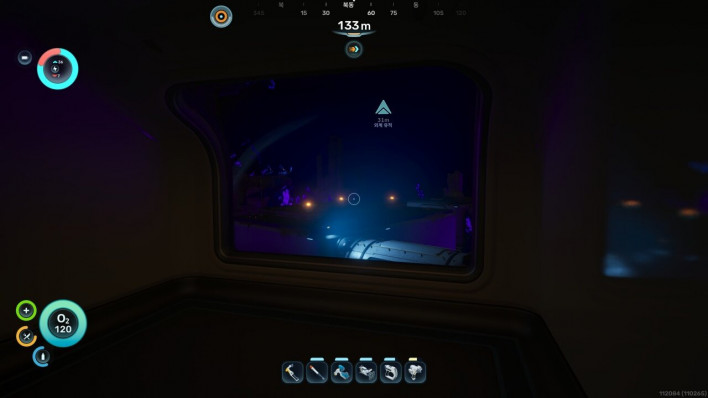
Aside from the desperation of survival, this planet is truly beautiful. Thanks to the detail and lighting implemented with Unreal Engine 5, this sea accurately captures a beautiful atmosphere by day and a terrifying one by night. I'm not sure what the planet's rotation cycle is, but day and night change quite rapidly, adding a sense of urgency for a player busy trying to satisfy their hunger.
Once you've filled your stomach, you start to notice resources. Unlike the previous game, items in 'Subnautica 2' are not collected randomly; you can now directly harvest visible minerals. As you collect a little titanium, quartz, and copper, you start to think that life on this planet might not be so bad after all.
Blueprints, Oxygen, and My Own Base

The Noetic Advisor, or 'NoA' for short, periodically delivers new messages to the player and provides quests that involve tracing the footsteps of colonists who visited this planet hundreds of years ago. These traces of past colonists play a very important role, as you can find many items that serve as materials for 'blueprints' nearby.


The 'Scanner' that the player can craft is crucial for scanning these items and acquiring blueprints. From diving gear to new types of base construction, vehicles, and chassis—you need blueprints to use almost every new tool and technology. Sometimes, among the colonists' traces, you'll find temporary shelters built inside caves, which serve as excellent resting spots where you can replenish oxygen lost during long dives.

Even considering it's in early access, the area available for exploration is quite vast. In contrast, the capacity of your initial oxygen tank is far from sufficient, so you must periodically return to the surface to replenish oxygen; the 'Air Bladder' tool plays a huge role here. You can use it to ascend quickly to the surface, or in an emergency, breathe the oxygen stored in the bladder to dive a little longer.
As you continue the game loop of securing food → gathering resources → preparing tools → and exploring colonist traces, the areas you can explore gradually expand. Eventually, you'll have your own base that is healing just to look at, and you'll be able to build the 'Tadpole' vehicle.
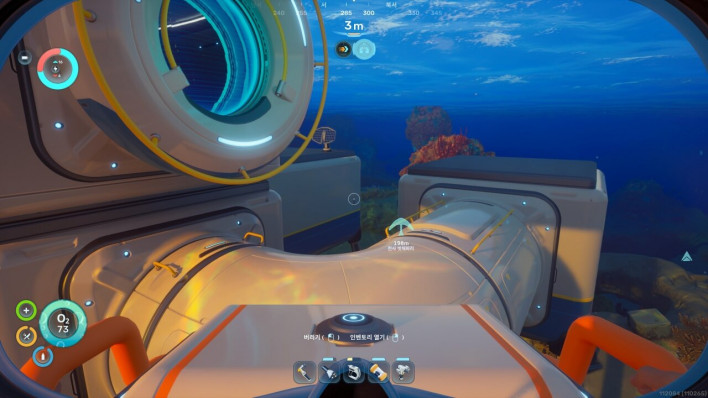

Base construction is an element the developers proudly emphasized even before the early access launch. In an interview, Gallego described this as a 'Sculptural System'—a structure where you can expand rooms little by little as you wish, moving away from the previous game's method of snapping together pre-determined shapes. The controls are very intuitive, and expanding just a little bit requires few resources, making it perfect for optimization.
Just building square rooms, curved corridors, and hatches creates a plausible underwater base, and if you make windows out of massive glass panes, the view from inside is breathtaking. If you install lights outside the base, you can also enjoy the quiet atmosphere that can only be felt at night.
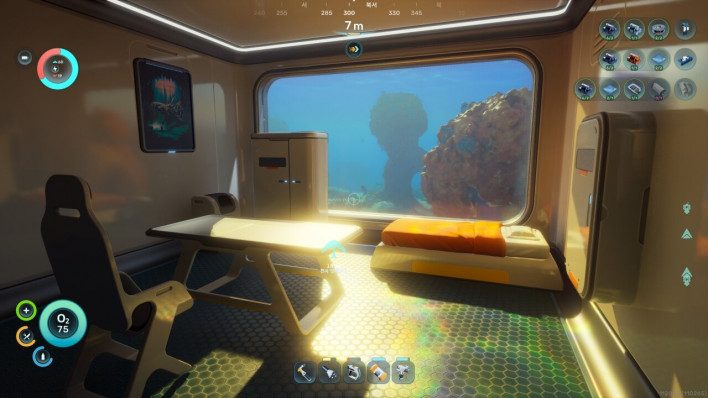
Acquiring the Tadpole, and Into the Deeper Sea
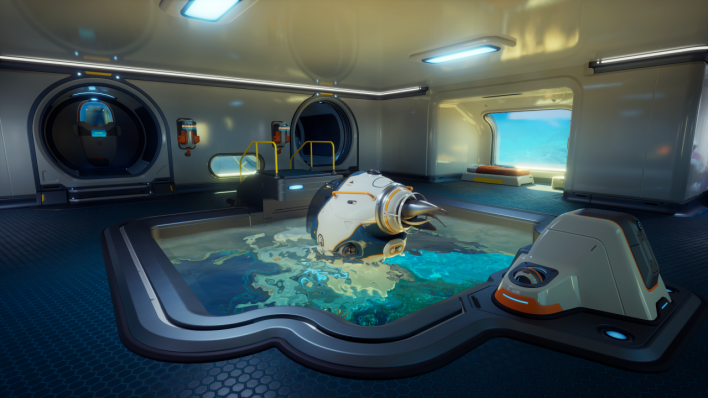
The Tadpole vehicle is proof that the player has begun to get used to this lonely underwater life. You no longer have to struggle with oxygen while going up and down to the surface, and you can travel faster and further. It requires several important resources to build, but once you have it, it becomes a precious partner you can never go back to living without.

The quests given by NoA also encourage you to travel further as time goes on. After obtaining the Tadpole, it leads the player into the deep sea, far from the initial life pod—a terrifying space where oxygen is depleted faster during normal dives. The surrounding sea also changes from a pleasant blue to a dark green that evokes the terror of the abyss, and scarier-looking alien fish threaten the last human on the planet at every moment.
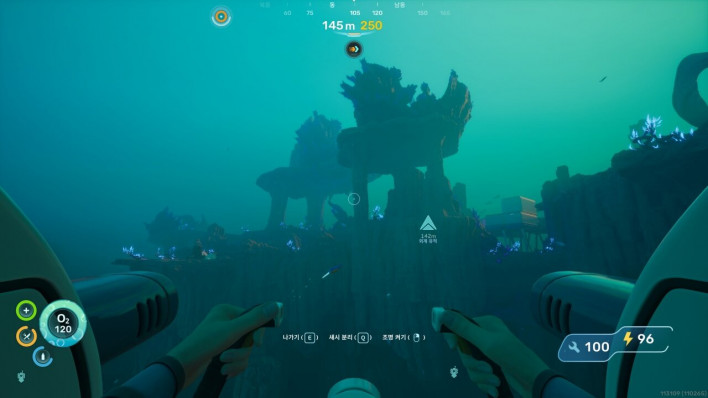
On the way from the starting area to the abyss, a terrifying giant creature, the 'Leviathan,' is swimming about. It is the squid-like 'Collector' that was revealed previously. When you become a target of a Leviathan, the BGM changes, and the Collector, in particular, is even scarier because it can inflict massive damage on the Tadpole. A total of 5 types of Leviathans are scheduled to appear at the time of early access, and I expect that seeking them out (and surviving) will be an interesting journey in its own right.
Shadows of an Ancient Civilization, and the First Death

Once you safely arrive in the deep-sea region, the full story of the planet that 'Subnautica 2' intends to tell begins to reveal itself very slowly. What made the colonists who arrived hundreds of years ago disappear, leaving only traces behind? Are we truly the only intelligent life on this planet? What is the identity of the 'Bloom' and the Protea virus that sickened the Feather Jellyfish? There is so much left to learn, and the sea remains silent.

The massive ancient structures visible through the shadows of the deep sea, obscured like hazy fog, are the highlight of this early access. In fact, it seems an ancient civilization lived on this planet before the human colonists arrived. The structures built in a style I'd never seen before, and the massive buildings that couldn't be taken in at a single glance, reminded me of the movie 'Prometheus.'
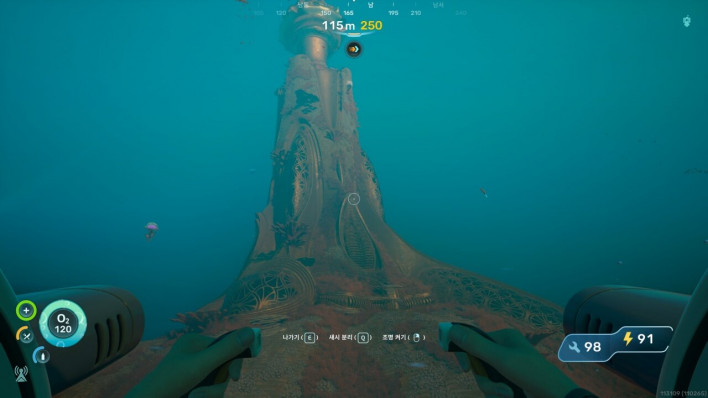
This sense of awe was short-lived, as I still had to survive in the deep sea, so I diligently gathered food and harvested resources. I upgraded the Tadpole to go deeper, and I was full of confidence, thinking I would soon uncover the secrets hidden by this planet and the ancient civilization.

While exploring so boldly, a message appeared: 'You are outside the allowed early access area.' Shortly after, a Leviathan with large wings swarmed in and smashed my Tadpole. It was my first death, and when I was reprinted at the base, I had lost my only vehicle in the deep sea. I can't even step outside the base without a vehicle—how will I survive from here on? Worry fills my mind.
May 15, 2026: Now, Together into That Sea
This is the journey of the preview version that could be experienced ahead of the 'Subnautica 2' early access launch. It was an adventure of about ten hours, but I really liked this perilously dangerous, dazzlingly beautiful sea.
Minor points of disappointment include the fact that resource quantities are not displayed at certain points depending on the location of storage within the same base, and that no one told me I could attach transport boxes to the back of the Tadpole. However, these are very minor compared to what I've experienced so far, and the optimization was quite good, allowing me to maintain immersion without any crashes or bugs throughout the preview.
Starting with the early access on May 15, Unknown Worlds plans to make the game even more enjoyable together with the players. If I can't find a way to survive in the deep sea, I plan to explore this sea again with a friend this time.

Sort by:
Comments :0