


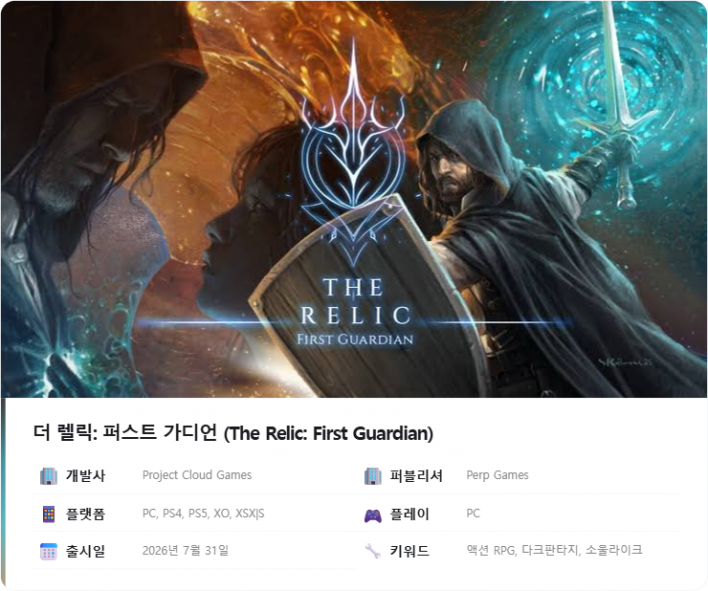
Project Cloud Games' debut title, 'The Relic: First Guardian' (hereinafter 'The Relic'), is set for its official release on July 31.
First revealed in a 2020 prototype video, 'The Relic' immediately captured the attention of gamers worldwide with visuals and action that were hard to believe came from a development team of only about 10 people. Of course, the road for 'The Relic' was not always smooth. The gap between their ambitious vision and the reality of being a small development team was a constant hurdle.
Nevertheless, Project Cloud Games did not give up, quietly continuing on its own path. After six years of development, the launch is finally just around the corner. The result of that effort is 'The Relic.' Of course, 'The Relic' is not a AAA title, and you may notice a few rough edges while playing. But one thing is certain: despite the limitations of its scale, the team never compromised on its unique vision.
'The Relic's' Narrative: Familiar Yet Fresh
Players find fun in different ways. Some love the combat system, others enjoy the depth that rewards repeated playthroughs, and some are drawn to a compelling story. While a game that combines all these elements is ideal, the most important thing is that if a game can deliver at least one of these with certainty, players will be hooked.
In that sense, my first impression of 'The Relic's' story was not particularly strong. Please don't misunderstand—it's not that the story is poorly written. It's more that I felt a sense of déjà vu.
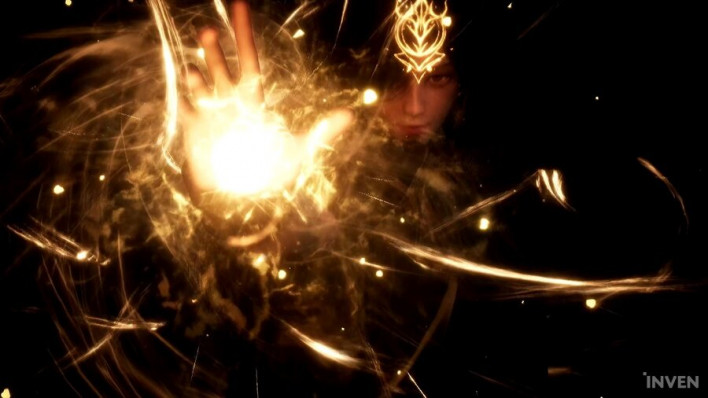
The dark fantasy genre has become somewhat formulaic. A world that was once sustained by something loses that power, plunging into darkness and chaos. The protagonist (the player) awakens on the brink of extinction and sets out on a journey to recover the source of that power—be it divine strength or a relic—to save the world. This is the quintessential cliché.
'The Relic's' basic story does not stray far from this. The 'Relic' that brought prosperity to the world is destroyed for some reason, giving birth to the Void. Beings affected by the Void transform into monsters called 'Brutals,' and civilization begins to collapse. The situation worsens as those who possess fragments of the destroyed Relic also succumb to the Void and turn into Brutals.
Amidst this, an mysterious woman awakens the protagonist, the First Guardian (hereinafter 'Guardian'), and the story begins in earnest. The Guardian follows the woman's guidance to recover the fragments needed to rebuild the Relic and save the world. This narrative is not significantly different from existing dark fantasy titles; aside from the terminology, it is essentially the same.
Naturally, this world-building and story feel familiar, which is a double-edged sword. It is easy to grasp because it is familiar, but it also fails to feel novel for the same reason. This is why I felt that sense of déjà vu earlier.
'The Relic' compensates for this weakness in the main story with a variety of sub-quests. One unique aspect is that many of these sub-quests also evoke a sense of familiarity—but not the kind born from dark fantasy tropes. It is because they reinterpret Korean folklore and legends within a Western-style dark fantasy setting.
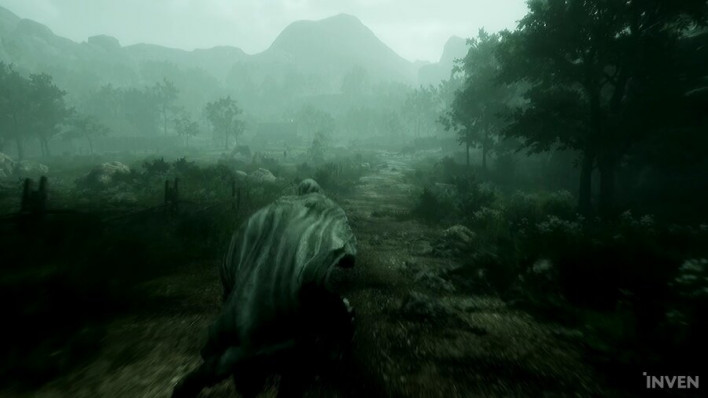
A prime example is the 'Fairy and the Woodcutter' legend, which you experience midway through the first chapter, 'Faded Mist Forest.' In the original tale, the fairy who married the woodcutter eventually retrieves her winged clothes and returns to the sky with her children. 'The Relic' reinterprets this to fit its world. I won't go into detail to avoid spoilers, but this reinterpretation shows a high level of polish, from the narrative aspects to the boss fight direction.

The differences don't stop there; the storytelling is also distinct. Regardless of the genre, there are generally two ways to convey a story: directly through the mouths of characters like the protagonist or NPCs, or indirectly through environmental storytelling.
Direct delivery makes the cause-and-effect of events clear, but it can sometimes feel overly verbose. Indirect storytelling, where players infer information from item tooltips or notes, fits the world-building perfectly but can be polarizing because it requires the player to do the legwork.
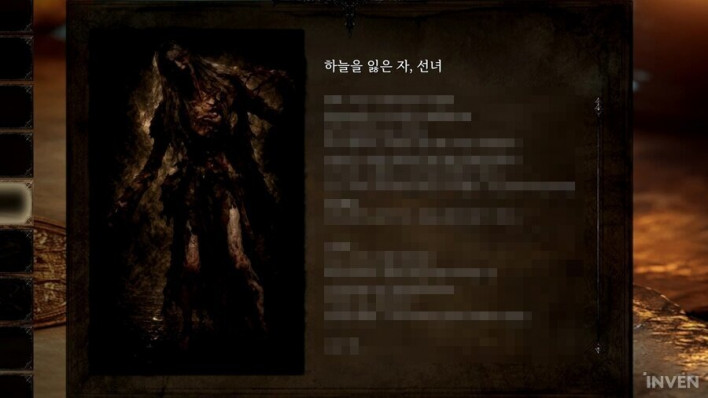
'The Relic's' storytelling sits somewhere in between, using a third-party narrator to tell the tale. Combined with the concept of basing sub-quests on Korean folklore, it creates a unique atmosphere, almost like a grandfather telling an old folktale.
It strikes a balance: it avoids the verbosity of direct character dialogue while preventing the confusion that can arise from purely indirect inference.
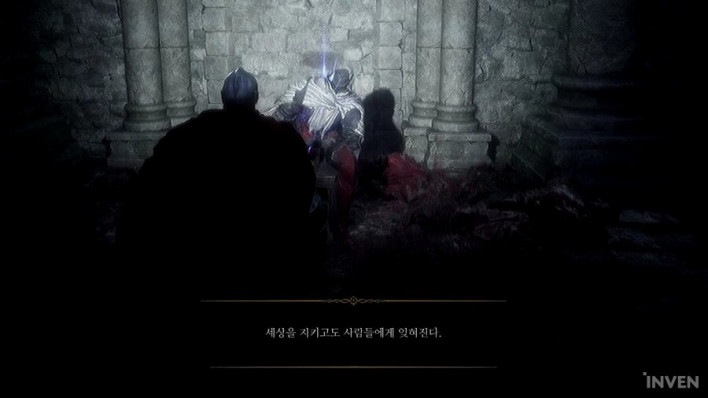
'The Relic's' narrative is an attempt to build its own elements within a familiar, established framework. Fortunately, the result is quite good—neither too verbose nor too bland—making it satisfying in many ways.
Exploration Is Growth
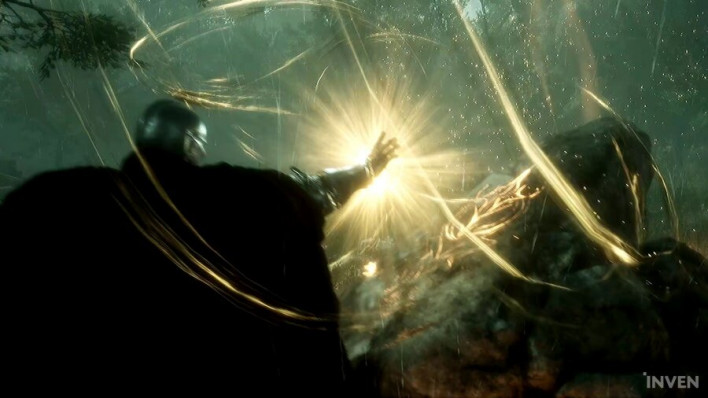
Making players explore naturally in an open world is not as easy as it sounds. You have to stimulate curiosity about what lies ahead while designing rewards for that exploration. 'The Relic' is cleverly designed so that exploration leads to character growth. While other games allow you to wander around to gain EXP, 'The Relic' does things a bit differently.
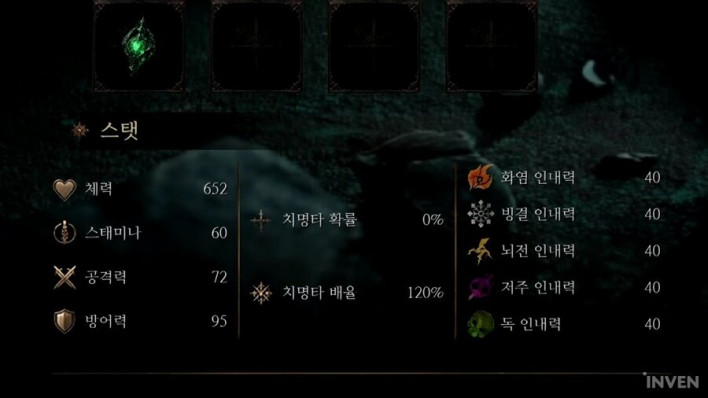
For starters, 'The Relic' has no levels. You don't grow your character by investing stat points one by one. Of course, that doesn't mean there are no growth elements. In 'The Relic,' you strengthen your stats and build your own loadout through weapons, armor, and relics—a type of accessory.
However, this is different from other games. One notable aspect of equipment-based builds is that there is almost no hierarchy between items. In most games, late-game gear is strictly better than early-game gear, but in 'The Relic,' that difference is barely noticeable. While a late-game weapon might have higher base attack power, the difference is negligible when you consider the unique sub-options on each weapon.
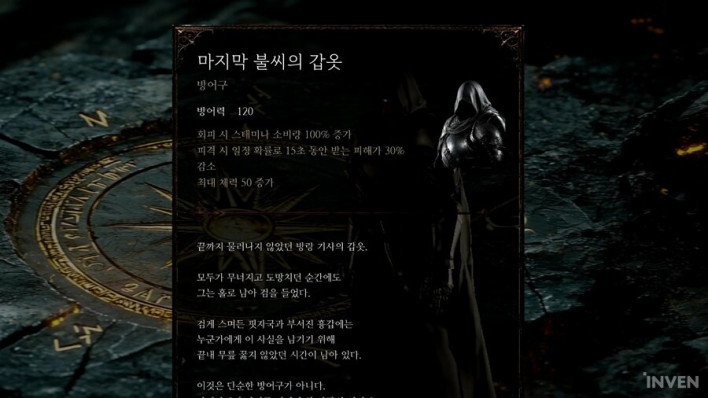
Take the sword, for example: some weapons have 'double-edged' options, like increasing attack power by 40% at the cost of 4% HP per swing, while others have more standard options like +15% attack power and -50 HP. The same applies to other weapon types. Two-handed weapons range from balanced options like +8% attack power and +50 HP to specialized ones that grant a 30% attack boost for 15 seconds upon a successful parry.
Armor is similar. Armor with a parry-based HP recovery option works exceptionally well with the aforementioned parry-focused weapons, while those who prefer skill-based combat might opt for armor with cooldown reduction. There are even pieces that boost the attack power of specific weapon types. In other words, the system allows for diverse setups tailored to your favorite weapons and playstyle, beyond just defense or stamina management.
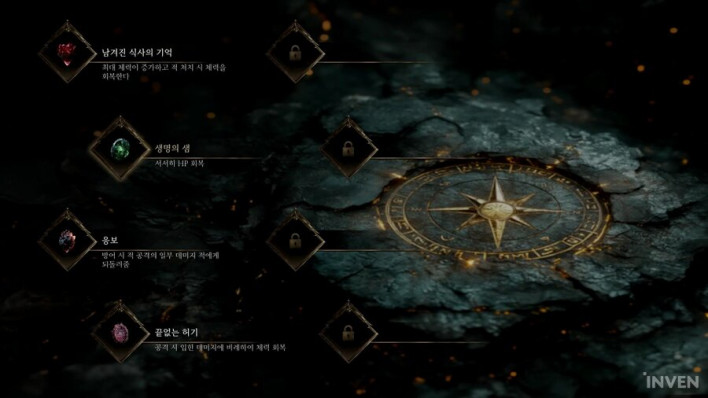
While weapons and armor are clearly defined by playstyle, relics act as accessories that support growth. They range from powerful items—like those that restore HP upon enemy elimination, provide bloodsucking, or boost skill damage for specific weapon types—to more general-purpose ones that increase HP, stamina, or elemental resistance. While these general relics might seem useless at first, they can offset the drawbacks of certain armor pieces that increase stamina consumption. Essentially, you build your core with weapons and armor, then use relics to maximize your strengths or cover your weaknesses.
Naturally, this equipment isn't just handed to you. You can get some by defeating main bosses, but to try out diverse builds, you must complete sub-quests hidden throughout the world and defeat optional bosses. The more you combine equipment and the more relics you collect, the stronger you become, which naturally encourages exploration.
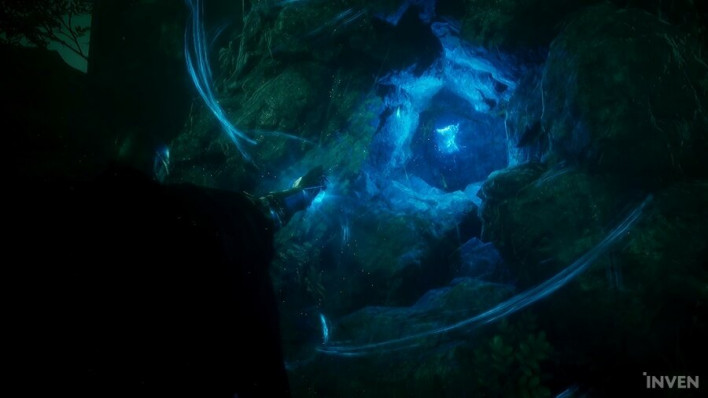
You also can't overlook Relic Mana. You need a certain amount to unlock skills, and the catch is that you have to physically explore the world to absorb it. It's hidden everywhere—from deep inside caves to the edges of hills—so you have to go out and find it yourself.
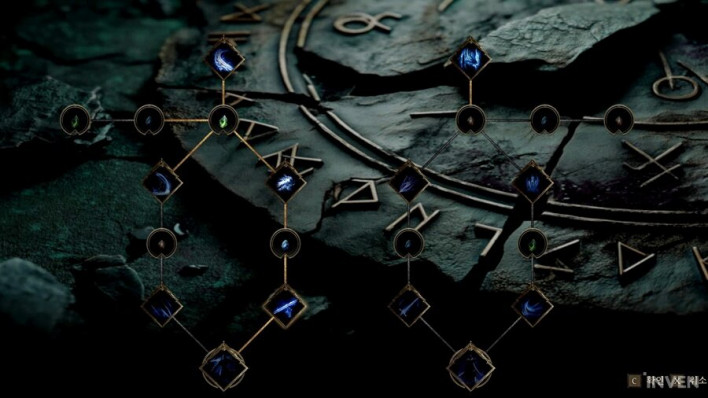
The process can be a bit arduous, but the payoff is certain. Relic Mana allows you to learn skills, passive abilities like HP/stamina/cooldown reduction, or powerful active skills. While these skills have long animations and carry the risk of being interrupted, their performance is undeniably strong.
Acquiring new equipment and collecting Relic Mana to unlock skills makes you stronger naturally. This is why I say exploration is growth.
5 Weapon Types, 5 Kinds of Action Catharsis
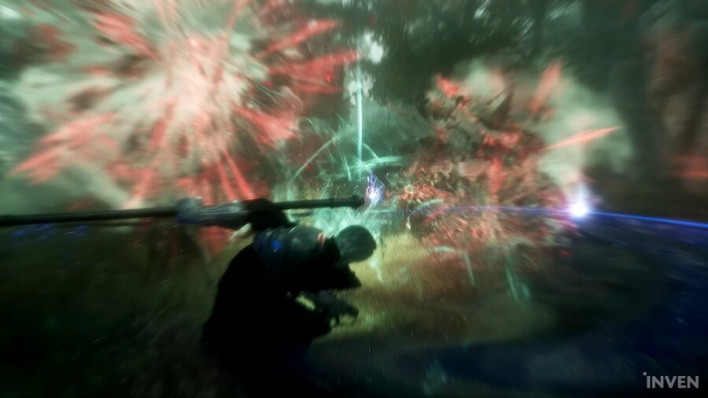
I also want to give high marks to the distinct feel of each weapon. Many games have a variety of weapons, but players usually end up sticking to just one. The reasons range from practical ones like 'it's overpowered' to simple preferences like 'it feels the best' or 'it's easiest to control.
'The Relic' was a bit different. For one, there are no inherently overpowered weapons, and each offers a different kind of action catharsis. Dual blades have low attack power but allow you to overwhelm enemies with speed, while the sword and shield offer a well-rounded, stable experience specialized in guarding and parrying.
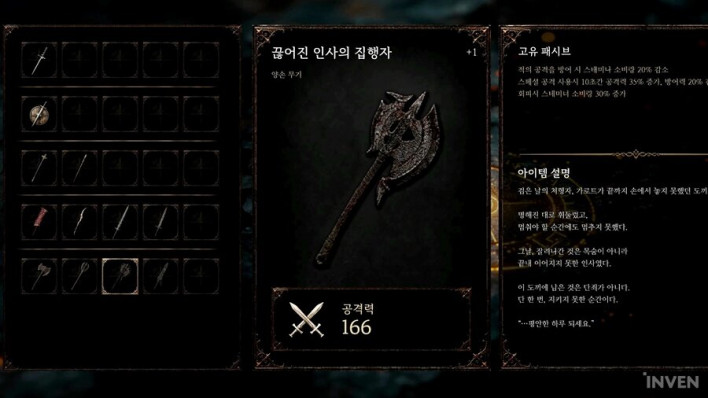
If you're looking for a powerful, opportunistic hit, nothing beats a two-handed weapon. It can easily stagger common enemies, and while its skills have long animations, they deal massive damage to bosses. The sword sits between dual blades and the sword and shield; with decent attack speed and a wide range, it's perfect for players who find two-handed weapons too slow and the others too plain.
The staff is a different beast entirely. While basic attacks are possible, the core lies in its skills. Other weapons are designed to use skills during openings in boss fights, but the staff is designed around the premise of using skills constantly. Its cooldowns are significantly shorter than other weapons, allowing you to cycle through 2-3 skills and have the first one ready again by the time you finish.

Of course, that doesn't mean the staff is overpowered. Its basic attacks are weak, and if you get hit while casting a skill, you'll be staggered and the skill will be interrupted, requiring even more caution.
The key to these weapons is that they each offer a different experience. If you want stability, use the sword and shield; if you want to aggressively overwhelm enemies, use dual blades; for a powerful single hit, use two-handed weapons; for a mix of flashy action and versatility, use the sword; and if you want to spam powerful skills, use the staff.
Personally, I usually stick to one weapon once I get used to it, but in 'The Relic,' I found myself switching weapons constantly because each one offered such distinct fun.

The Size of the Development Team Isn't the Measure of Fun
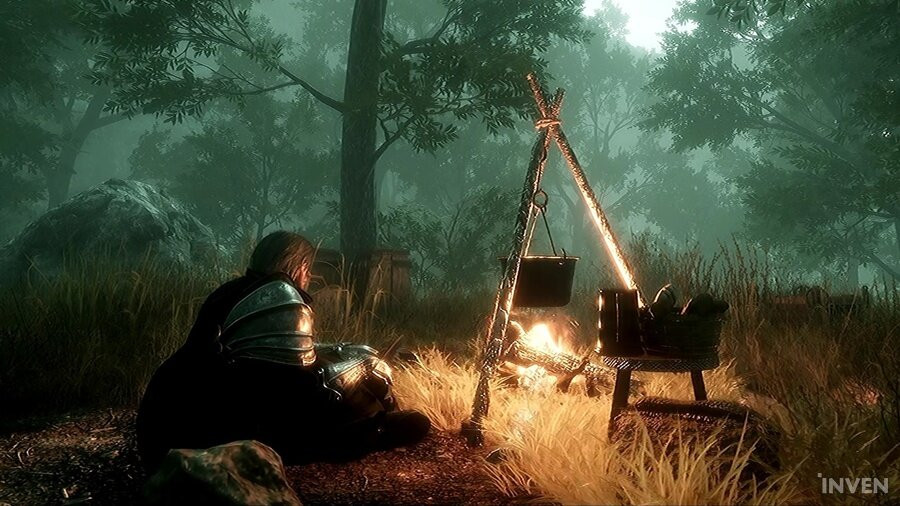
'The Relic' is a game with as many shortcomings as it has charms. While animations generally connect well, some parts feel awkward, and dodging while running can send you flying several meters. At times, this can make you feel as if you've defied gravity.
From that perspective, evaluations of 'The Relic' will inevitably vary depending on your expectations. If you cannot accept the minor awkwardness that inevitably comes with a small-scale development, you might find the game underwhelming. Furthermore, the fact that many AAA action RPGs (and action-adventures) exist makes it difficult for 'The Relic,' as it will inevitably be compared to them, whether fair or not.
However, if you shift your perspective slightly, 'The Relic' can be seen as a solid action RPG. While it may lack polish in some areas, it has everything it needs. With 80 types of bosses (including mini-bosses), dozens of weapons, armor, and relics to combine, and nearly 90 sub-quests and exploration elements, it is packed with content.
'The Relic' may be polarizing, but one thing is certain: it is fun. Ultimately, the most important thing in a game isn't the visuals, the polish, or the size of the development team—it's the power to keep the player engaged until the end. In that sense, 'The Relic' is a game that possesses that power.
![]()
- Hongman "Nowl" Yoon
- Email : nowl@inven.co.kr




Sort by:
Comments :0