


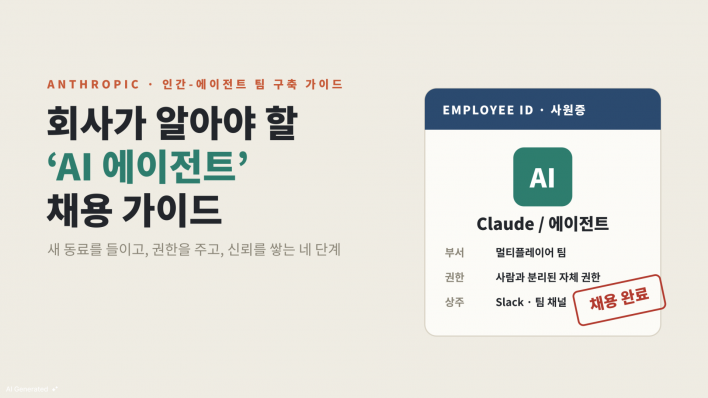
Just a few years ago, collaborating with AI was a solitary task, involving a one-on-one exchange in a chat tab. It was a structure where a user asked a question, the AI answered, and the user followed up—a 'one person, one tool' dynamic.
Anthropic, however, has declared this approach a relic of the past. In a post on its official blog on the 24th titled 'Building Effective Human-Agent Teams,' the company argues that as AI takes on complex, sophisticated tasks like coding, research, and financial analysis, the collaboration paradigm is shifting. The way we work is evolving from 'single-player' to 'multi-player.' The era of a single human unilaterally commanding one agent is over. The future lies in building 'complete teams' where humans set the strategy and multiple AI agents divide the execution.
This report summarizes four key lessons Anthropic learned from months of internal experimentation. Interestingly, these lessons are not new concepts. Clear goal setting, defined roles, thorough documentation, and shared quality standards are exactly the 'good team habits' that human organizations have adhered to for decades. The difference is that with advanced AI agents joining the team, strictly following these basic rules has become more critical than ever.
From a 'Tool' to Call to a 'Colleague' in Residence
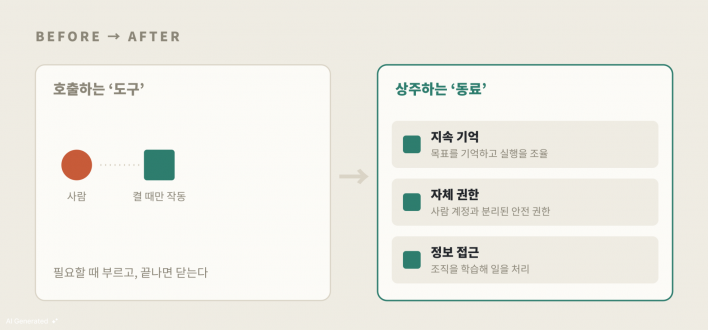
What does it actually look like to 'work as a team with AI'? Anthropic defines it as a 'multi-player agent'—an AI that collaborates with the entire organization simultaneously, rather than just an individual.
There is a clear distinction between these and the chatbots we commonly use. Technically, they might seem similar in that they possess their own memory and skills. However, the decisive difference lies in their 'workspace' and 'qualifications.' A multi-player agent is granted its own credentials, independent of any specific individual. Above all, it resides in the space where actual work takes place. In Anthropic's case, the stage is a collaboration tool like Slack. It is not a one-off tool that only turns on when a user calls it, but rather something closer to a colleague that resides in a team channel.
For an AI agent to pull its weight as a member of an organization, three prerequisites—akin to a human's 'hiring conditions'—are essential.
The first is 'persistent memory' to remember team goals and coordinate execution. The second is 'segregated authority' to ensure the agent operates only within safe and predictable boundaries; because the agent does not borrow a human's account, its scope of work is clearly defined. The third is 'broad information access' to learn organizational operations and process tasks according to goals.
Only when these three pieces of infrastructure are in place can an agent join the team. However, joining and performing are two different things. These are merely technical foundations. For a human-agent team to actually deliver results, human change must come first. New ways of collaborating and clear norms that all team members must follow are required. This is why the four lessons derived from Anthropic's internal experiments are drawing attention.
Lesson #1: Work in the Open
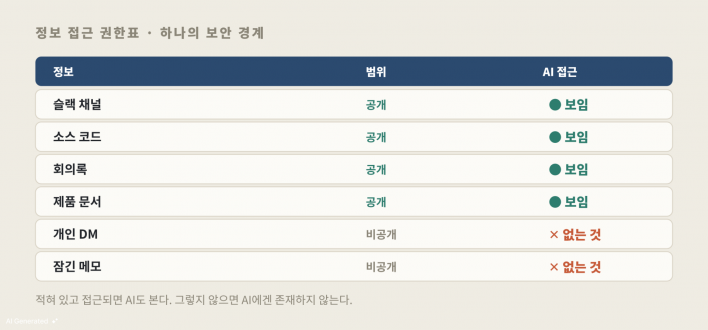
For an AI agent, there is no such thing as 'private conversation' or 'tacit agreement.' Agents understand context based solely on text that the organization has made searchable—Slack messages, source code, shared documents, and meeting minutes. Personal direct messages (DMs), water-cooler chat, or documents with restricted access provide no context to an agent. If it isn't recorded and accessible, it doesn't exist to the agent.
For this reason, Anthropic does not set access permissions document by document or channel by channel. Instead, it sets broad 'security boundaries' at the level of the entire Slack workspace or document library. Within these designated boundaries, all context flows to both humans and AI. Worrying about whether to make a specific channel public or share a specific document causes decision fatigue for both humans and AI. Simplifying these boundaries eliminates such inefficiencies.
The effect of information transparency is clear. An agent that understands what was canceled in a meeting will not suggest a discarded task. An agent that has learned the product specifications of other teams may even recommend proven success patterns. In particular, because agents read vast amounts of text at speeds far exceeding humans, they act as problem-solvers, frequently pointing out related tasks that practitioners might have missed.
Of course, this does not mean all sensitive conversations must be public. If security is required, one can always send a DM to Claude or use existing services. Changing information sharing to the organization's 'default' requires a cultural shift in the workplace. However, the productivity gap between teams that move with an agent that holds all the context and those that do not will become impossible to ignore.
Lesson #3: Define Roles Clearly
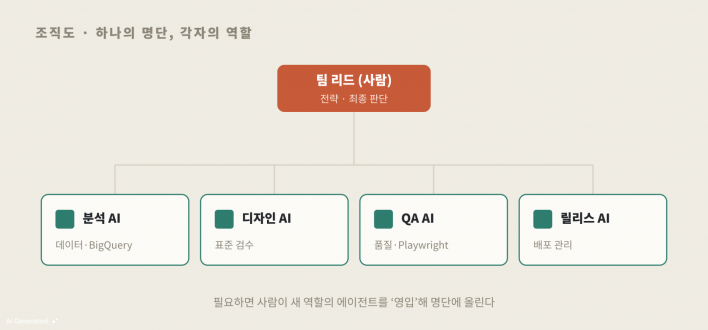
The key to successful collaboration is not technology, but 'who does what.' A human-agent team fully shares rosters, outputs, and workspaces. In this setup, agents perform different roles, each with their own unique permissions, skills, and tool access. One agent might handle data analysis, another might audit design standards, and a third might synthesize research materials.
When a project begins, team members first communicate with agents to establish specific roles and collaboration processes. Once roles are set, one agent can call another, passing specific tasks to the right person with the appropriate memory and access. The important thing here is to provide the tools necessary for the job. A data analysis agent needs access to 'BigQuery,' and a QA agent needs 'Playwright MCP' to perform at its peak.
If role division is blurry, members end up running their own individual AIs, leading to duplicated work and fragmented team context. A prime example is tracking data metrics. If one multi-player agent handles this, the whole team can look at the same numbers. Humans should collaborate with agents in the same thread, focusing on 'final judgment and strategic decision-making'—the domain only humans can handle.
In fact, one engineering team at Anthropic built a 'roster' to formalize the roles of humans and agents. Defining roles in advance as skill files not only makes specialization easier, but also allows anyone in the company to quickly replicate and deploy the type of agent they need. As a project grows, one can simply add an agent to handle new areas. This team recently 'hired' a new 'Release Manager Agent' to handle the software deployment process.
Lesson #4: Set a Clear Goal (North Star)
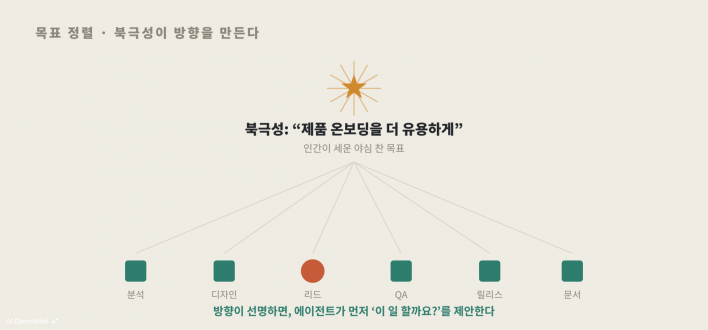
The decisive difference between an agent that only does what it's told and one that proactively suggests new tasks lies in 'clear direction.' The agents playing pivotal roles at Anthropic do not stop at completing assigned tasks; they go a step further to propose new projects and workflows. This proactivity emerges when a team with rich context and clear role division adds one final element: an unwavering value-oriented point, the 'North Star.'
The North Star is an ambitious, macro-level goal that helps team members judge whether the task at hand is moving in the right direction. At Anthropic, the entity that establishes this North Star is always human, rooted in the company's mission and business goals. Once the North Star is codified in text, human team members share it with the agents. Humans then make the final decision on which agents to empower to lead new workflows, as not every agent in the team possesses the necessary skills and reliability.
There is a real-world example. A team at Anthropic developing internal tools set a North Star to 'improve the product onboarding process.' An agent on the team then proactively suggested modifying the error message text in the onboarding flow. This small change actually led to an increase in the weekly onboarding success rate. A clearly defined North Star provides agents with consistent behavioral guidelines and opens up practical opportunities for them to actively contribute to team productivity.
Lesson #5: Expand Autonomy in Proportion to 'Trust'
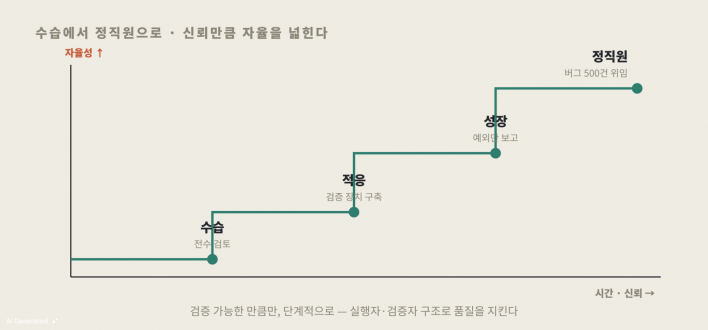
They didn't just hand 500 bugs to an agent from day one. Anthropic teams grant autonomy only to the extent of the reliability the agent has proven, and then carefully expand the scope of work. While there are success stories of engineers letting agents handle 500 bugs independently, the start was gradual.
Just as it takes time for a new colleague to join a team, gauge their capabilities, and get in sync, the same applies to agents. An adaptation period is essential to identify the agent's performance by assigning various tasks, and to learn how to explain goals and which skill files and prompts yield the desired results. It is also important to re-test existing tasks whenever the Large Language Model (LLM) is updated. Safety fences that once prevented an agent from going off-track can become shackles that hinder creative problem-solving for a more advanced model.
The keyword Anthropic emphasizes most in this process is 'verification.' Agents that have delivered excellent long-term results have multiple mechanisms to verify their output before human review. They apply automated tests to source code and clear rubrics and style guides to technical documents. By establishing standards and designing all processes to be verifiable, the final quality stays on track. This is why the 'Doer-Verifier' structure, where one agent performs the work and another cross-verifies it, is frequently used.
An engineering leader at Anthropic once formed a task force combining a few team members and many agents to resolve a massive project backlog. First, a group of agents scanned the entire backlog to identify owners and calculated the complexity of unassigned items to score them. Then, another group of agents selected low-to-medium difficulty tasks from that list and modified the source code directly.
In the initial phase, the leader reviewed every decision made by the agents to categorize issues requiring human judgment. Later, they trained the agents to judge these exceptions and escalate them directly to the leader. They built an efficient system where humans intervene only in key decisions involving delicate trade-offs.
Furthermore, the team had agents write their own weekly reports recording 'Lessons & Missteps' to prevent the repetition of the same mistakes. Over time, the leader was able to delegate increasingly complex tasks to the agents, drastically reducing the time spent on guidance. Once the agents achieved independent autonomy, they were taught that 'human attention is the scarcest resource.' The agents' behavioral patterns were designed to batch questions, summarize key context to help human team members catch up quickly, and limit the number of items a person reviews at once.
In the end, it comes back to the basics of a good team
Anthropic concludes by suggesting a five-point self-diagnosis kit for human-agent teams.
| ✅ | ① Information Transparency · Is information transparently shared and searchable for both humans and AI. ② Role Clarity · Are there separate slots for humans and AI on the team roster, and are their practical duties distinct. ③ Tool Appropriateness · Does the agent have the weapons (permissions) to do its job. ④ Quality Verifiability · Are there evaluation criteria and tests in place to cross-verify results. ⑤ Milestone Clarity · Is there a clear North Star that everyone is looking toward. |
The destination of these questions is clear: direction, roles, documentation, standards, and the room to learn from mistakes. These are the basics of organizational culture we already knew. AI agents are not some fantasy-like new technology. Rather, they are a mirror showing how a team falls apart when it skips the basics. The teams that achieve the best results by making a powerful partner like an agent their ally are the ones that are most persistent in keeping these obvious basics.
![]()
- Byungho "Haao" Kim
- Email : haao@inven.co.kr
-





Sort by:
Comments :0