


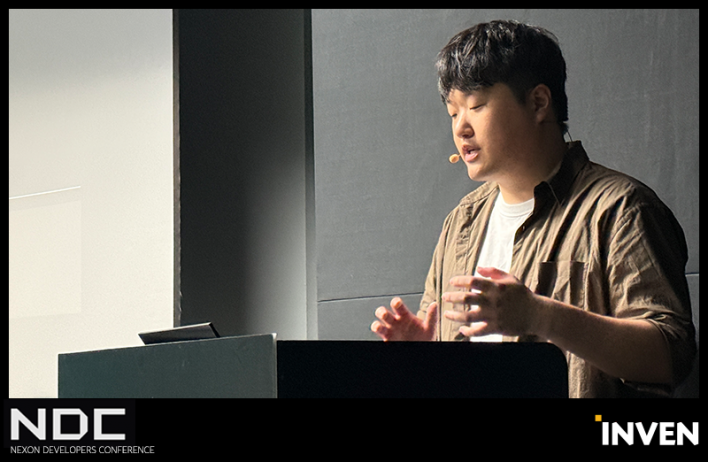
Topic: The Dilemma of Freedom and Responsibility in 'MapleStory Universe' - The Paradox Created by a Permissioned Chain Speaker: Ryu Gi-hyeok, Head of Blockchain at NEXPACE Field: Private Blockchain Recommended Audience: Developers, server engineers, and game service planners (PD/PM) considering the development or adoption of blockchain-based games or services
Tags: #NDC26 #Blockchain #MapleStory
[🚨 Lecture Topic] This session shares how we resolved three real-world hurdles encountered during live operations: the risk of 'Approve' hacks, reduced convenience due to gas fees, and regulatory obligations for contract deployment.
Blockchain is often summarized as 'freedom that requires no one's permission.' However, after operating a live game service for over a year, we found that this freedom directly clashed with the company's 'responsibility' to protect its users.
Ryu Gi-hyeok, Head of Blockchain at NEXPACE, took the stage at NDC 2026 to candidly discuss this dilemma, born from five years of building and over a year of operating the blockchain game 'MapleStory Universe.' The lecture title itself reflects this: 'The Dilemma of Freedom and Responsibility - The Paradox Created by a Permissioned Chain.'
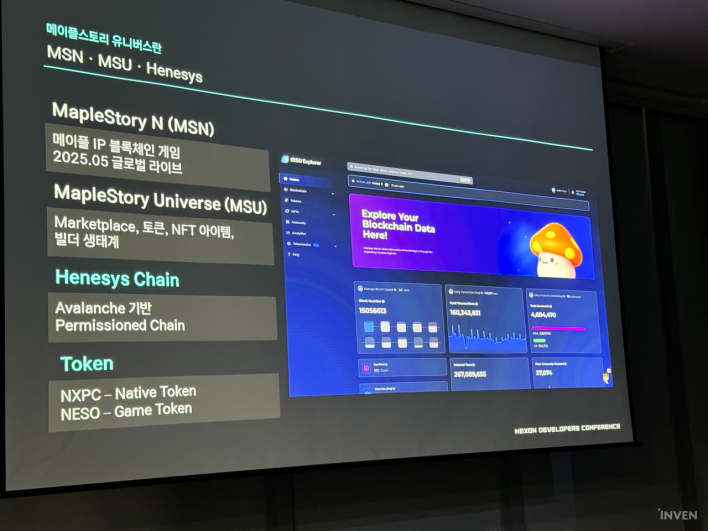
First, some terminology: 'MapleStory N (MSN)' is a blockchain game based on the MapleStory IP, which has been live for over a year since its global launch in May 2025. 'MapleStory Universe (MSU)' refers to the entire ecosystem, including this game, the marketplace, tokens, NFT items, and apps created by external developers (builders).
The blockchain infrastructure supporting all of this is the 'Henesys Chain.' Ryu defined the nature of his presentation not as a design guide for games or token economies, but as a retrospective on "what value a company can pursue when using blockchain and how to realize it." The core question driving this was: "Can blockchain's freedom and a service provider's responsibility coexist."
Transparency and Reliability: The Freedom Promised by Blockchain
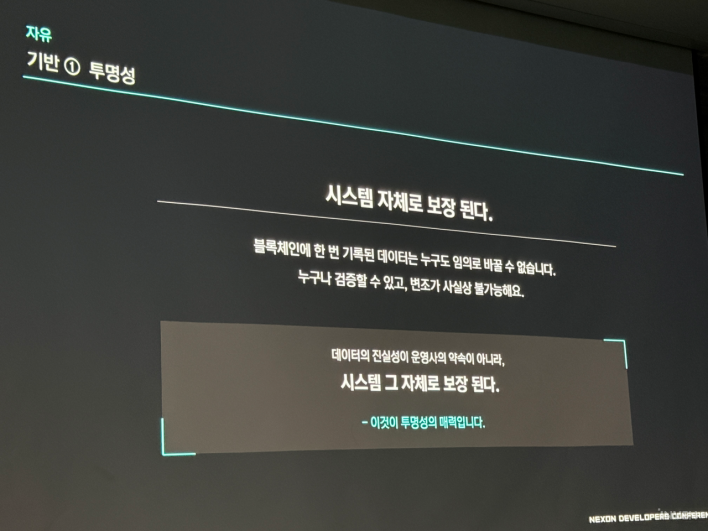
Ryu explained that while the appeal of blockchain lies in 'freedom,' that freedom only holds up on two foundations: transparency and reliability.
Transparency comes from the fact that once data is recorded, no one can arbitrarily change it. Even if someone tried, it would be immediately exposed, breaking trust with users, making tampering effectively impossible. Because the recording process is public, issues like unintended bugs are easily discovered, and it is easy for the operator to prove that such issues were 'not intentional.' In essence, the integrity of the data is guaranteed by the system itself, not by the operator's promise.
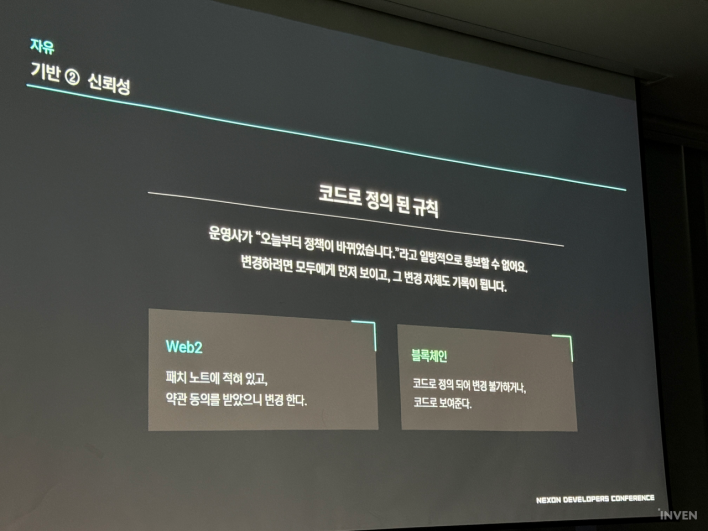
Reliability comes from the fact that rules are set in stone via code. In a traditional game, you have already obtained consent to terms of service, so you can just change them and write it in the patch notes. In blockchain, however, an operator cannot unilaterally announce, "The policy has changed as of today." The structure is built on publicly disclosing what can be changed in the code, thereby 'contracting' trust through that mechanism.
Ryu viewed these two elements as what make blockchain an 'agreed-upon infrastructure' rather than a simple database. On top of it, anyone can create tokens, upload smart contracts (code that executes automatically when conditions are met), and trade assets. The most powerful result of this freedom is 'scalability.' NEXPACE started the project with this dream, but as the live launch approached, the ideal began to hit the wall of reality.
The 'Three Walls' Encountered Between Freedom and Responsibility'
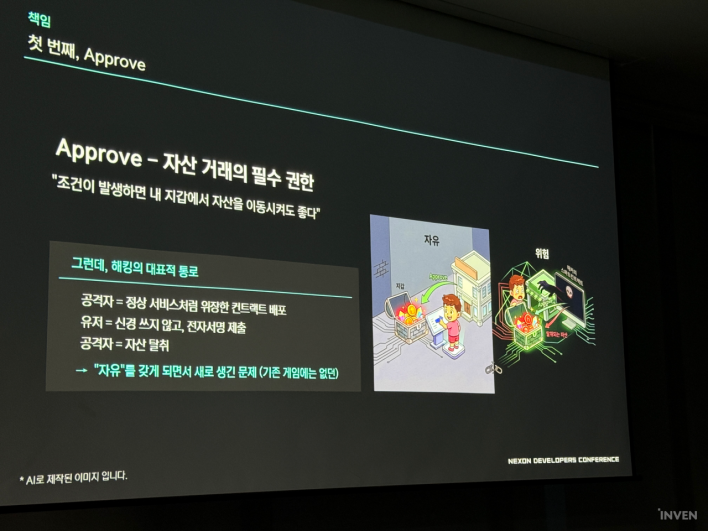
The first wall he mentioned was 'Approve.' To trade assets freely on a blockchain, a smart contract must receive prior authorization from the user, essentially saying, "You may withdraw assets from my wallet when specific conditions are met." It is a concept similar to automatic bank transfers and is essential for marketplace transactions and in-game event processing.
The problem is that this 'Approve' function is a primary gateway for blockchain hacks. Attackers launch malicious smart contracts disguised as legitimate ones, and users inadvertently click 'Allow,' leading to their assets being drained. It is a new responsibility that comes with freedom.
NEXPACE responded with a whitelist approach, hardcoding the system so that its own assets could 'only be traded with company-approved contracts.' Even if a hacker uploads a malicious contract, they cannot cause damage without approval. It seemed like a clean solution, but we didn't realize the side effects at the time. As the ecosystem grew and the number of external builders increased, the operational burden of analyzing and approving every contract they uploaded grew exponentially.
The second wall was 'gas fees.' On a blockchain, every action—such as sending tokens or minting NFTs—incurs a fee (gas fee). While the costs themselves have become much cheaper than before, Ryu pointed out that the real issue is 'convenience.'
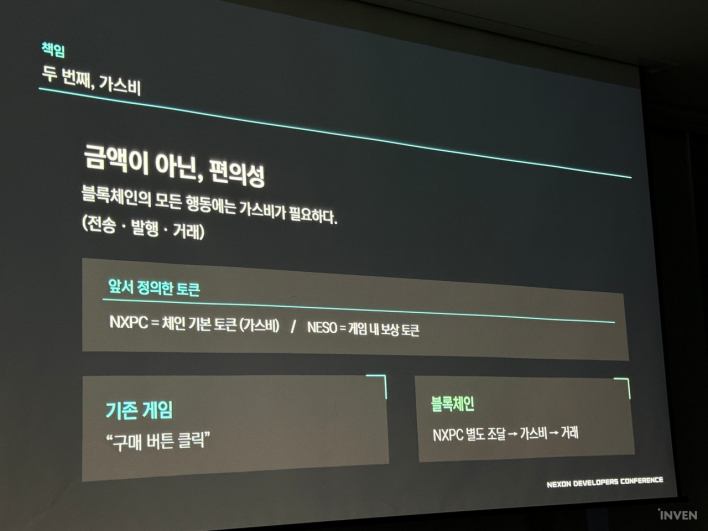
For example, if a new user earns in-game resources (NESO) and wants to trade an item, they must separately acquire NXPC, the token used for gas fees. In a traditional game, this would be a one-click purchase; in blockchain, it requires the preparatory step of 'securing gas fees.' Ryu recalled, "We constantly saw users who, after withdrawing tokens from an exchange, had to withdraw again because of gas fees, or posts in the community begging for gas fees worth less than ₩10."
There are many solutions, but the trap was that no matter which method was chosen, the service provider ultimately had to bear the cost. NEXPACE decided to absorb 100% of the gas fees. The question then became where that money would come from, and the conclusion reached is the key: "Instead of forcing a imitation of a permissionless chain, let's move to a permissioned chain, collect the gas fee revenue ourselves, and use that money to support users." It was a circular structure.
Even open chains like Bitcoin and Ethereum are, in reality, validated by only a few well-capitalized companies. We judged that improving the user experience outweighed the benefits of insisting on an open chain. Thus, NEXPACE chose a closed structure, operating 13 validator nodes directly. It was a decision to sacrifice 'decentralization'—another face of freedom—to lower the gas fee hurdle.
Choosing a closed chain brought new obligations: Know Your Customer (KYC) and Anti-Money Laundering (AML) requirements. This is a burden not found in open chains; we must monitor daily withdrawal limits per wallet and track asset flows to block suspicious transactions. In an open chain, if one node blocks a user, they can ask another node to bypass it, leaving room to evade responsibility. In a closed system where we operate all 13 nodes, there is no escape. The company bears the responsibility entirely.
Then another problem arose. If we allowed anyone to upload smart contracts freely, there could be paths to bypass limit monitoring and asset tracking. Ultimately, NEXPACE made a choice: we restricted smart contract deployment itself. We effectively closed off the essential blockchain freedom of 'anyone can upload and anyone can trade' ourselves.
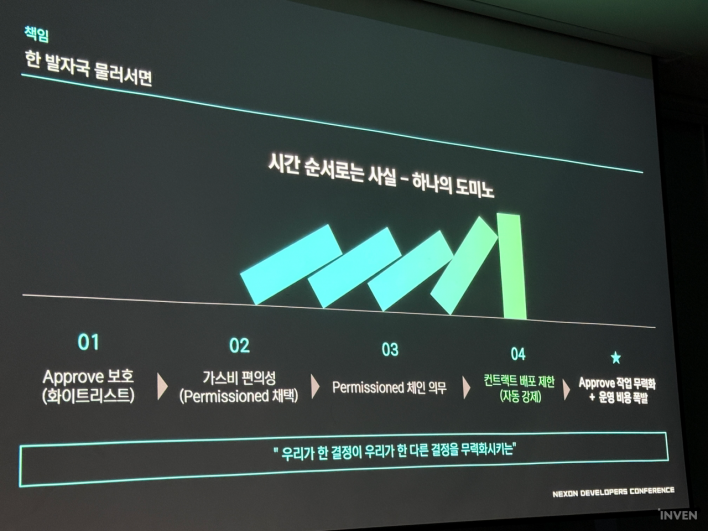
The three decisions were not isolated; they were a single domino effect. We introduced a whitelist to prevent hacks, chose a closed chain to solve gas fees, and once we became a closed chain, regulatory obligations forced us to block contract deployment. But by blocking deployment, the first decision (protecting 'Approve') became moot, as hackers couldn't upload contracts anyway.
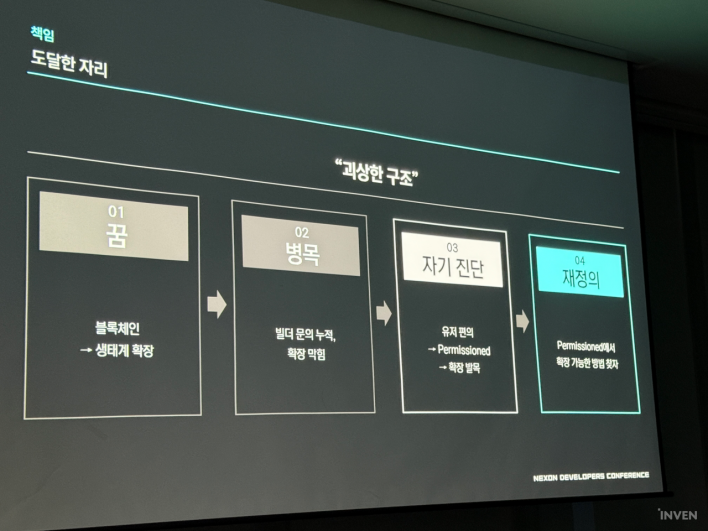
Ryu recalled, "The position we reached was a structure that even I felt was bizarre." At the end of every choice made to protect users, the very ecosystem expansion we initially dreamed of was being held back.
"Couldn't we have just not used blockchain?" five Years of Skepticism
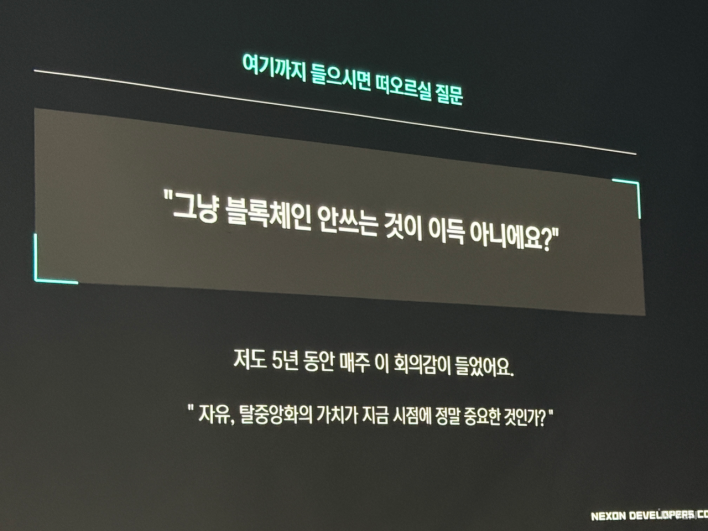
Hearing this, a natural question follows: "At this point, isn't it better not to use blockchain (Why Blockchain)?" Ryu admitted that he fell into this skepticism every week for five years. However, it wasn't a doubt about the value of token economies or NFTs. He believes blockchain finance—such as stablecoins, Real World Assets (RWA) like tokenized stocks, and decentralized exchanges—is already proven. His skepticism was about 'whether it makes sense to record every minute detail of a game on the blockchain.'.
He confessed that his most skeptical moment was a year before the live launch, as the areas requiring protection exploded. Among them, the 'Safe Room'—the method by which a company signs on the blockchain—caused unimaginable effort.
A company cannot use a standard personal wallet; it must prepare a separate, sealed room without internet access. After receiving approval from senior management, at least five people must enter the room, open the safe, take out the computer, connect to the internet, and then perform electronic signatures while monitoring each other according to a set procedure.
This process had to be repeated every time a new builder was added. Ryu said, "The probability of a private key being stolen is 1 in 2 to the 256th power. It's astronomically low, and I often thought it would be better to spend that time making fun services rather than enduring this inefficiency."
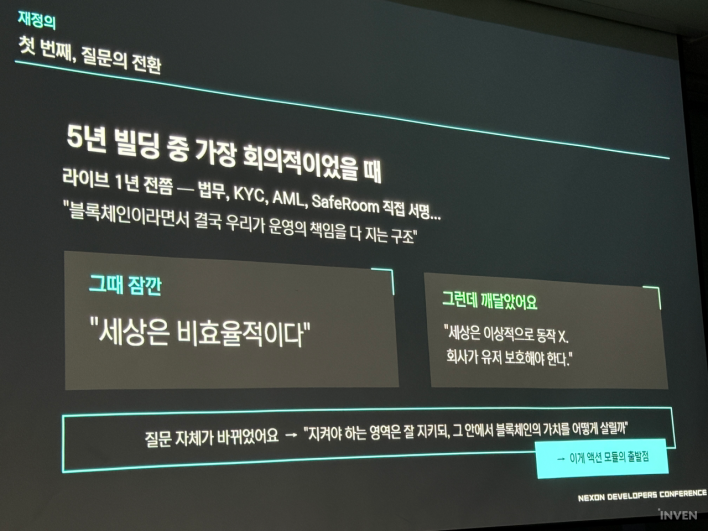
However, this process was also an opportunity for him to learn how traditional Web2 companies have built products. It was a realization that "perhaps the freedom blockchain talks about was too idealistic. Since the world doesn't work ideally, service providers must take responsibility for protecting users." From then on, his question changed to, "How can we preserve the value of blockchain while keeping what needs to be kept?" This shift in questioning became the starting point for the solutions that followed.
After overcoming his skepticism, Ryu summarized that the value NEXPACE truly wanted from blockchain boiled down to two things.
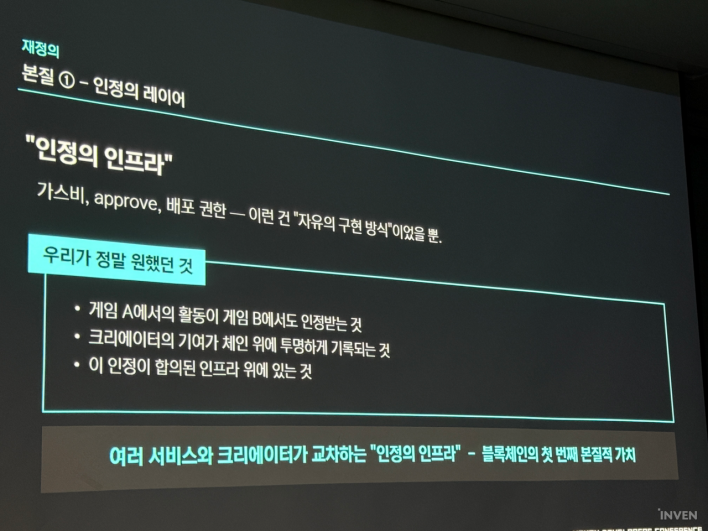
First is the 'infrastructure of recognition.' Things like gas fees or contract deployment were just ways to implement freedom; what we really wanted was something else. It is for activities in Game A to be recognized in Game B, for a creator's contributions to be transparently accumulated on the chain, and for this data to reside not on a company's closed database, but on a public infrastructure that everyone recognizes. This foundation, where various services and creators cross-recognize each other, was the essential reason we wanted to use blockchain.
Second is the 'coexistence of payment and data.' The 'x402' protocol announced by Coinbase in May 2025 was the catalyst. It revived the long-unused internet payment signal (HTTP 402), allowing AI agents to automatically pay tiny amounts in cryptocurrency when calling data or functions from other agents.
Ryu focused not on the AI, but on the fact that 'buying and selling data with micro-payments is possible because it's blockchain.' For example, if you have an AI investigate an event, it needs several newspaper articles; since you can't subscribe to every news outlet, you pay a micro-amount for just one specific article.
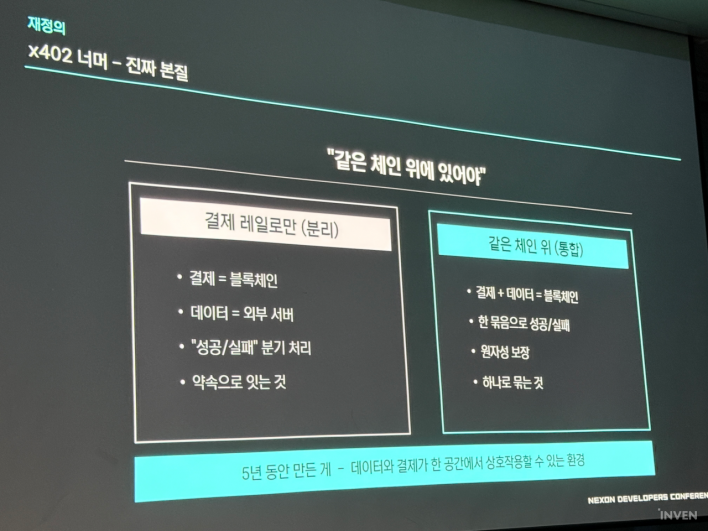
He went a step further. For payment and data to be truly bound together—meaning if the payment succeeds, the data must also be delivered—they must be on the same chain.
If payment is done on the blockchain and data is fetched from the outside, the payment might succeed while the data transfer fails. Using blockchain as a simple 'payment channel' is on a different level from putting the data itself on a chain where payment is possible. NEXPACE is actually putting vast amounts of data on the Henesys Chain, which is why he explains that this chain is more than just a place to exchange tokens; it is an 'environment where data and payment are interlocked in one space.'
"Responsibility through Modules, Freedom through Combination" - The 'Action Module' Reached After Much Deliberation
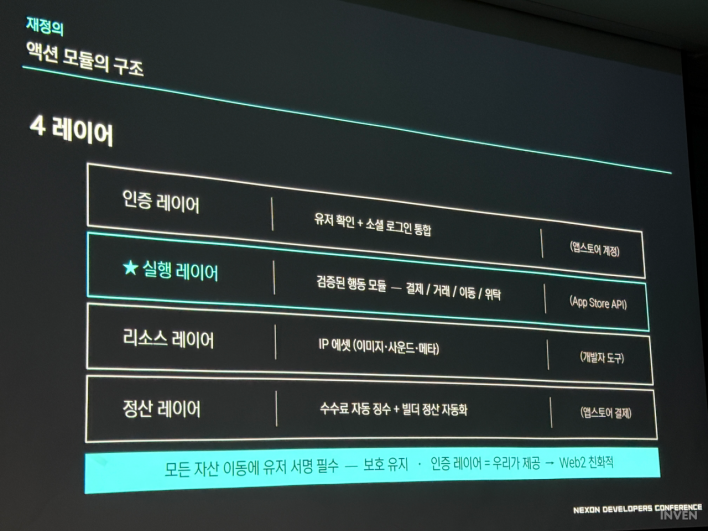
So, how can we unlock the restricted contract deployment? Ryu's judgment was that we cannot escape regulatory obligations unless we revert the closed chain to an open one. The answer reached after much deliberation is the 'Action Module.'
The core of the Action Module is that the company provides verified functional blocks in advance, and builders combine them like Lego to create their own services. Comparing it to a smartphone, it's like how it's dangerous for anyone to create apps with OS-level privileges, so you only open verified APIs, and developers build apps on top of that. The standard of control shifted from 'who can upload a contract (the subject)' to 'what actions are permitted (the action).'
The Action Module consists of four layers: an 'Authentication Layer' that integrates user verification and social login, an 'Execution Layer' that provides verified action blocks for builders to combine, a 'Resource Layer' that provides IP assets, and a 'Settlement Layer' that automatically collects fees and settles payments with builders.
For example, by combining a 'token transfer module' and an 'item transfer module,' one can create a trading platform like a marketplace. Every asset movement requires a user's signature, so protective measures are maintained. Ryu cited 'leveling out operational costs' as the biggest advantage of this structure. Previously, as the number of builders increased, review and Safe Room work increased proportionally, but if modules are pre-verified, operational costs remain constant regardless of the number of builders. He summarized this as "opening responsibility through modules and freedom through combination."
"What matters is moving forward step by step in a direction we believe is better"
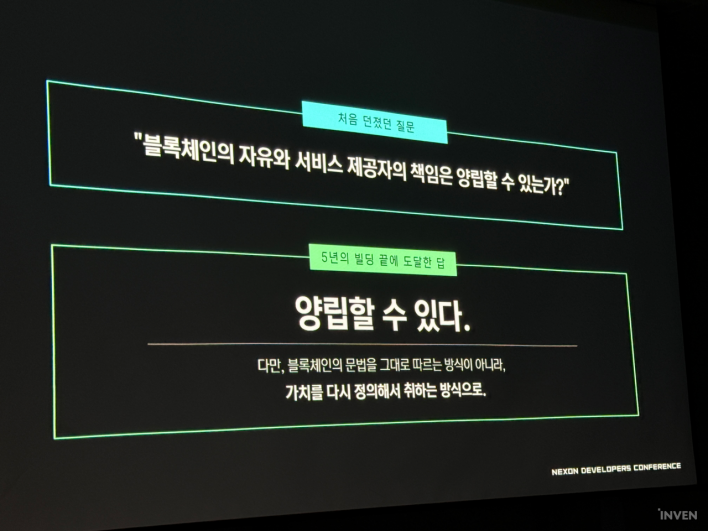
Ryu summarized the last five years of building in one sentence: "If you try to follow the grammar of blockchain as it is, it will inevitably clash with the service provider's responsibility to protect users." Nevertheless, he saw the value of freedom and expansion provided by blockchain as irreplaceable in the user and creator ecosystem.
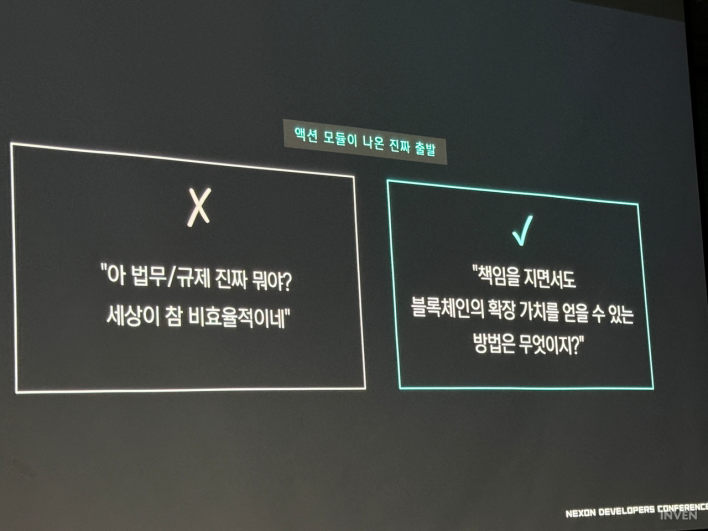
At the same time, he pointed out a trap that Web3 projects easily fall into. We should not simply dismiss Web2 regulations and procedures as 'inefficient'; we must find ways to gain the expansion value of blockchain while taking advantage of the legal and institutional benefits that Web2 possesses. He added that recent successive hacking cases also stemmed from areas that were previously ignored because they were considered inefficient.
His answer to the question he posed at the beginning, 'Can blockchain's freedom and a service provider's responsibility coexist?' was "Yes, they can." However, not by following the grammar of blockchain as it is, but by redefining its value and adopting it accordingly.
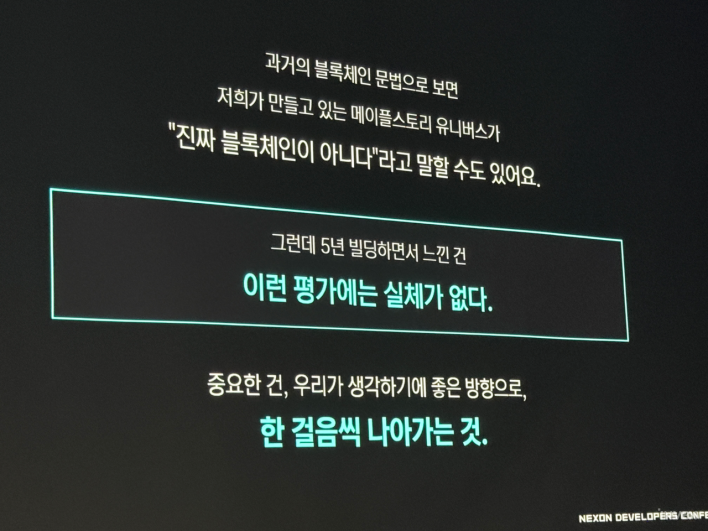
In closing, Ryu said, "If you look at it through the grammar of the past, some might say the MapleStory Universe we built is 'not a real blockchain,' but such evaluations have no substance." He ended his presentation by saying, "What matters is moving forward step by step in a direction we believe is better."
![]()
- Kyuman "Frann" Kim
- Email : frann@inven.co.kr




Sort by:
Comments :0