


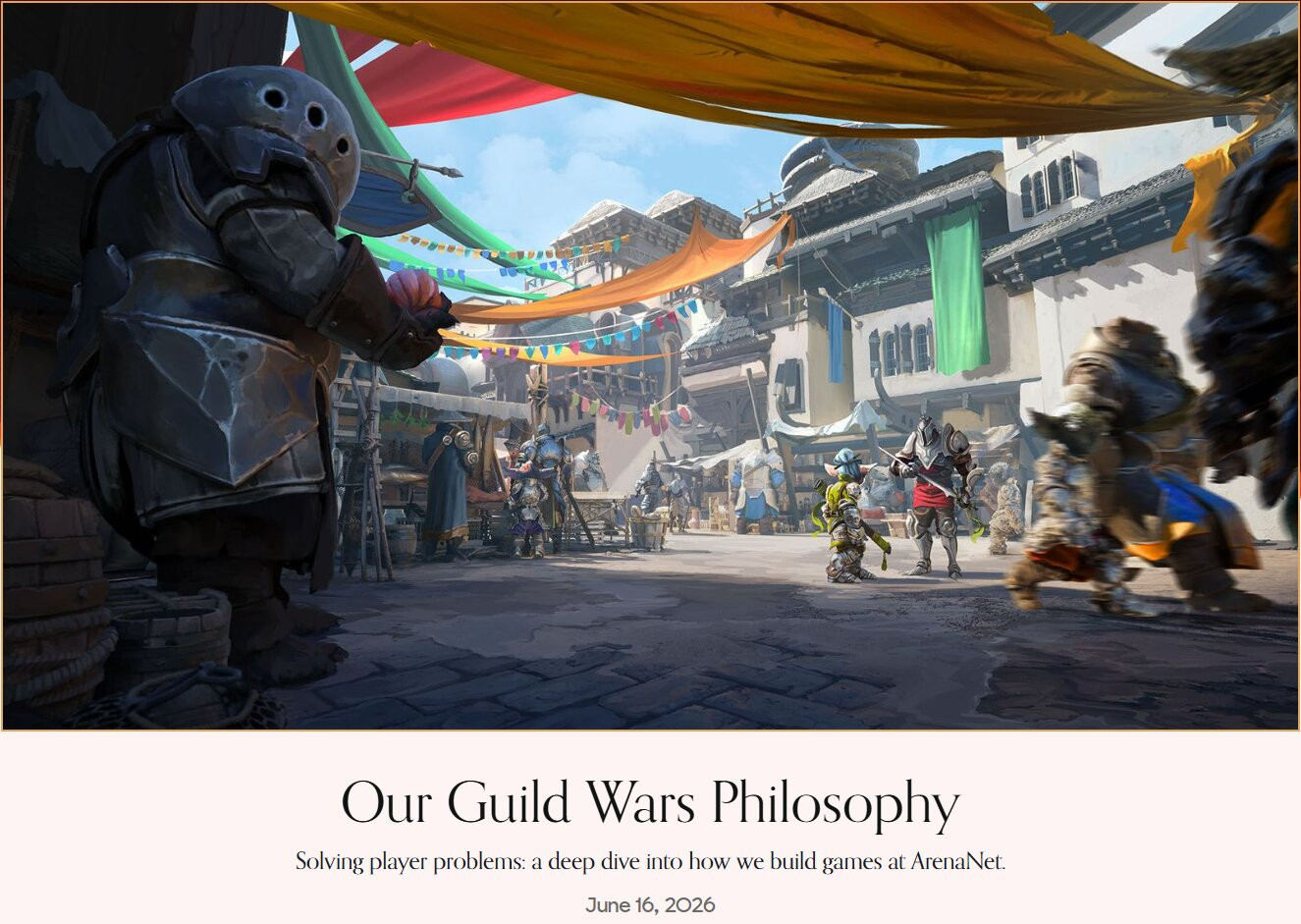
ArenaNet has released a developer blog outlining the development direction for its upcoming title, 'Guild Wars 3.'
On the 16th (local time), ArenaNet Studio Director Colin Johanson shared updates on Guild Wars 3 via the official website, introducing the development philosophy that has guided the studio over the past 21 years. He stated that in creating Guild Wars 3, they moved away from the question of "what a sequel should look like" and instead started from the "fundamental philosophy that defines how ArenaNet makes games."
According to Johanson, ArenaNet's development philosophy is relatively simple: when creating a new game, they examine the current state of the genre—including its strengths and weaknesses—identify the problems, frustrations, and limitations players face, and then ask, "How can we solve this?" He explained how this approach is being applied to the four core pillars that have defined the Guild Wars series.
1. No Subscription Fees: "Battle Passes Are Just Another Form of Subscription"
Director Johansson identified 'no subscription fees' as his first core philosophy. He explained that when Guild Wars launched in 2005, subscription fees were the standard model for MMOs, and the decision to forgo them was not merely a pricing policy, but a declaration regarding accessibility and long-term value. He firmly stated that Guild Wars 3 will also follow a buy-to-play model at launch, with no subscription fees.
However, he noted that simply saying "no subscription fees" is not enough. After examining modern MMOs and live-service games, he observed that subscription fees haven't disappeared; they have simply changed form. He criticized systems like paid battle passes and seasonal tracks as "new forms of recurring charges," arguing that they are "hidden behind the clean packaging of being "optional," masking the reality of a subscription fee from the player."
Consequently, he emphasized that Guild Wars 3 will feature neither monthly subscription fees nor battle pass subscriptions. The policy is that once players purchase the game, they can enjoy it whenever they like, and if ArenaNet earns the players' trust, they will offer separate products worth investing in, such as expansion packs.
2. Naturally, No Pay-to-Win
The second pillar is the exclusion of 'pay-to-win' mechanics. Johanson stated that the position they held before the launch of Guild Wars 2 remains valid today.
He believes players should be able to spend money on items for visual differentiation and self-expression, account services, and convenience items that save time. However, he drew a firm line, stating that it is unacceptable in Guild Wars for a player who spends money to gain an unfair advantage over a player who invests their time.
3. Respecting Player Time and Investment: The Return of the 'Hall of Monuments'
The third philosophy is to respect the player's time and investment. Director Johansson pointed out that MMOs have often been perceived as a genre that demands a massive time commitment, much like a 'second job.' He noted that if a player only has 30 minutes, they often spend the entire time managing their inventory, selecting content, and setting up their character, leaving no time to actually play the game.
He emphasized that since players today have more choices than ever, it is the developer's responsibility not just to create content, but to ensure that the time spent in the game feels meaningful. Whether playing daily, for an hour or two a week, or returning after a long break, players should feel satisfied with the time they have invested.
For existing fans, he revisited the previously announced 'Hall of Monuments.' He explained that this system will link Guild Wars 2 and Guild Wars 3 accounts to provide various rewards, serving as a gesture of gratitude for the time and investment players have poured into the series. Specific details on the time-respecting systems will be revealed later.
4. Innovation and Evolution of the MMORPG Genre
The final pillar is the innovation and evolution of the genre. Johanson emphasized that ArenaNet is not aiming for a direct sequel. The fact that Guild Wars and Guild Wars 2 share the same universe yet are completely different games was intentional, as each title challenged the conventions of its time, solved the problems players faced in that era, and attempted something new.
He observed that the MMO landscape today is different from the past. Player expectations have shifted, technology has advanced, the boundaries between MMOs and live-service games have blurred, and as game libraries have grown, the time available to dedicate to a single game has actually decreased. Therefore, rather than simply extending existing results, they asked, "What is the next evolution of the MMO at this point in time."
As a result, Guild Wars 3 is expected to be a unique game that stands apart from the studio's previous two titles. Johanson explained that ArenaNet's two existing games sit at opposite ends of the MMORPG spectrum.
First, 'Guild Wars Reforged' is a game where small teams—consisting of the player and henchmen, hero NPCs, or other players—tackle challenges primarily in instanced environments. Unless directly invited, players do not see others outside of social hubs. He added an anecdote that while they marketed it as a 'CORPG (Cooperative Online RPG)' at launch, the branding didn't stick; everyone called it a MMORPG, and it even won several MMO of the Year awards. Ultimately, they accepted the assessment that it was a unique form of MMORPG.
On the other end, Guild Wars 2 focuses on large-scale experiences in a vast open world. Examples include massive world boss battles, map-wide meta-events, and large-scale PVP. Unlike other major MMOs, it lacks servers or world concepts that limit which players you can meet; instead, it uses a megaserver system to configure maps so that players connected in the same region can enjoy the game together.
Guild Wars 3 will be positioned in the middle of this spectrum, which aligns with the movement and combat system goals ArenaNet is aiming for. While it will be much closer to a MMORPG than Guild Wars Reforged, it will not attempt to replicate the large-scale gameplay that defines Guild Wars 2. The vision is for the three games to coexist as distinct experiences, each telling different stories in the world of Tyria across different time periods.
Johanson acknowledged that the current explanation is intentionally broad and vague, noting that as there is a long journey ahead until launch, they will gradually reveal specific details about various game systems and content.
Johanson summarized that these four pillars form the foundation for the game's overall direction. He emphasized that they will return to these principles whenever they introduce the game in more detail, and that player feedback will be a major pillar of that process. "We only know our solutions work when the players tell us they do."
Finally, he stated that Guild Wars has always been a conversation between developers and the community, and that this will not change with Guild Wars 3. ArenaNet has invited player participation through their newly opened official Guild Wars community Discord server and social media channels.


Sort by:
Comments :0