


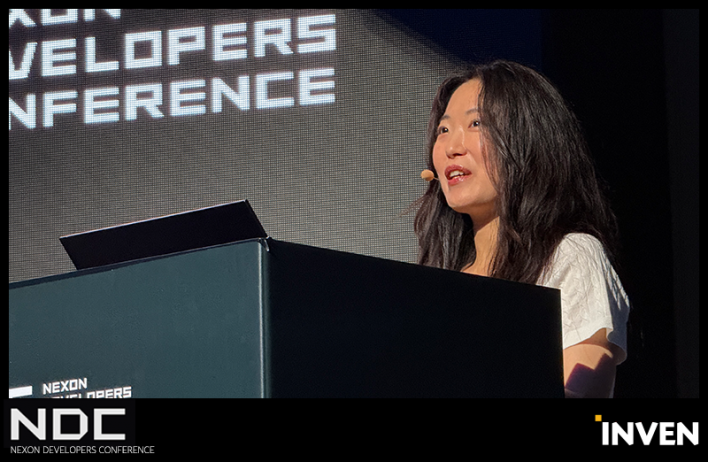
Topic: Oops, My Finger Slipped and I Skipped It: A 'Mabinogi Mobile' Main Quest Production Diary for the Short-Form Era Speakers: Kim Hye-jin, Jo Seol-bin - Team Leads at devCAT Category: Game Design Recommended for: Those looking for insights on mobile storytelling, IP reinterpretation, immersion design, and information delivery in the short-form era, as well as those interested in translating text-based narratives into actual gameplay experiences (quests)
Tags: #NDC26 #Quest #Story #MabinogiMobile
[🚨 Presentation Topic] In this session, two teams share their collaborative process of turning stories into gameplay experiences, illustrated with real production cases. We candidly discuss how we designed and evolved mobile MMORPG narratives within the content consumption environment of the short-form era, along with the insights and trial-and-error we encountered along the way.
In the era of short-form content, where the way people consume stories has changed, how should a mobile MMORPG—which requires players to follow a long, continuous narrative—deliver its story.
At NDC 2026, devCAT’s Cho Seol-bin (Story Team) and Kim Hye-jin (Narrative Production Team) tackled this question head-on. Their session was titled, 'Oops, My Hand Slipped and I Skipped It.'
The two explained how they tackled the difficult challenge of creating a story that people want to watch until the end, even when a skip button is available, using the actual production of 'Mabinogi Mobile' main quests as a case study. This is also why the Story Team, which designs the world and narrative, and the Narrative Production Team, which implements those intentions into gameplay, took the stage together.
The Era of 47-Second Attention Spans... "From Stories That Are Read to Stories That Are Experienced"
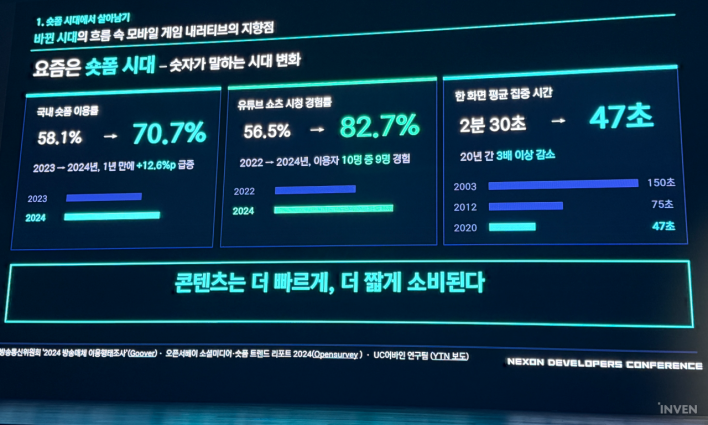
Jo Seol-bin began by addressing 'surviving in the short-form era.' People who do not watch short-form videos—videos under one minute—are now in the minority. As of 2024, the domestic usage rate for short-form content reached approximately 77%, and YouTube Shorts boasts a 82.7% usage rate, meaning over 8 out of 10 people watch them. The average human attention span is now 47 seconds, having shrunk more than threefold in 20 years. Content is being consumed faster and in shorter bursts.
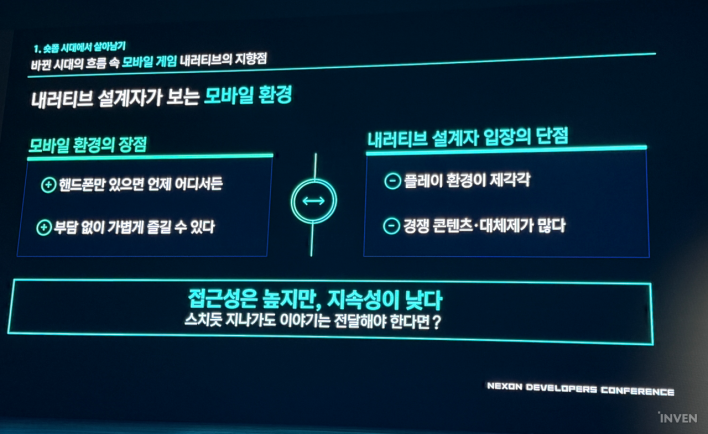
The problem lies in the double-edged nature of the mobile platform. While high accessibility—the ability to enjoy games anywhere with just a phone—is a strength, it becomes a disadvantage for storytelling. Play environments vary from person to person, and the same screen is filled with competing content like short-form videos, social media, and other games, making it very easy for players to drop off.
Jo diagnosed the situation: "Mobile has high accessibility but low retention, so stories often pass by like a fleeting glance." devCAT's conclusion was clear: stories must be made 'experiential.' They aimed for stories that are easy to read yet rich in content, and further, for that content to become the gameplay itself—moving away from stories that wait to be read toward stories that are woven into the experience.
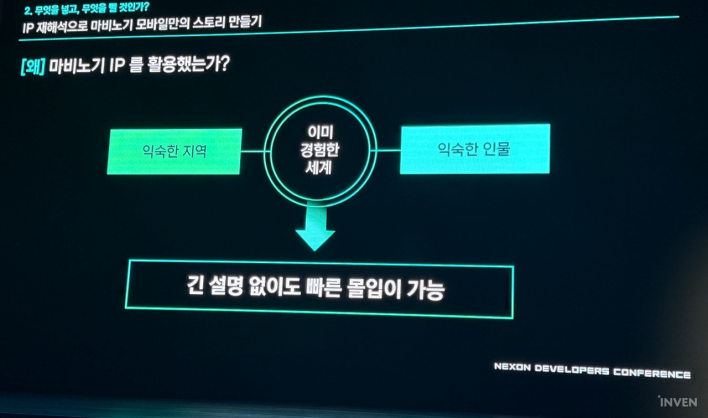
The next question was, 'What to include and what to exclude?' The primary goal for Mabinogi Mobile was summarized in one line: "Maintain the grand framework of the Mabinogi world, but show a new story unique to mobile."
Jo cited 'time' as the reason for this direction. In the short-form era, there is no time for long explanations, so the power of an already known world—the IP—is crucial. She described an "IP as data stored through experience." When people encounter something familiar, they understand and immerse themselves quickly without needing long explanations. However, since everything being identical would lack novelty and kill interest, they had to layer a new mobile-exclusive story over the familiar world.
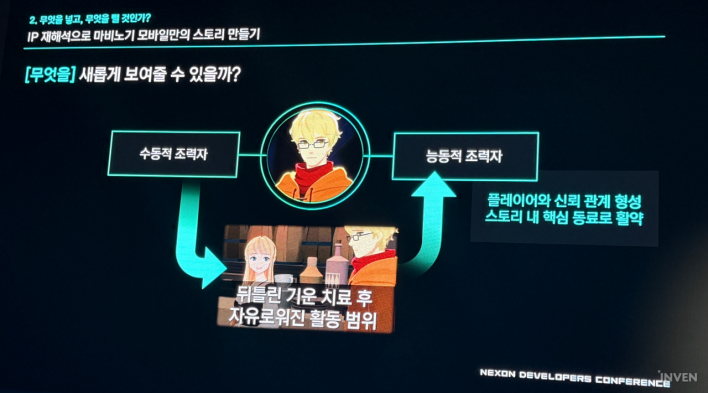
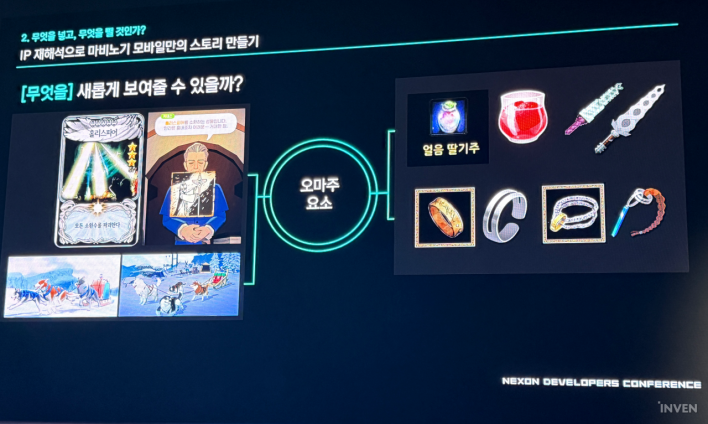
That 'novelty' was found in new roles and relationships for characters. For example, Tarlach, who remained a passive helper in the original Mabinogi due to physical limitations, overcomes those limits in the mobile version with the help of characters from Mabinogi Heroes, acting proactively; this change creates new relationships and events. Furthermore, they recreated and integrated scenes, settings, and items from related titles like Mabinogi Duel, Husky Express, and Mabinogi Heroes to provide a sense of familiarity mixed with fresh excitement.
"Not what to add, but what to subtract"... 18-character speech bubbles and the 'Asmodian'
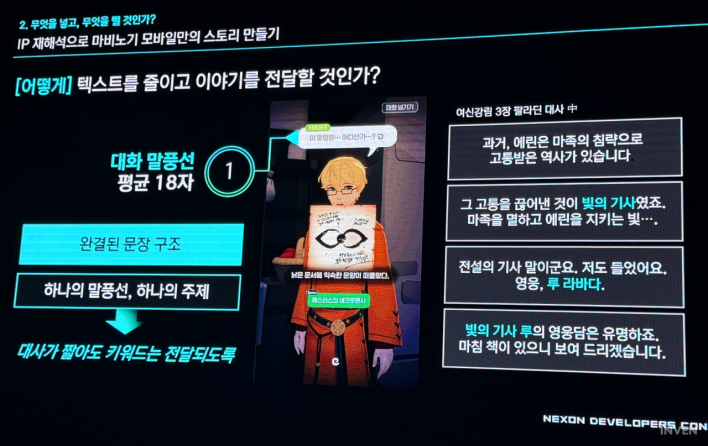
The starting point for the delivery method was the same concern. Mobile has high churn rates and, above all, small screens that make long explanations difficult. Therefore, the most important question was, "Not what to add, but what to subtract." devCAT began by reducing the character count and the amount of information in the text.
For character counts, NPC dialogue bubbles were written to average 18 characters, never exceeding two lines. The key was not just writing short, but ensuring the content was conveyed despite the brevity. They structured each bubble to complete a single topic and goal, so that even if a player stopped playing and resumed later, they would know what the conversation was about. They also utilized button text in the dialogue window to skip known information and move quickly to the next part, and used choices to give players a sense of direct participation during moments requiring immersion. Instead of long explanations, they actively used single images to convey situations, supported by short messages at the bottom of the screen.
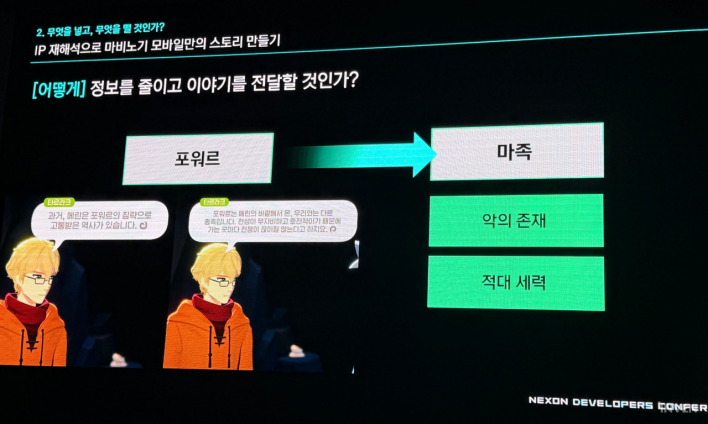
When reducing the amount of information, the first thing they looked at was the target audience. Mabinogi Mobile aimed to be a game that anyone—regardless of age, gender, or familiarity with games or fantasy—could immerse themselves in without pressure. Thus, they reduced elements that raised the barrier to entry for the world-building. A prime example is proper nouns.
Jo asked the audience if they knew the Celtic mythological race name 'Fomor,' and few raised their hands. However, when she changed it to 'Asmodian,' many more hands went up. She explained, "When you say 'Asmodian,' people immediately guess they are 'a force opposing us' without needing a long explanation."
In the same way, they replaced difficult names with intuitive expressions, such as changing the proper noun 'Lia Fail' to 'Ancient Wisdom' and 'Adamantium' to 'Unbreakable Ore.' By lowering the difficulty of information, they aimed to reduce issues where the story drags or learning fatigue accumulates by skipping explanations and getting straight to the point.
Walking the tightrope between immersion and tempo: The 'selective' Paladin chapter
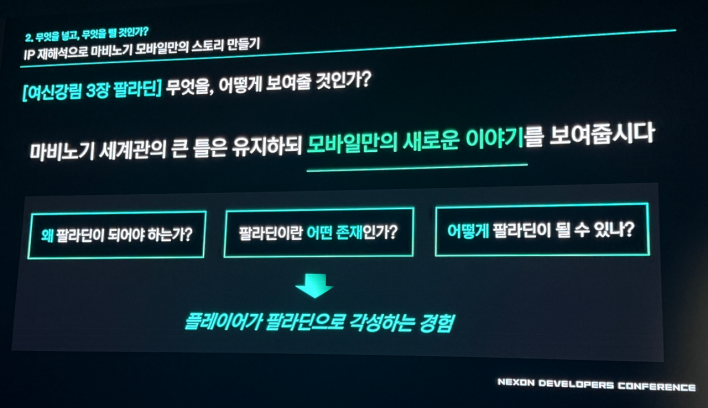
A case where these principles were applied is the Paladin chapter of 'Goddess' Descent Chapter 3.' According to the speakers, this chapter had an unusually large amount of information to convey. Major events followed one after another, from why one joins the Order of Knights to life in the Order, reasons for leaving, encounters with spirits, trials, blessings, and conflicts with key figures.
Since they couldn't explain all of this in detail on mobile, devCAT prioritized the 'core experience.' The core of Chapter 3 was 'why the player must become a Paladin, what a Paladin is, and how one can become one.' Therefore, they centered the experience on the player's awakening as a Paladin and trimmed away elements that strayed from that focus.
For instance, the collusion and conspiracies between political factions and the Order of Knights, which were treated in detail in the early parts, were not explained in one long sequence but were scattered in short, frequent bursts to increase exposure. The 'love story between a spirit and a human,' which was off the main path, was omitted, along with episodes about finding an ideal partner or crafting armor.
Instead, they focused on the flow of the player thinking, choosing, and finding the answer to 'What is a Knight of Light?' The new Order of Knights colleagues also took on roles of supporting and cheering for the player rather than just being information dispensers, allowing the player to feel greater achievement and reward when they finally reached awakening in the finale.
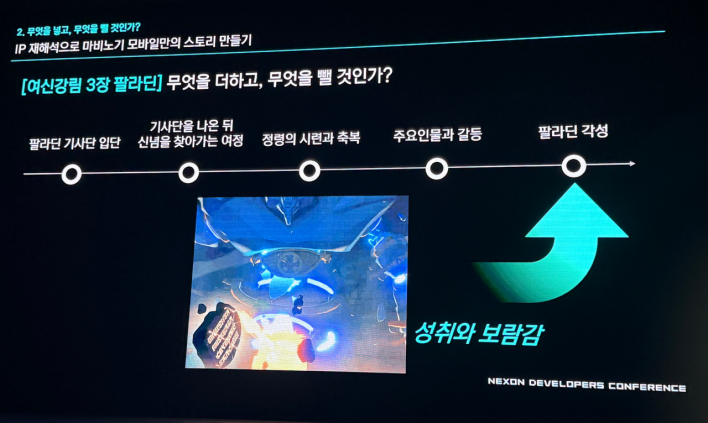
However, adding something always means subtracting something else. Event-driven progression increases play tempo but reduces exposition, weakening immersion in character emotions and the world. Conversely, strengthening probability and emotional arcs slows the tempo and disperses player attention, risking the player being relegated to a 'bystander rather than the protagonist.' Jo stated, "Ultimately, mobile storytelling was a task of constantly adjusting the balance between immersion and tempo."
Therefore, devCAT looked beyond limited text to find ways to make players experience the story without characters speaking directly. The first method was optional books/letters/item cards. Explaining the Knight of Light in NPC dialogue required 7 taps just to skip, but putting the same content in a book ended the conversation with a single bubble. This systematically dispersed long explanations and prevented conversations from dragging. However, they avoided structures where reading books was mandatory to understand the story, keeping them as auxiliary devices to enrich the world.
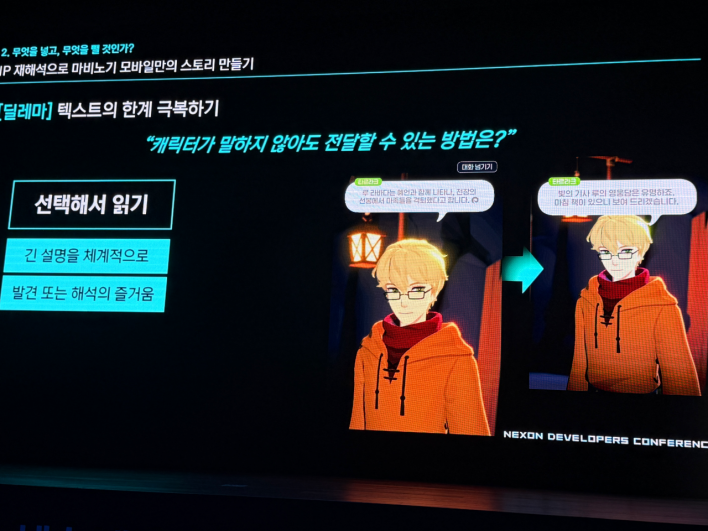
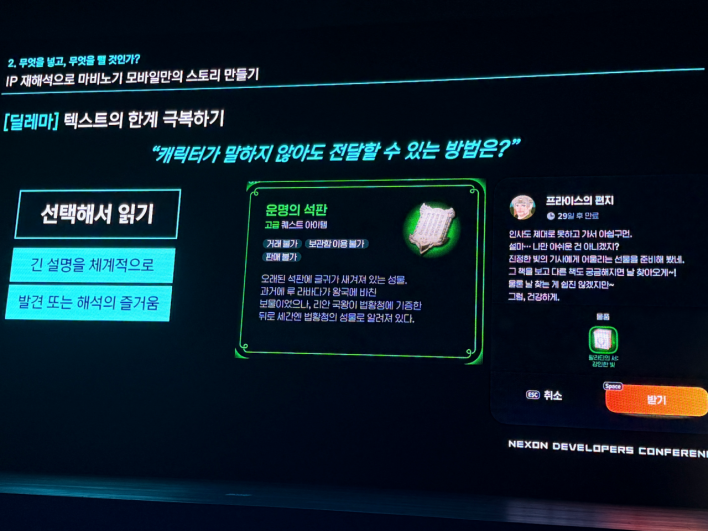
The second is the background. Through props that decorate the space and interaction points placed throughout, they indirectly conveyed the story of the space and provided the fun of exploration. This, too, was not a mandatory progression element, so those who didn't want to see more could simply pass by.
The third is audiovisual elements like sound and animation. They conveyed situations and emotions richly through NPC expressions, movements, and voices; supplemented immersion and tempo with cutscenes when dialogue alone was difficult; and allowed players to feel the atmosphere through BGM suited to the space.
Jo summarized that "the important thing is not to make everyone read all the information, but to design it so they can choose," aiming to let players experience the story in their own way by providing detailed settings for those who want to know more, while allowing those who don't to still understand the main context.
Turning text into play... 'Three axes' that leave an impression even when short'
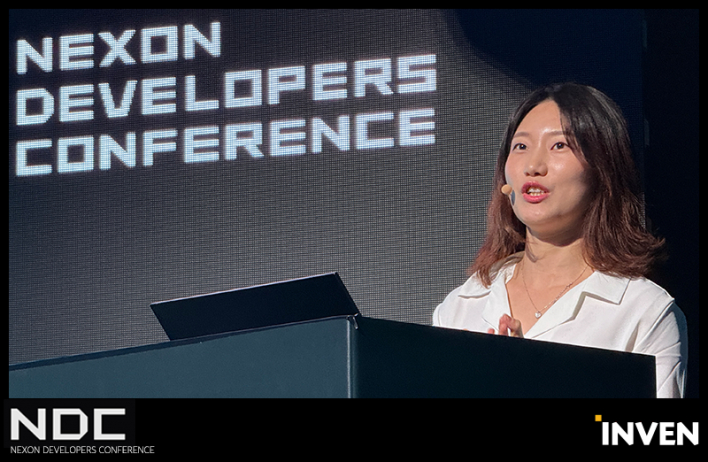
Kim Hye-jin took over to explain how this refined story was turned into play to become an 'experience.' The Narrative Production Team works to turn written stories into 'play sequences'—the flow that players experience directly. This is because gaps that were not visible in text only become apparent when moved into gameplay.
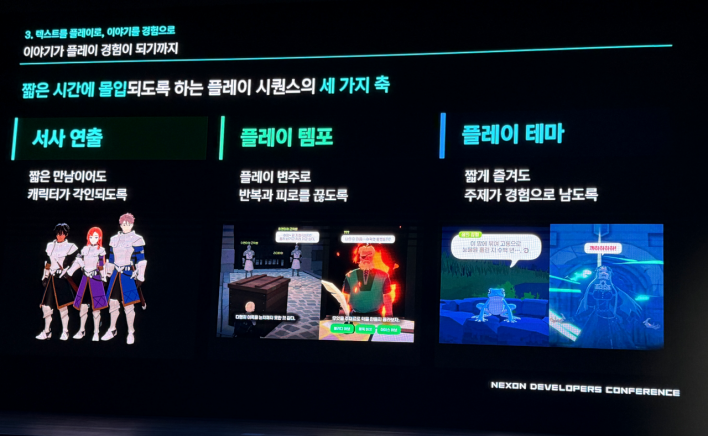
Kim summarized the answer to creating immersive play in a short time into three axes: 'Narrative Direction' to fill the gaps in progression so characters leave an impression even in short encounters, 'Play Tempo' to break boredom by planting variations in repetitive sections, and 'Play Theme' to design gameplay that fits the chapter's subject.
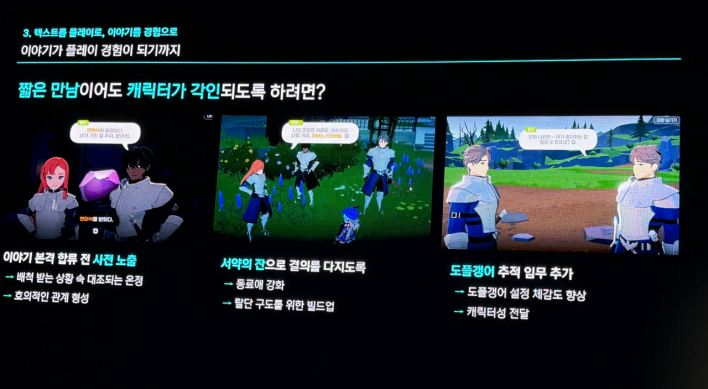
An example of narrative direction was again the Paladin Order colleagues. During the implementation process, two weaknesses appeared: the time to interact with the members was too short, giving the impression of parting before getting attached, and the threat of the 'Doppelganger,' who deceives those around them by taking on others' appearances, did not directly resonate with the player.
To compensate, devCAT added three sequences: a scene where the player briefly encounters the members before they officially join to build affinity in advance, the 'Cup of Vow' sequence where they share a drink to solidify their resolve (the same composition was used in the later farewell scene to connect the emotional arc), and a tracking mission where the player directly chases the Doppelganger, who was previously only mentioned in dialogue. The direction for all three was the same: instead of explaining the narrative at length, make it a direct experience, however short.
The most guarded aspect of the second axis, play tempo, was 'repetition.' Due to the nature of mobile games, short sequences are repeated frequently; if the same method of play is repeated even if the content is different, the player quickly learns the pattern. The moment the next action becomes predictable, anticipation drops. Therefore, devCAT chose 'play variation'—making the same format feel different—as the answer. Even if the same choices appear, a choice based on inferring the situation from clues and a choice based on intuitively matching patterns are felt as completely different experiences.
There were three design principles for variation sequences: provide an experience different from the existing one, make the player participate directly rather than just watching, and minimize the burden of failure. Based on this, they defined three types: 'Manual Operation' where concentration increases during direct control but safety devices are in place to skip after repeated failures; 'Minigame' which conveys the world and sense of life, can be passed freely without failure, and gives small rewards for a perfect score; and 'Unique Direction' that provides freshness with unexpected moments. They inserted these three appropriately into every repetitive section to provide new experiences and refresh the tempo, even if short.
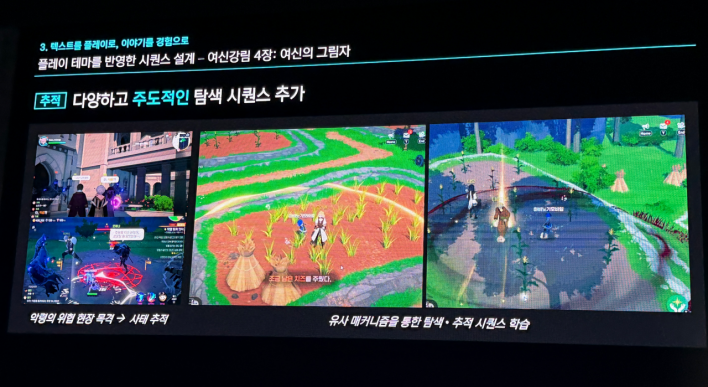
The third axis is the play theme. It started from the idea that if you can't rely on text explanations, the gameplay itself must become the story. devCAT set core play keywords for each chapter. Chapter 3 was 'Choice,' Chapter 4 was 'Tracking,' and the Chapter 4 side story was 'Purification.' In the choice theme, they utilized the momentary concentration that occurs when a player naturally pauses to select an option to draw them into the story.
In Chapter 4, the tracking theme, they made the player the subject chasing the event. To do this, a motive to move actively was needed, so devCAT showed the Goddess Morrighan missing at the beginning of Chapter 4 in the place where the player always met her. Although it was originally a twist scene for the latter half, it was rearranged to the beginning to create a tracking motive. The moment the familiar progression is broken, the player naturally thinks, "Huh, what's this?" and at that moment, tracking begins without explanation.
Afterward, by witnessing the scene of the threat directly, chasing the truth, and finding the way to the Goddess themselves, they became a 'tracking player' rather than a 'person following along.' In the purification theme of the Chapter 4 side story, they consistently featured an item called the 'Sword of the Soul' from tombstone reinforcement to the final battle, allowing the meaning of 'tool of purification' to accumulate naturally through repeated play rather than explanation.
"Not a refresh, but a context break": Lessons left by variation and 'choices without answers''
Kim also candidly shared what effects this design actually had. The narrative direction side was successful. From Chapter 3, where the sequence was reflected, reactions expressing anticipation for the next story increased, and affinity for new characters was formed. The narrative was delivered through play, and that experience led to anticipation for the next story.
On the other hand, for play tempo, not all variations worked as intended. While there were positive reactions to the new play itself, there was also feedback that the flow was broken when the play switched at a moment of heightened tension.
The point Kim particularly noted was that "if the intention of why this play is inserted now is not sufficiently conveyed, it is read as a context break, not a refresh." The lesson learned here was clear: at moments of high narrative tension, maintaining immersion must take priority over short refreshes. Since then, they have been designing more carefully, considering both reducing repetition fatigue and the balance of narrative flow.
Among the play themes, the one that had the most impressive effect was the choice theme. The key was presenting 'dilemma choices with no right answer.' They made players actually ponder by reflecting their own tendencies and values, and prepared paths where rewards could be obtained in other branches so that a specific choice would not solidify as the 'correct' one.
As a result, voluntary discussions broke out among players regarding sequences where the experience and flow changed depending on the choice, and reactions of discovering reward motives on their own also appeared. Choices without answers did not end in simple consumption but expanded into voluntary discussion and replay.
Expanding and shrinking again, "Deciding the size of the story vessel first"
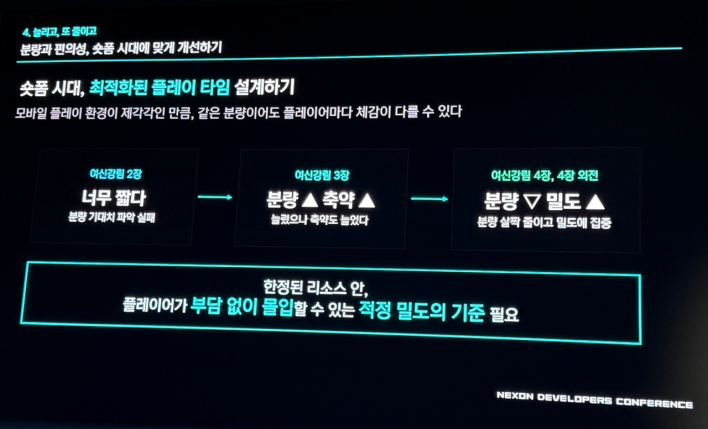
The discussion continued on length and convenience, broadening the view to the entire chapter. devCAT examined feedback from previous chapters. Chapter 2, which was centered on character introductions, received many reactions that it was "too short," so they increased the length of Chapter 3, but this time, feedback returned that it "lacked probability" due to excessive compression.
So, from Chapter 3 onwards, instead of just reducing the length, they focused on flow and probability. As content consumption becomes shorter and play environments vary, the same length is felt differently. While increasing both length and density is ideal, it was not easy with limited resources, so devCAT decided to find a 'standard for appropriate density' first, rather than 'as much as possible.'
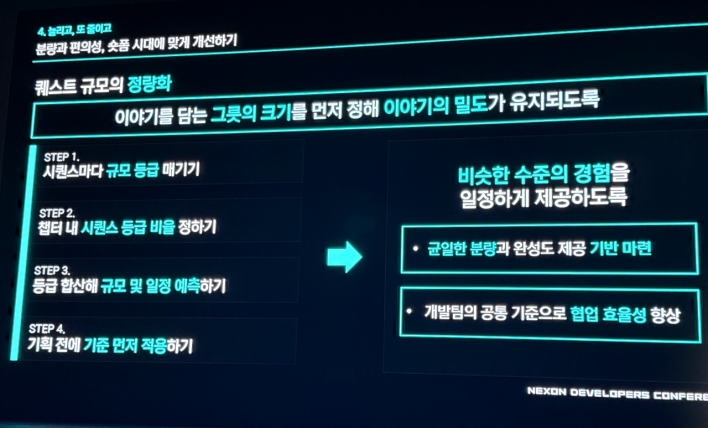
They also flipped the approach. Instead of deciding the length according to the scale of the story, they decided the length—the 'size of the story vessel'—first and designed it densely within that. To do this, they classified all previously created play sequences into grades, including direction scale, production difficulty, and time required, and set standards for what ratio of each grade to compose for each chapter. Applying this standard from the planning stage allowed them to design densely with the upper limit of the story set from the beginning; the variance in experience quality per chapter decreased, and common standards within the development team were established, increasing collaboration efficiency.
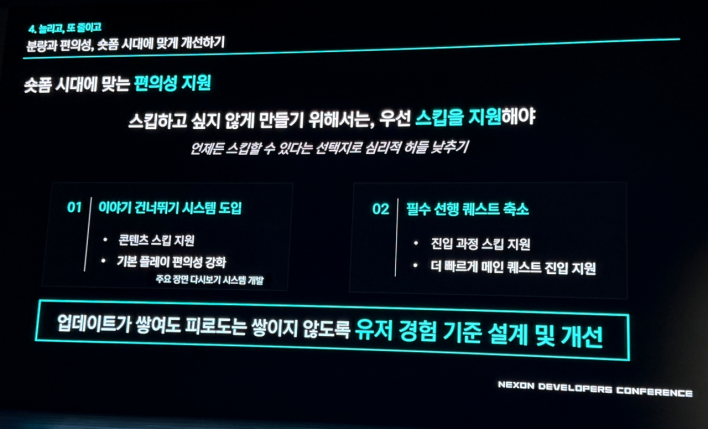
The final concern was convenience. In live services, content burden accumulates as updates pile up, and wanting to skip that burden is a natural reaction.
devCAT chose a counter-intuitive approach. "To make people not want to skip, you must first support skipping." The intention is to lower psychological burden with the option that one can skip at any time. Accordingly, they introduced a story-skipping system to strengthen basic convenience and reduced mandatory pre-requisite quests to lower the entry burden for new users. At the same time, they are developing a 'Replay Major Scenes' feature to view content missed by skipping.
"So that the story continues even if your finger slips"
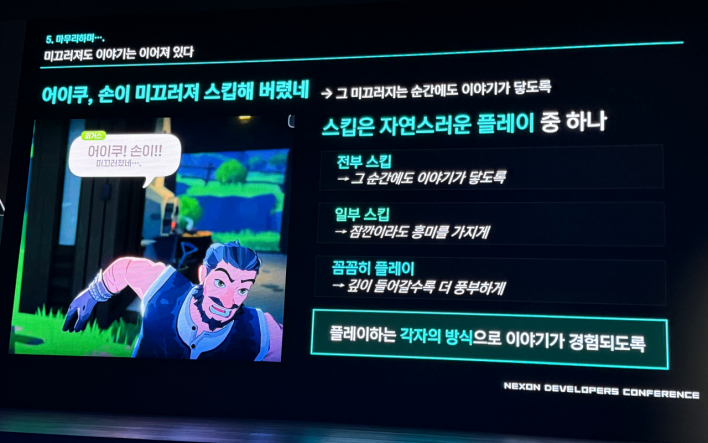
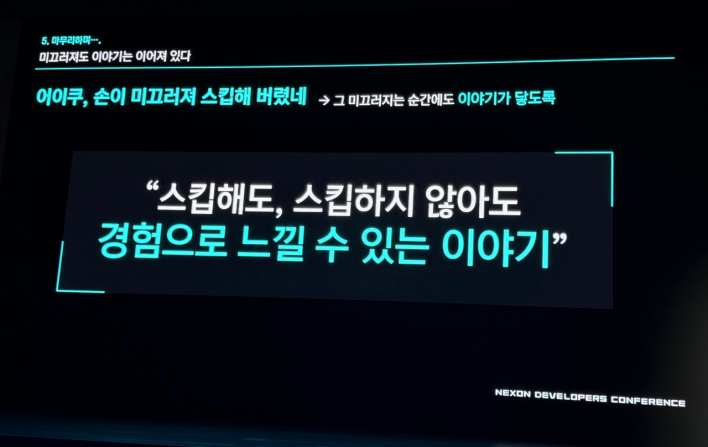
Jo took over for the conclusion. She chose "the story continues even if you slip" as the message she wanted to convey through this presentation. In this era, skipping is one of the natural ways to play in itself, and they wanted to make it so that players who skip everything, players who skip only some, and players who don't skip at all can all experience the story in their own way.
She added, "If the story reached you even in the moment you skipped, you might become interested for a moment, not want to skip at that moment, look it up later, and eventually become even more deeply immersed." Finally, Jo ended the presentation by saying, "I hope this presentation today was able to make your fingers stop for a moment."
![]()
- Kyuman "Frann" Kim
- Email : frann@inven.co.kr






Sort by:
Comments :0