


In the past, a game marketer’s job was akin to repetitive, manual labor: planning and creating ad assets from scratch, setting them up individually across every media channel, and monitoring performance. However, as generative AI and Agentic AI rapidly automate these processes, the marketer’s role is shifting from 'executor' to 'strategist who determines what to do and designs the direction.' The race to create more assets faster has reached its limit; now, the ability to accurately measure why certain assets work and to make informed decisions is becoming far more critical.
Appier is at the forefront of this transformation. Since its founding in 2012, the company has grown as an AI-native Agentic AI as a Service (AaaS) provider, with a name that combines 'AI' and 'Happier'—reflecting its vision of a world where everyone is happier with AI.
At the 'Game UA 2026' seminar on June 4, Appier introduced its 'Creative Intelligence Loop,' which leverages its Agentic AI capabilities. The structure creates a virtuous cycle: when a client inputs video assets, the AI learns from the campaign data to generate new assets, executes them as actual ads, and then autonomously learns from real-time performance to optimize future results.
Following the seminar, INVEN met with two general managers from Appier Korea—Lee Bo-hyeok, GM of Ad Cloud Solution Sales, and Park Sun-gyo, GM of Account Management—to discuss Creative Intelligence and the future of marketers in the AI era.

To start, could you introduce yourselves and share your perspective on the current state of AI, given that your company has been working with it since the early days.
Lee Bo-hyeok - I oversee sales at Appier Korea and have been with the company for about eight years. I joined when we were starting our ad business and have been here through the launch of our CRM solutions, witnessing Appier’s growth firsthand.
Appier helps clients achieve their KPIs through AI. Our CEO, Chih-Han Yu, comes from a background in autonomous driving research, so we have integrated AI into everything—from ads to CRM—from the very beginning. The biggest change is that while AI used to work invisibly in the background, such as in campaign optimization, generative AI now allows us to create ad assets directly and show them to clients. In a sense, the 'invisible' AI has now emerged to help automate client workflows.
Park Sun-gyo - I’ve been with Appier for about two and a half years, having previously worked at an advertising agency. Initially, I led the Korean operations team, handling ad optimization, asset planning, and performance analysis. Since June of last year, I’ve also been managing the U.S. and European regions, sharing successful cases with our global team and applying international best practices to the domestic market.
Developers I’ve interviewed recently have complained about rising ad costs and creative fatigue. What changes are Korean game marketers experiencing, and are there any unique characteristics in the Korean market compared to the global landscape?
Park Sun-gyo - The biggest difference is that Korean marketers invest significantly more time and effort into the creative process itself. They dive deep into planning, design, production, and the post-mortem analysis of which assets performed well. In contrast, while global markets value assets, they place more emphasis on how to better utilize and maximize media channels and whether those channels are truly effective. One side focuses on the creative, while the other focuses on operations tailored to media characteristics.
Lee Bo-hyeok - Preferred genres also vary by region. Korea has a strong preference for MMORPGs and idle/growth games, whereas global markets like the U.S. are dominated by match-3 and casual genres. Consequently, the way marketers plan their assets differs based on these genre preferences.
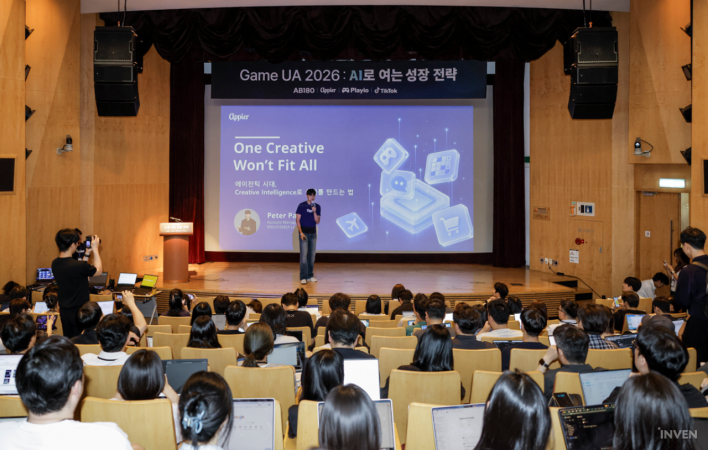
You mentioned global insights like MAU Las Vegas at the seminar. Are there areas where Korean game companies are lagging behind global trends?
Park Sun-gyo - It’s not so much that they are lagging, but rather that the Korean market is smaller than the U.S., so there are fewer media options to operate. While the Korean market tends to focus on optimizing a small number of channels, the global market tends to focus on incremental growth by utilizing a wider variety of channels.
Overseas, there is much more scrutiny on whether adding a new channel simply reaches the same users again or provides additional value. While Korea focuses on assets or user interest, the global market focuses on incremental effects. Leading domestic companies are already looking into this, and I expect mid-sized studios to follow suit.
Lee Bo-hyeok - Because the population and market size are larger abroad, there is a vast array of media channels. In Korea, performance-based UA media is concentrated on a few major platforms, and it is still rare to see active use of programmatic channels—a sentiment shared by both agencies and game companies.
Does the tendency of Korean gamers influence why Korean marketers focus so heavily on assets? Is the frequent use of celebrities in mobile game ads part of that.
Park Sun-gyo - Korean gamers love MMORPGs and place great importance on content elements like gacha systems. They care about whether those elements are well-integrated into the ad assets. Another key factor is 'social proof' or the sense of a 'major trend.' They want to know if a game is successful enough that their friends are playing it. Korean marketers spend a lot of time thinking about how to creatively convey that sense of trendiness and game content. The effective approach varies by genre: puzzle games focus on immersion through direct experience, while blockbusters highlight storylines or character appeal.
Lee Bo-hyeok - Because Korea values IP and blockbuster titles, hiring celebrities is effective. That is why foreign game companies almost always use celebrities when marketing in Korea.
Park Sun-gyo - That also ties into the sense of a 'major trend.' When a developer spends enough on ads to hire a celebrity, gamers perceive it as a signal that the company has high expectations for the game and will support it for a long time. That expectation of longevity gives them the confidence to invest (spend money) in the game.

In your lecture, you used the analogy that 'you wouldn't put Son Heung-min in goal' to emphasize the importance of differentiating assets by media. Have you seen actual performance differences between using one 'winning' asset across all media versus differentiating by channel?
Park Sun-gyo - We can certainly see the difference when clients provide assets. Some send the same sizes used on other platforms, while others create assets specifically for Appier. The market is still divided; some marketers prefer a broad strategy, while others apply insights from one channel directly to others.
Since the market is currently geared toward major media platforms, marketers' standards are set accordingly. However, platforms like Appier operate differently and require tailored assets to function well. To break that mold, we introduced a solution that automates asset planning and insight generation using AI-created content.
Could you explain the 'Creative Intelligence Loop' in more detail?
Park Sun-gyo - The first step is for the client to input their video assets into our system. The AI then reads the campaign data for those assets to identify which elements performed well and creates a first-generation AI asset based on that. We then run the actual ads and monitor performance metrics like CTR or CPI.
On another data axis, we analyze the elements within the video: length, presence of characters, color emphasis, and whether the storyline is character-driven or reward-driven. The core is to combine these campaign data and video element axes to score effectiveness and iteratively produce second and third-generation assets.
Many marketers are already doing this, but the key message is that if an agent does it for them, they can achieve similar or better efficiency with less time. The AI doesn't just create assets; it creates a 'Creative Intelligence Loop' where it autonomously learns from real-time performance to optimize, continuously improving within that loop to fit the brand.
At the Las Vegas roundtable, you shared the insight that 'the difference between high-performing teams is not better assets, but better measurement infrastructure.' How is this measurement actually carried out?
Park Sun-gyo - Back when I was at an agency, one of the things marketers spent the most time on was naming and labeling assets—for example, labeling a character intro video as 'CharIntro_CharName_30s' to extract insights.
While this can be done manually, the VLM (Visual Language Model) in our new solution does that work instead. Instead of humans manually extracting elements and stuffing them into filenames, they can leave that to the AI and focus on whether the results are accurate, if the methodology is sound, and how to improve.
For measurement to be valid, enough data must be accumulated to form a confidence interval. Therefore, the more marketers use the solution, the better the model becomes. The method is essentially A/B testing. The model continuously verifies in the backend whether performance improved specifically because of a certain element, while excluding other variables.
AI prioritizes and conducts tests that would take humans weeks or months, and it provides statistical confidence levels. Because we can see how things work based on actual campaign data, we get more reliable analysis. Our message is that when the excellent content capabilities of Korean marketers are combined with this precise measurement infrastructure, it creates even greater synergy.
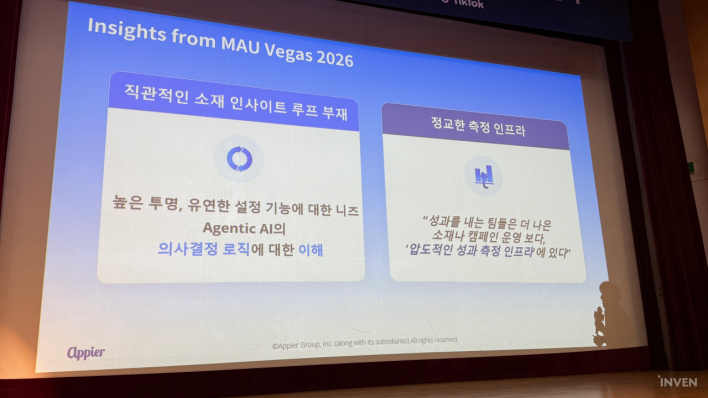
It was impressive to hear that even the timing of when the 'X' button or 'Play Game' button appears in an ad is a strategic decision. Could you elaborate.
Park Sun-gyo - People have different patterns and psychological triggers depending on the platform. The key is identifying when immersion is at its peak, which is usually when an action is required. On YouTube, it’s when the 'Skip' button appears; on our platforms, it’s when the 'X' or 'Close' button appears. Immersion rises at the moment the user is prompted to act.
You need to understand when to trigger that user action within the small mobile screen. That’s why I mentioned that for CTAs in the latter part of an ad, how long they are exposed is more important than just showing them. A common-sense understanding of how platforms are used allows for a more natural data-driven approach.
If AI learns brand assets to automatically generate content, how is quality control—such as brand tone and manner or guideline compliance—handled?
Park Sun-gyo - We ensure that all content is generated by passing through a base layer of brand guidelines, brand safety, and tone-and-manner rules provided by the client, so they don't have to worry about the basics. However, since it is AI, we have a three-stage verification process. First, manual human review; second, a semi-automated review where humans and AI work together to flag what needs human attention; and finally, once the process is sufficiently refined, fully AI/system-based verification.
Furthermore, we have a mechanism where all AI-generated assets are shown to the client for approval or rejection. Even if the AI creates the asset, the final decision rests with the human—the client and the marketer in charge. The act of approving or rejecting also becomes a learning signal. The loop continuously learns: it creates more of what is approved and becomes more cautious with types that are rejected.
Are there any creative intelligence elements specific to the game industry, as opposed to general advertising?
Park Sun-gyo#@:Game developers often aim for global expansion beyond just a Korean launch. Therefore, fast and precise localization is crucial. They must be sensitive not only to text copy but also to the story and content within the video to fit local markets. Our solution extracts the elements that make an asset work and suggests directions for second and third-generation production, which is particularly useful for game developers.
Recently, gamers have been feeling fatigued by low-quality AI-generated assets, exaggerated ads unrelated to the actual game, and indiscriminate ad exposure. Does the performance-driven, rapid mass-production of assets exacerbate this fatigue, and how do you balance short-term performance with accurately representing the game.
Park Sun-gyo - First of all, such assets are used because they actually work in the market. If people didn't react and it didn't lead to sales, they wouldn't be used. There is a proven data-driven aspect that taps into human psychology and drives conversions. However, I agree that an overabundance of such assets increases fatigue. That is why our solution includes a mechanism for marketers to decide for themselves whether or not to use those assets.
Also, interestingly, if there are too many AI assets, a counter-reaction can occur. The appreciation and bond for what feels "original," "creative," or "well-made by a human" may grow. This gives marketers a chance to think about original ideas among the assets the AI produces. Mass production isn't inherently bad; it’s a matter of how you utilize and control it.
Lee Bo-hyeok - Sometimes, if an ad using content unrelated to the game—so-called 'fake ads'—gets a good response, developers actually develop that content into real in-game features. In that sense, marketers are becoming more involved in game design, so it shouldn't be viewed solely in a negative light.
You mentioned that if AI reduces repetitive tasks, there is more time to invest in other work. In the AI era, what roles remain that only human marketers can—and should—perform?
Park Sun-gyo - As my role expanded from junior to senior and then to lead, I realized my work was shifting from execution to making better decisions. As AI agents become more sophisticated, the role of individual marketers will likely change in a similar way.
Basic operations and report writing will be left to AI, while the role of decision-making—deciding which campaigns to monitor, what results to look at, what proposals to make, and choosing between the options an agent provides—will grow. I also believe marketers will take on a 'tuning' role, maintaining and repairing agents to ensure they run well and inputting better data and signals.
Lee Bo-hyeok - AI struggles to grasp the vision or culture of a specific game studio. Determining the vision and goals for a title is a domain for marketers who understand the company culture. Marketers will increasingly focus on the big picture and overall context, and by offloading repetitive tasks to agents, they will have the breathing room to focus on those high-level tasks.
AI provides results based on data, but there are clearly aspects that data cannot capture. Synthesizing those elements to provide direction and guidelines is ultimately the job of the human marketer.
What is the biggest change Agentic AI will bring to game UA in the next 1–2 years, and what should Korean game companies prepare for?
Park Sun-gyo - In the next 1–2 years—or even starting next month—the role of team leaders will be to build an environment where team members can solve problems and experiment using AI. Using agents is becoming as common as using the internet. The important thing is whether the agent I created can interact with the agent my colleague created.
The key will be how to improve the efficiency of the entire team, not just individual tasks, and how team leaders design that infrastructure. Appier also operates multiple agents, and they must collaborate under the same goal to create synergy. If goals conflict, the system collapses.
Therefore, both individual and organizational capabilities are becoming important, and the ability to make agents interact under a single purpose will become more critical than just creating many agents.
Lee Bo-hyeok - I recently met a game company that produces 3–4 titles a month and has automated repetitive tasks like soft launches and asset/region settings across the company. When a new title is released, assets are automatically set up across various media, allowing them to quickly grasp performance and pivot immediately. Tasks that marketers used to do manually are now handled by agents, making them much more efficient.
As an aside, within Appier, we consider AI utilization so important that it accounts for about half of our KPIs. Our sales organization also uses a sales agent that analyzes client meetings to point out what went well and what needs improvement, and the accuracy is quite high.
Lastly, do you have any words for game marketers.
Lee Bo-hyeok - From a sales perspective, solution providers like us can cover areas that 'Walled Garden' media like Google and Meta cannot. Whether it’s in terms of assets or custom tuning tailored to KPIs, we are open, so I encourage you to test as many diverse media channels as possible.
Park Sun-gyo - In the same vein, please feel free to refer to your existing operational methods and experience, but I hope you will also consider Appier’s unique operational methods and optimization points. If you combine the experience our operations team has accumulated with the directions we propose, I believe we can achieve even better results.
![]()
- Kyuman "Frann" Kim
- Email : frann@inven.co.kr






Sort by:
Comments :0