


In June 2026, Apple’s annual developer conference, WWDC26, featured a special session that captured the gaming industry's attention. Polish game developer CD PROJEKT RED revealed the entire process of porting 'Cyberpunk 2077' to Mac. The speakers included Garrett Austin, an engineer from Apple’s Game Performance team, and Paweł Sasko, Associate Game Director at CD PROJEKT RED.
The presentation provided a detailed technical breakdown of the challenges the developers faced, the tools they employed, and the standards they set. While casual users might simply think, "The port turned out quite well," for developers, this was highly anticipated news. In reality, the Mac port of Cyberpunk 2077 was the result of an immense amount of preliminary research, design, and optimization.

💡 'Why Now for Mac' - The Maturation of Apple Silicon
The development team had clear criteria for deciding to port Cyberpunk 2077 to Mac. It wasn't just about expanding the platform; the primary question was whether they could guarantee a level of quality that they would be proud to put their name on.
Director Paweł Sasko explained, "CD PROJEKT has a long history with Apple platforms. We determined that the hardware performance of Apple Silicon has now evolved enough to run a game of 'Cyberpunk 2077's' caliber at high quality." They set three specific standards.
▲First, maintaining the game's visual identity. The unique lighting, materials, and overall visuals of Cyberpunk had to be represented at the same level as on other platforms. ▲Second, stable performance. The frame rate had to remain consistent even in scenes that stress both the CPU and GPU, such as crowds, traffic, and combat. ▲Third, a level of polish befitting the Mac platform. This meant providing a native experience that feels naturally integrated into the macOS environment, rather than a simple port.
'Cyberpunk 2077' is a notoriously demanding game. Night City processes crowds, traffic, AI, physics, animations, quests, and system interactions in parallel, with a significant portion of this load concentrated on the CPU. Graphically, scenes often feature neon, reflective surfaces, headlights, and volumetric lighting simultaneously, while also supporting advanced rendering modes like ray tracing and path tracing. The game required such high specs that even gamers who experienced its initial launch can immediately understand why it has been used as a benchmark game every time new hardware is released.
For this game to run properly on Mac, Apple Silicon had to mature to a point where it could handle that level of workload. The developers decided that the time was now.
🔍 Before Touching the Code - Preliminary Analysis Using the Game Porting Toolkit

The first step of the port was not code modification. CD PROJEKT RED’s approach was to use Apple’s 'Game Porting Toolkit (GPTK)' to run the Windows-based build in a macOS translation environment. The goal was not final performance metrics, but information gathering.
During this evaluation phase, the team used three parallel data sources: statistical frame time data from the engine's internal profiler, real-time rendering status via the Metal HUD, and CPU system profiling broken down by thread. They repeatedly executed pre-defined 'hotspot sequences'—specific high-load scenes within the game—to collect consistent data.
Several patterns emerged from the results. On high-end hardware, the GPU load was better than expected, suggesting that performance targets for a native Metal rendering pipeline were realistic. Conversely, in scenes dense with crowds and traffic, such as driving through the city, CPU load spiked significantly. The team immediately realized that CPU optimization would be the core challenge of the porting process.
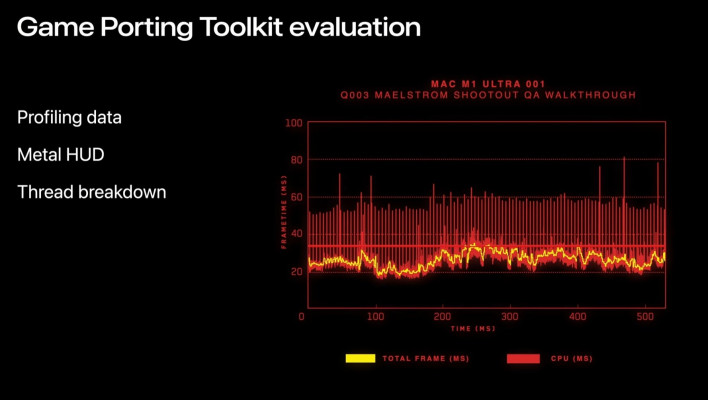
Two findings were particularly noteworthy. One was the irregular fluctuation in frame times caused by real-time shader translation, and the other was that the audio middleware consumed high resources in certain scenarios. Both issues stemmed from the nature of the translation environment itself and were resolved during the transition to a native binary. This case highlights the importance of the preliminary evaluation phase, as GPTK allowed them to identify these issues and plan their response before native development even began.
Based on this evaluation, the porting roadmap was solidified. There were four main stages: ① Setting Mac as a practical development target, ② implementing rendering and shader paths using the Metal API and Metal Shader Converter, ③ adding platform-native features, and ④ performance optimization and polishing.
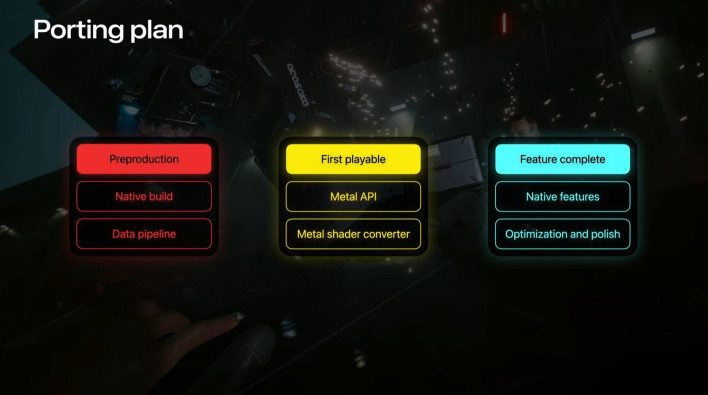
The first stage, 'making Mac a real target,' sounds simple but involved significant work. They had to generate native builds using the macOS toolchain and reconfigure not only the game executable but also all internal tools used during development to fit the Apple Silicon environment. For the data pipeline, they added macOS as a parallel platform to the existing build pipeline. They also had to adjust the system to ensure that platform-specific archives and shader caches were generated separately.
The most difficult part was adjusting at the architectural level. The 'Cyberpunk 2077' engine contained assumptions built over years based on different CPU architectures. The team used unit tests to identify code that worked as-is on Apple Silicon and parts that needed modification, continuing the porting process by building what they called an 'architecture bridge.'
⚙ Transition to Metal and the 'For this Mac' Preset
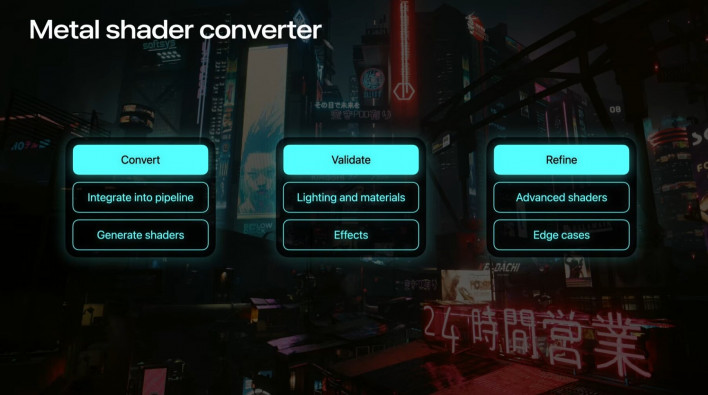
Once the native build was ready, the next key was the rendering pipeline. Cyberpunk's shaders were not just vast; they were complex. The entire rendering path, including lighting stacks, post-effects, ray tracing, and path tracing, had to be moved to a Metal API-based foundation.
The Metal Shader Converter was a key tool in this process. The team integrated it into the shader build system so that Metal shader output was automatically generated as part of the regular build. They then ran iterative validation loops. First, they checked lighting and post-effects in static in-game scenes, then moved on to dynamic scenes involving camera movement, streaming, and gameplay. Advanced rendering modes like ray tracing and path tracing were also stabilized through a process of performance optimization and verification to ensure visual output matched other platforms.
After the native Metal foundation was stabilized, the next challenge was ensuring consistent performance across various Mac devices. This process utilized MetalFX upscaling technology. By rendering at a lower internal resolution and reconstructing it to a higher resolution, it reduces GPU load while maintaining overall image quality. Combined with Dynamic Resolution Scaling (DRS), this ensured the target frame rate was maintained consistently even as scene complexity changed.
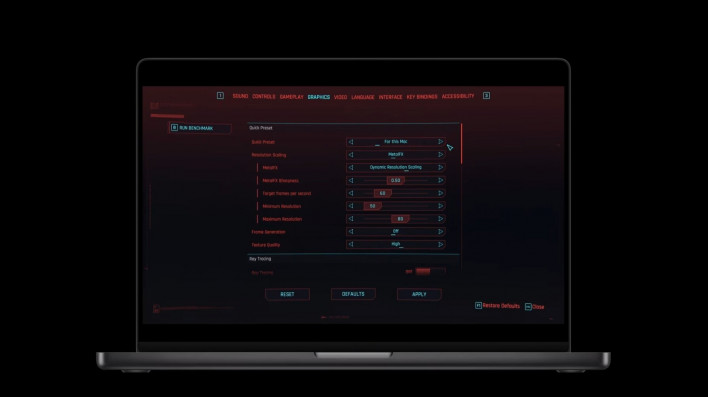
Built upon this technical foundation is the 'For this Mac' preset. This feature automatically detects the hardware of the Mac running the game and instantly applies the optimal graphics settings for that device. It means that players don't need to navigate the graphics options menu; the environment is automatically set to be optimized for their specific Mac from the moment they launch the game.
The development team set target frame rates of 30 or 60 for all supported Mac devices and tuned the minimum and maximum resolution boundaries using a combination of MetalFX and DRS to maintain those frames within each device's performance limits. Video settings are also configured automatically, with output resolution, VSync, and HDR activation determined by display and system specifications.
For example, on a MacBook Pro with an M5 Max chip, the settings are based on the Ultra preset, with MetalFX upscaling and DRS dynamically adjusting within 50–80% of the internal resolution to target 60 FPS. VSync is locked to 60 FPS, and HDR is automatically enabled if the internal display supports it. Even one of the most dense scenes in the game, the 'Black Market' from Phantom Liberty, ran stably at 60 FPS with these settings.
Director Paweł Sasko added, "We are seeing other developers start to adopt the 'For this Mac' setting approach. I think it's a healthy change for the entire ecosystem."
✨ Detailed Polish for a Native Mac Experience
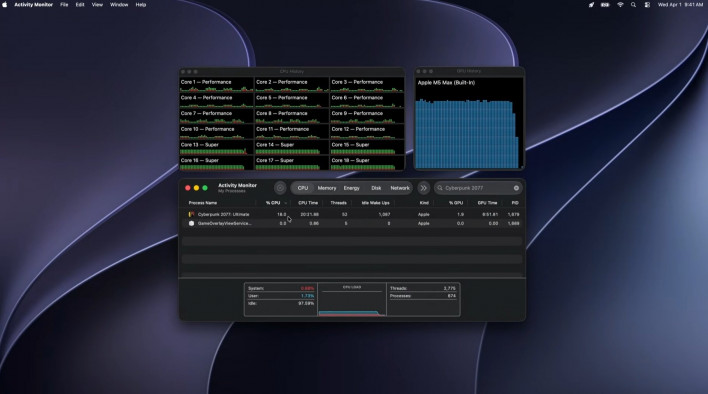
Beyond technical feasibility, another reason to pay attention to the Mac version of 'Cyberpunk 2077' is its level of integration with the macOS ecosystem. The team worked on platform-specific elements across the board, including system event responses, input devices, displays, audio, and cloud saves.
macOS notifies external apps of situations like app switching or display changes through system events called NSNotifications. The team implemented these in the game to automate various actions. When the game disappears or is obscured, rendering stops to save CPU and GPU resources, and if the display resolution changes, the game window automatically resizes accordingly. Seamless transitions, such as hiding the game cursor and showing the system cursor when opening a game overlay, were implemented this way. Additionally, Apple’s Game Mode automatically activates for apps classified as games, prioritizing CPU/GPU resources and doubling the Bluetooth sampling rate, which reduces latency for wireless controllers and AirPods.
Furthermore, native support for third-party controllers was achieved through the Game Controller framework, and advanced controller features like touchpads and adaptive triggers could be connected using existing implementations. Considering that Mac laptops come with trackpads, options like aim toggles and middle-mouse button input replacements were designed to be automatically detected and enabled.
One particularly standout feature is the HDR implementation. Usually, to properly enjoy HDR in a game, you have to manually adjust values in a calibration screen. The Mac version of 'Cyberpunk 2077' fully automated this process using Apple’s Extended Dynamic Range (EDR) API. This method queries the display's maximum EDR value in real-time and reflects it in the tone mapper, ensuring the best possible HDR output is always applied automatically, even if display performance or ambient conditions change. For displays with sufficient EDR headroom, like Apple’s XDR displays, the game is set to enable HDR automatically, so players don't need to touch the settings.
Night City’s soundscape was originally designed for spatial audio. The team utilized Apple’s Spatial Audio API to implement head-tracking-based spatial audio for AirPods. The audio middleware implements Apple’s Spatial Audio API via AVAudioEngine, enabling the `listenerHeadTrackingEnabled` property. Without any extra settings, connecting AirPods allows the game to automatically provide an immersive spatial audio experience.
As the game was already released, cross-save functionality was also implemented. The Mac version supports save file synchronization via iCloud Drive. This is combined with their own cross-progression system, allowing players to continue games started on PC or console on Mac, and vice versa.
🏁 A Milestone Port: Could This Be a Turning Point?
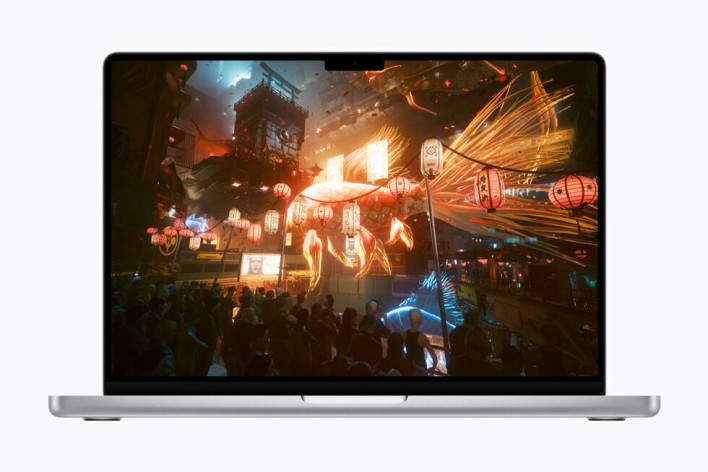
'Cyberpunk 2077: Ultimate Edition' was named 'Mac Game of the Year' at the 2025 Apple App Store Awards. App Store user reviews were also favorable. In closing the presentation, Paweł Sasko shared his thoughts: "Ultimately, what matters is not how much effort we put in, but what kind of result we leave for our players."
The WWDC26 Cyberpunk 2077 session had many interesting elements. By revealing the entire porting process as a methodology—from preliminary analysis via the Game Porting Toolkit and building a shader pipeline using the Metal Shader Converter to the combination of MetalFX and DRS and the 'For this Mac' preset system—it provided a concrete guide and milestone that other developers can reference.
Apple presenter and engineer Garrett Austin also encouraged developers at the end of the session, saying, "I hope you check how your games run on macOS in the Game Porting Toolkit evaluation environment. You can get started quickly without writing any code." He also briefly introduced 'Game Porting Toolkit 4,' which includes new agentic coding features.
The case of 'Cyberpunk 2077' was less about benchmark numbers and more about proving, through an actual commercial game, that Apple Silicon has matured into hardware capable of handling AAA titles. Games that required high specs on PC, such as Resident Evil, Crimson Desert, Lies of P, and Wuthering Waves, are already running in the Apple Silicon ecosystem.
Personally, I found this presentation by Apple and CD PROJEKT RED quite interesting. By introducing not just simple methods but concrete examples applied to a game alongside the developers, it serves as a milestone and guide that developers considering Mac expansion or porting can study. I hope this presentation becomes a real turning point that encourages many more developers to take on the challenge of game development for macOS.






Sort by:
Comments :0