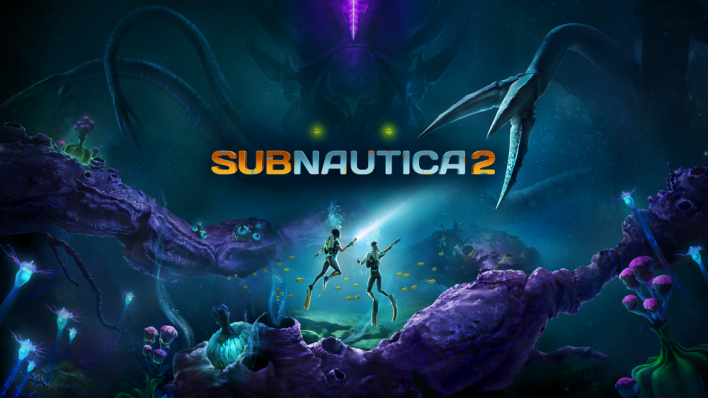
Subnautica 2, the official numbered sequel to the marine survival adventure series that has sold over 18.5 million copies worldwide, will launch in early access on May 15 at 12:00 a.m. KST. One week ahead of the release, developer Unknown Worlds held an online press conference for global media to unveil the game's identity, vision, and future roadmap.
The event featured Anthony Gallegos, Lead Designer of Subnautica 2, and Scott MacDonald, Creative Media Producer. The presentation included an introduction to the series' identity by Gallegos, a demo walkthrough of the new planet, and an Early Access roadmap presentation by MacDonald. In the subsequent Q&A session, the two addressed questions from media outlets across Asia, including Korea, China, and Japan.

"Subnautica is an exploration game with survival elements"
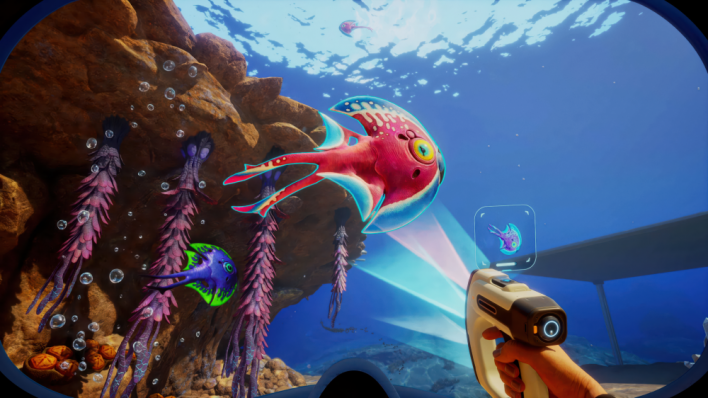
Anthony Gallegos began the presentation by defining the series' identity. While many players categorize Subnautica as a 'survival game,' he clarified that the development team considers 'exploration' to be the core of the series.
This identity extends to non-violence and player autonomy. Gallegos emphasized that the series has consistently maintained a non-violent stance and that providing systems for player self-expression is a key value. He explained that the team avoids forcing players down a set path, instead providing minimal guidance to allow players to set their own goals and feel rewarded for their discoveries.
The differentiation of Subnautica 2 begins with a new planet. Moving away from the previous setting of Planet 4546B to an entirely new alien world, this title focuses on securing a unique identity while retaining the core fan base through new stories, creatures, Leviathans, and game systems. As it has been over a decade since the series launched, a wide range of modern 'Quality of Life' features meeting 2026 standards have also been introduced.
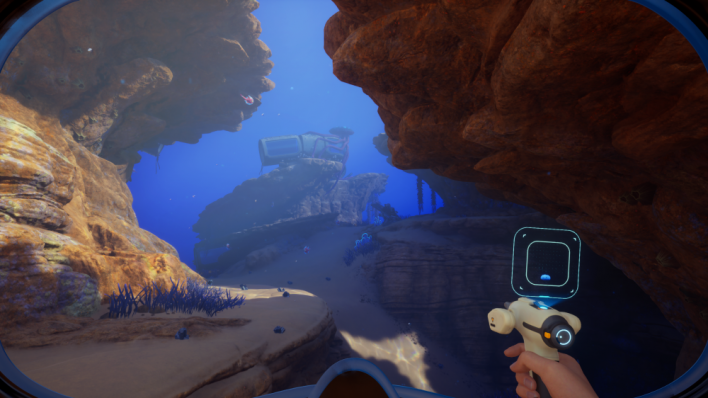
The First Step onto a New Planet, and 'BioMod'

The demo video began in the shallow waters of the new planet. As in previous titles, players adapt to the planet by securing basic survival resources like oxygen, water, and food. However, in this installment, players start in a state where they 'cannot naturally digest food' upon arrival. The premise is that players must alter their own bodies and genetics to adapt to the planet's environment.
The medium for this change is the new 'BioMod' system. It allows players to interact with alien lifeforms to acquire new physical abilities; the video briefly showcased the process of a player gaining the ability to digest food.

There are also changes to resource gathering. The previous system, where results were randomized, has been replaced with an intuitive structure where the resource visible on screen is exactly what the player collects. Gallegos explained that this change was made in response to player feedback.


The graphical leap due to the transition to Unreal Engine 5 was also highlighted. Gallegos visually demonstrated how Lumen-based cave lighting and Nanite-utilized environmental details have significantly improved over the previous title. Elements like cave diving are designed to create early-game survival pressure through a calm sense of tension—constantly making the player aware of their remaining oxygen—rather than through the pursuit of massive enemies.
The video also revealed changes to the inventory system. Subnautica 2 introduces an expandable inventory, allowing players to increase storage space through upgrades acquired during gameplay. Additionally, the behavior patterns of the new 'Hammerhead' creature were demonstrated, showing it actively interacting with the environment, such as interacting with coral or headbutting its own kind.
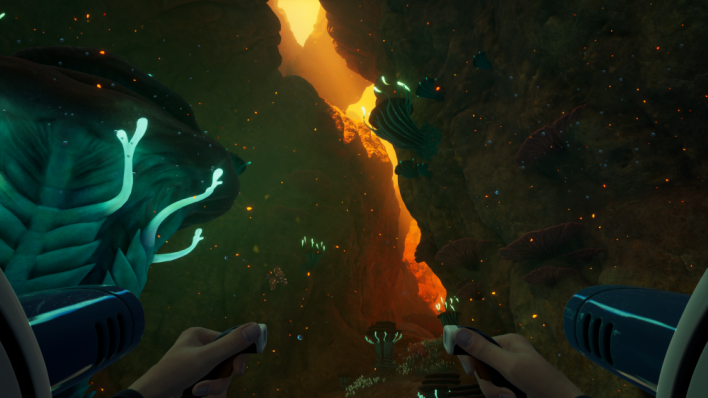
New Tools, the 'Tadpole' Vehicle, and New Dangers

Subnautica 2 has also overhauled the crafting system. While recipes available early in the game are limited, they expand gradually as the player progresses. The new 'Survival Multitool,' which replaces the knife from the previous game, serves as a multipurpose tool integrating a hammer and a small switch-axe blade, while basic equipment like fins and oxygen tanks remain.
The scanner remains the heart of the crafting system. The demo showed the player crafting a scanner, which serves as both a gateway to acquiring new blueprints and a tool for accumulating information in the databank by scanning creatures and the environment.
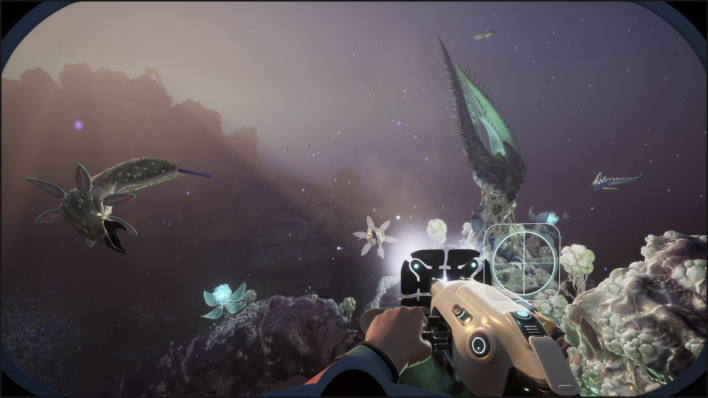
One of the major new settings in this title is an infectious disease called 'Bloom.' Creatures and plant clusters across the planet are infected with Bloom, and finding a cure for this disease is one of the main narrative pillars. Gallegos added a poignant explanation regarding the hostile creatures infected with Bloom.
" These creatures are not inherently evil; they have simply become hostile due to the infection. Ultimately, if a player defeats them, it is akin to a form of merciful euthanasia.
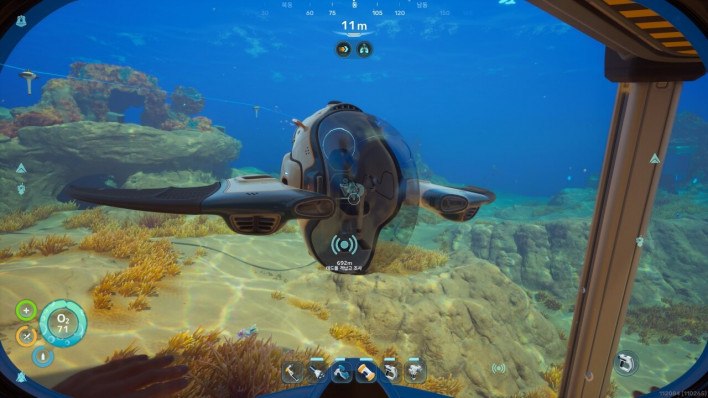
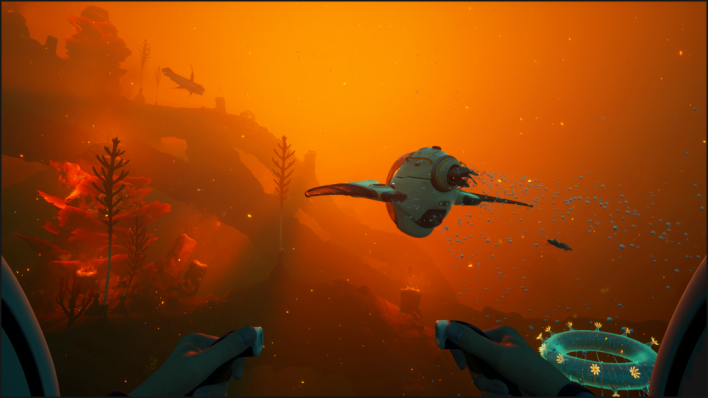
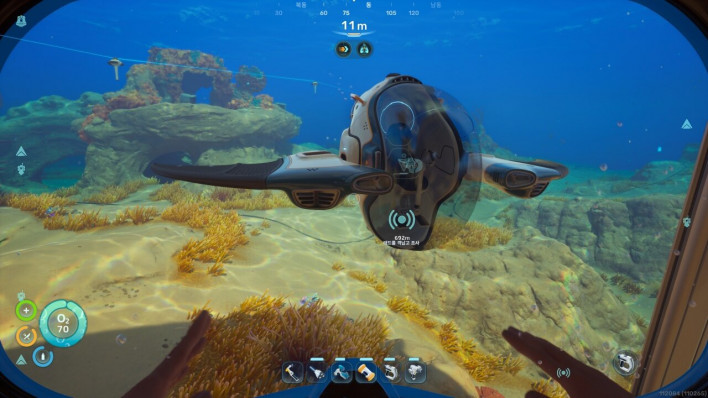
The new vehicle, the 'Tadpole,' was also unveiled. Its most significant feature is the 'Chassis' system. By equipping the base Tadpole with a wing-shaped 'Scout Ray' chassis, players can achieve much more agile and faster mobility. Two types of chassis will be available at the time of Early Access launch, with more to be added in future updates.
A New Dimension of Base Building and 4-Player Co-op
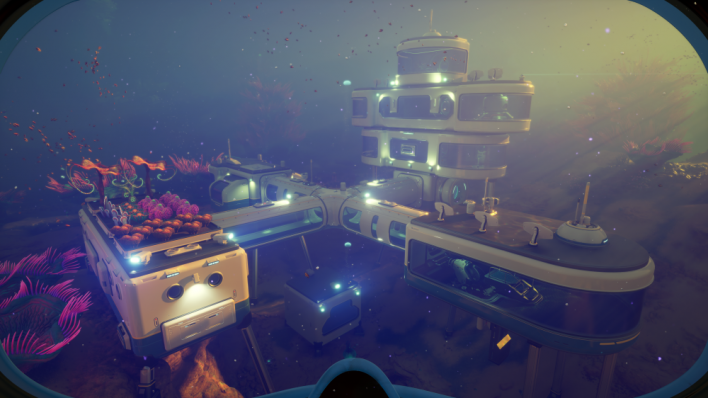
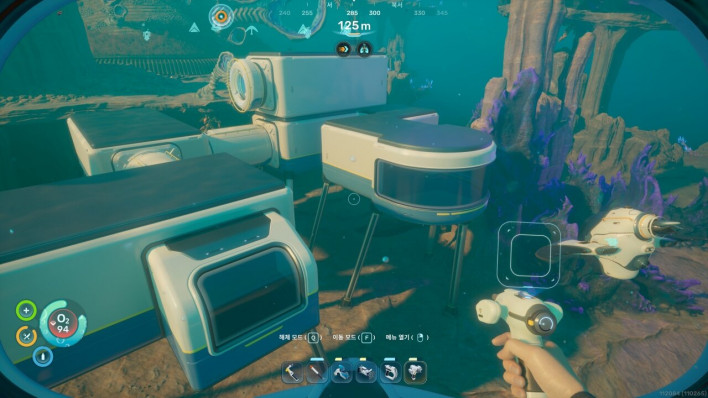
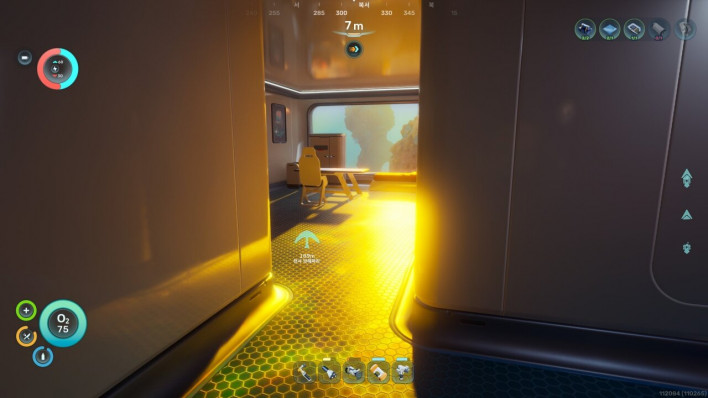
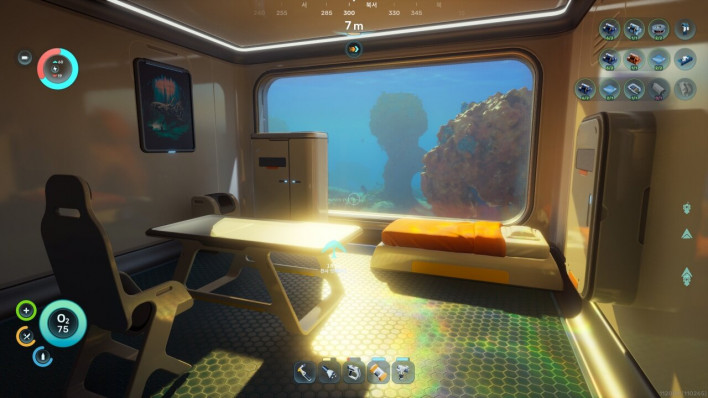
The base building system has been redesigned more extensively than ever before in the series. Gallegos described the building in this title as a 'sculptural system.' Moving away from the previous method of connecting pre-defined shapes, this structure allows players to place a base form and then pull on parts to create free-form shapes. At launch, decorative elements such as ship docking, various interior decorations, customizable signs, storage bins, and pottery will be included, some functional and others purely for aesthetic satisfaction.
A particularly notable aspect of base building is the freedom to change the shape of windows. Players can create anything from small circular portholes to massive floor-to-ceiling windows, with the light entering the room changing based on the window's shape. Scott MacDonald revealed that windows are one of his favorite elements of base building.
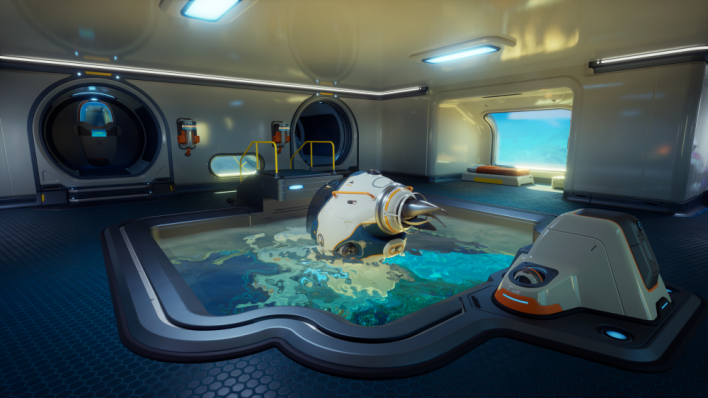
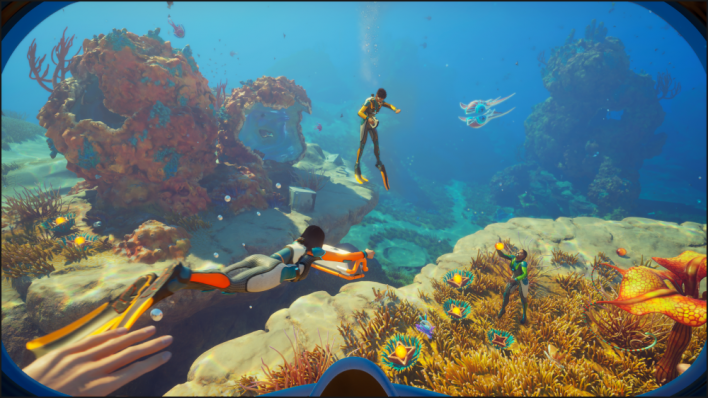
Along with this, a co-op mode has been added for the first time in the series. It supports up to 4-player co-op and offers cross-play between Xbox and PC. The demo showed players building a base together in a co-op environment, where the sculptural system allows for natural collaboration, such as one player pulling out a large wall chunk while another modifies the irregular sections. A 'Creative Mode' will also be available from the start of Early Access.
Gallegos emphasized that power management remains a critical variable in base building. The demo video showed an instance where over-expanding facilities led to a power shortage, causing even the oxygen generator to shut down.
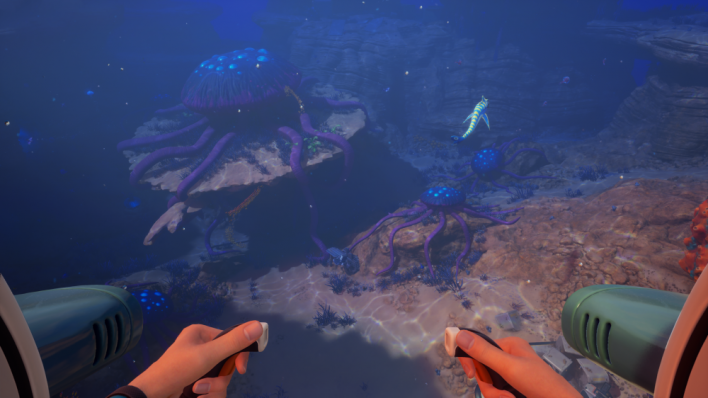
Finally, the 'Leviathans,' the giant creatures that are iconic to the series, were revealed. Subnautica 2 will feature a total of 5 types of Leviathans at the time of Early Access launch. The video showcased the non-aggressive 'Giant Coral Crab' Leviathan and the 'Collector,' a predator with giant tentacles.
Starting Today (15th)! Early Access Roadmap
In the latter part of the presentation, Gallegos revealed the business model and the operational direction for Early Access. The price for Subnautica 2 in Early Access is $29.99 (US), with regional pricing applied separately. The price is expected to increase at the time of the full release.
" We wanted to set the price at a level that is as reasonable as possible for those who join us during the Early Access phase to begin the journey with us.
The Early Access period is expected to last between two and three years. Gallegos explained that this time is intended to fully incorporate fan feedback, emphasizing that the launch build is by no means sparse, as it already contains dozens of hours of story content.
Scott MacDonald then unveiled the update roadmap for after the Early Access launch. The first update, arriving shortly after launch, will focus on 'Quality of Life.' This includes improvements to the BioMod system, additional 'Blight' encounter content, expanded shipwreck gameplay, improvements to vehicle docking and crafting, expansion of PDA and databank entries, and a priority system for voice logs. Many immediately noticeable quality-of-life features, such as expanded BioMod slots in the inventory, the introduction of a 'Sprint' function, and improvements to the storage system, will also be included.
The second update will be 'Co-op focused.' It will concentrate on strengthening the co-op play environment, including improvements to the ping (HUD signal) system that can be displayed across the world, base builder tool improvements, and a strengthened 'Pinned Recipe' system that anchors resource information to the corner of the screen. The most notable addition is voice chat. MacDonald revealed that 'Proximity Chat' was the most requested feature in the community following the announcement of Subnautica 2. This second update will include proximity chat, along with animated emotes, a player reviving system, and additional customization options.
The long-term roadmap thereafter focuses on large-scale content expansion. New biomes, creatures, resources, and tools will be added, and at least one new vehicle will join in the near future. Notably, it was revealed that a 'large submarine'—a long-requested feature by the community—is currently in long-term development. It is a vehicle that occupies a position equivalent to the Cyclops from the previous game.
In terms of story, content will expand in 'chapters.' The first chapter will be available at the time of Early Access launch, with subsequent chapters added sequentially. MacDonald emphasized that since some players follow the story even while playing only in Creative Mode, it is crucial to continuously expand the narrative. In addition, regular operational updates such as bug fixes, balance adjustments, and optimizations will continue.
Asian Media Q&A Session
What are the new underwater environments, creatures, or ecosystems that the development team is most proud of.
Anthony Gallegos = I think our answers might differ. For me, there is an area near the end of the Early Access content where the true nature of this world is revealed. It is the deepest region in the game, and some truly impressive, dramatic moments unfold there. It's hard to describe without spoilers, but I will say it is a region with majestic architecture.
Scott MacDonald = I am most proud of the handling of the new 'Tadpole' vehicle. The 'Seamoth' from the previous game was a vehicle beloved by fans. I believe the Tadpole not only recreates that operational feel but, through the additional chassis system, elevates it to a level that surpasses the original Seamoth. Sometimes when playing a sequel, people say, 'It doesn't feel like the one I remember,' but the Tadpole really feels 'just like it did back then.' I am very proud of the team for that.
Can new players who haven't played the previous games enter Subnautica 2 without difficulty? Conversely, what connecting elements are prepared for series fans.
Anthony Gallegos = Subnautica 2 is being built so that it does not assume prior experience with the previous games. This is a very important principle for us. Familiar elements appear throughout. The mega-corporation 'Alterra' remains, and many similar craftable items exist. However, narratively, it is a separate story, distinct from the previous game or 'Subnautica: Below Zero.'
To borrow the words of our scenario writer, we have 'never forgotten' those stories. Callbacks to the lore of previous works are scattered throughout the game, providing additional depth for series fans. Even if you haven't played the previous games, there is absolutely no problem in understanding the main narrative. However, if you are familiar with the previous works, you will have a slightly richer experience.
As it claims the same genre, what are the unique differentiators of Subnautica 2 that could not be experienced in the previous games.
Anthony Gallegos = As I mentioned at the beginning, it was important to maintain the feeling that the game still belongs to the series. Core survival elements like oxygen management and exploring an alien world remain. The differentiators start with a new planet, new alien lifeforms, a new story, and new mysteries to unravel. There are also many new gameplay systems that weren't shown much in the trailer. The BioMod system, which allows players to inject active and passive abilities into their bodies, is a prime example, acting as a secondary growth track. The key is not to change the gameplay entirely, but to add new layers of growth on top of existing mechanics.
Scott MacDonald = One thing to add: creature AI and environmental systems have been significantly improved. You will see creatures interacting with each other much more deeply. This was impossible in the old engine, but thanks to the move to Unreal Engine 5, we were able to make the planet itself feel alive.
A multiplayer mode is being introduced for the first time in the series. What is the background behind the decision to introduce multiplayer, and how will you resolve the conflict between the series' characteristic sense of isolation and multiplayer.
Anthony Gallegos = Multiplayer was actually an element the team always wanted to challenge since the original Subnautica, but we ultimately decided not to include it in the first game. When we started developing the sequel, the first thing we looked at was the most popular fan requests, and one of them was multiplayer. Subnautica 1 had an unofficial multiplayer mod called 'Nitrox,' which had over 700k downloads. We realized the community's demand was that high, and that was the biggest motivation for the decision.
Regarding the issue of isolation, I can clearly state that multiplayer is not mandatory. Players who want that sense of isolation can play alone from start to finish. Co-op is strictly an option. That is why we usually call this game a 'single-player game with optional co-op.' It is not a multiplayer game. And honestly, you can still feel plenty of isolation even when playing in co-op. This planet is not filled with other colonists. With at most three other companions besides yourself, the feeling of being quiet and solitary remains intact.
Scott MacDonald = I want to add one thing. Many people think that the sense of horror will disappear in co-op play, but our internal test results show otherwise. Don't you share the joy or fear when you go to the movie theater with friends or family? The same thing happens in co-op play. If you witness a Collector Leviathan chasing a friend in a dark, foggy environment together, that fear is actually shared more intensely.
The team built up long-standing know-how with the Unity Engine, and the series' characteristic horror owed a lot to the blurriness and sense of the unknown that came from those technical limitations. With the transition to Unreal Engine 5, visual fidelity has increased significantly, and multiplayer is being introduced; how will you reinterpret 'horror' amidst these changes.
Anthony Gallegos = I do not agree with the concern that horror will decrease as visual fidelity increases. On the contrary, thanks to more realistic lighting, we can revive the sense of 'truly dark areas' that Subnautica 1 had. We are using volumetric fog very carefully and intentionally keeping the draw distance short to create the eerie feeling unique to being underwater. In reality, if you look ahead in the ocean, you can't see much beyond 20 meters, and we are using this as a benchmark for our game design. Constantly blocking visual information ultimately makes the 'horror of the sea' stronger.
Additionally, as you learn what happened to the colony, psychological horror elements will also be emphasized more. This aspect was shown in the past, but we plan to dig deeper this time.
Scott MacDonald = Thanks to moving from Unity to Unreal Engine 5, we are free from the technical constraints that occurred due to past PC hardware limitations. Now, we can intentionally choose which tone to create—areas with very long sightlines or areas that are short-sighted and shrouded in fog. At the same time, we have naturally brought over the familiar sensations that Subnautica 1 managed to capture well despite technical limitations.
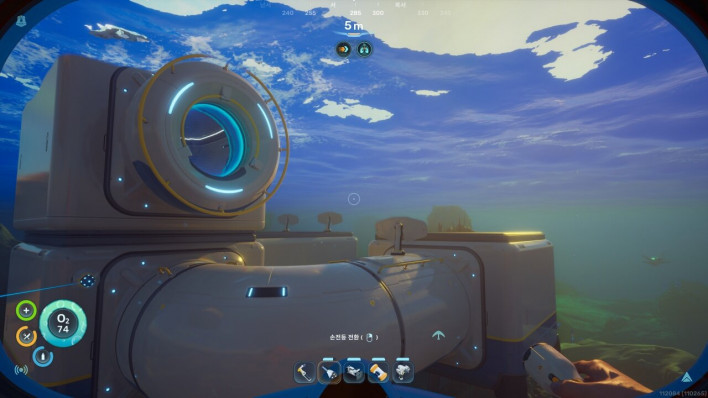
Vehicles are one of the areas where players have been most vocal. How do you plan to give each vehicle unique functions and appeal so that it doesn't end up as an 'all-in-one vehicle' with all functions integrated in the late game.
Anthony Gallegos = The vehicle design philosophy is very similar to that of Subnautica 1. We view it as a 'layer system.' In the late game, large vehicles with certain utility appear, but because of their size, there are situations where you have to operate smaller vehicles separately. Those smaller vehicles also cannot enter places like narrow caves, so eventually, there comes a moment when you have to get out of the vehicle to scan and gather resources yourself. Even if a large vehicle seems to provide safety, it is a structure that ultimately puts the player back in a vulnerable state.
The Tadpole is the first step in this structure. It is the first small submarine the player gets, and we give it identity by equipping it with a chassis. The base Tadpole, the version equipped with Scout Ray wings, and the 'Hull' chassis that briefly appeared in the cinematic trailer each provide completely different operational feels. In particular, the Hull provides a heavy operational feel suitable for cargo transport, with enhanced multiplayer functionality and storage space. Additionally, a mech suit equivalent to the Prawn Suit from the first game and a large submarine equivalent to the Cyclops are also in development. The goal is to satisfy the series' core fantasy while giving them more character through the chassis system.
Scott MacDonald = We also paid attention to designing the vehicles to look cute and appealing. Players will especially love seeing the Tadpole expand over time.
A new modular base building system has been introduced. How much freedom does this system provide to the player.
Anthony Gallegos = I can confidently say it provides the greatest freedom in the history of the series. In the previous game, it was a method of connecting pre-made shapes, and even within those limits, players created amazing bases. This time, you can place pre-defined shapes and then pull on parts to transform them, allowing for much more dynamic forms. As a result, slightly bizarre or impractical bases might appear, but we welcome that. Everything doesn't need to result in perfect efficiency. Players should be able to express themselves through their own architecture.
The same freedom applies not only to the basic structure but also to windows. You can create a wide variety of window shapes, and the way light enters the room changes depending on the window's shape. The same 'pulling' transformation system is applied to corridors. We plan to expand this system to more base-building elements, like sofas that attach to walls, in the future. Expanding the scope of self-expression has become our core philosophy.
Scott MacDonald = I want to emphasize the window story. From small circular portholes to massive floor-to-ceiling windows, you can make them exactly as you want. And the way the light enters through those windows is truly impressive. Players will be surprised when they see it for themselves.
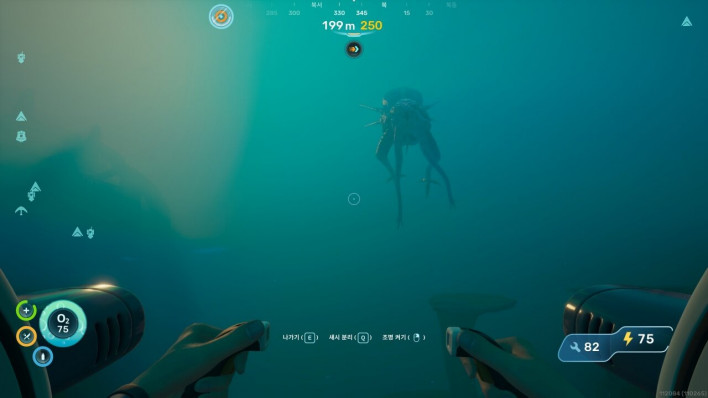
Approximately how many Leviathan-class creatures will appear on the new planet? Also, I am curious how the new Leviathans differ from the Reaper Leviathan or Sea Dragon Leviathan of the previous games.
Anthony Gallegos = At the time of Early Access launch, 5 types of Leviathans are ready. Two of these are clearly aggressive creatures like the Sea Dragon or Reaper. One of them is the Collector. There is also the 'Shiver Leviathan,' which is our equivalent to the Void Leviathan, and the Giant Coral Crab Leviathan. Including the giant clam 'Great Jaw' that appeared in the cinematic trailer and the 'Deep Wing Brooder' that we have been running as part of community events, there are five types.
These five types encompass aggressive entities, relatively peaceful ones, and those on the boundary. We designed them hoping that Leviathans would provide players with both awe and moments of terror like the Reaper. We plan to add many more Leviathans during the Early Access period.
Do you have plans to introduce a pet system like the Hoverfish from the previous game.
Anthony Gallegos = We are well aware that the comfort and joy pets provide to players are very important. To give you the conclusion first, we plan to put something similar into the game. The question is whether the pet will be a creature form that the player raises and grows, or a robot form that the player crafts and accompanies. The implementation method is not yet finalized, but the direction that there should be a companion the player can take with them is clear. However, this will also be provided as an 'option.' This is because some players may consider isolation a core experience and feel that a pet ruins that sensation.
Scott MacDonald = To supplement, the reason the Hoverfish was loved was that it was cute and charming to see it doing its own thing in its own environment. We have a similar creature. It's a small crab that wanders around anemones. It just looks at the player and then goes on its way, and players will definitely love it.
Anthony Gallegos = Lastly, one thing to add: what has always been important in Subnautica's creature design is the balance between very realistic, terrifying creatures and cute, somewhat quirky ones. We intend to keep these two together in one world.
'Subnautica: Below Zero' was criticized for having a map that was too narrow and complex, making exploration feel like a maze. Has this feedback been reflected in Subnautica 2.
Anthony Gallegos = In this title, we intend to leave more breathing room between biomes. It's a direction that appropriately mixes sections where biomes are adjacent to each other, like in Below Zero, and sections that are far apart, like in Subnautica 1. I think both have their own value. However, we are clearly aware that there was a problem with wayfinding in Below Zero. The key is to provide just enough guidance so that the sense that the player is discovering and deciding for themselves remains alive. Since Below Zero was criticized for having somewhat strong guidance, we intend to take a step back in that regard this time. And all these judgments are also the core of Early Access. We think we are on the right track, but if fans feel differently, we will adjust during the open development process.
Scott MacDonald = We took the criticism of Below Zero's map seriously and have been working to create a better map by reflecting it. As Gallegos said, there are areas that are more spread out rather than always clustered together. Below Zero is a great game, but there is something to learn from every work. The most important thing is to listen to the voices of the fans.
The success of the previous game was largely due to deep interaction with the community during the Early Access period. Based on feedback regarding Below Zero's map exploration, scale, and main story pacing, what optimizations and adjustments have been made for Subnautica 2.
Anthony Gallegos = For us, the starting point for all work is Subnautica 1. When we think about how to handle lighting, creature spacing, and progression structure, Subnautica 1 is always the benchmark. Below Zero is also a good work and achieved critical acclaim, commercial success, and high ratings on Steam, but it is also true that there was reasonable criticism. We are using Subnautica 1 as our gameplay benchmark while incorporating the excellent quality-of-life improvements that Below Zero brought. I think the combination of these two will give Subnautica 2 a clearer identity and resolve the pacing issues.
A significant part of the pacing issue stemmed from the fact that Below Zero was more guidance-oriented and the speaker character had a large presence. Players felt the story was 'given' to them, and the sense of 'discovering' it, like in Subnautica 1, was weak. So this time, we are clearly returning to a direction where players discover the story for themselves.
Scott MacDonald = To supplement, we have been conducting internal and external tests in parallel for a long time. External tests targeting core fans were very important. If they said, "This part needs more explanation," we reinforced it, and if they said, "We need to take a step back here," we did so. That doesn't mean they design the game. We do the design. However, that early-stage feedback was very important, and I think the volume of that feedback will be much larger after launch. Thanks to listening to those voices early, Subnautica 2 will be able to launch in a significantly improved state.
The series has always had a lot of content derived from community feedback. Are there any community suggestions that were particularly impressive during the development of Subnautica 2.
Anthony Gallegos = Even the core progression structure and pacing were changed through community feedback. A user with the nickname 'Tor' is an impressive case. He pointed out that base-building parts were unlocked too quickly in the early game. His opinion was that it would be much better to use just one corridor for a while and learn the expressive base-building system itself. He was absolutely right. We slowed down the distribution of parts the very next day, and as a result, a much more natural pace was created. Once you get used to one way of doing things, you need an outside perspective, and community participation becomes those outside eyes.
The 'Scanner 2 PRO' advertisement released by the official team on April Fool's Day was a hot topic. Do you have any plans to release it as actual merchandise.
Scott MacDonald = We have no separate plans to release a physical Scanner 2. It was a small prank to enjoy April Fool's Day. However, I will say one thing: a variation of the scanner that hasn't been revealed yet might appear in the game. You could call it 'Scanner 2,' but please check the details by playing it yourself.
Anthony Gallegos = We are also conducting some merchandise business. There are already products like plushies related to Subnautica. So, the possibility that this kind of merchandise will come out in the future cannot be completely ruled out. If you really want it, please keep voicing your opinions. We will definitely receive that message.
Subnautica 2 has maintained the #1 spot on the Steam wishlist for a long time, and it is known that about 5 million wishlists have been collected when combined with other platforms. I would like to hear your thoughts on this global support.
Anthony Gallegos = I don't know the exact number. I know it's close to the figure you mentioned or at a very high level. Setting aside the exact number, I can say one thing: the support poured into this game is overwhelming. Speaking as someone who joined the studio, in my previous project, I thought it was a 'huge achievement' when the trailer reached 500k views. But the Subnautica 2 trailer exceeded 1 million views in less than a day. Seeing that an overwhelming amount of wishlists have come in not only from the US and Western Europe but also from Asia, I realize how great the opportunity we are facing is and how extensive the fan base is that we cannot disappoint. This is also the reason why we chose to launch in Early Access. As much as everyone hopes the game won't be disappointing, we feel that sentiment tenfold.
Scott MacDonald = We have seen so many wishlists and so much love from all over the world, especially Asia. A Western studio that started with only US personnel has now become a global studio, and we are learning new technologies and methods to understand various markets. Opening an account on Bilibili is an example of that. We are trying to communicate more with everyone in Asia. Facing the reactions from all over the world is a great strength for the studio.
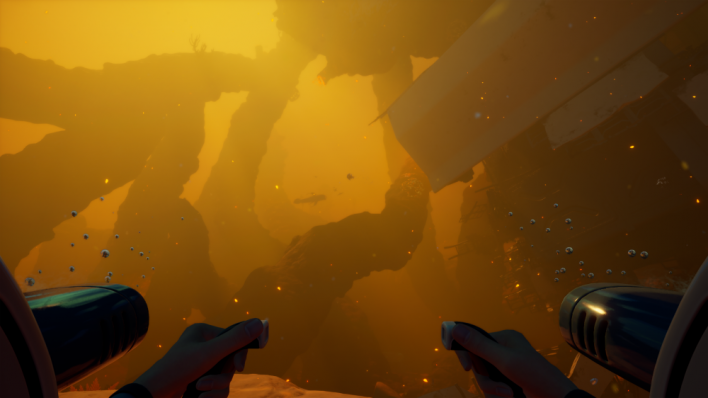
Will characters from the previous games reappear? Are core settings from the previous games, such as Alterra or the Kharaa virus, scheduled to return.
Anthony Gallegos = There are definitely parts that callback to the influence of characters from the previous games. However, the protagonists of the story we are telling this time are new characters. For example, a figure like Riley from the first game might be mentioned, but they will not appear directly. We want to tell the stories of new characters. However, if you have watched our video series 'Voices from Beyond,' you can see that it contains many callbacks to the Kharaa incident or Riley. In fact, the colonists the player meets in Subnautica 2 are more like refugees who fled the terrible chaos caused by the Kharaa incident in space. Even if we don't blatantly bring the characters back, we have never forgotten the flow of the previous stories.
Listening to the presentation, it seems that various content is prepared even after Early Access. In the developers' view, what percentage of the entire Subnautica 2 is the current Early Access build.
Anthony Gallegos = It is difficult to give an exact percentage. We have a clear vision and story for what kind of game we want to make by the official release, but it could change significantly depending on fan feedback, or the volume could increase significantly if we discover the need to add new biomes in terms of pacing. So, it is more accurate to tell you the average playtime instead of a percentage. Currently, it takes an average of about 20 hours to clear the first Early Access build. Of course, there is a huge variance depending on how much time you spend on base building and whether you collect all creature information. There are players who have spent 70 hours. I personally have played for nearly 500 hours, but that is a figure accumulated over a long time.
For reference, the fastest clear record within our studio, which knows the game inside and out, is 7 hours, and that is effectively a speedrun figure. So, this Early Access launch contains an amount of content that has never been attempted in any previous work, and as a result, we expect it to be a work with a much larger volume than previous games.
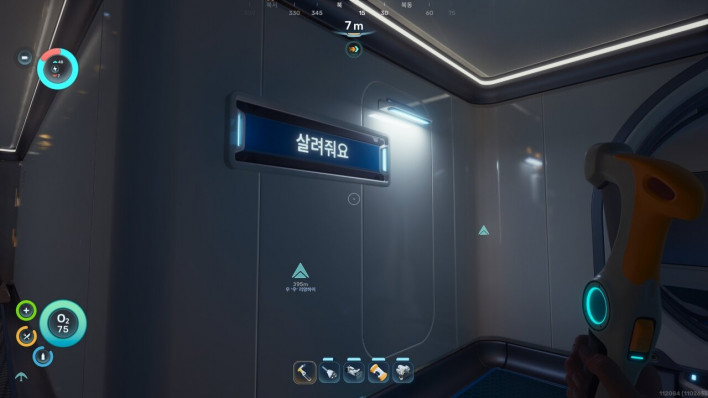
Cephalopods are perceived differently by culture. In the West, they are often seen as objects of fear, while in East Asia, they are often considered familiar food ingredients. I am curious how you considered this cultural difference when designing cephalopod-type creatures like the new Leviathan 'Collector.'
Anthony Gallegos = Our team is clearly aware of these cultural differences. However, I will say one thing: squid and octopus are actually consumed as food all over the world. My wife also enjoys eating calamari (fried squid). The same logic applies to sharks. Sharks are also consumed as food all over the world, and the Reaper Leviathan from the previous game is essentially a shark-like form, but we made it an object of fear.
Therefore, I think the key is not 'what kind of creature it is,' but 'how you present it' and 'how huge it is.' Even if it's a cute creature usually, if you encounter it at a huge size in the ocean, it becomes a threatening existence in itself. While being aware of the differences in perspectives across various cultures, we are focusing on making that creature feel like a 'monster-like existence' no matter where it is seen.
Lastly, if you have anything you would like to say to fans in Asia, including Korea.
Anthony Gallegos = Thank you to everyone who took the time to join us. I am sorry that I could not answer all the questions, and I hope there will be more opportunities to communicate in the future. We feel very lucky that there are fans all over the world who are interested in our game. Our game is being made not only for those close to us but also for you who are far away. I ask you to participate in the Early Access and open development process so that your voices can be reflected in the game.
Scott MacDonald = Thank you so much for joining us today and giving us the opportunity to answer. I hope this kind of event will be held again, and I ask you to continue to contact us actively. I will make time to respond as much as possible, and I will be waiting for your feedback after the Early Access launch. To the readers and viewers, whoever you are, your voices are always important to us.

Sort by:
Comments :0