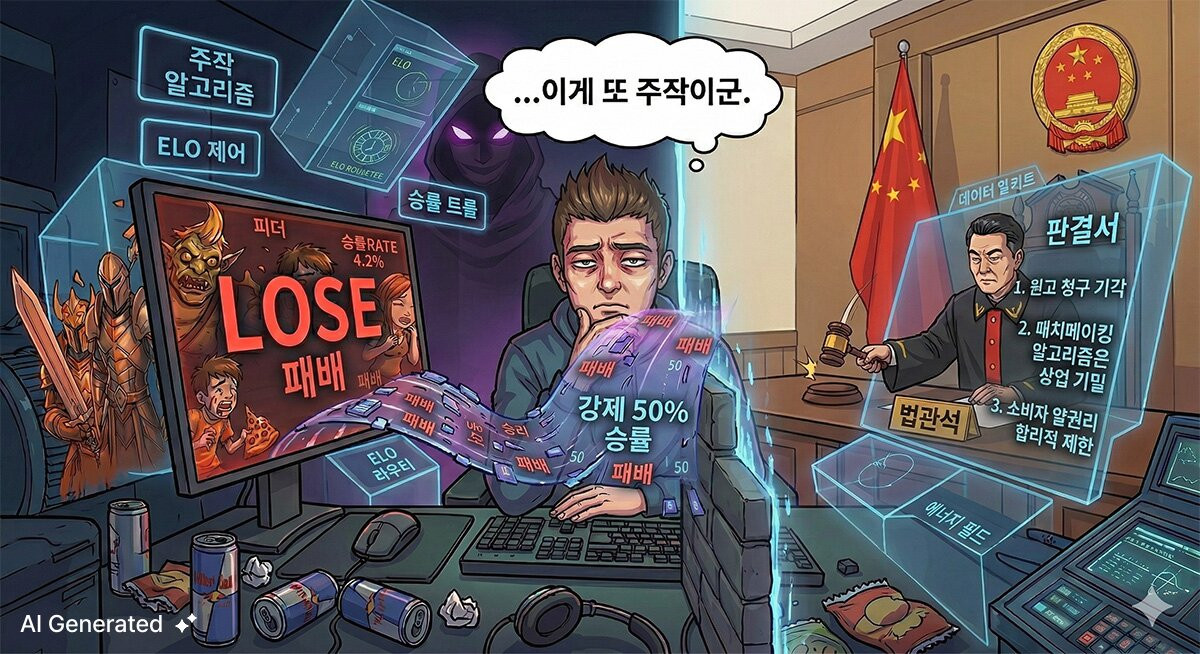
The complaint that games 'intentionally pair you with low-skilled teammates after a winning streak to force your win rate toward 50%' is a long-standing urban legend in PVP (player-versus-player) gaming. This claim has surfaced not only in League of Legends but also in various other PVP titles, including Heroes of the Storm, Overwatch, and Marvel Rivals.
Riot Games directly addressed these allegations on October 2 of last year via its official Korean channel. Matthew Leung Harrison, Lead Gameplay Designer at Riot Games, stated, "Matchmaking is based solely on skill, and there is no mechanism that intentionally forces an individual's win rate to 50%." He explained that the system does not intentionally assign lower-skilled teammates to reduce queue times, and that a player's win rate naturally converging toward a level appropriate to their skill after a winning streak is a normal phenomenon.
| 📒 | - '50% Win Rate' Matchmaking Conspiracy in PVP Games Like 'LoL' Escalates to Lawsuit Over 'Honor of Kings' Algorithm - Chinese Court Rules Matchmaking System a "Core Trade Secret," Dismisses Plaintiff's Claim Due to Risks of Algorithmic Abuse - Tencent: "Matchmaking is Strictly Skill-Based"... System Refinement and Communication Are More Realistic Solutions Than Forced Disclosure |
The dissatisfaction with matchmaking, which is so widespread that game companies have to issue official explanations, actually escalated into a lawsuit in China. Sun Qianhe, a lawyer from Qingdao, Shandong Province, and a player of the game 'Honor of Kings,' filed a lawsuit against Tencent last August, demanding the disclosure of the detailed matchmaking algorithm under Article 8 of China's Consumer Rights Protection Law. Sun argued that the matchmaking system induces gaming addiction by capping win rates at 50%, and he urged the company to disclose the algorithm through media and social platforms.
However, during the trial, the plaintiff failed to provide a clear legal basis for why the algorithm should be disclosed.
Conversely, legal and academic experts argued that gaming companies' trade secrets must be protected. Zhu Wei, an associate professor at the China University of Political Science and Law and a member of the China Consumers Association's expert committee, pointed out that "the matching system constitutes a trade secret, and if trade secrets are not protected, the right to know becomes meaningless." Zhang Qi, a senior partner at Yingke Law Firm in Shanghai, also explained that "the matching mechanism is a core competitive advantage of a game and meets the requirements for trade secret protection." Xu Xiaoben, a professor at Zhongnan University of Economics and Law, added that "online games are unrelated to the public interest, making excessive administrative intervention inappropriate."
During the trial, Tencent attempted to disprove the theory that it artificially controls win rates at 50% by presenting randomized data. According to the statistics, User A, who played 752 games, had a win rate of 76.1%; User B, with 2,398 games, had a 71% win rate; and User C, with 472 games, recorded an overwhelming 81.6% win rate. The company aimed to demonstrate that individual skill, rather than artificial system control, is the key factor determining win rates.
On April 9, the court of first instance ruled in favor of Tencent. The court stated, "A game's matching algorithm does not fall within the scope of the "right to know" as defined by the Consumer Rights Protection Law." The court dismissed the plaintiff's claims, ruling that "if the algorithm were to be transparently disclosed, malicious users could exploit its loopholes to undermine fairness and cause user churn, which would hinder the development of the gaming industry."
Although the lawsuit was dismissed, Attorney Sun expressed his intention to appeal immediately after the trial by interpreting parts of the verdict in his own way during a live broadcast on Douyin (the Chinese version of TikTok). During this process, Sun's personal account gained 120,000 followers in a single day.
Chinese gaming industry experts pointed out that opening a 'Pandora's box' by forcing the disclosure of technical trade secrets could ultimately serve as a guideline for malicious abusers. They suggested that rather than speculation and emotional litigation, the realistic alternative is for game companies to make efforts to improve their systems and engage in transparent communication that the majority of users can accept.


Sort by:
Comments :0