Lee Kang-wook, Chief AI Officer (CAIO) at KRAFTON, presented a new agenda for game AI at one of the world's most prestigious machine learning conferences. His agenda focuses on three key areas: in-game AI agents that cooperate and compete with players, interactive world models that challenge the role of traditional game engines, and production AI that transforms the game development pipeline.
The presentation took place at 'AI for Games,' an official social event of the International Conference on Machine Learning (ICML 2026), co-hosted by KRAFTON and world-model developer Odyssey on the evening of the 6th at COEX in Seoul. ICML 2026, running through the 11st at COEX, is the largest in the conference's history, featuring 23918 submitted papers and approximately 15k attendees.
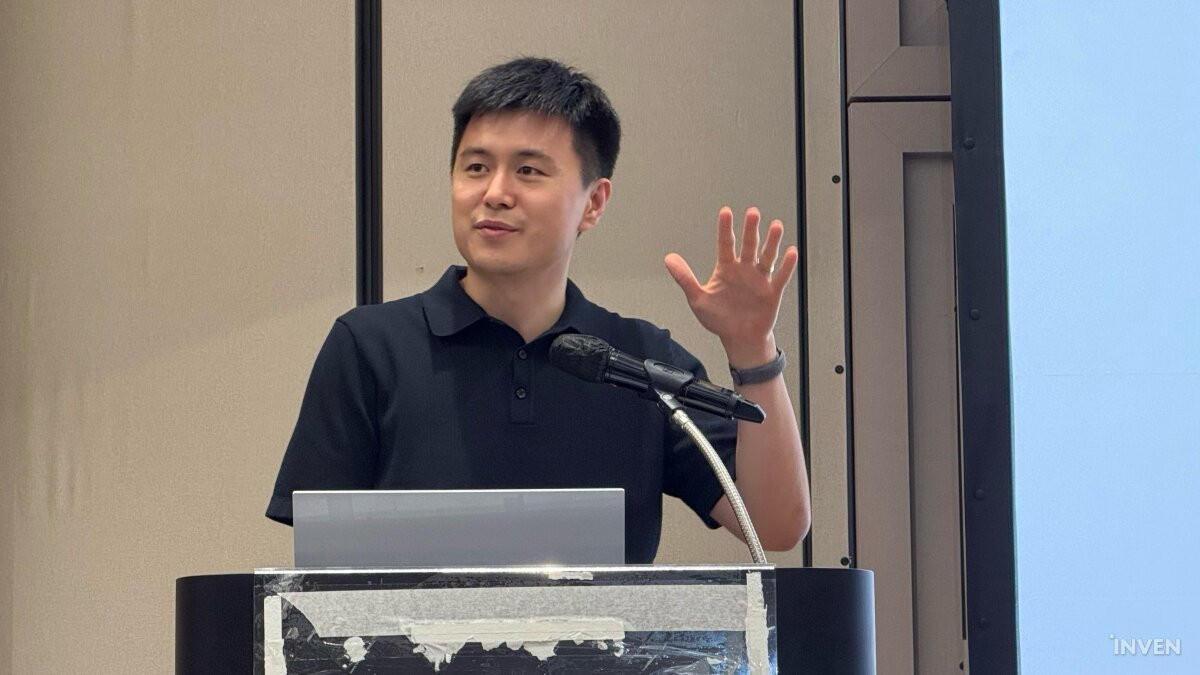
CAIO Lee served as the event's organizer and moderator. Speakers included Peter Stone, Chief Scientist at Sony AI (Professor at UT Austin); Lukas Schäfer, Researcher at Microsoft Research; Kim Min-jae, CTO of NC AI; Yenni Zaiden-Schwartz, Researcher at Odyssey; and Park Jung-soo, an engineer at NVIDIA. They discussed the theme: "AI that can defeat human champions already exists, but can that AI make a game 'fun'."
In his opening remarks, CAIO Lee explained the motivation behind the event. "We are witnessing numerous exciting research breakthroughs, and we are seeing those breakthroughs translate into actual games," he said. "For those who want to work in this field, now is the perfect time."
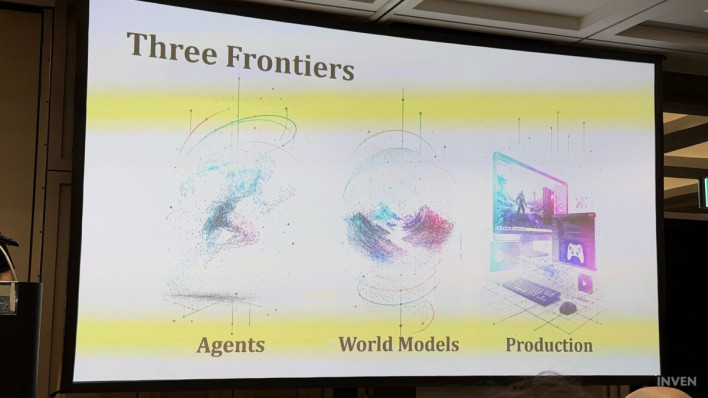
He outlined the three fronts, each with a distinct critical perspective. Regarding agents, he noted, "Games have long featured NPCs, but now there is a push to integrate true AI agents into games to create a much more immersive experience."
He offered an open outlook on world models: "We have built games using physics engines and graphic rendering until now, but world models that generate video could potentially replace game engines in the long term. Who knows? We might end up using game engines and world models together to create games."
He placed even greater emphasis on production issues. "Even with excellent creative capabilities, the current pipeline requires 4 to five years and massive costs for a single game," he said. "The upcoming GTA 6 took that much time and money to make. I hope AI agents will help make game production much more efficient."
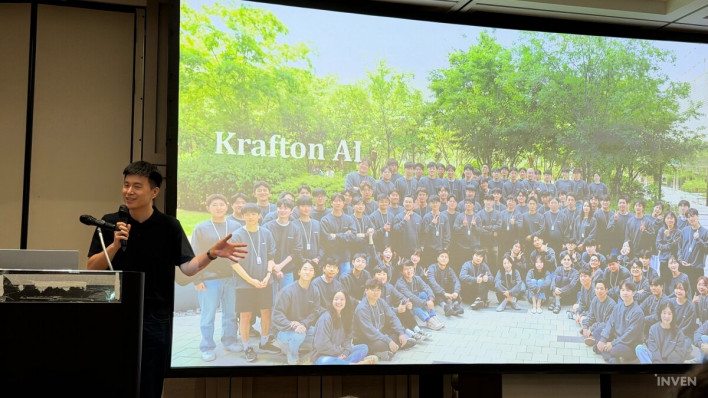
KRAFTON's current status was also revealed. CAIO Lee introduced KRAFTON's AI research organization, which, with about 150 members, is one of the largest groups in the gaming industry globally. He cited 'PUBG ALLIE' as the company's first major AI product recently launched for PlayerUnknown's Battlegrounds.
He described ALLIE as "an in-game AI agent that you can talk to and team up with to play together," adding, "The latency is so low that it feels almost like a real friend. You can discuss combat situations, decide what to do together, and request specific actions." He credited his team for the progress, noting, "We collected a lot of data during the two-week beta test, which we will use to further train the model."
"We Created Superhuman AI, but Fun Was the Problem"

The first speaker, Professor Peter Stone, summarized the five-year history of Sony AI's 'GT Sophy.' GT Sophy is a reinforcement learning agent that graced the cover of Nature in February 2022, becoming the first AI to defeat human champions in real-time control tasks rather than turn-based games like chess, Go, or poker.
The stage for this was 'Gran Turismo,' a simulation so precise that the lap time difference between a professional driver in a real car and in the simulator is less than 0.1 seconds. GT Sophy started out randomly hitting the accelerator and driving the wrong way on the track, but within a day in a training environment powered by networked PlayStation consoles, it was posting lap times faster than the best human players. Within a week, it had defeated four of the world's top drivers. It independently mastered techniques such as slipstreaming—tucking in behind a lead car to reduce air resistance before accelerating to pass—and choosing defensive lines to block overtakes rather than just taking the fastest racing line.
In the fall of 2023, GT Sophy was officially integrated into Gran Turismo 7 for PS5. Professor Stone introduced this as the world's largest commercial deployment of an end-to-end reinforcement learning agent, where research results moved beyond academic papers to become game content played by millions of users.
He also introduced a new study unveiled last week: a 'coachable agent' applied to 'Horizon Forbidden West.' A single reinforcement learning policy can handle diverse playstyles, such as long-range shooting and CQC, and users can adjust a slider to change the style in real time. He noted that this feature is particularly valuable for quality assurance (QA), where every possible action path must be explored.
He also shared lessons learned during the commercialization process. Professor Stone admitted that since constantly facing a superhuman opponent isn't fun, the core challenge of productization was not performance, but 'making it fun' and 'making it configurable.' While beating humans was a scientific challenge, he explained that once applied to a game, the metric shifts from win rate to enjoyment.
"With 30 Human Demonstrations, You Get an AI That Plays Games"
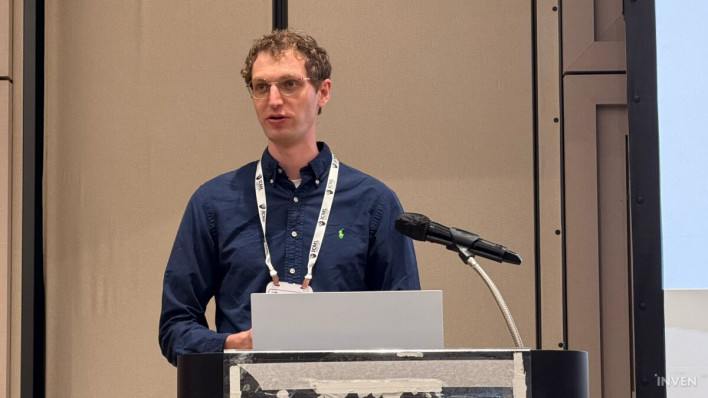
Lukas Schäfer of the Microsoft Research Game Intelligence team introduced research on two pillars: world models and gameplay agents. The team's flagship achievement is 'WHAM' (World and Human Action Model), published in Nature in 2025.
The key was data efficiency. The agent demonstrated by Schäfer learned to play actual games from just 30 human gameplay demonstrations, and they have now reduced the required demonstrations to 10–15. The model predicts actions within 30 milliseconds to achieve real-time performance at 30 frames per second, a result that overcomes network latency in remote environments where the model is on an US server and the game is on a KR server.
There was also a theoretical contribution. He announced that he is presenting a paper at this ICML explaining why models that predict future states first and then condition actions on them are superior to traditional Behavior Cloning (BC). While knowing the future reduces uncertainty in action selection, there is a trade-off: if the future prediction itself is inaccurate, harmful biases can arise. However, he proved that under certain conditions, learning efficiency and generalization performance are guaranteed.
He noted that research into world models and action models is converging under the name 'Action Models,' and this trend is leading directly to physical AI in robotics beyond gaming.
Not a Success Story, but a Failure Story: "AI is a Supporting Actor"
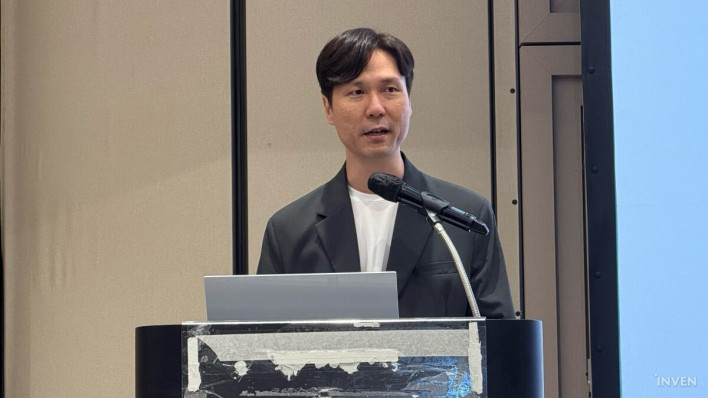
NC AI CTO Kim Min-jae presented a session titled 'Beyond Hype,' where he shared lessons learned from applying generative AI to game production and operations, focusing primarily on failure cases.
In terms of achievements, NC AI has deeply integrated text and image generation AI into the planning and concept art stages, and expanded asset production to core stages using proprietary tools for 3D mesh, texture, and sound generation. Tools currently in service include a localization tool that generates multilingual voice and lip-sync from Korean text, motion search to find game-ready animations in vast libraries, real-time chat translation, and a multimodal CS chatbot that understands game screenshots.
The problem was the point of contact with players. While AI NPCs were technically capable of endless conversation, players preferred dense, emotionally resonant narratives designed by human writers. The same was true for customization features that automatically generated 3D characters from user photos. Although it was a project CTO Kim led personally 4–5 years ago, adoption was low because even when the AI presented a character that "looked like you," players wanted an idealized character, not their real-life likeness, in the game.
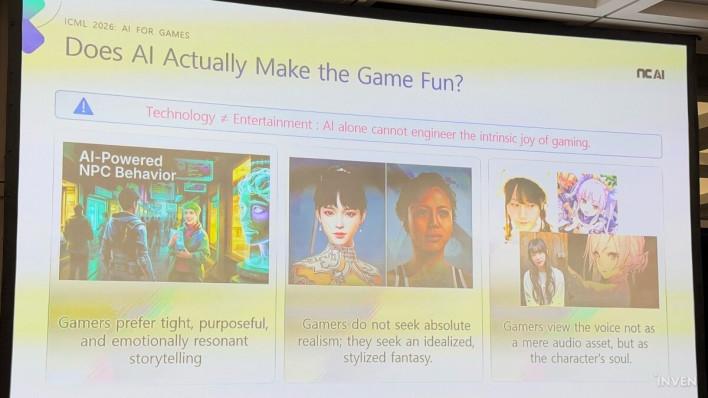
The strongest backlash came from attempts to replace voice actors with AI voice synthesis (TTS). This was particularly prominent in subculture games; his diagnosis was that for the fandom, voice actors are like K-pop idols, and their voices are not just audio files, but the soul of the character.
He also introduced the concept of the 'hallucination paradox.' While the entire AI industry uses strict Retrieval-Augmented Generation (RAG) systems to reduce hallucinations, games are fictional worlds with their own unique physics, languages, histories, and races. Forcing fact-grounding based on reality kills the fiction and destroys the creative unpredictability needed for world-building. Just as penicillin was discovered through a lab mistake, creative innovation in games comes from serendipity; thus, the goal of game AI is not 0% hallucination, but setting the boundary between knowledge and creative deviation.
CTO Kim concluded, "AI is not the protagonist of the stage, but a supporting actor; the protagonist is always the gameplay." He emphasized, "The job of AI researchers and developers is not to show off how smart the model is, but to deeply understand player psychology and accurately identify technologies that serve the fun."
Panel Discussion
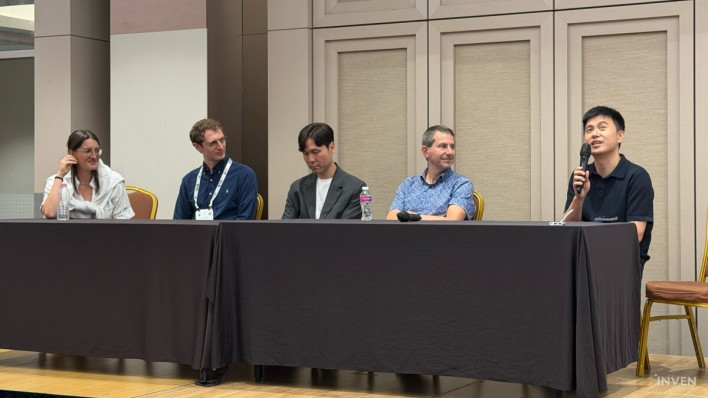
"Not AI That's Good, But AI That's Fun"
In the panel discussion following the presentations, CAIO Lee asked: "The biggest concern we face the moment we try to deploy these agents in actual games is not 'what is an agent that plays the game well,' but 'what is an agent that makes the game more fun and immersive?' For a publisher and developer like us, rather than pure researchers, this is a question everyone faces. Ultimately, what matters is what makes the game more immersive and fun. Can we train more fun and immersive agents through reinforcement learning?"
Professor Stone categorized game AI agents into two types: in-game agents that create fun as opponents, teammates, or NPCs, and QA agents that help developers find defects.
Researcher Schäfer argued that 'optimization' is not the answer. No player wants a game where they lose every time, and what makes video games different from other research domains is the unique resource of human demonstration data. He noted that if you ask 10 players what kind of teammate they want, you will get 10 different answers, suggesting that human-like play and personalized adjustments are key.
Differences in design philosophy also emerged. Professor Stone revealed that Sony AI has intentionally excluded imitation learning from human play data and stuck to pure reinforcement learning. The judgment was that it might be more fun for the AI to develop its own style or be coached via sliders rather than being constrained to mimic humans. This stands in direct contrast to Microsoft's approach, which uses human demonstrations as a resource.
"Everything is a World Model"
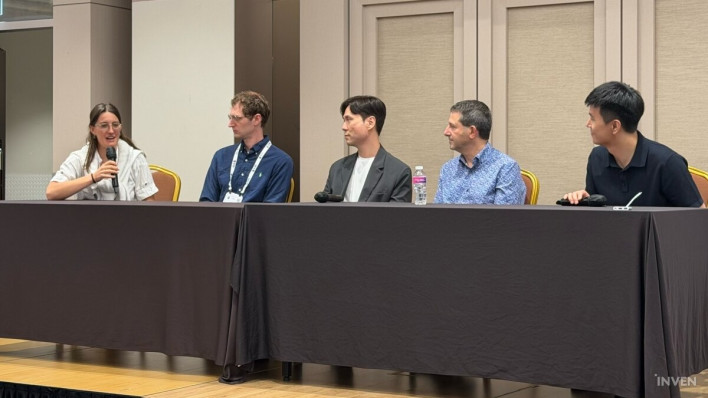
CAIO Lee, noting that he has been experimenting with various world models himself, pointed out, "World models can be used as auxiliary tools to improve vision and action models, but they could also become alternatives to game engines." He asked, "How far are we from using world models as real-time game engines that handle graphics and perhaps even multiplayer? As far as I know, computational efficiency isn't there yet. Is it 10 years away? five years."
No one provided a specific number. Researcher Zaiden-Schwartz replied that even if not used for viewpoint prediction or imitating existing games, world models themselves could already be a new element of fun. It allows for creative play where you can add anything you imagine to the world, not just fixed objects. However, she predicted it would take several years or more to replace high-end HD graphics.
Researcher Schäfer acknowledged the speed of development, noting that real-time operation was considered impossible just a few years ago, yet usable real-time models already exist. However, he predicted that there is no reason to completely replace excellent 3D graphics technology, and it will instead permeate specific use cases within game engines.
CTO Kim Min-jae raised the issue of consistency. Even simple casual mobile games have unique stories and visual identities; the moment a world-model-generated world breaks that identity or game rules, the player's immersion collapses instantly. While acknowledging the character consistency issue, Researcher Zaiden-Schwartz countered that in creative games where users make their own rules, like Roblox, it could actually be a potential strength.
Professor Stone pointed out that a world model is ultimately a transition function that takes state and action to predict the next state, and by that definition, game engines are world models, and model-based reinforcement learning has always utilized world models.
The dichotomy of whether to use a world model or not is a fiction; it is merely a matter of degree. He summarized, "The conclusion of this panel is that everything is a world model."
Regarding Odyssey's multi-agent world model structure, which separates simulation and rendering, CAIO Lee concluded, "The way it connects different models for different roles resembles how we designed game engines long ago. Let's see if we will see engines that combine what comes from neural networks with what comes from physics and graphics."
When an audience member asked about generalizability across games, CAIO Lee replied, "I don't know how good coding agents will be in a few years, but if a perfect coding agent emerges that can code any game, that is a world model. A world model in the form of a program can be generalized to any game." He presented code generation as a third path, distinct from the binary choice of video generation versus game engines.
"Not Replacing Testers, But Replacing Boredom"
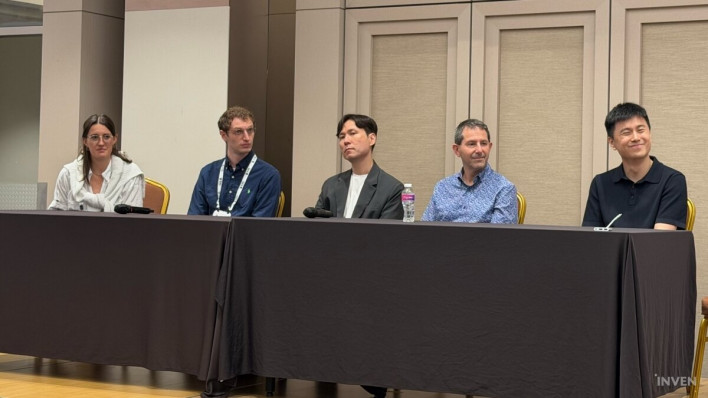
CAIO Lee expressed the frustrations of the industry. He presented three approaches to QA automation: #1 designing an agent that is good at QA, #2 using a world model to find vulnerabilities with an agent, and #3 classic automated QA. However, he admitted, "Honestly, I haven't seen a QA agent good enough to solve the problems we have right now."
Professor Stone argued that augmentation, not replacement, is the answer. AI is much more efficient than humans at repetitive tasks like finding edge cases—such as teleporting to the other side of the map if a character steps wrong. He also explained that if incentive systems are designed correctly, they can find cheats and shortcuts that developers need to block.
He also noted the distinction in development stages. QA agents should be deployed while the game is being built, while play agents for opponents and teammates should be created after the game is nearly complete. Putting a play agent into an unfinished game inadvertently turns it into a QA agent that only finds flaws.
When CAIO Lee asked, "Has NC AI tried QA automation?" CTO Kim Min-jae answered with a field example. He explained that their QA organization has built and operates its own 'Monkey Test' agents that tap game screens overnight to find missing text, broken icons, and non-functional buttons, and they have also delivered models that generate QA checklists using LLMs fine-tuned for the game domain.
Researcher Schäfer revealed that their research on few-shot learning started with QA. The rich knowledge human testers have about 'where things are likely to break' is irreplaceable; what AI should take over is the repetition and boredom of having to reproduce the same bug dozens of times per patch. CAIO Lee supported this with his experience at PUBG. "In a game designed for 100 players, even if you want to test an intermediate version, you need to gather 100 people to start a match, which is nearly impossible," he said, highlighting the structural demand for multiplayer game QA where testing cannot even begin without bots. He evaluated Schäfer's human-demonstration-based approach as having great potential at this exact point.
The discussion also covered the connection between game AI and physical AI. Professor Stone traced the lineage of 'AI vs. Human Champions' from board games to video games (GT Sophy, Dota) and on to physical games like drone racing and table tennis. He introduced how Sony AI's table tennis robot defeated a player who is ranked 5th in the world and a two-time Olympic silver medalist, and how the lessons from GT Sophy were directly linked to this project. When asked about a comparison to AlphaGo's 'Move 37,' he cited cases where a pro driver learned a new driving technique after watching GT Sophy's braking timing, and a pro coach said after seeing the table tennis robot's spin shot, "It's a technique humans wouldn't have tried, but now I can try to follow it."
To an audience question about research into human-like NPCs with persistent values and internal states, CAIO Lee opened up the design of ALLIE. ALLIE is an agent based on a small language model with a three-layer memory structure: an in-context memory layer (the ability to understand and perform patterns immediately based on information and examples in a given prompt without prior parameter modification), a retrieval layer that summarizes and stores in-session conversations, and a cross-session retrieval layer that spans multiple matches. "It can refer to conversations during the game as well as stories shared in past sessions," he explained.
He also revealed the data collection method for creating more human-like agents. "We rented an internet cafe and recruited thousands of players, recording their voices and play as they played the game to see what they said to teammates and how they conversed, using this for model training," he said. "It's still in the very early stages, but I haven't seen other cases that have attempted this."
In the day's discussion, attendees noted that with the era where the goal was to defeat human champions effectively ending with GT Sophy, 'fun' and 'player psychology' have been identified as the final goals. This is evidence that the technology has matured and a signal that the next stage of competition, evaluated by fun rather than benchmark performance, has begun. It shows that the gaming industry, now in its second or third year of generative AI adoption, is moving past the period of hype into the stage of verification.

Sort by:
Comments :0