In the esports events at the 2026 Aichi-Nagoya Asian Games, there was a word heard just as often as news of the national team athletes' matches: "physical therapist." Regardless of their game or age, numerous national team players voiced their gratitude toward the physical therapy team in broadcasts and interviews. At the start of the Busan training camp, players were unfamiliar with leaving their bodies in the hands of physical therapists, but once management began, they frequented the therapy room so often that the threshold was practically worn down with reservations pouring in. At the event venue, some players even came and lay down before their scheduled treatment time.
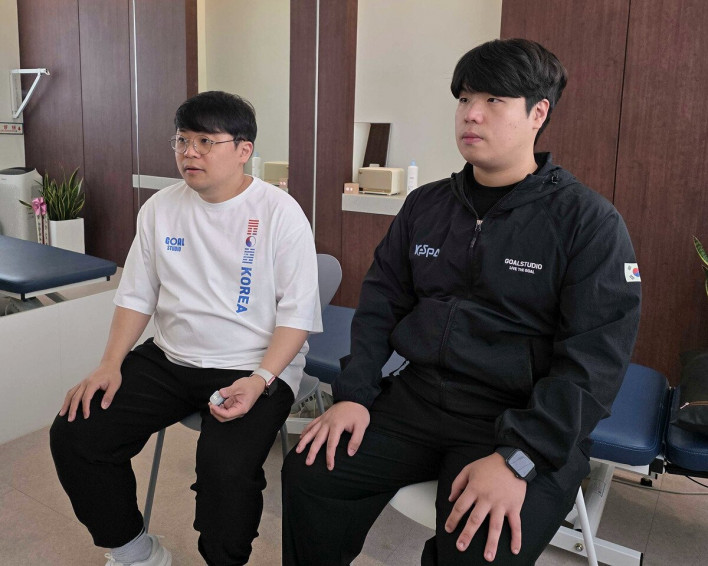
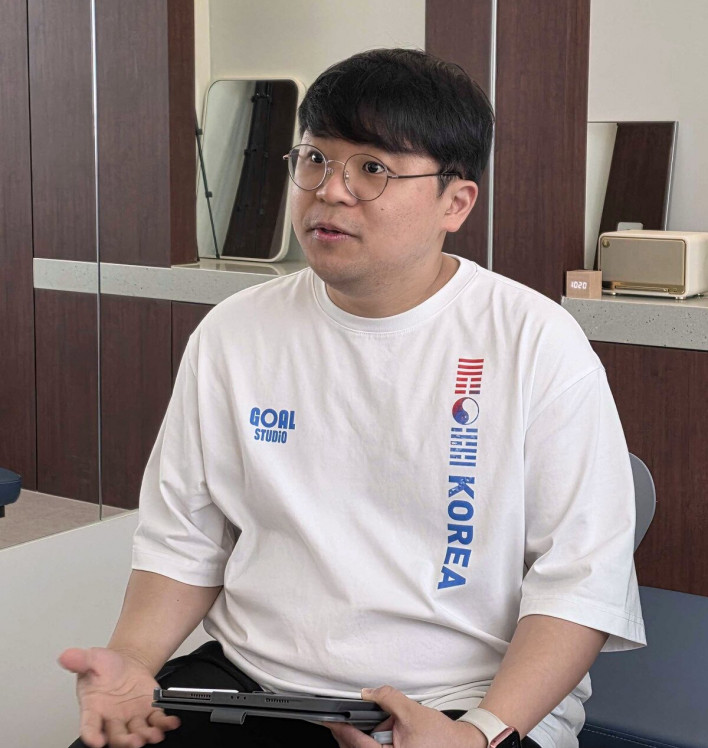
The main figures who captured the hearts and minds of the players are Kim Jae-pil, Director of the Esports Division at PNP Healthcare (a 10th-year physical therapist), and Yoon Seung-heon, Physical Therapist (5th-year). A physical therapist who once dreamed of becoming a 'StarCraft' pro gamer but changed his career path due to pain and a plateau in skill, and a physical therapist who was a former athlete retired due to injury and a gaming enthusiast. These two individuals, each with a somewhat special background, applied individually to the association's public announcement and joined after interviews. Together with their colleague Heo Heon, who could not join this interview due to schedule and location constraints, they guarded the wrists and backs of the players throughout the Asian Games.
Their work did not end with simply massaging tight muscles. They examined the equipment and posture used by each player, guided customized exercises, and even checked how many hours they slept and what they ate. It was essential care for pro gamers who repeatedly push delicate movements of their hands and arms to the limit while keeping their bodies stationary in chairs for long periods.
We met the two physical therapists to ask what they discovered while caring for the players' bodies at the Asian Games base camp. After hearing their story, the reporter personally received conditioning to see what the process of "esports conditioning" they spoke of actually looks like.
First, please introduce yourselves and tell us how you joined the national team for this Asian Games.
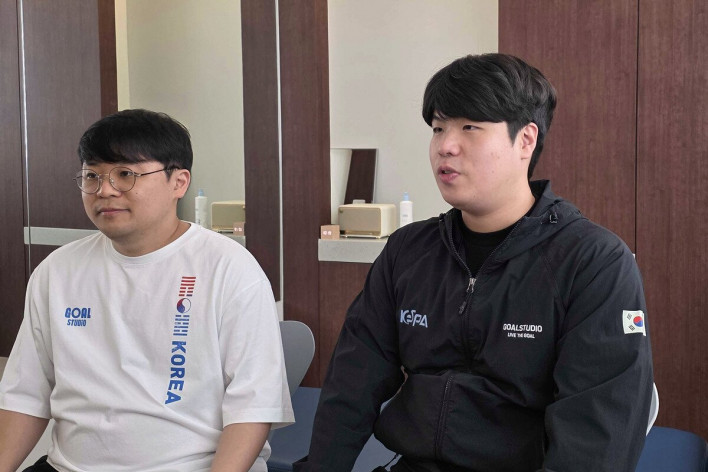
" PNP Healthcare Director Kim Jae-pil: I am Kim Jae-pil, a 10th-year physical therapist currently serving as Director of the Esports Division at PNP Healthcare and working at Aon Exercise Center. After working in hospitals and other facilities, I joined the company three years ago after hearing that I could specialize in caring for esports players.
PNP Healthcare Physical Therapist Yoon Seung-heon: I am Yoon Seung-heon, a physical therapist in my 5th year. While specializing in manual therapy at a hospital, I learned that there was a company specializing in treating pro gamers. Having loved games since my student days, I naturally came to the esports field.
As for the national team, I first participated as part of the national therapy team during the 2024 Korea-China-Japan Esports Competition. At the time, I felt a lot of regret because the schedule was short and experience was lacking, so I wanted to challenge myself once more as a national team therapist at this larger Asian Games. Seeing the association's announcement, I applied individually apart from my company and was selected after an interview.
We are also curious about what led you to choose physical therapy as a profession and the rewards you feel while working.
" Kim Jae-pil: My father was a physical therapist. I personally dreamed of becoming a 'StarCraft' pro gamer when I was young, but I gave up on that path as my skill plateaued and I experienced frequent body pain. Afterwards, as I enrolled in physical therapy and studied, the process of caring for each individual and bringing about change was as interesting as a game. That thought of directly taking care of players' bodies led me to where I am today.
Yoon Seung-heon: I was originally an athlete, but after undergoing surgery due to a major injury, I failed to return to sports and changed my career path. While looking for a job related to the body, I started physical therapy. Even if players don't express it loudly, when they quietly return saying they feel definitely different after receiving care, and when I feel in the hospital that I've made a positive change in a patient's life, that is when I feel the greatest sense of reward.
Compared to dealing with general patients or traditional athletes in a hospital, are there any characteristics you noticed while managing pro gamers' bodies?
" Kim Jae-pil: At first, I approached it looking only at structural conditions identified on X-rays or MRIs, such as forward head posture or straight neck and spine, but there were cases where things didn't resolve as expected. Pain doesn't necessarily appear only from structural damage; it can also be a warning signal and hypersensitivity reaction sent by the brain. Pro gamers, in particular, maintain one posture for over 10 hours a day and have irregular sleep patterns, making recovery slow. Only when approaching comprehensively by considering pain mechanisms, daily habits, and recovery alongside body structure were we able to provide practical help.
Yoon Seung-heon: Pro gamers are a unique hybrid of athletes and office workers. While maintaining high concentration, they push fine physical capabilities of delicate areas like fingers and arms to the limit, yet their actual posture remains fixed for long periods like office workers. On the other hand, compared to the physical abilities they expend, they are also a group with the lowest awareness of the importance of managing and strengthening their bodies.
How is care actually conducted? Please explain the exact concept of "conditioning" as physical therapists call it.
" Kim Jae-pil: "Conditioning" is not magic that boosts game skills; it means returning a player to a healthy physical state where they can fully demonstrate their original capabilities without pain. We mainly utilize four methods: massage care, taping, exercise therapy, and education. Since pain often comes from a lack of movement, we need to encourage exercise, but each player has different physical stamina and goals. We provide customized guidance according to individual needs, such as whether they want external physical changes or need stamina to concentrate for long hours.
Yoon Seung-heon: You can think of it as comprehensive conditioning based on physical therapy. Beyond massage and exercise therapy, we also look at meals and sleep patterns. Right before a match, we recommend a diet that lowers inflammatory responses in the body and even help establish sleep routines.
Kim Jae-pil: On site, we did a lot of nagging to reduce spicy or fried foods that could interfere with blood circulation or affect condition. Instead, we recommended eating bananas or almonds in the morning for energy balance.
Were there any players at this Asian Games who were particularly memorable or proactive about conditioning?
" Yoon Seung-heon: Kim Young-chan from 'Gran Turismo 7' stands out in my memory. He had pain and weakness in his arm, so we checked his grip strength frequently, and he was so passionate that he came in morning, afternoon, and evening to log it by hand, and even called us to the practice room to ask for status checks. Yeon Je-gil and Lee Kwang-no from the fighting game events also had frequent pain before and after training, so I remember conducting conditioning multiple times a day to raise their physical condition.
Kim Jae-pil: Older players definitely had higher interest in their bodies and understood the necessity of care well. When we recommended customized postures and routines for each player, they actively accepted feedback, which helped maintain match performance.
Does the physical burden or management method for players differ depending on the game title or equipment used?
" Yoon Seung-heon: Differences depending on input devices per title are quite significant. For example, in 'Gran Turismo 7', players must exert force directly to turn the racing wheel handlebar, and impact from car crashes or road vibration feedback is transmitted straight to the arms, placing a substantial load on them.
Kim Jae-pil: Since Kim Young-chan is also a real-life racer, we had to consider existing physical burdens he carried as well. Apart from that, monitor height, field of view angle, and chair environment are also important. Whether the in-game screen is in windowed or full screen mode, and whether input devices are keyboards or arcade levers, completely changes how the body is used and the physical stress applied. On top of this, we also look at age, weight changes, and long-accumulated usage habits.
How did you feel when players frequently mentioned the physical therapy team on broadcasts and in interviews?
" Kim Jae-pil: Watching the broadcasts, I felt very proud and honored. First, being able to join the national team and be there with them; second, the emotion when they won medals and the players' positive reactions; and third, I felt the greatest reward when they didn't forget to mention our therapy team in interviews and broadcasts.
Yoon Seung-heon: I only did my duty, but I was grateful that they mentioned us far more than expected. It made me feel that what we do actually helps players enough for them to directly feel it. During the Busan training camp, we were worried demand might be low because players were unfamiliar with it, but once we started, so many came that reservations poured in. It was very rewarding to know that they felt the need for it and recognized its value.
How long does a single session usually take, and what is the appropriate care cycle?
" Kim Jae-pil: At the Asian Games, due to the nature of team care, we conducted sessions in 30-minute intervals, whereas individual care normally takes about an hour. In the initial stage when pain is severe, we provide intensive care 2 to 3 times a week to quickly reduce pain and restore function. Afterwards, as condition improves, we gradually widen intervals to once a week or once every two weeks while monitoring self-management. Checking like a nag whether they are exercising, how many hours they slept, and what they ate is all part of our job.
Yoon Seung-heon: In short tournaments, some players require daily care until the competition ends.
Do you continue to interact with the players even after the tournament?
" Kim Jae-pil: We still stay in touch. Even last week, someone invited us to drop by casually, so they came to experience exercise training, and like Kim Young-chan, there are cases where players check in or continue consulting us for other pain issues. During the tournament, head coaches and coaches also received care together, and coaching staff members who were former pro gamers often visited daily because they had many uncomfortable body areas.
A question gamers often wonder about: is there a "worst posture" that should absolutely be avoided?
" Kim Jae-pil: There is no posture in the world that is absolutely bad, nor one that is perfectly good for the lower back. Assuming a specific posture is the body's natural compensatory reaction to disperse load from that area to elsewhere. What matters is not the posture itself, but how long you stay in one posture; adjusting your sitting position or standing up after a certain amount of time is the answer. Pro players often lose their in-game form when trying to forcibly change their posture. If they must stick to a familiar posture to maintain form, we approach it with customized conditioning to build muscles and stamina capable of enduring that posture.
Yoon Seung-heon: There is a saying in physical therapy: "The best posture is the next posture." Defining a specific posture as a "bad posture" can plant psychological anxiety (a yellow flag) in players, which may actually cause their bodies to tense up more. Take any posture comfortably, but changing posture frequently at around 30-minute intervals is best.
If you were to pick pain prevention tips that ordinary gamers who enjoy games can practice in daily life?
" Kim Jae-pil: First, you need to recognize how many hours your body can endure without pain—in other words, how many hours your "physical battery" lasts. If you are a pro, self-management to build a body capable of handling long hours of play is essential.
Yoon Seung-heon: I would like to emphasize three points. First, as mentioned earlier, get up and move between games to change your posture frequently. Second, regular aerobic exercise, which is effective in reducing pain and inflammation. Third, improving eating habits—taking care to eat healthy meals regularly rather than relying solely on fast food is important for long-term joint and muscle health.
What environmental regrets did you have at this tournament, or what support would you like to see supplemented for esports players in the future?
" Yoon Seung-heon: Players need to actively move their bodies beyond just massage, but it was regrettable that the physical space at the local base camp was narrow and lacked a sufficient environment for exercise. Long-term, I hope awareness grows that conditioning and exercise are crucial to extending a pro gamer's career. I hope the association also promotes the necessity of exercise and health care, and establishes a system where players can put this into practice.
Kim Jae-pil: If securing physical training time tailored to esports traits, psychological rapport, and systematic support for healthy snacks/diets like bananas or almond drinks are backed up, players will be able to maintain better condition. Furthermore, I hope players do not try to overcome tiredness or warning signs in their body through sheer practice volume alone, but instead seek experts to resolve the root cause. If you force yourself to adapt and play while your body is impaired, it becomes much harder to regain your original form later.
As we wrap up the interview, do you have any final words you would like to share?
" Kim Jae-pil: Although there were many concerns during the process of applying and joining the national team, I would like to thank CEO Jeong Mun-seok of PNP Healthcare for helping us succeed. I am also deeply grateful to the national esports players who trusted and followed us on site, and I was proud to be with them. Finally, I want to express my thanks once more to therapist Heo Heon, who couldn't be at this interview due to schedule and location constraints, and therapist Yoon Seung-heon, with whom I relied on and gained strength at the tournament site.
Yoon Seung-heon: I also thank CEO Jeong Mun-seok for opening up many opportunities. Since conditioning is a field directly linked to a pro gamer's performance and career longevity beyond simple massage, I hope players take more interest in their bodies and actively receive care.
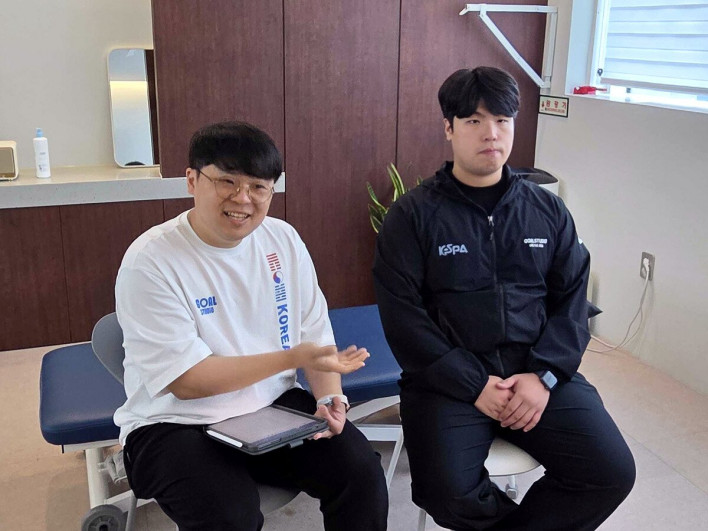
Conditioning as experienced firsthand by a former pro reporter
After the interview ended, there was a brief time to experience care firsthand. What Director Kim Jae-pil checked first was usual daily playtime and when discomfort began to show. A fellow reporter answered that when playing as a former 'StarCraft' player in the past, stiffness in the nape of the neck and back set in after playing two to three consecutive hours. Director Kim noted, "Those two to three hours are your physical battery capacity," and immediately moved to movement checks.
The first step was standing up, bending at the waist, and sitting down and standing up as if squatting. Director Kim advised, "Don't think of it as a squat, just think of sitting and standing comfortably," and after having the reporter repeat the movement, observed the angle of descent and range of motion. The diagnosis was 'excessive tension in the lower back.' The explanation returned that the descent angle was identical every time and movement around the lower back was locked up.
Instead of forcibly correcting posture, Director Kim guided rolling the pelvis toward the abdomen while rounding the back, first waking up the stiffened movement. Next, he had the reporter sit on the edge of a chair and repeatedly bend the upper body deep enough for both hands to touch the floor before standing up. Director Kim explained, "This is a process of inputting to the brain that 'it's okay to move this much, you can do it,' relieving pressure accumulated on the lower back."
Although there was no severe pain right away, waking up movement through changing motions made the descent process when sitting down again significantly more comfortable than at first.
Taking over the baton, Physical Therapist Yoon Seung-heon moved to care for the arm area, which nearly every player sought at the Asian Games. It was the exact care that fighting game veterans like Lee Kwang-no received twice a day.
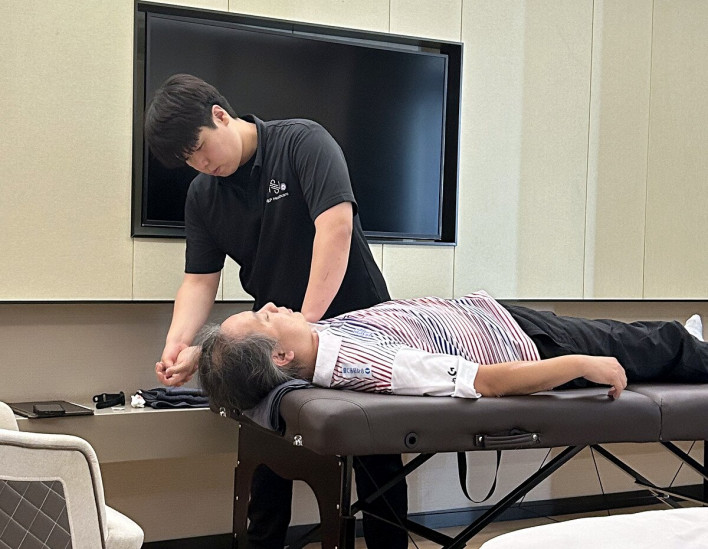
First, while seated in a chair, nerve sensitivity was checked by raising both arms and bending the wrists backward, after which arm and shoulder positions were changed while lying on a bed. While testing seated showed no particular pulling sensation, adjusting arm angles while fixing shoulders on the bed brought a tight pulling feeling along the arm. Turning the head in the opposite direction of the arm made the pulling sensation even stronger. Therapist Yoon explained, "It's a process of creating space by massaging the pathway where the nerve passes while stretching and releasing the arm, with the head turned away from the hand to lengthen the nerve."
After Therapist Yoon massaged around the pulling area and checked reactions, the arm was pulled again with the same movements as before care.
"It pulls a bit less than before."
Next, when stretching both arms overhead, the right arm felt a "lighter sensation with less strain" compared to before care. The two therapists repeatedly had the subject perform movements, listened to responses, and rechecked the same movements to demonstrate the change.
When managing players, this final check process leads directly to actual gameplay. Director Kim explained that after finishing care at the quarters, he immediately has players move their mouse and keyboard or launch practice mode to ask about in-game sensations. They check down to how the fingertips feel when returning to habitual playing motions. The question posed to a 'League of Legends' player was this specific:
"Try using Ezreal's Q skill—how does it feel right now?"
Even in the short observation of player management, one could see how meticulously the physical therapists checked the players. And throughout the interview, it was clear that professional-level care can only be achieved by looking comprehensively at health across various aspects, including player posture, dietary habits, and lifestyle patterns.
2026 Asian Games Esports National Team
Stories from the national team with the physical therapy team
Especially as the tournament drew near and practice time increased, pain developed in various areas like the wrists, arms, back, and ankles from turning the wheel.
The physical therapy teachers diagnosed exact symptoms, checked my posture during actual gameplay, and provided care accordingly, so I could feel my condition recover day by day. Thanks to them measuring my grip strength daily and helping me focus solely on the game, I think I was able to win a bronze medal. Thank you so much to the teachers who helped me!
I received physical therapy during training, and given the nature of a pro gamer's profession, I believe physical elements and condition management are crucial. My physical state actually improved greatly while receiving treatment, which allowed me to concentrate even more on training.
In particular, since this is a profession that uses wrists a lot, wrist management is important. After treatment, my wrists, which felt heavy, became much lighter, allowing me to maintain good condition during important matches.
They also detailed things I was usually curious about, such as diet management and sleep posture, which was very helpful. It was a meaningful time not just receiving treatment, but also learning how to manage my body day-to-day.
Thank you sincerely for helping me concentrate on training and matches in good condition.
However, receiving rehabilitation exercises and massages for painful areas from physical therapy teachers actually reduced the pain, and I felt a difference in condition during practice and matches depending on whether I received treatment. Furthermore, they provided helpful health information, such as identifying causes of pain stemming from usual gaming posture and rehab exercises good to continue in the future.
The physical therapists systematically checked individual conditions and pain, providing customized treatment accordingly.
Thanks to them, I could manage my physical condition more effectively, and with pain relief stabilized, I was able to fully dedicate myself to training and matches.
I realized that physical therapy can be of huge help to esports as well, gaining another way to try improving my match performance.
Thanks to receiving physical therapy consistently during the long training period, I was able to train in a stable environment until the end. Thank you!
Every time I received treatment once a day, my mind felt much clearer, and I could directly feel noticeable improvements in uncomfortable body areas, which was amazing.
In my case, my neck and shoulders tend to get bad when stressed or in difficult situations, but thanks to the therapists during this Asian Games season, I was able to focus on training without major discomfort.
I want to express my sincere gratitude to the three therapists who always treated us meticulously throughout this Asian Games period and helped us devote ourselves to training.
Through physical therapy, I hardly felt physical discomfort during the camp period and could immerse myself entirely in practice.
Also, pointing out issues with my usual posture and solutions in detail was very helpful.
They matched the players' entire schedules from early morning to late at night, yet always greeted us with a smile and kindness, allowing us to receive treatment in comfort every time. I want to make sure to convey my gratitude.
Given the nature of esports, many people needed physical therapy, and resolving awkward postures and stiff muscle issues helped relieve tension, which had a practical effect on building good match performance.
The physical therapists supporting players on site are proud members of the national team as well, and I offer my gratitude once again.