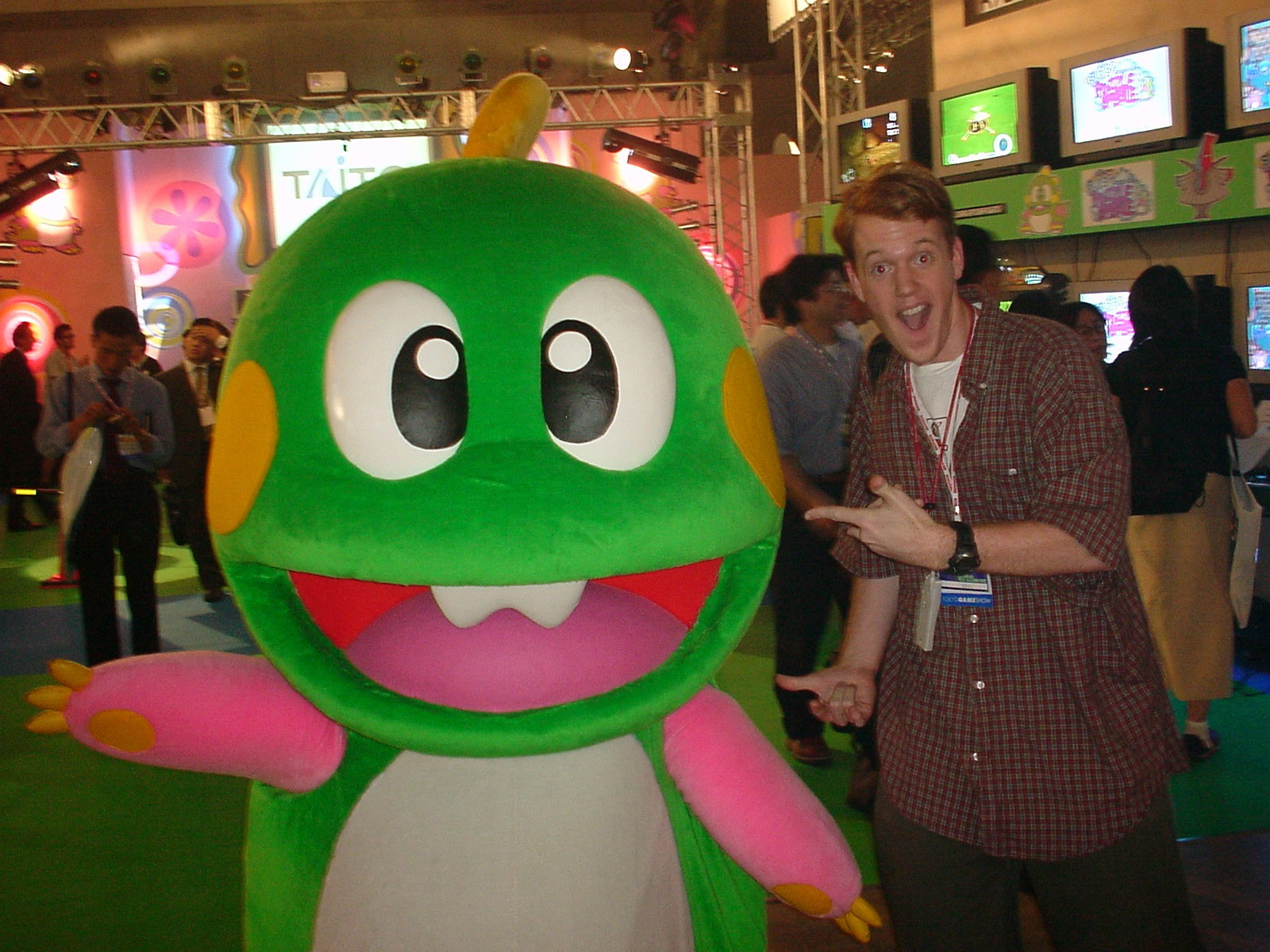
The Video Game History Foundation (VGHF) has added more than 300 never-before-seen photos of Japan's late-1990s and early-2000s game industry to its free Digital Library, in a new set called the Colin Williamson Photography Collection.
According to a release, Williamson wrote for IGN, PC Gamer and other outlets at the time. He covered shows such as Tokyo Game Show and the JAMMA Show, an arcade industry trade event, and interviewed developers including Hideo Kojima and composer Nobuo Uematsu. He shot it all on a digital camera. In 1999, that was still new tech. The photos are now free to browse and use for educational purposes.
The VGHF is a US non-profit that works to save the history of video games: old games, source code, magazines and the paper trail around them. Its Digital Library is the online archive where much of that material is opened up to the public.
Trade shows and Akihabara streets
Trade show shots include the Gran Turismo 3: A-Spec booth and a Shenmue exhibit (complete with a forklift, the release notes). Others show a street promotion for Space Channel 5 with producer Tetsuya Mizuguchi. There is also Nintendo's Space World event, where the company showed off the Game Boy Advance.
Williamson pointed his camera at the streets too. The release singles out Akihabara and other Tokyo landmarks, such as the red Club SEGA exterior and the SEGA Hi Tech Land arcade sign with Sonic the Hedgehog on it. Stacks of CRT TVs and PC monitors fill other frames; ads for Jet Set Radio and Final Fantasy IX turn up as well.
“As a journalist and a fan, Colin had the foresight to capture not just the big events, but also everyday scenes of gaming culture in Japan,” said Phil Salvador, Library Director at the VGHF. “We might consider pictures like these to be unremarkable when we take them, but decades later, they can be an important snapshot of history.”
Williamson recently joined the VGHF podcast, Video Game History Hour, to talk about his years covering games in Japan. Patreon members get an extra-long bonus section on the collection.
What the 2026 impact report says
The collection lands right after the VGHF's 2026 impact report, which looks back on the past year. According to the report, the Digital Library now holds more than 8,000 cataloged items. That works out to 61,000 individual files.
The report also points to Xcavator, an unfinished NES game cancelled in 1991. The VGHF recovered its source code in 2024 from the family of the late programmer Chris Oberth. With help from Mega Cat Studios and iam8bit, the game was then put on sale; all profits go to the foundation's preservation work.
The group now owns Computer Entertainer as well. According to the release, it was the only American magazine known to cover home console games in the mid-1980s, and it reviewed The Legend of Zelda and Super Mario Bros. at launch. Every issue has been digitized. All of it is free to use under a Creative Commons license.
“We knew people were interested in genuine, human-curated history, but we had no idea just how popular this resource would be,” said Frank Cifaldi, executive director of the VGHF. Cifaldi added that the library serves ‘hundreds of curiosity seekers from around the world every day’.
Next up is the annual Winter Fundraiser. It starts on December 1st (Giving Tuesday) and runs through the month, with new videos and blog posts on influential trendsetters and cancelled projects. More details are due in the coming weeks.
The Video Game History Foundation is a 501(c)(3) non-profit founded in 2017 by former game journalist Frank Cifaldi, with a physical space in Emeryville, California. It runs on donations from the game and history communities, which can be made through its official site or Patreon.
The following was sent as a press release to Inven Global.