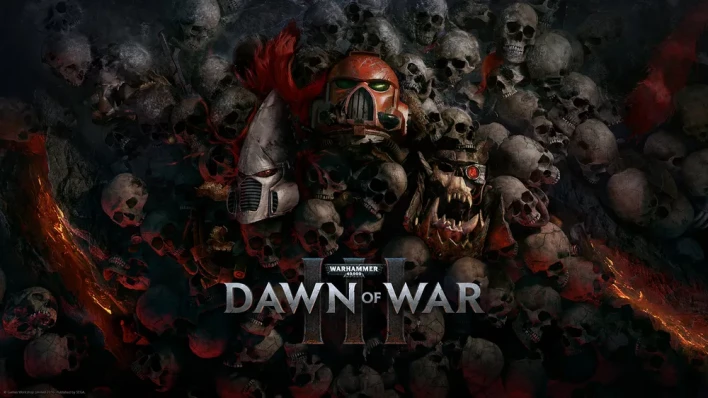
In 2017, 'Warhammer 40K: Dawn of War 3' was released with great fanfare. And then, it flopped just as grandly.
About a year later, the developer officially declared the game abandoned, so there is no denying its fate. Much like a certain entry in the C&C series, it was treated among gamers as if it had practically been erased from history. Personally, I found it quite enjoyable—after all, games where Imperial Knights stomp around aren't exactly common.
In any case, following the crushing failure of Dawn of War 3, Warhammer 40K RTS fans began engaging in wishful thinking of their own.
"Surely Dawn of War 4 will get its act together when it comes out?"
"Since CA keeps making Warhammer Fantasy, wouldn't they make 40K too?"
...they wondered. And as fate would have it, after many years, both of these dream projects emerged at once: Creative Assembly's in-development 'Total War: Warhammer 40K' and 'Warhammer 40K: Dawn of War 4' (hereinafter Dawn of War 4). Consequently, both titles found themselves in a somewhat peculiar position. While they pursue different goals when examined in detail, they share the undeniable common ground of being strategy games based on the same source material.
Having recently played 'Total War: Warhammer 40K' briefly and shared my thoughts, it is now time to write down my impressions of playing 'Dawn of War 4'.
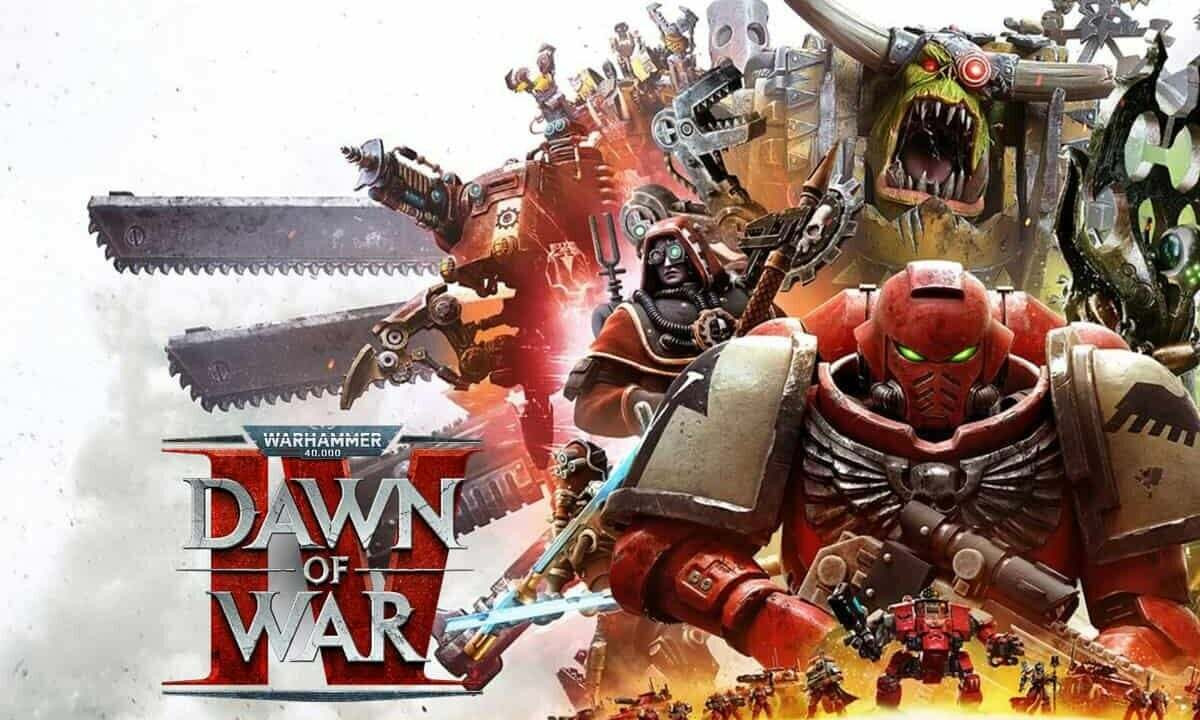
Dawn of War steps out from Relic's wings Cherry-picking only the best elements
The first point to address is that the developer has changed. The Dawn of War series was traditionally developed by Canadian studio Relic Entertainment, which constantly tried new ideas across three installments.
While the first game followed relatively traditional RTS rules, the second entry heavily incorporated systems from Relic's other franchise, Company of Heroes. Then, by the third game, they combined MOBA rules to create a bizarre strategy game—and the fact that these mechanics failed to suit the tastes of existing gamers was one of the reasons behind Dawn of War 3's failure.
Meanwhile, new developer KING Art Games cherry-picked only the worthiest elements from the previous three games. In other words, they laid out all the established mechanics and helped themselves to only the tastiest offerings, like a buffet.
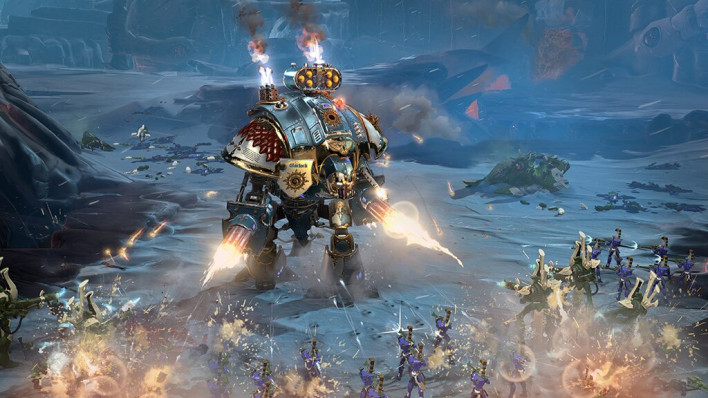
At its core, 'Dawn of War 4' is based on the traditional RTS mechanics of the first game. Production buildings exist for each unit type, and players establish front lines around resource nodes while battling for territory. Unlike Dawn of War 2 and 3, which focused on small elite forces, players can train armies and engage in large-scale clashes as long as resources permit. Reinforcements and recovery are also simple, allowing forces to be continuously replenished as long as resources are available.
At the same time, it tastefully incorporates elements from Dawn of War 2 and 3.
Before battle, players can select a Commander for their faction, and the army's synergy changes depending on that Commander's archetype. Taking Space Marines as an example: choosing a Chaplain mounted on an Assault Bike favors a highly mobile army composition. Selecting a Chief Librarian boosts the effectiveness of formidable melee units like Bladeguard Veterans or Assault Intercessor Squads. A Company Master is versatile but lacks mobility, making him a solid pick when pursuing a heavy, durable composition.
The wargear (equipment) and abilities assigned to each unit remain as well. However, their execution has been simplified so that it no longer feels overwhelming. Selecting wargear is mostly a matter of tailoring choices to the opponent's army composition, and active abilities are limited to at most one per unit (aside from Commanders) or none at all, making them easy to manage.
What 'Dawn of War 4' aims for is relentless attrition warfare and high-level tactical adaptability. Where Dawn of War 2 aimed for maximum combat efficiency with small forces, and Dawn of War 3 required careful army composition centered around strategic objectives, Dawn of War 4 focuses on observing the shifting battlefield and continually producing units that effectively counter the enemy's roster.
Of course, ordering tactical retreats to save high-veterancy squads or unleashing powerful Stratagems and tactical strikes on concentrated enemy forces is still necessary. However, compared to previous entries, squad wipes carry far less burden, and reinforcements arrive rapidly. After playing a few matches, players will quickly feel that overall micromanagement has been reduced, making the game far more approachable.
Distinctly differentiated factions Oozing with the charm of asymmetrical RTS design
From another perspective, 'Dawn of War 4' showcases asymmetry—a cornerstone of strategy gaming—exceptionally well. Long ago, early RTS titles were mostly symmetrical; games like 'Total Annihilation' or 'Warcraft 1 and 2' featured minor unit stat differences, but were symmetrical at their core. Asymmetrical RTS design truly was established through Command & Conquer and StarCraft, where, as everyone knows, the Zerg, Terran, and Protoss play completely differently.
All four playable factions in 'Dawn of War 4' feature heavily asymmetrical design, each brimming with unique characteristics.
The 'Space Marines' are defined by small elite units and reserves. While each unit is very expensive and total squad count is low, individual unit stats are remarkably strong and versatile. Even Infiltrator Squads, which function like scouts, are stronger than most line infantry, while Bladeguard Veterans or Terminator Squads are powerful enough to destroy three or more enemy squads single-handedly. However, because they are so elite, losing a squad results in a severe loss of firepower. This weakness can be offset using 'Reserves'—units produced ahead of time that can be deployed onto the battlefield at a moment's notice.
The 'Orks' are defined by rapid expansion and massive numbers. Because every unit can build structures (Orks construct by throwing down scrap and assembling on-site), they can plant 'Waaagh! Banners' across the map and engage in continuous attrition warfare with forces that reinforce at blinding speeds. While individual unit quality is lacking, Orks crush their foes through sheer numerical superiority across most front lines.
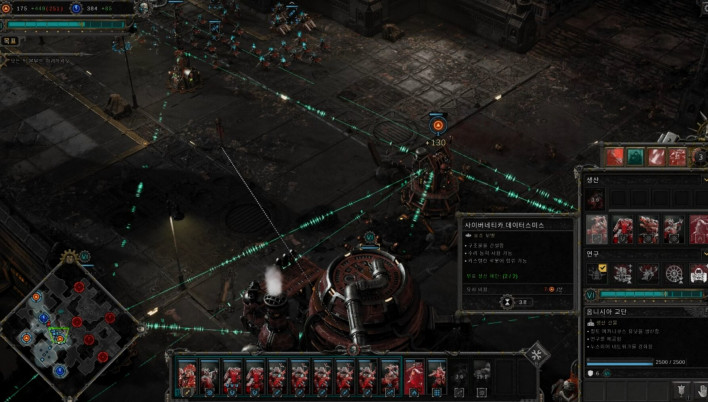
The 'Adeptus Mechanicus' centers on rapid tech upgrades through the 'Noosphere'—a network relay between structures—and overwhelming ranged firepower. While they have few builder units, properly spacing buildings to create the network boosts structural defense, making established positions tough to break while long-range forces easily deny enemy advances.
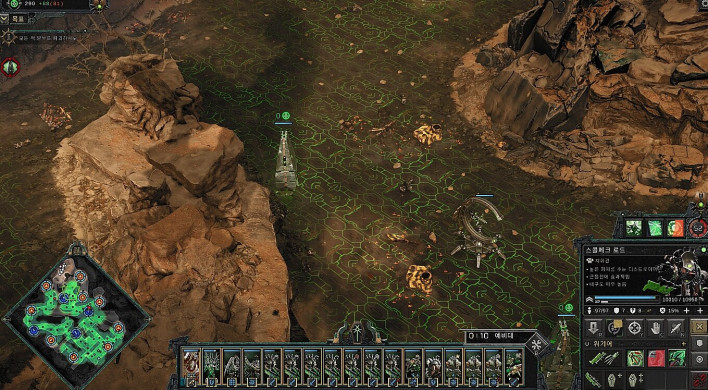
The 'Necrons' possess the most unique traits among the four factions, starting with a completely different resource system. Requisition points, which serve as the primary resource for other factions, are captured simply to deny them to opponents, while Power—the secondary resource—reduces unit production costs when secured. Instead, the Necrons' dedicated resource, 'Dominance,' is generated by Necron buildings, with all units and structures produced and maintained through Dominance alone. Furthermore, Necron buildings generate a 'Power Matrix' zone—much like Zerg Creep—where unit durability and health regen receive major boosts, making Necron gameplay revolve around expanding controlled territory across the map like a game of land grab.
As a result, every faction in Dawn of War 4 keeps your hands busy, yet none feel remotely alike.
Space Marines demand APM to retreat vulnerable squads and deploy Reserves where needed; Orks require constant micro to throw unending waves into combat while building new troops. The Adeptus Mechanicus must continuously construct buildings to bridge Noosphere relays, while Necrons require tactical planning to expand the Power Matrix while managing a thoroughly unique army roster.
The one disappointment is that the 'Astra Militarum'—the 'Imperial Guard'—is not a playable faction despite looking nearly complete. Players can control the Imperial Guard during the campaign, where their core fantasy of combined-arms combat featuring armor, infantry, and Ork-rivaling numbers comes through brilliantly, even if the available roster was limited.
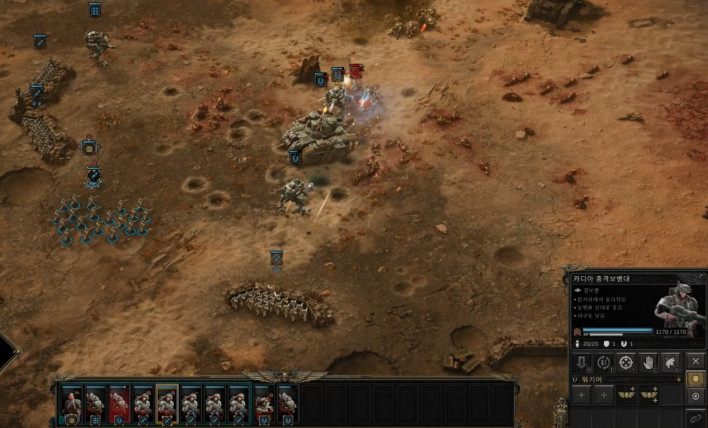
And the feeling of playing every single one of these factions is immensely satisfying. Whether it's deceiving enemies with a small Space Marine force before crushing them with Reserves, overpowering opponents with brainless Ork wave tactics, setting up supreme turtle defenses while gradually expanding territory as the Adeptus Mechanicus, or commanding peculiar Necron units while erasing clumped enemy units with gravity shockwaves—it is all tremendously fun. It leaves one genuinely excited to see how future factions like the Aeldari or Tyranids will be handled when added.
A triumphant return to Warhammer 40K RTS Faction balance remains an unknown
However, certain aspects could not be confirmed from the demo build alone. Faction balance, for instance, remained difficult to gauge even after multiple playthroughs, as Space Marines felt far too strong. Because there is virtually no way to beat Space Marines in equal-number engagements, balance visibly breaks down on resource-rich battlefields. Abilities activated via 'Command Points,' such as orbital strikes or gravity shockwaves, also vary wildly in performance between factions, leaving you questioning whether they are working as intended after using them.
Of course, saying "I haven't fully gotten the hang of it yet" is likely more accurate than "balance is bad." There were times I wiped out Space Marines with massive Ork hordes, or crushed two Space Marine squads with a single unit of Necron Warriors, so it is closer to me having yet to fully figure it out rather than one faction simply being overpowered.
Thus, these concerns reflect typical RTS anxieties rather than definitive facts. As everyone knows, faction balance is the ultimate challenge for any RTS—even more so for a game that maximizes asymmetry like this one. Even StarCraft, nearly 30 years after release, still sees endless debate over balance, so a brand-new title is bound to face scrutiny.
However, my concerns are not overly great.
It is common for a franchise to lose its direction when changing developers, and while I admittedly worried about that, 'Dawn of War 4' did not stray off course. It retains the appeal of the original game that started the franchise, the unique qualities that set Dawn of War 2 apart from other strategy titles, and the distinct commander traits that were one of the few strengths of Dawn of War 3. In terms of balance, it is closest to the first game, but its beautifully crafted asymmetry ensures it is distinctly its own.
Because this was based on a limited demo build rather than a full review build, I could not evaluate everything in the game and thus omitted a score. Nonetheless, 'Dawn of War 4' makes a magnificent return to the core essence of a Warhammer 40K RTS—boasting enough charm to stand proudly alongside its potential rival, 'Total War: Warhammer 40K'.