On October 15, Nexon released Episode 3 of "Over-Talk," introducing "Dimensions," the server-linking content for its upcoming MMORPG, Overgeared. In this video, author Lee Jong-beom, Gray Games producer Choi Byung-chun, director Yoon Soon-jun, and science communicator Gweodo appeared to explain the motivation behind creating Dimensions, the movement structure, exclusive rewards and exchanges, and the division system that regulates server disparities.
In Overgeared, a dimension refers to an individual server. The developers explained that there are over 20 servers in the game, likening each server to an Earth. Players do not have to stay restricted to their home server; they can travel to other dimensions to meet players there, earn resources and rewards, and use local exchanges.
The focus of "Over-Talk EP3" was placed on what players can do after moving, rather than the server transfer feature itself. The concept is to broaden player interaction laterally by connecting people, resources, and economies across servers, rather than having players repeat fixed progression routes on a single server.
■ Short-Term 'Visits' and Base-Relocating 'Migration'
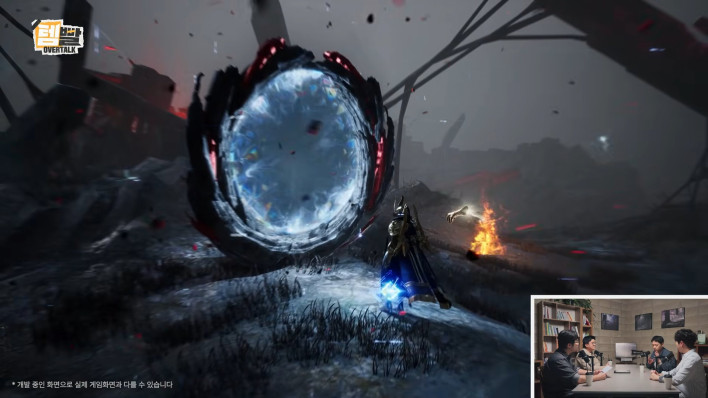
Dimensional travel is divided into visits and migration. The developers likened visiting to taking a trip—going to another dimension and then returning to one's home dimension. In contrast, migration fully moves a character's base of operations to another dimension. While they mentioned that moving back after a full migration is possible, details regarding cooldown times, repetition limits, and application conditions were not disclosed this time.
During the movement process, players pass through the "Abyss," the space between dimensions. The developers described it as a scene where players are sucked into the Abyss as they travel between dimensions. Science communicator Gweodo compared this to higher-dimensional spaces like the Tesseract or hypercube in the movie Interstellar, interpreting the lines shown on screen as timelines. The Tesseract and timelines served as scientific metaphors added by Gweodo.
The developers stated that dimensional travel itself is not designed as a paid item. Instead, in-game currency earned through play is used for travel costs, and limits are placed on how long players can stay in another dimension. On the dimensional map, server locations are displayed like constellations; moving to a farther dimension costs more and imposes stricter limits on stay duration. They explained that this design allows freedom of movement while preventing players from over-concentrating in a single dimension or becoming overly fragmented.

Not all dimensions are linked without restriction from the start. Multiple dimensions are grouped into "Divisions." Dimensional Divisions were introduced as a system to be updated shortly after launch, with inter-dimensional competition taking place across three divisions—Upper, Middle, and Lower—based on content participation levels.
New servers will feature a separate Division pool. This serves as a protective measure, restricting transfers for a set period to prevent established players from veteran servers from instantly jumping into newly opened servers and widening the power gap. The developers explained that dimensions are split into Upper, Middle, and Lower divisions according to content participation, noting that player activity directly affects their dimension's division standing.
Inter-dimensional relationships are not limited to competition alone. The developers also mentioned scouting players from other dimensions to participate together in siege battles. However, details regarding scout targets and procedures, siege participation conditions, division promotion/relegation criteria, and rewards were not disclosed.
■ Ores and Bosses of Other Dimensions, Merchant Gameplay Targeting Price Discrepancies
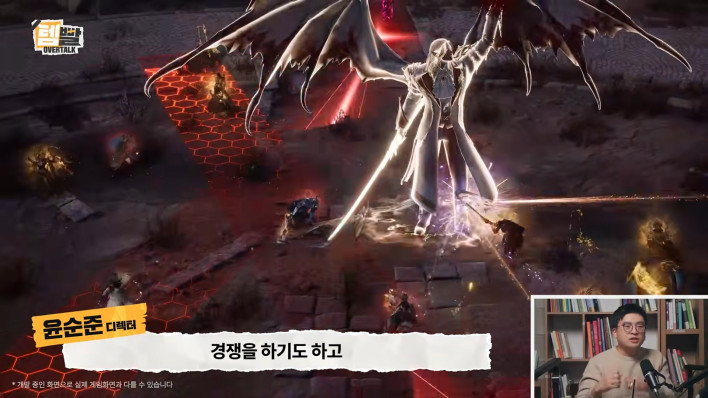
The most direct incentive driving players to move is dimension-specific rewards. Even when engaging in the same hunting activities, certain rewards can only be obtained in specific dimensions, along with crafting ores or powerful bosses exclusive to particular dimensions. When rare resources or bosses spawn in a specific dimension, players from multiple servers can gather and compete. In effect, the heavy weight given to items and crafting in the original work has been adapted into a motivation for server transfers.
However, it remains unknown which rewards and ores are divided by dimension, as well as boss spawn intervals, participant limits, and loot distribution methods. How rules will be enforced to prevent powerful servers from monopolizing specific dimensional resources also remains to be seen.
Economic activity also crosses server boundaries. After arriving in another dimension, players can utilize the local exchange. If an item expensive in their home dimension is cheap elsewhere, players can buy it locally and resell it for a profit.
However, price differences do not automatically guarantee profits. Because travel costs to other dimensions and exchange transaction fees apply, players must factor in transit expenses alongside purchase and sale prices. Beyond combat and boss raids, this structure creates clear purpose for dimensional travel among players who mine ores, craft gear, and trade goods by seeking out market price arbitrage. Still, details regarding the scope and quantity of items transferable between dimensions, price update methods, and trade restrictions were not disclosed.

The developers defined Dimensions as a "platform for interaction." Rather than one-time content consumed and discarded after a single update, it is designed as a foundation where player activities and relationships continuously accumulate, serving as a base to introduce new forms of encounters and competition throughout the game's live service.
Producer Choi Byung-chun described this approach as aiming to create "an MMORPG closest to the real world." The perspective is that when people gather, relationships form, and as those relationships build up, rules and institutions emerge. The vision is to treat each server as an independent world while connecting them with other worlds whenever necessary to build a larger society.