
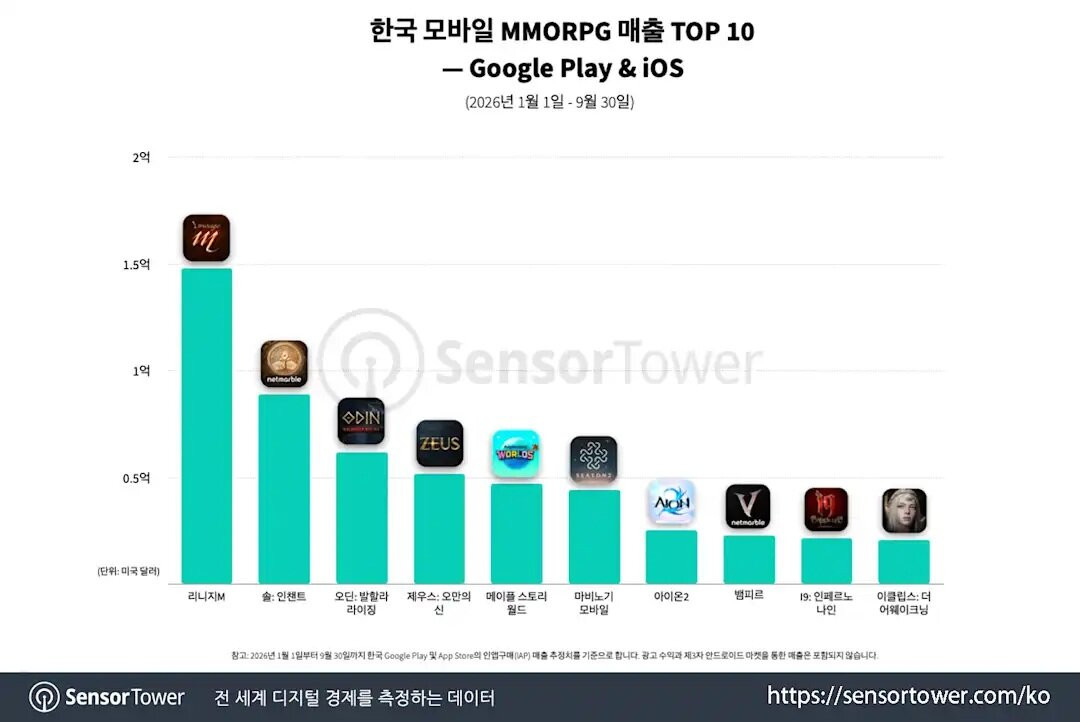
The South Korean mobile MMORPG market is showing signs of revenue recovery on the back of major new releases. According to Sensor Tower, monthly revenue for mobile MMORPGs in South Korea began rebounding in June 2026 and reached its highest level in nearly a year in September.
MMORPGs have long been a primary revenue-generating genre in the South Korean mobile gaming market, but competition has intensified with the recent growth of 4X strategy games. Sensor Tower's market size data shows that monthly revenue for 4X strategy games outpaced MMORPGs for most of the first half of this year.
The recovery in MMORPG revenue coincided with the launch timing of major new titles. Netmarble's 'SOL: enchant' launched on June 18, followed by Com2uS's 'Zeus: God of Arrogance' on August 26, and Smilegate's 'Eclipse: The Awakening' on September 10. Together, these three titles accounted for 13.4% of total South Korean mobile MMORPG revenue in September.
According to Sensor Tower App Performance Insights data, all three titles entered the top 10 in cumulative revenue for mobile MMORPGs in South Korea in 2026 as of the analysis period. Among them, 'SOL: enchant' ranked second among MMORPGs and sixth among all mobile games with cumulative revenue of approximately $90 million. It recorded the highest cumulative revenue among new mobile games released in South Korea this year.
In terms of revenue during the first 30 days after launch, 'Zeus: God of Arrogance' showed strong momentum. Generating approximately $35 million during that period, it recorded the highest initial revenue among new MMORPGs released in 2026.
Both games highlighted their unique gameplay elements in their advertising. 'SOL: enchant' promoted quality-of-life features such as offline character progression and its "Divine Authority" system, which allows players to participate in server management and content unlocking. Hiring actor Hyun Bin as its commercial model, the game emphasized player agency with the slogan, "Everything in the game, as you will."
'Zeus: God of Arrogance' highlighted its Greek mythology setting and AI automation features. Among its top video ad creatives by impression count, 30-second videos focused on delivering an immersive world and combat experience, while 15-second videos emphasized gameplay convenience via AI mode.
Differences were also evident in the timing of ad campaigns and channel budget allocation. According to Sensor Tower Digital Ad Insights, 'SOL: enchant' concentrated its advertising immediately post-launch from June 18 to June 21, ranking fourth in ad spend and third in ad impressions among game brands in South Korea during that period. Most of the budget was allocated to Facebook and Instagram, while YouTube secured 7% of total impressions with just 2% of total ad spend.
'Zeus: God of Arrogance' began advertising in July prior to launch and scaled up its campaign starting in the second week of August. Ad spend and impressions peaked on launch day. It utilized multiple channels including YouTube, mobile apps, Naver, and Instagram, with YouTube receiving the largest portion of ad spend and accounting for 63% of total ad impressions.
Sensor Tower analyzed that while the two games employed different advertising strategies, YouTube was a notably key channel for both. In Sensor Tower Audience Insights, the 35–44 age group represented the largest share of the core gamer persona at 40.9%, and YouTube accounted for 51.5% of all digital ad impressions targeting this demographic.
Sensor Tower explained that a strategy delivering distinct game features through clear advertising messaging—while accounting for reach among core demographics and channel exposure efficiency—can support a new title's market entry.