To think that Vanillaware's very first PC port would be 'Muramasa'—what a deeply emotional moment.
'Muramasa: The Demon Blade' was first released on the Nintendo Wii in 2009. Later, with the 2013 PS Vita release adding 'Genroku Legends,' players could enjoy the stories of six different characters. 'Muramasa: Revenant Blades' is a near-definitive remaster reborn for modern platforms roughly 17 years after its initial launch. It is also deeply meaningful as the first Vanillaware title to step onto PC.
Last September at 'Bilibili First Look' held in Shanghai, China, I had the chance to play 'Muramasa: Revenant Blades'—published by Marvelous—hands-on for about an hour. Attendees could choose between Kisuke or Momohime, but picking one meant you couldn't play the other in the demo. Naturally, picking Momohime was the only logical choice in the world.
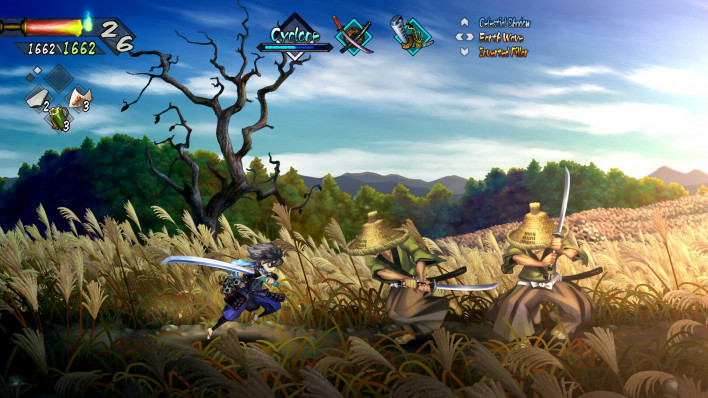
In the base game, 'Muramasa' traces the journeys of two main protagonists, Kisuke and Momohime. Kisuke starts from the western edge of the map and heads east, while Momohime travels in the opposite direction from east to west. While their backstories differ, there is little difference in how both grow stronger by collecting numerous demon blades.
What caught my eye first was how remarkably clean the port was. The visuals were so crisp that it was hard to believe this was a 17-year-old game, and neither the aspect ratio nor the controls fell short compared to modern games. Before the demo began, a representative explained that the characters, maps, and animations had been upgraded to suit 4K environments.
On-screen, Vanillaware's signature hand-drawn aesthetic was fully preserved, leaving almost no impression that it was an old game. Traces of the original design remain in parts of the UI, particularly choice screens, but even these felt like nostalgic elements.

'Muramasa' is a side-scrolling action game. You progress through the story by moving left and right, and sometimes up and down across maps. You might be blocked by barriers or hit a dead end for no apparent reason, while other times you encounter unexpected NPCs that trigger story events.
Combat functions similarly to random encounters. As you traverse the map, a giant exclamation point pops up in the center of the screen and enemies spawn. Once you defeat them all, a results UI appears showing how much currency you earned. Weapons cannot be drawn before combat begins, making the boundary between battle and non-battle states very clear.

As the developers noted, executing flashy swordplay through simple button inputs is a hallmark of 'Muramasa.' On a controller, there is only one basic attack button. Even with the addition of the Secret Art button and the weapon swap button, just three buttons are enough to produce spectacular sword action.

Combining directional inputs with the attack button alters your moves. Attacking while holding Up launches enemies into the air for airborne combos, while pressing Down in mid-air performs a downward slam. You can also press Left or Right in the air to chain into a dash attack.
The demon blades collected as you progress each contain a specific 'Secret Art'—essentially a skill. Using a Secret Art or guarding and parrying enemy attacks consumes the weapon's 'Spirit Gauge.' When this gauge empties, the blade breaks and its performance drops drastically, requiring you to keep it sheathed until it recovers. Because of this, rather than relying on a single sword, you must rotate and manage multiple blades.
Both Kisuke and Momohime equip three demon blades at a time. On an Xbox controller, you can press the Y button to swap between the three swords at any moment to keep fighting, making the Spirit Gauge displayed below each sword critical.
When the demon blade icon at the top of the screen glows during battle, swapping to another sword triggers 'Iai,' an attack that hits the entire screen. In this way, 'Muramasa''s swordplay revolves around the interplay of basic attacks, Secret Arts, and weapon switching. You can push a blade's Spirit Power to its limit and switch to another demon blade right before it breaks to keep the stylish action going.
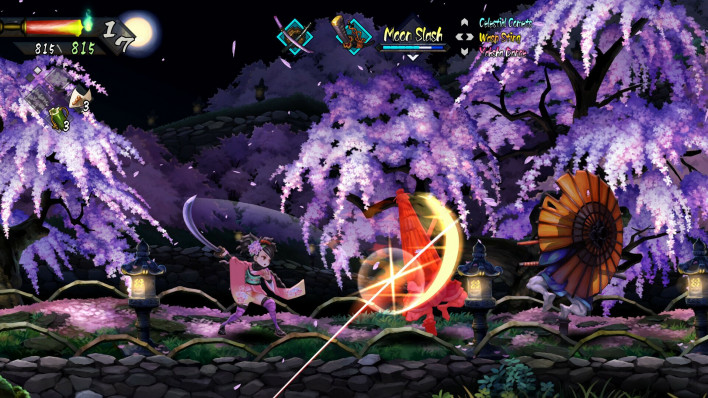
In addition, 'Muramasa: Revenant Blades' introduces a crucial new feature: a system where players can directly learn and separately equip Secret Arts that were previously tied to specific weapons.
In the original game, every Secret Art was locked to its respective sword. Countless times players had to reluctantly abandon a blade with a favorite skill simply because its attack power was too low. In 'Revenant Blades,' however, repeatedly using a specific demon blade's Secret Art allows you to permanently master that technique. Once mastered, you can assign your desired Secret Arts into slots regardless of your currently equipped sword, enabling even flashier and more efficient combat.
Learning skills is simple: 'use the blade's Secret Art repeatedly.' The more you use it, the higher the skill's mastery grows, and reaching a certain threshold lets you learn that Secret Art as your own. Learned Secret Arts can be slotted into up to three ground slots and three aerial slots. By combining directional inputs with the Secret Art button, you can trigger specific techniques, with mastery and damage increasing as you use them repeatedly.
Mastered techniques can be used regardless of the currently equipped weapon's built-in skills. This allows for combos such as unleashing a mapped Secret Art followed immediately by the equipped sword's unique Secret Art. Of course, doing so drains Spirit Power rapidly, making mindless spamming risky; it proved far more effective for unleashing burst damage when a boss presented a major opening.
Naturally, the changes in 'Revenant Blades' do not end there. The item quick slots have been expanded from four to eight, giving players plenty of room to prepare recovery items and support tools for boss fights. Furthermore, the hot springs and cooking systems—central elements of 'Muramasa'—have been revamped. New scenes not found in the original have been added to the hot springs, offering various events beyond simple HP recovery.

Fitting for a game long famous as a "food mukbang game," numerous new dishes will be added to the menu. Travel content such as fishing and palanquin transport is also included. Modes for viewing illustrations and character animations, as well as a feature to rewatch cutscenes, have also been freshly added.
Even from a short demo, 'Muramasa: Revenant Blades' felt like a remaster meticulously crafted for modern platforms. A game previously playable only on the Nintendo Wii and PS Vita—hardware that is now difficult even to obtain—and thus relegated to being Vanillaware's hidden classic, is finally returning on new platforms.
In particular, the system that allows players to master Secret Arts previously tied to weapons, combined with growth elements where the skills themselves grow stronger through use, is set to offer far more freedom in character builds than the original.
Although not playable in the demo, the four protagonists added as DLC in the PS Vita version are included by default. With all six characters' stories playable from launch, players can expect a generous amount of content.