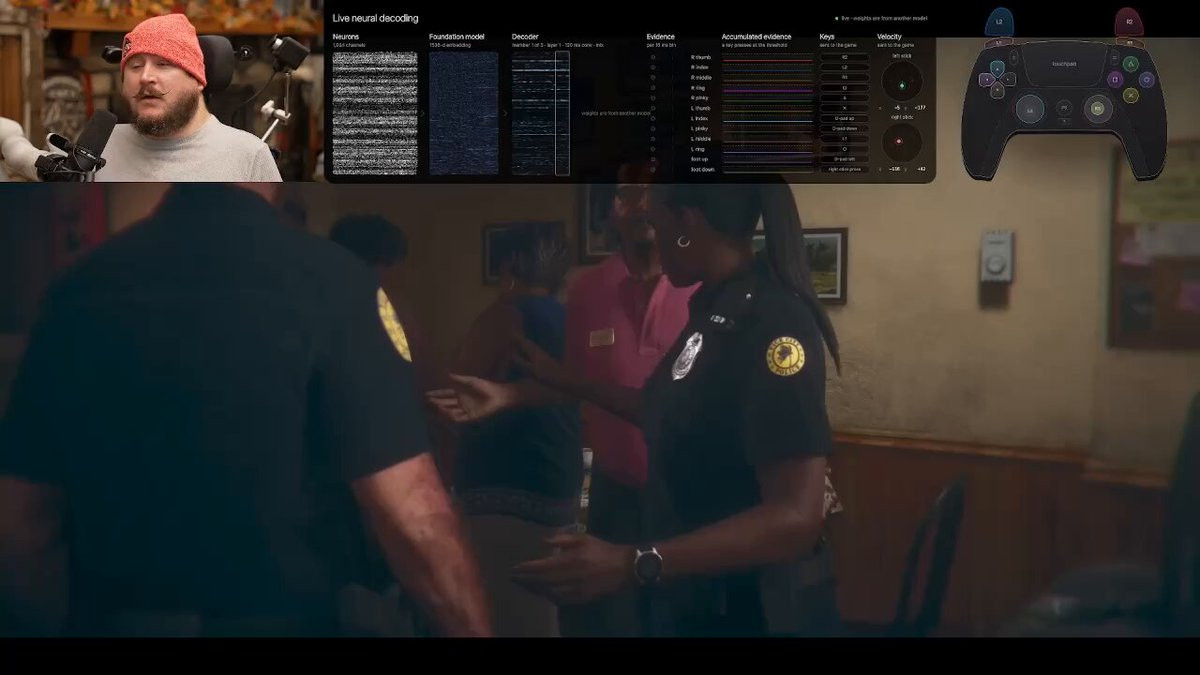
Neuralink has released footage of one of its clinical trial participants playing Grand Theft Auto VI (GTA VI) using only the company's brain implant.
The company shared the two-minute video on X (formerly Twitter) on November 20th, a day after the game's launch. The post read simply: "Playing GTA VI with a Neuralink." In a follow-up post, Neuralink said its devices are investigational and have not been approved by the US Food and Drug Administration (FDA) or other regulators.
How the game is controlled
The video shows the player on a webcam feed next to a 'Live neural decoding' panel and an on-screen PlayStation 5 DualSense controller that lights up as each input fires. He drives, flies a plane and gets into fights by thinking about small body movements. "Right now I'm just like tapping my ring finger. Each ring finger. Bam. Look at that," he said while throwing punches.
He explained that the team later "added my feet in, or at least my foot," to cover more buttons. To pull the plane's nose up, he said he has to imagine sliding his right hand forward, which he described as "almost like the mouse motion."
The player is not named in the video. He did describe life before the implant, though. "Before the old chip and surgery, I was using a mouth stick and an iPad," he said, adding that it "made your jaw sore." Controlling a computer gave him "your portal to the world back," he said.
The tech behind it
Robert Dale Smith, whose X bio lists BCI applications at Neuralink, said on X that he has been "working on enabling Neuralink to control any device.. including PlayStation 5 to play GTA VI at launch!" He credited JoypadOS, his firmware for controller adapters, which according to his website handles USB and Bluetooth input and translates between controller protocols.
Neuralink describes its brain-computer interface (BCI) as a device that turns neural signals into actions. According to its website, people in its clinical trials use the implant to control computers and robotic arms with their thoughts. The participants it lists include people living with spinal cord injuries and amyotrophic lateral sclerosis (ALS).