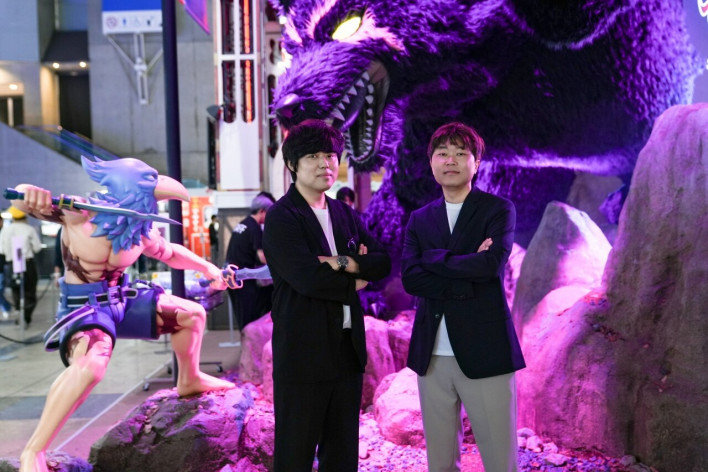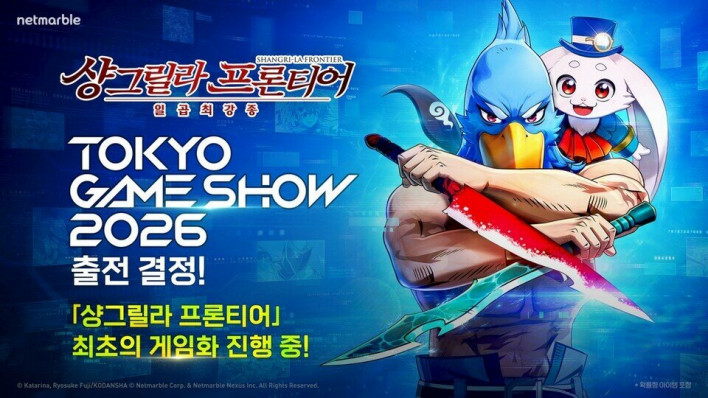
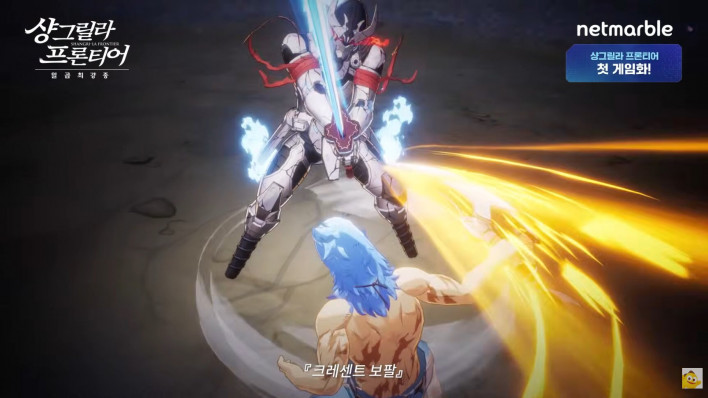
Netmarble is showcasing its new collectible RPG, "Shangri-La Frontier: The Seven Colossi," at Tokyo Game Show 2026, held at Makuhari Messe from September 17 to 21. Based on the light novel and manga of the same name, the story follows high school student Rakuro Hizutome, an avid player of trash games, who dives into the hit VR game Shangri-La Frontier. Reimagined as a mobile title, "Shangri-La Frontier: The Seven Colossi" preserves the thrilling feel of the original through a simple yet fast-paced system of tags, combo chains, and breaks. At the show floor, a demo build featuring the fight against Wezaemon the Tombguard—the climax of Season 1 of the anime—is being offered to deliver that same excitement directly to fans.
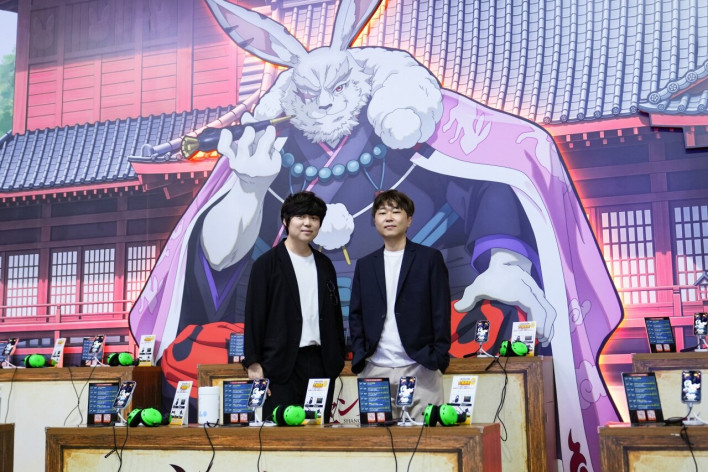
Why did Netmarble pay close attention to "Shangri-La Frontier," from joining the anime production committee to adapting it into a game? Head of Business Division Kim Hyung-jin and Netmarble Nexus Lead PD Kim Kyung-ryul answered 45 questions from the media at TGS 2026.
A story about playing games finally becomes a real game
Q1. What made you decide to create a game using the Shangri-La Frontier IP?
Head of Business Division Kim Hyung-jin = Shangri-La Frontier is a constantly growing IP. Starting as a web novel, Kodansha expanded it into a manga, which then led to an anime, growing bigger with each step. We saw games as the next logical step.
The fact that the original work is a story about a "player taking on a game" made adapting it into a game extremely appealing. Because the setting itself is a virtual gaming world, making it a game directly connects with the core essence of the original, unlike other IPs. We felt it would resonate not only with fantasy fans but also with active gamers.
With that level of confidence, rather than simply licensing a completed IP to build a game, we invested directly in the anime production to help grow the IP itself together. We also attach great significance to this being the first game adaptation of "Shangri-La Frontier."
Q2. What sets Shangri-La Frontier apart from existing games based on anime or web novel IPs, and how did you try to reflect that in the game?
Head of Business Division Kim Hyung-jin = Previous anime and web novel IP games were mostly about transferring the original narrative into the vessel of a "game." In contrast, Shangri-La Frontier's biggest weapon is that it is already a game in itself. We focused on translating the experience of the player stepping directly into Sunraku's shoes and clearing that world with companions into the tactical fun of tag battles.
Q3. Currently, the narrative progression in the original Shangri-La Frontier story is somewhat limited in volume and moves at a relatively slow pace. How do you plan to handle future updates?
Head of Business Division Kim Hyung-jin = The main axis of the official launch version will be recreating the major episodes of Season 1 of the anime, while expanding stories not fully covered in the original in the form of "side stories." Because these side stories are created alongside the original author, we have the capacity to consistently introduce new content regardless of the original work's pacing. In addition to side story narratives, we plan to sequentially reveal original characters and bosses created through the supervision and collaboration of the author.
Launching first in Japan, followed by Korea and global services
Q4. How far will the story progress upon official launch, and what are the differences and update plans between the Korean and global versions? Will separate Korean voice acting be provided?
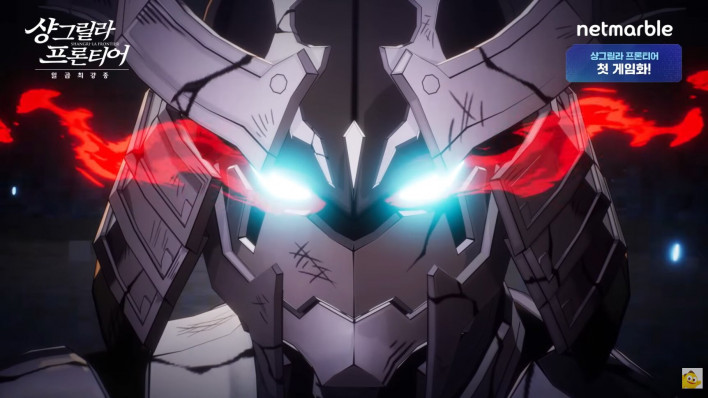
Head of Business Division Kim Hyung-jin = We are preparing story content up to "Wezaemon the Tombguard," which serves as the climax of Season 1 of the anime. For launch, we plan to release the Japanese version first. For the Korean and global versions, we are considering a simultaneous release after applying the stability and improvements verified during the Japanese service. However, we are not considering trimming content or changing product structures by region; our principle is to deliver the same title tailored to each region's language and environment. Updates will also be operated to minimize regional gaps.
For the voice acting, the Japanese version features newly recorded performances by the original anime cast. Korean dubbing is currently under review, and we will announce details once confirmed.
Q5. You mentioned targeting a release within the year. What is the expected release window?
Head of Business Division Kim Hyung-jin = A specific date has not been finalized yet. As this is the first game adaptation, we are giving our all to craft a game that satisfies the fans. Since we are presenting the demo build directly to fans for the first time at this Tokyo Game Show, we will reflect the feedback received here until the very end, and announce an exact schedule once we deem it ready.
Q6. What element do you most want to appeal to Japanese fans with the demo build, and what reaction do you most want to verify?
Head of Business Division Kim Hyung-jin = What we want to show most is the fidelity of the reproduction that brings iconic moments from the original to life. This build opens right with the battle against "Wezaemon the Tombguard," essentially leading with the climax of Season 1 of the anime. The reason we chose this battle was because we felt it was the most honest way to demonstrate just how far we went in recreating those moments.
On top of that, we prepared high-caliber performances by the original voice cast and playable sections where players can directly parry Wezaemon's attacks. Main characters are provided with special specifications so players can immediately experience top-tier, flashy skills. Moving fans from a position of "watching" to "playing for themselves" is the goal of this demo.
There are two main things we want to verify: whether fans of the original feel "I am playing this moment right now," and the tactile feel of the tag combat. Finding the sweet spot between the ease of auto-combat and the strategic depth of tags, combo chains, and breaks was our toughest challenge. We will gauge whether we got it right through feedback from players, and refine any areas that need work before official release.
Q7. Could you elaborate on how you plan to expand service regions following the Japanese launch of 'Shangri-La Frontier'?
Head of Business Division Kim Hyung-jin = We are preparing to launch first in Japan, the birthplace of the original IP. Afterward, we plan to sequentially expand service to Korea and global regions, fully incorporating the operational experience and player feedback from Japan to present it in a form suitable for each market.
Building the world of Shangri-La Frontier with the original creator, not just licensing an IP
Q8. How much of the original IP's scope can be used in the game, and to what extent can original content be introduced?
Head of Business Division Kim Hyung-jin = It is difficult to disclose specific contract terms. However, in working-level practice, we value standards more than scope.
First, the foundation of the lore is based on the original light novel, while visual representations follow the manga and anime. Game-exclusive areas, such as character battle skill designs and side story scenarios, go through supervision by original author Katarina and manga illustrator Ryosuke Fuji without exception. Although called "supervision," it is closer to a collaborative creation process, to the point where game-original concepts have been incorporated into the canonical lore. Rather than asking how much of the IP's scope we can use, we approach our work by asking if a decision helps grow the IP.
Q9. Are there any notable anecdotes from the contracting process?
Lead PD Kim Kyung-ryul = As Netmarble Nexus's first project based on an external IP, it was a continuous learning process. To share one fun episode, there was an instance where the author liked a game-original setting so much that it was integrated into the canonical lore. Also, when we proposed the name "Bunnigar" for a character that appeared without a name in the original, Katarina suggested "Bannini," combining "panini" and "bunny." Building characters together with the author like that was particularly memorable.
Q10. 'Shangri-La Frontier: The Seven Colossi' is the first game adaptation of the 'Shangri-La Frontier' IP. Since the original work tells the story of players enjoying and clearing a game, the approach must have differed from typical manga/anime IP games. What was the core aspect of "ShangFron-ness" that the dev team emphasized when porting it to mobile?
Lead PD Kim Kyung-ryul = It can be summarized as "Dive into the world of ShanFron anytime, anywhere." We chose smartphones as the main platform because we wanted to capture the feeling of Sunraku diving right into the game after school. Above all, we put the most effort into recreating the world of the original exactly as it is.
Q11. Since the setting of the original is a game world, there must have been much deliberation on where to place the player's perspective. Did you discuss this with the original author or production companies?
Lead PD Kim Kyung-ryul = We set our benchmark on giving players the perspective of "directly experiencing" Sunraku's journey. Throughout this process, we constantly received supervision from Katarina and Fuji. For example, before Lycaon appears, there is a scene where the moon is completely blotted out; we judged this essential for lore fidelity and reflected it even after significantly altering the existing cutscene structure.
From open world to portrait tag battle: Redefining 'ShangFron-ness'

Q12. Early in development, the project was known as an Unreal Engine 5 anime-style open-world RPG, and an interview was held at TGS 2023 under that premise. However, the build revealed after 3 years turned out to be a much more casual tag battle collectible RPG. What changes occurred in development direction during that time?
Lead PD Kim Kyung-ryul = We reviewed several directions early in the project and ultimately decided to focus on the core essence: "being able to connect to the world of the original anytime, anywhere." That conclusion led to smartphones, portrait orientation, and tag battles. By securing accessibility, we were able to dig deeper into fidelity, such as cutscenes, voice actors, and recreating iconic scenes. It was a choice that prioritized faithfully delivering "ShangFron-ness" over outward appearances.
Q13. You mentioned it is not open world, but how did you approach conveying the feeling of exploring the game world of the original Shangri-La Frontier?
Lead PD Kim Kyung-ryul = While it isn't an open world where you roam freely, we tried to capture the emotion of "discovering" each region and landmark from the original as you progress through the story. Reaching towns like Secondil or witnessing changes in the Secret Garden later on are examples. We expressed the fun of exploration through "discovery and recreation" rather than spatial traversal.
Q14. Could you explain the choice of portrait orientation in more detail?
Lead PD Kim Kyung-ryul = Just like Sunraku, we wanted to capture the feel of diving right in whenever you have a spare moment. We also felt that a portrait screen, allowing quick sessions played with one hand, fit best with a mobile-centered design.
Q15. 'Shangri-La Frontier' is unique in that the original work is set inside a 'game within a game.' Leveraging this IP characteristic, how far do you plan to expand the game-specific fun of 'Shangri-La Frontier: The Seven Colossi'? What kind of game do you hope it settles into post-launch?
Lead PD Kim Kyung-ryul = As the original is a story about tackling powerful foes, we condensed the "tactile fun of boss strategy" into tag battles, combo chains, and breaks. A game you can play lightly on busy days, yet challenge endlessly when you want to dive deep. We hope it establishes itself as a title where players can enjoy the thrill of boss strategy for a long time.
Recreation as the backbone, original elements filling in the gaps

Q16. Did you focus primarily on recreating the original work or on original content?
Lead PD Kim Kyung-ryul = The main axis is a faithful reproduction of the original, specifically Season 1 of the anime. You can think of it as building side stories and original characters created with the author on top of that backbone. It's a direction that prioritizes recreation while expanding through original elements.
Q17. How far did you follow the original story, characters, and worldview, and from where did you introduce game-original elements?
Lead PD Kim Kyung-ryul: The lore is based on the light novel, while visual representations follow the manga and anime. On the other hand, character skill designs, expanding characters that only had names in the original, and side story scenarios are game originals. Naturally, all these original elements underwent supervision by the author.
Q18. The game story primarily recreates major episodes from Season 1 of the anime while also introducing behind-the-scenes stories and original characters not covered in the original. How did you aim to naturally harmonize 'recreation of the original' and 'new game-exclusive elements'? Could future side stories also expand to supplement characters or events not fully covered in the original?
Lead PD Kim Kyung-ryul = Taking Season 1 of the anime as the backbone, we are preparing side stories that supplement characters or events not fully addressed in the original. For example, there are side story episodes like the "Rabbit Kingdom Tour" involving characters from "SF-Zoo." Future side stories will also expand to naturally fill in the blank spaces of the original.
Q19. What special elements will original fans welcome, and what features were prepared so players unfamiliar with the original can start without burden?
Lead PD Kim Kyung-ryul = For the former, I would point to the high-caliber performances newly recorded by the original voice cast, lore-faithful reproductions of iconic scenes like Lycaon appearing after the moon is hidden, and bringing mascot Emul's charm to life in 3D. Also, characters that briefly passed by in the original being reborn as playable characters will be a welcome detail for fans.
In the opening, Sunraku catching a Vorpal Bunny is naturally woven into the tutorial, and because it features portrait mode and simple tag battles, control burdens are low. Furthermore, since the story immerses players with fully voiced cutscenes right from the start, we expect even those who do not know the original to begin comfortably.

Q20. The story adopts a structure that shows the 'Wezaemon the Tombguard' battle right from the start before jumping back to the past, utilizing fully voiced cutscenes and QTEs. Why did you choose this introduction, and what did you focus on most to offer a fresh experience to both fans who know the story and new players?
Lead PD Kim Kyung-ryul = We chose a structure that grabs attention with an intense climax first before rewinding to the past. This was because we wanted to give original fans the pleasure of experiencing an iconic scene first, and new players a powerful first impression. In particular, we focused most on elevating the experience from "watching" the original to "directly experiencing" it through fully voiced cutscenes and QTEs.
Q21. In the original work, as the protagonist moves between reality and games, stories of other trash games besides SLF take up a significant volume. How do you plan to implement this?
Lead PD Kim Kyung-ryul = Above all, the game focuses on immersing players in the world of "Shangri-La Frontier." Therefore, stories of other games appearing in the original do not take up a major proportion and are condensed into cinematic presentations when necessary. However, for titles with large roles in the original like "Nephilim Hollow" or "GGC," we are trying various experiments to implement different combat experiences.
The moment of switching is the key to strategy: Tag, Combo Chain, and Break systems

Q22. Action takes up a major part of the original manga and anime. How did you implement this in the game?
Lead PD Kim Kyung-ryul = Rather than direct action controls, we designed the thrilling feel of action to come from decision-making and timing when tagging characters in and out. The original's flashy action details are faithfully captured in cutscenes, while action sections you experience directly—such as parrying Wezaemon's attacks—are placed throughout the game.
Q23. You highlighted the 'tag battle system' as a core differentiator. Why did you design a structure that goes beyond simple character swapping to 'combo chain attack → ultimate skill → break'? What is the core thrill of combat?
Lead PD Kim Kyung-ryul = We designed it so that swapping characters isn't just swapping, but expands tactical options. You build up ultimate skills with combo chains, leading into combat's highlight: the "Break." The rush of building up to enter a Break and exploding final damage through combos is the core thrill of combat.
Q24. Combat systems like 'Tag Strike,' 'Link Strike,' and 'Break' are interconnected quite organically. What was the most difficult part of balancing combat during development?
Lead PD Kim Kyung-ryul = Finding a balance that satisfies both the convenience of auto-combat and the strategic depth of tags, combo chains, and breaks was the hardest task. It couldn't require too much manual input, nor could it leave nothing to manage, so we put a lot of effort into finding that sweet spot.
Q25. It stands out that despite being auto-combat based, the game adopts various systems like elements, Tag Strike chains, and ultimate skills. How far is auto supported for these systems?
Lead PD Kim Kyung-ryul = All battle systems provided are supported automatically. For instance, ultimate skills after combo chain attacks are triggered automatically. However, combat is balanced so that playing manually offers a greater advantage in steering battles favorably.
Q26. Why did you choose a combat structure that emphasizes timing and judgment over direct controls, and how much depth do you plan to provide skilled players?
Lead PD Kim Kyung-ryul = We wanted anyone to enjoy it comfortably on mobile in portrait mode, so we prioritized timing and decision-making over precise controls. In return, for skilled players, final damage varies greatly depending on which buffs and debuffs you secure before entering a Break and in what order you deploy ultimate skills, offering plenty of depth to master.
Q27. You chose a method of 2-character combat within a 4-character squad. Do the remaining two characters outside the active main and sub characters simply wait? If they affect combat, how do they do so?
Lead PD Kim Kyung-ryul = Benched characters don't just sit idle; they are designed to contribute overall party synergy and serve as swap resources.
Q28. Each character has elements and types. How are they utilized in battle?
Lead PD Kim Kyung-ryul= Each character has unique elemental attributes and chain types, which tie into target monster affinities and Break combo conditions. During a Break state, quickly tagging characters according to the chain types displayed at the top of the screen is key.
Q29. In the original, most battles from the protagonist's perspective relied heavily on Sunraku's physical skill. How are parrying and dodging used in in-game combat?
Lead PD Kim Kyung-ryul = Just as players experience parrying Wezaemon's attacks early in the game, we prepared specific sections to offer the tactile feel of action. Additionally, there is a system to parry enemy attacks throughout combat, and tagging in sync with enemy attack timing allows you to dodge. Because buffs and debuffs directly affect final Break damage, how well you manage them dictates the outcome of battle.
Clan and co-op content: Reading enemy patterns to break boss strategies and the Seven Colossi
Q30. In the original work, multiplayer elements including the guild system are mentioned often. How much do you plan to implement guild and co-op content in the game?
Lead PD Kim Kyung-ryul = Yes, we are preparing clan content like defeating Wezaemon to recreate those memorable moments from the original where players "overcome the impossible together." However, it was not included in this Tokyo Game Show build. We will polish it carefully before presenting it officially.
Q31. Hidden elements known only to the protagonist's group, including hidden quests, appear frequently in the original. How do you plan to roll out 'hidden' elements in the launch version as players progress through story or content?
Lead PD Kim Kyung-ryul = To capture the unique fun of hidden elements from the original, we are preparing features that players can discover themselves during gameplay, such as side stories or changes in the Secret Garden. We look forward to players finding the details themselves while playing.
Q32. From early on, players experience battles against powerful monsters from the original, such as 'Wezaemon the Tombguard' and 'Great Serpent of Gluttony.' What aspect of the original did you focus on most when implementing boss monsters in the game?
Lead PD Kim Kyung-ryul = Our primary focus was bringing the distinct personality and attack patterns of original bosses to life. For example, "Mud Digger" was inspired by Sunraku's restricted mobility in the Forty-Nine Swampland, so we added mechanics that hinder character tagging and reduce mobility. We wanted to recreate that tactile joy of reading enemy patterns and finding counter-strategies.
Q33. Bosses are designed with distinct 'chain types' and 'Break points.' How do you plan to differentiate boss strategies post-launch so players rethink new strategies?
Lead PD Kim Kyung-ryul = Through internal testing, we are revamping the combat system to avoid forcing specific chain types. Rather than requiring fixed compositions, we are focusing on how players leverage boss-unique mechanics. We are preparing systems so users can forge their own strategies.
Q34. In the original, the process of Sunraku's group analyzing powerful monsters' traits and finding strategies through trial and error is a core highlight. You mentioned each boss has different chain methods and tactical elements. How do you plan to differentiate the unique traits of each upcoming 'Seven Colossi' through battle mechanics?
Lead PD Kim Kyung-ryul = The 'Seven Colossi' represent the ultimate goal of this journey, and we are planning each future Colossus with distinct mechanics and combat styles. Players will experience the fun of changing party compositions or control requirements depending on the boss. Specific specs and implementation methods are currently in development and will be revealed sequentially after launch.
Q35. The Wezaemon fight required only 3 party members, whereas the Ctarnidd fight involved a 5-person party. How do you plan to implement party co-op content?
Lead PD Kim Kyung-ryul = As the number of participants differed by opponent in the original, we want to implement battles of varying co-op scale through formats like clan co-op battles. We will refine specific numbers and implementation methods before introducing them officially.
Q36. Some enemies require satisfying specific patterns to conquer, like Wezaemon's Clear Sky, Grand Calamity. Could you introduce some key enemy patterns?
Lead PD Kim Kyung-ryul = Fundamentally, bosses are designed around reading and countering enemy patterns. A prime example is the pattern mentioned earlier with "Mud Digger," which restricts movement and tag switches. Detailed patterns for each boss will be introduced one by one through future content.
22 characters in the demo build, followed by progression balancing player affection and tactical strategy
Q37. The demo build features 22 characters. What are the attributes and tiers for each character?
Lead PD Kim Kyung-ryul = Each character has unique elemental attributes, chain types, and a tier system. In this Tokyo Game Show build, main characters are prepared with special specs so players can experience the powerful, flashy skills of top-tier characters directly. However, attributes and tiers are currently being adjusted, so we ask for your understanding that we cannot disclose detailed specifications at this time.
Q38. What roles do characters other than Sunraku play in combat or party composition?
Lead PD Kim Kyung-ryul = Roles are clearly divided by elemental attributes, chain types, signature gear, and secret scrolls. For example, Dogmata acts as a close-range tank taking enemy attacks, while Bannini acts as a ranged damage dealer attacking from afar.
Q39. Currently 22 original characters have been implemented, and original characters are planned to be added later. When reinterpreting characters as playable units, how did you reflect the original's personality in their combat styles?
Lead PD Kim Kyung-ryul = We tried to translate each character's personality and narrative into their combat style. In particular, many characters had no combat scenes depicted in the manga or anime; for these characters, we built new battle profiles through consultation and supervision with Katarina.
Q40. Each character has attributes and chain types, and skills can be altered through signature gear and secret scrolls. In character collection and progression, how did you design the fun of building one's own party and strategy?
Lead PD Kim Kyung-ryul = Combining signature gear and secret scrolls with characters draws out greater performance. The process of collecting and raising characters directly expands strategic options, allowing players to feel the satisfaction of completing their own party and strategy for each boss.
Q41. How are you balancing character usability between original fans who want to play around favorite characters and players seeking optimal compositions for boss encounters?
Lead PD Kim Kyung-ryul = We are designing signature gear and secret scrolls so that favorite characters can be sufficiently built up to perform well. We are striking a balance where optimal element-matched compositions and favorite-character-centered compositions can both function effectively.
Q42. Besides characters, signature gear and secret scrolls were introduced as core elements. How can players obtain these two?
Lead PD Kim Kyung-ryul = We are preparing signature gear and secret scrolls to be obtainable through story progression, dungeons, and subjugation content.
Q43. Defeating Seven Colossi Unique Scenario EX clear rewards were central to story progression. Can gamers use rewards like that in formats such as signature gear?
Lead PD Kim Kyung-ryul = Regrettably, we are not planning rewards in a form that players directly equip or use. However, since defeating one of the Seven Colossi holds immense honor, we are designing rewards with a focus on that aspect.
Q44. Unique characters exclusive to this game, like Dogmata and Bannini, appear. Are there any other characters created through collaboration that you would like to introduce?
Lead PD Kim Kyung-ryul = Besides Dogmata and Bannini, there are characters like Biblio and Scholate who first appeared in the manga. What skills they use and in what stories they play active roles will be introduced through future content. Also, there are characters playable for the first time at this Tokyo Game Show, and we will share more details on another occasion.
Q45. The game is launching on mobile and PC. Are there differences between platforms? Also, if preparing a PC version, a console version could be prepared as well—was there a reason for excluding it?
Lead PD Kim Kyung-ryul = Because our direction focuses on delivering fun through timing and strategic selection of ultimate skills via simple touch controls rather than direct manual character control, the experience gap between mobile and PC is not large. At launch, our primary platform plan is mobile, and we focused our efforts on delivering the most enjoyable experience on mobile.