Square Enix's new title, Final Fantasy Resonance (hereafter FF Resonance), is a unique game in many ways. For starters, it marks the first time that HD-2D—initially introduced through Octopath Traveler in 2018—has been brought to the Final Fantasy series, coming after a full eight years. This first pairing of the Final Fantasy series and HD-2D carries significant meaning.
That's not all. Its origins are also extraordinary in many respects. It is neither a new numbered entry nor a spin-off in the traditional sense. Based on Season 1 of the mobile game Final Fantasy Brave Exvius (hereafter FF Brave Exvius), which ended service in 2025, it is a newly crafted title rebuilt for consoles. Nor did the team stop at simply porting the original to consoles; everything from the combat system and graphics to the characters and story has been completely restructured.
Looking at FF Resonance naturally raised several questions. Why remake a mobile game that had already shut down into a console game? Can it deliver enough fun as a fresh Final Fantasy entry even to players who never experienced the original? And in a recent Final Fantasy series that has increasingly shifted toward action, what kind of direction is FF Resonance pursuing with its HD-2D visuals and turn-based combat? As the release date drew near, these questions only grew.
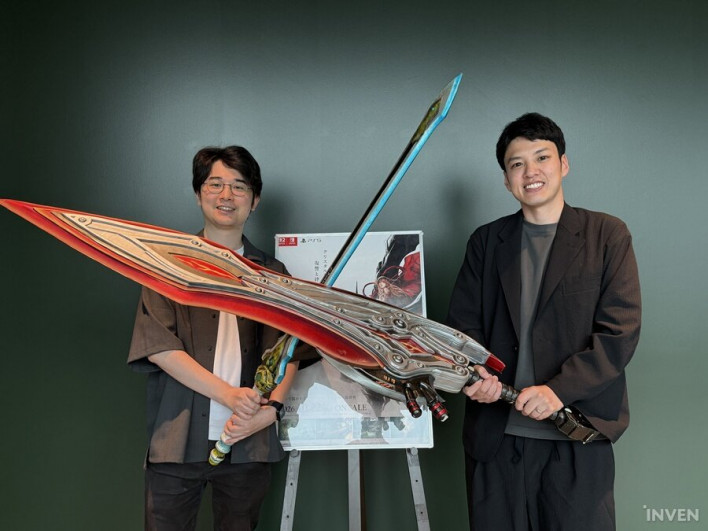
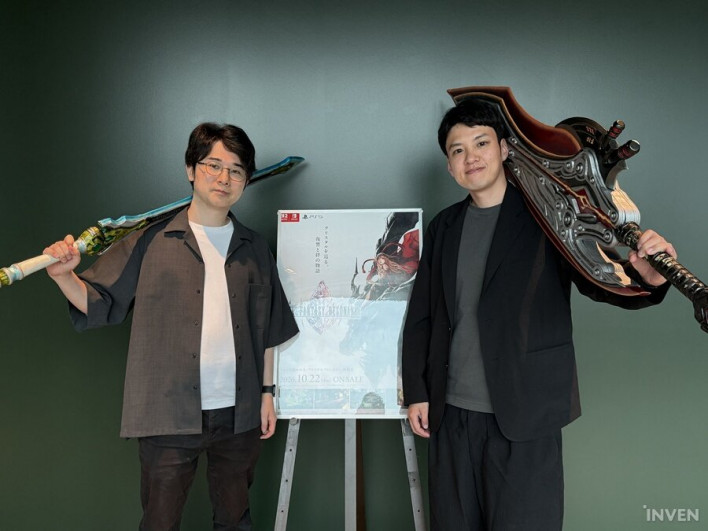
Then came the opportunity to finally answer those questions. We met directly with director Hiroto Furuya and producer Keisuke Nakajima to sit down and chat. We visited Square Enix's Shibuya office to hear about a wide range of topics surrounding FF Resonance—from what prompted the start of the project and why they chose classic turn-based combat, to the developers' deliberations over random encounters and HD-2D, as well as the potential for future sequels.
There seem to be very few cases of reviving a shut-down mobile game as a console title. We understand that FF Resonance began with the end of FF Brave Exvius's service. Were there any difficulties from planning to execution?
Nakajima: First of all, when we began planning FF Resonance, the decision on whether FF Brave Exvius would end service hadn't been made yet. So it wasn't a project developed thinking, "FF Brave Exvius is about to shut down, so let me remake this for consoles." In fact, it was almost the opposite. As an independent team, we started the project with the idea of creating a game that players could enjoy regardless of what happened to FF Brave Exvius, and we developed the game's content, systems, and overall composition accordingly.
As for difficulties, there were certainly quite a few. The combat system is a prime example. We adopted a combat system that is different from FF Brave Exvius. Beyond the need to build a battle system where players feel a sense of exhilaration even after just playing a little bit, pixel-art Final Fantasy games often bring to mind the job system—one of the key features of classic entries. We deliberated heavily on how to effectively integrate these elements.
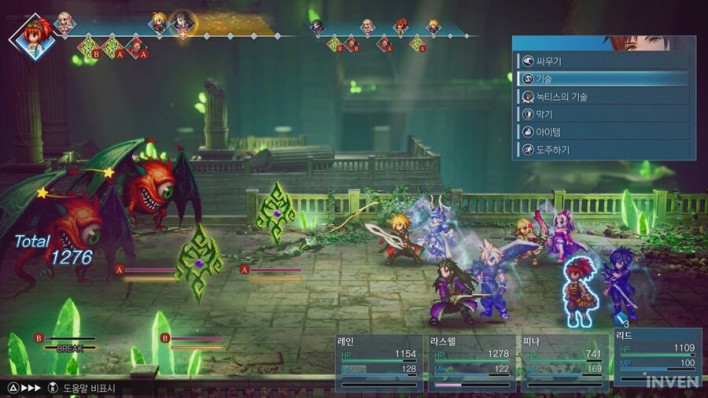
Character balancing was also a major concern. FF Resonance features a wide variety of characters, combining main characters and Vision characters. Since we couldn't have specific characters feel weak, adjusting the balance and assigning roles so that every character had a distinct function was far from easy.
We also can't leave out the HD-2D graphics, which are one of the key features of FF Resonance. As is typical with HD-2D titles, because the backgrounds are 3D while the characters are 2D, there were many situations where the pixel art looked disconnected. Blending them together naturally was extremely difficult, and the art team put in a tremendous amount of effort to make it look seamless.
I think this game might feel somewhat unfamiliar to Final Fantasy series fans. It isn't a new numbered title, but a spin-off, and a reinterpretation of a mobile game that has already shut down. What do you think is the biggest draw that FF Resonance offers to Final Fantasy fans?
Furuya: First, I'd point to the story. It follows a classic narrative about saving the planet. Beyond that, it features a mysterious girl, summons, a group in mysterious armor, and crystals—elements that follow a quintessential Final Fantasy story while still retaining FF Resonance's unique charm.
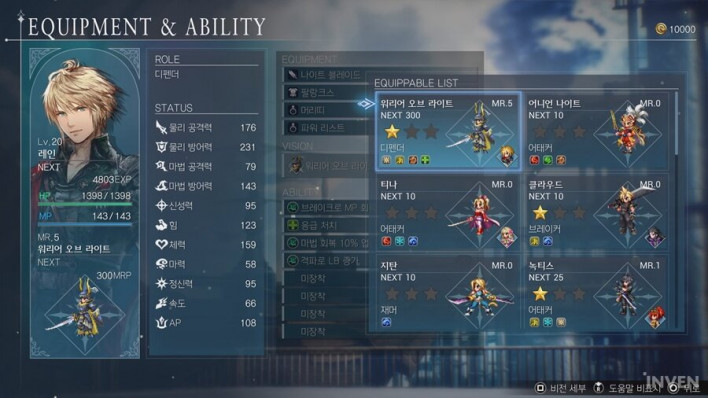
There's also the combat system. We restructured it with unique FF Resonance elements—combining Visions, which feel like a further evolution of Final Fantasy V's job system, with distinct playstyles per character brought over from other Final Fantasy entries. As a result, we created a battle system that feels fresh yet evokes a nostalgic familiarity. Existing Final Fantasy fans will likely find a lot to enjoy here.
To sum it up, we developed the game keeping in mind that Final Fantasy fans should feel a sense of nostalgia reminiscent of classic entries while simultaneously experiencing something entirely new.
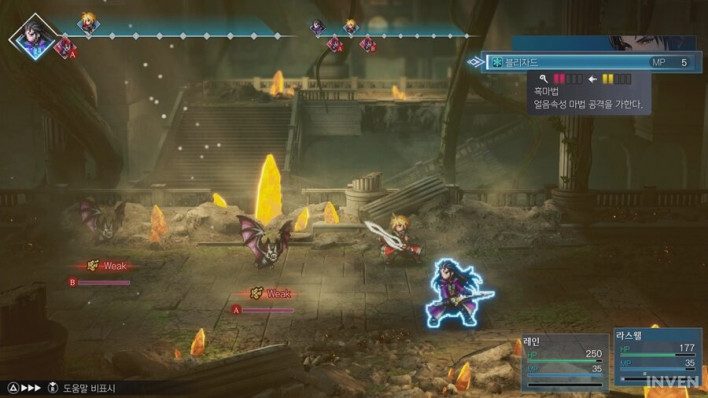
There appear to be around 10 characters appearing as Visions. There were likely many more candidates—what criteria did you use to select them? Were there any characters you wanted to include but ultimately left out due to various criteria? Lastly, since Vision characters required balanced performance per character, how did you consult with the original developers during that process?
Nakajima: As you mentioned, the current set of Vision characters was decided through several selection criteria, and the most important factor was the proportion of Vision characters per numbered entry. We wanted to avoid releasing too many characters from a single numbered game, so using that criterion, we aimed to include one character from every main entry released so far wherever possible.
Of course, some argued that picking only one per series was too few, suggesting we should pick at least two. But if we did that, just counting the numbered series would yield around 30 Vision characters. In that scenario, characters with similar concepts or roles would inevitably overlap, resulting in some characters never being used. There was also the matter of balance. We felt that flooding players with too many choices wouldn't necessarily be good for those building team combinations. Factoring in these various conditions led us to the current number.
As for balancing the Vision characters, we finalized it through discussion with the original developers as you asked. Beyond mere performance and balance, we produced them under the supervision of the original team—covering everything from what animations suited each character to which skills they should use and what level of performance was appropriate.
Nowadays, turn-based combat is sometimes perceived as somewhat static. In particular, there is a perception that if character levels or stats are high, enemies can be defeated without much thought. With recent turn-based RPGs attempting various approaches to overcome this, how does FF Resonance implement combat fun and strategic depth?
Furuya: I believe one reason turn-based RPG combat can feel monotonous is that enemies are simply too weak—in other words, too easy. That's why battles can feel increasingly boring or repetitive as you progress, so in FF Resonance, we set the difficulty to be somewhat challenging to prevent that.
This also ties into FF Resonance's unique features. Players can devise a wide variety of strategies using Vision customization. For instance, players can equip Ability Visions. Because we designed it so players can craft their desired builds and enter combat using the Vision system, we adjusted the difficulty to be a bit harder to ensure combat remains dynamic.

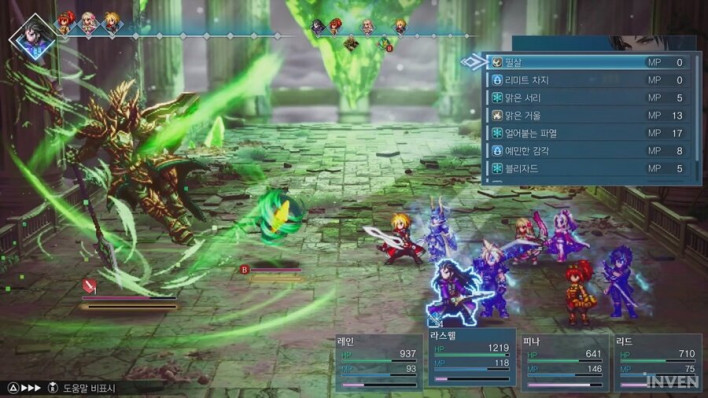
While that covers our efforts to alleviate turn-based combat monotony from a strategic standpoint, the next aspect is battle tempo. Depleting the Break gauge below an enemy's HP bar puts the enemy into an incapacitated "Break" state. By keeping battlefield conditions constantly shifting in this way, we ensured that combat itself does not feel repetitive.
On top of that, triggering a "Full Break" by Breaking all enemies grants an Extra Phase for additional turns, while enabling ultimate-tier Resonance skills. These boast powerful effects across the board, whether dealing massive damage to enemies or healing allies. Through these strategic elements and pacing accelerators, FF Resonance ensures combat rarely feels monotonous despite being turn-based.
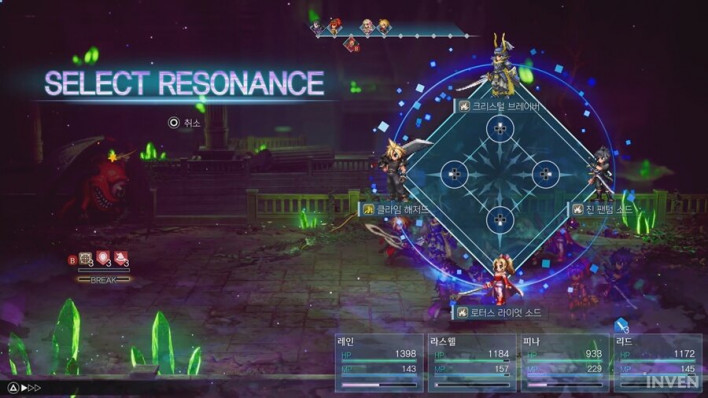
Many recent games use symbol encounters so players can choose whether to fight or avoid battles. In contrast, FF Resonance uses random encounters, making combat unavoidable. What was the reason for adopting random encounters despite it being something players might find tedious, and how do you plan to prevent battle fatigue during extended play?
Furuya: The main reason we chose random encounters is due to FF Resonance's core design philosophy. In classic RPGs, clearing a dungeon was structured around fighting standard mobs and ultimately beating the dungeon boss to complete it. In this process, players had to manage resources like HP, MP, and items, which itself added to the gameplay enjoyment. Because FF Resonance was designed to capture that atmosphere and tone, we felt random encounters were a better fit and decided to adopt them.
Of course, we are well aware that fighting standard mobs repeatedly can feel tedious. However, as explained earlier, we adjusted FF Resonance so even mob battles remain engaging by introducing mechanics like the Break system to keep combat lively, so we hope players enjoy that aspect as well.
Additionally, to lessen the burden on players, we implemented several measures so players can prepare to a degree, such as battle speed adjustments and adding a radar indicator on the minimap to improve visibility regarding incoming encounters.
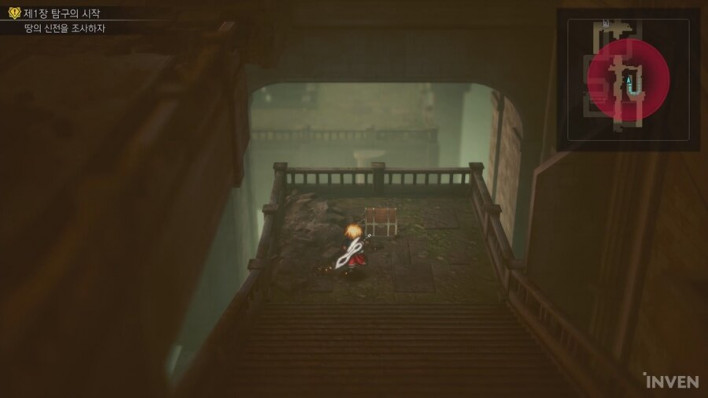
Nakajima: Additionally, we adjusted the mob encounter frequency depending on the dungeon. For instance, in dungeons focused on gimmicks or puzzles, frequent encounters would inevitably become annoying, so we lowered the encounter rate or frequency accordingly.
On the other hand, I personally believe there is distinct fun unique to random encounters. The biggest advantage of symbol encounters is that you can initiate combat whenever you want. As a result, players often just walk past standard mobs. Random encounters aren't like that; you might encounter mobs in the middle of a path or inside a dungeon, and sometimes those moments end up being more memorable. Ultimately, it impacts player experience. Believing it could serve as an element that heightens the gameplay experience, we chose the random encounter system.
Indeed, while walking around, we could see the radar gradually shift from green to yellow to red, indicating that a random encounter was about to happen. You just described this as "enemies approaching"—if you stand completely still, does the encounter gauge decrease back from red to yellow to green, or change in any similar way?
Furuya: That's not the case (laughs). Saying "enemies are approaching" was strictly a figure of speech, so standing still won't reduce the random encounter probability.
While previous turn-based Final Fantasy entries frequently utilized the Active Time Battle (ATB) system, FF Resonance does not use ATB. Did you follow this approach simply because the original game didn't use ATB, or did you intentionally choose a different style to create combat unique to FF Resonance?
Nakajima: It wasn't done this way just because the original didn't use ATB either. Rather, it's more accurate to say that the current battle system without ATB was simply a better fit for FF Resonance.
Mentioning Final Fantasy naturally brings ATB to mind for many. However, looking at recent entries in the series, you can see they have moved much closer to 3D real-time action games, where reflexes and split-second decisions take center stage.
By contrast, FF Resonance aims to be a classic Final Fantasy. We aimed for a game where players can take their time to think and decide—whether to hit an elemental weakness, focus on a single enemy or use area-of-effect skills against multiple targets, or prioritize depleting HP versus reducing the Break gauge.
Even if we had used ATB, we could have enabled indirect turn-based play via pausing, but we felt using ATB would inevitably lead to a turn-based battle requiring some degree of reflexes. Ultimately, because FF Resonance aimed to let players deliberate and decide at their own pace, we decided to use a traditional turn-based system.
Looking at the opening, we could see "Cinematic Pixel" in action—a modern pixel presentation tech that pixelates 3D models. However, when summoning espers or using Vision Resonance skills, standard 3D CG appears, which was a bit puzzling. Unifying everything with Cinematic Pixel might have seemed better; was that not considered, or was there a specific reason?
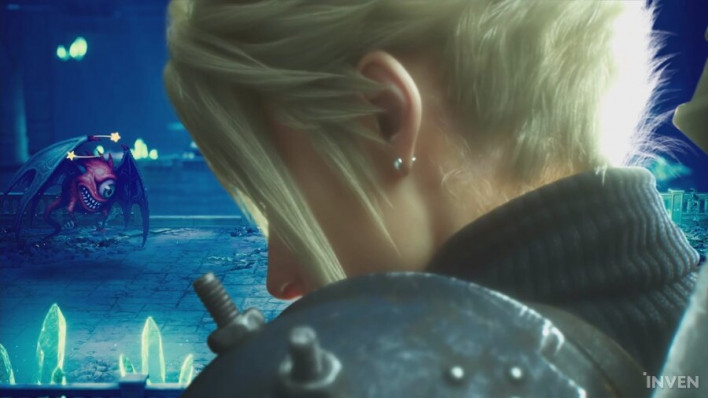
Nakajima: We naturally considered that. For the sake of visual consistency, we internally tested rendering the current 3D CG sequences in Cinematic Pixel as well, but ultimately concluded that 3D CG looked better.
Taking Cloud as an example, as everyone knows, he is the protagonist of Final Fantasy VII and a quintessential handsome character. But when we applied Cinematic Pixel, the result simply didn't live up to the handsome visual everyone expects from Cloud. Looking at that, we realized that wasn't what fans would want to see either.
So while it slightly compromises visual consistency, consensus favored showcasing the best representation for each scene, resulting in the current form where 3D CG is used for specific sequences.
FF Resonance is based on Season 1 of FF Brave Exvius. The original game concluded its service after Season 4; what happens to the story from Season 2 onward? Also, did you choose Season 1 with future sequels in mind?
Nakajima: Since FF Resonance, which covers Season 1, hasn't even been released yet, it's difficult to speak about a sequel at this stage. In fact, we aren't currently developing a second entry covering Season 2.
Of course, if conditions align, we would love to make a second entry covering Season 2 if possible. If that happens, it would likely be an evolved game compared to FF Resonance—incorporating new presentation techniques or adding fresh systems, fitting for a Final Fantasy title.
However, that is strictly hypothetical. Doing so would also raise development hurdles significantly, so right now we are simply devoting our full energy to FF Resonance.
Director Furuya previously served as director for Another Eden, a mobile game that felt like a console title. How did that experience influence the development of FF Resonance?
Furuya: Honestly, I don't think there was much that provided direct help. Console and mobile are inherently different, not just in development but in their live environment. In mobile games, for example, you have monthly updates, and player feedback on content is fast, direct, and passionate. Still, having that experience developing a mobile game gave me a rough sense of what the development environment and atmosphere surrounding FF Brave Exvius must have been like.
I do think that understanding ultimately had a positive impact on developing FF Resonance. For instance, when trying to implement specific specifications (content or systems), there might have been things that were difficult to do on mobile, giving me insight like, "They probably built it this way because it was mobile." That kind of perspective was helpful.
While the Final Fantasy series has recently shifted toward action, FF Resonance leads with pixel graphics, HD-2D, and turn-based combat. Is it fair to say there was an intent to revive the feeling of classic Final Fantasy through this direction? Furthermore, does this signify a "revival of turn-based Final Fantasy"?
Nakajima: We didn't attach such grand meaning to it (laughs). Rather, even in this era dominated by 3D action games, we believed classic Final Fantasy-style turn-based combat could still resonate if executed well. We thought it would be exciting to create a game that preserves traditional turn-based combat fundamentals while integrating new technology.
This is something I thought back when I was in charge of the Actraiser remake, but while modern game install sizes are absurdly massive compared to the past, fun isn't strictly proportional to file size. Indeed, there are games boasting massive storage requirements that feel mediocre, and conversely, older games that are more fun.
In that sense, we hope players view FF Resonance as a game pursuing the authentic fun of traditional turn-based combat.
The Korean game industry heavily relies on online, mobile, and live-service models. As a result, end of service often means the complete end of that game's legacy. In that light, looking at FF Resonance evokes a sense of envy. If other studios were to convert a live-service game into a single-player packaged game like FF Resonance in the future, what advice could you give on key considerations or things to avoid?
Nakajima: Even with a base game like the original, porting to consoles isn't as easy as it sounds. From cost alone, there are so many factors to consider that it practically demands a budget on par with creating a brand-new title. From that perspective, unless it's a project capable of attracting new fans rather than relying solely on existing fans, speaking realistically, profitability isn't particularly strong.
Therefore, what matters most is not only creating a work that sparks nostalgia among original fans, but above all, delivering a polished, engaging title that can capture new fans as a standalone console game.
Finally, please leave a word for Korean gamers waiting for FF Resonance.
Furuya: FF Resonance builds upon FF Brave Exvius while adding new elements to transform it into a fresh console game.
As someone who personally loves Korean games and enjoyed online games, I hope FF Resonance succeeds and sets a precedent that remaking a shuttered mobile game into a console title can succeed, establishing a positive precedent for the industry. So please buy and play the game!
Nakajima: FF Resonance is packed with the core appeal of Final Fantasy. For fans who love classic Final Fantasy games, our goal is to offer a title that brings nostalgia, making them think, "This is the kind of Final Fantasy I was waiting for," or "There used to be a Final Fantasy with a feeling like this".
Of course, it isn't only for long-time fans. Ideally, we developed this game hoping it can serve as a entry point for players who know of Final Fantasy but haven't played one, or as an invitation to return for those who loved Final Fantasy in the past but no longer play. Please look forward to it.