This game has serious style.
That was my immediate thought upon seeing Shape Farm's two-player co-op game 'Orbitals' when it was surprisingly revealed at last year's The Game Awards. From its now-retro 80s and 90s anime visuals to its core identity as a two-player co-op title, and the feeling of playing through an anime series brought on by the synergy of the two—among the many games unveiled at the time, 'Orbitals' stood out remarkably.
Of course, alongside the anticipation came a touch of worry. Given its nature as a two-player co-op game, comparisons to the works of Hazelight Studios—who arguably hold the crown in this genre—were unavoidable. Since it would inevitably be measured against them one way or another, I needed to see what truly sets 'Orbitals' apart.
When 'Orbitals' finally opened its doors, however, those concerns completely washed away. It was far more than a mere genre clone, boasting not only high polish but also a distinct identity of its own.

The sensation of 'playing' an anime
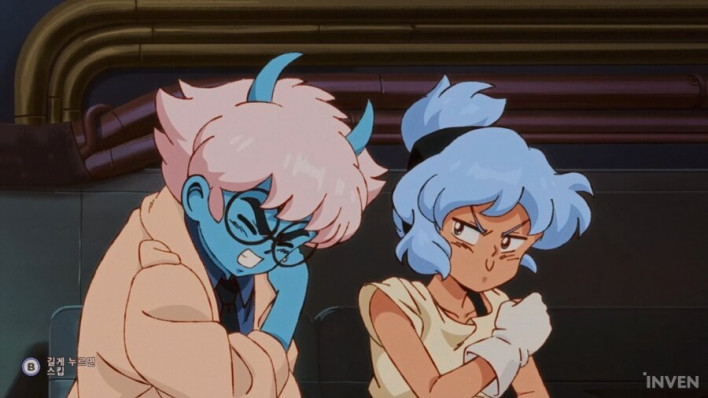
If asked to pick the most striking feature from 'Orbitals' first impression, I would point to its visuals without hesitation.
The two protagonists, Maki and Omura, as well as the NPCs, feature designs that look as though they jumped straight out of an 80s or 90s retro anime. Combined with hand-drawn visual stylings, frame-by-frame animation, and cinematic presentation, it creates an aesthetic that anyone who loves retro anime is bound to fall for.
These visual characteristics aren't limited to design and art style alone. There is another indispensable element when talking about movies and animation: frame rate.
Much like the 80s and 90s anime 'Orbitals' emulates, a significant portion of media content—including modern animation and films—is still produced at 24 fps. In the past, 24 fps was chosen as an economical compromise to save film costs while appearing natural to the human eye, but the situation is different today. If desired, creators can produce high frame rate (HFR) media or use frame interpolation to make 24 fps footage look as smooth as 60 fps.

Yet the reason so many visual works stick to 24 fps is simple. Audiences' eyes have long grown accustomed to 24 fps animation and movies, making it perceptually the most comfortable presentation.
'Orbitals' actively leverages this familiar sense. To capture the retro anime feel characteristic of VHS tapes, it applies 24 fps to character animation and 12 fps to environmental animation. For a game like 'Orbitals' that takes retro anime aesthetics as its visual direction, these frame rate choices are vital.
The issue is that such lower frame rates belong to cinematic language. While console games are occasionally locked to 30 fps due to performance limits, that is a hardware-driven compromise, which differs from artistic intent. In video games, higher frame rates generally offer better responsiveness and smoother visuals.
Additionally, the gap between the game's overall frame rate and the animation frame rates of characters and environments must be considered. For instance, if the game engine runs at 60 fps while character animation is capped at 24 fps, the disconnect can look jarring or awkward. Ultimately, 'Orbitals' needed to find a balanced compromise that preserved both gameplay smoothness and retro anime style movement.

'Orbitals' found common ground by intentionally capping the overall frame rate slightly. That compromise is around 40 fps. While exact figures were not measured, judging by the absence of typical 60 fps fluidity during actual gameplay, it appears to be tuned to roughly 40 fps. This choice seems designed to reduce stutter associated with low frame rates while preserving the signature feel of retro anime across the game.
This 40 fps target is a noticeable shift compared to the 30 fps frame rate seen during the demo back in April. At that time, the developers explained that capping the game at 30 fps was an intentional choice to capture an animated feel; in practice, however, sluggishness from the low frame rate felt far more prominent than any retro charm.
This area was my biggest worry prior to reviewing the game. Thankfully, settling on 40 fps has resolved much of that concern. While still lower than standard game frame rates, it never feels sluggish enough to hinder gameplay. Instead, it blends naturally with the stylized character and environmental animations, making the visual identity of 'Orbitals' stand out even more clearly.

The final result of this careful tuning exceeds expectations. Transitions between gameplay and cutscenes feel almost seamless, genuinely delivering the feeling of 'playing' through an anime.
The core joy lies in overcoming challenges, not simple co-op


Overall gameplay faithfully adheres to the established conventions of two-player split-screen co-op games. The cooperation here broadly falls into two types. The first is working together while separated, with each player executing their own role. For example, if Maki's path is blocked, Omura presses a button or steps on a pressure plate to clear a way forward.
On top of this, 'Orbitals' adds various equipment. Gear equipped before disembarking from the ship serves as a key tool for solving puzzles scattered across each region. Players leapfrogging through the same space with different gear use their respective abilities to overcome obstacles together, or clear obstacles blocking their own paths while briefly separated.
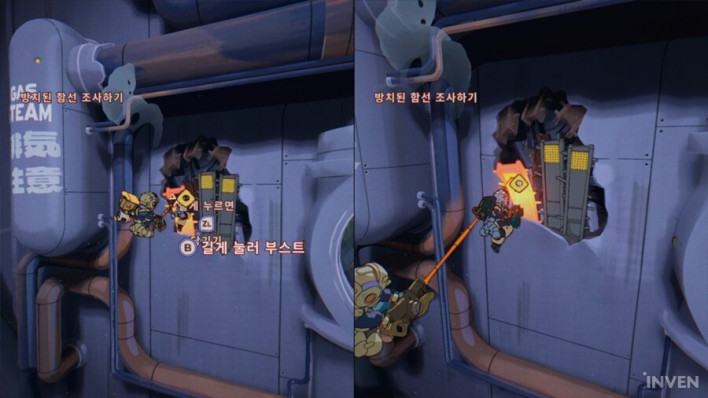
The second type involves two players tackling problems side-by-side in the same space. A prime example is when one player heats up a path blocked by steel beams using a laser beam, while the other pulls it away using a grappling hook. Compared to the former method, overall puzzle difficulty here is on the lower side, but it is far from trivial. Some sequences demand synchronized teamwork—such as riding a moving lift while stepping left and right to balance its direction while simultaneously clearing incoming obstacles.

The highlight of co-op play is undoubtedly combat, such as boss battles. When piloting the ship, for example, one player sits in the pilot seat handling movement and evasion while the other sits in the gunner seat dedicated to attacking. Roles are not strictly segregated, either; depending on the situation, the pilot may need to assist in combat. From fundamental puzzles to boss fights where cooperative thrills peak, 'Orbitals' requires two players to move in lockstep like a three-legged race from start to finish.

Dividing roles and keeping in sync creates the joyful clamor unique to split-screen co-op. In segments requiring lift balancing, players shout "Left! Left! Next... Right! Right!" After dying to a sudden obstacle on a tight curve, they naturally discuss their next strategy, saying, "Ah, let's go left here next time." Even failure becomes a natural step in solving problems together.
The low penalty for failure is another aspect that makes co-op in 'Orbitals' so enjoyable. In most games, repeated failure leads to frustration. In 'Orbitals', however, that pressure is virtually nonexistent. Falling off platforms or walking into traps usually respawns players nearby with no penalty, and tricky co-op puzzle segments feature generous save points so you never have to start over from scratch. As a result, even when facing demanding puzzles, players can focus on the process of trying again and solving it rather than fearing failure.
Pacing between puzzles and platforming is also well executed. If identical puzzles and platforming sections repeat, players quickly grow accustomed to patterns, dulling the fun. 'Orbitals' alleviates this concern by constantly introducing appropriate twists. Just when a mechanic feels familiar, it introduces new elements to inject fresh excitement into gameplay.




It is also worth highlighting how surprisingly seamlessly various genre elements—such as shooting and rhythm mechanics—are integrated. Playstyles shift alongside story progression, while solving regional puzzles introduces new gameplay mechanics and boss battles add novel elements per phase. Yet these transitions never feel abrupt or out of place; they flow smoothly. Coupled with varied puzzles, these mechanics keep the gameplay feeling fresh all the way to the end.
The accessible puzzle difficulty also plays a role in sustaining co-op enjoyment. In segments requiring precise coordination like a three-legged race, players might die a few times learning trap layouts and syncing movements. But it stops right there. After a failure or two, the solution becomes clear. Other puzzles follow suit; segments requiring gear automatically lock onto relevant objects, offering player-friendly design throughout so that virtually no puzzle feels like an impassable wall.

Though 'Orbitals' delivers high polish and satisfying cooperative play, it is not without minor shortcomings. If I had to point out one thing, it would be the heavy emphasis on puzzles and platforming. While working together to solve obstacle-like puzzles is the core of co-op games, players expecting more intense action might find this puzzle-and-platformer-heavy structure somewhat lacking.
Of course, this is merely a minor quibble. As mentioned earlier, 'Orbitals' is not built around action in terms of worldbuilding, atmosphere, or concept. In that sense, the lighter combat feels less like a true flaw and more like a personal wish for a bit more action.
A joy only completed 'together'
Masterpiece games are often jokingly called 'games worth stealing a console or graphics card to play.' In that sense, 'Orbitals' is a game worth doing whatever it takes to find a friend to play with.
While such phrasing usually carries high praise, in the case of 'Orbitals', it also highlights a genre limitation. As a two-player split-screen co-op game, it simply cannot be fully enjoyed alone. Furthermore, its puzzle-centric design might initially seem like a barrier to entry. Although targeted objects and visible hints are scattered throughout, certain puzzles require both players to scan their surroundings until having that shared "Aha! That's it!" breakthrough moment.
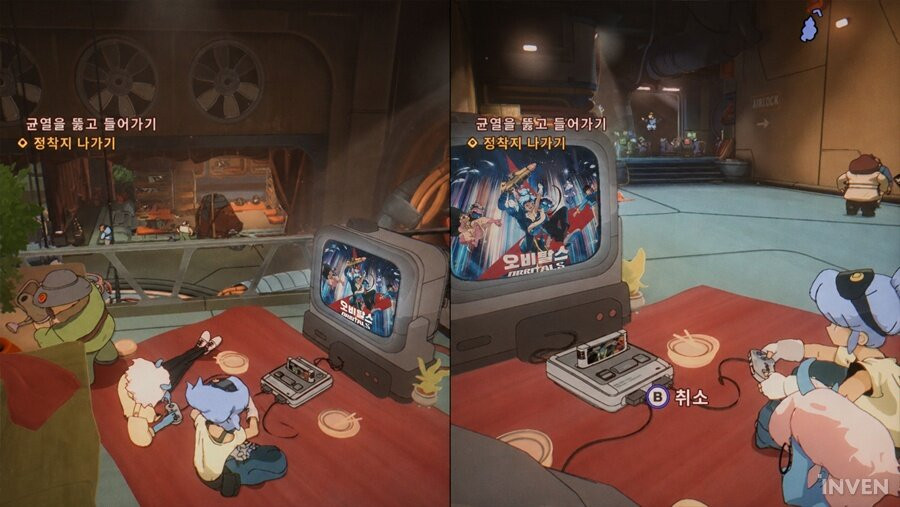
Yet while these traits might seem like drawbacks or barriers at first glance, actually playing 'Orbitals' turns them into its greatest charms. These days, gamers often laugh and chat over Discord while playing together, but that still feels quite different from sitting side-by-side at an arcade cabinet. Even when gaming for fun, coordinating raid mechanics with friends can sometimes feel like work.
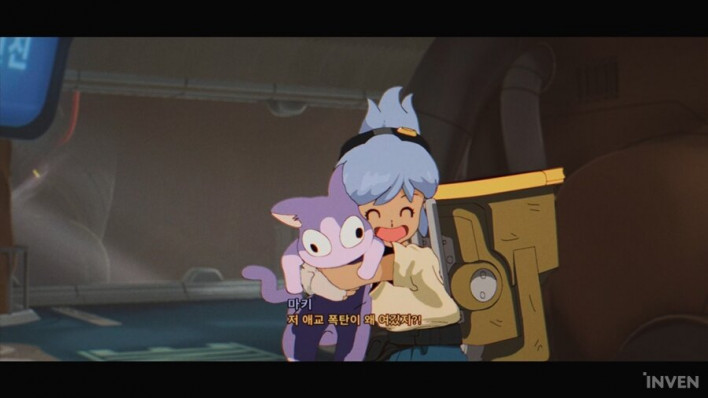
'Orbitals', on the other hand, is different. No matter how many times you fail, you can try again without pressure, conversing and laughing along the way. Rather than 'clearing' a game with someone, it feels closer to literally 'enjoying' a game together—a quality I personally adored.
Imaginative stage layouts, manageable difficulty, and distinctive co-op mechanics showcase 'Orbitals' unique identity with conviction. Its level of polish stands toe-to-toe with established masterpieces of two-player co-op gaming. On top of that, it boasts immersive gameplay that makes hours fly by, leaving players exclaiming, "Wait, how is it this late already?"
While it supports online play—meaning you don't strictly need to be in the same room—the game's true brilliance shines when sitting together and seeing each other's reactions firsthand. So if you are a gamer who enjoys cooperative titles, invite a close friend over, set a couple of cold beers on the table, and dive in. And if you don't have a friend handy, 'steal' one if you must. This game is undeniably worth it.

- Co-op fun that shines in local play
- A harmony of diverse genres and puzzles
- Seamless connections between cutscenes and gameplay
- Retro visuals capturing 80s-90s nostalgia
- Game design that removes the fear of failure
- Somewhat average story and storytelling
- Divided opinions on the 40 fps cap
- A friend to play with is strictly required
Review Platform: NSW2 (NSW2)