Over the past decade, China's animation industry has expanded significantly. The market size, including animation, comics, and related spin-off products, grew from 76 billion yuan (approx. 15.5 trillion won) in 2019 to 400 billion won (8.18 billion won). Amid the rise of the Chinese animation industry from a cultural periphery to one of its core sectors, YHKT ENTERTAINMENT was a prominent production studio. In particular, 'Ling Cage' became a flagship title of Guochuang (domestically produced Chinese animation), surpassing 10 billion cumulative views.
At Gamescom, YHKT ENTERTAINMENT presented its answer in the form of a game. Narrative-driven fantasy action RPG Bringer is an attempt to transfer the studio's nearly 10 years of accumulated video and directorial know-how into a new medium—gaming. Entering the game market using its signature strengths in cinematic direction and visual presentation as weapons is not unprecedented globally or domestically. However, what makes this noteworthy is that it comes from a studio that sat at the pinnacle of Chinese animation.
Setting up a booth in Hall 10 of Koelnmesse in Cologne, Germany, Bringer welcomed game fans under the development studio name YHKT ENTERTAINMENT. Here are my impressions from experiencing the title not as an animation, but as a playable hands-on game.
The Bringer demo begins with Nyx, a character dragged along by something dark and viscous as if consumed by darkness. Nyx, who initially resembled a young girl, soon grows wings and mutates into a monster barely recognizable as human. Following this cinematic sequence, the game transitions straight into a boss battle against the monster.
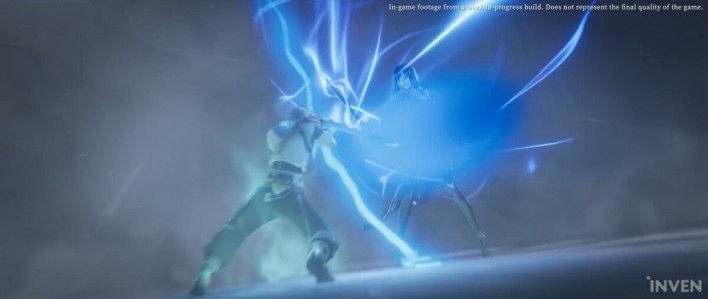
What left the strongest impression in this section was the visuals. Since Bringer espouses an animated style, it naturally calls to mind the visuals of anime-style games commonly referred to as subculture games. Although specific character implementation methods and designs differ, anime-style games smooth out skin tones, feature distinct outlines, and use stylized body and face depictions, making their visual direction relatively predictable.
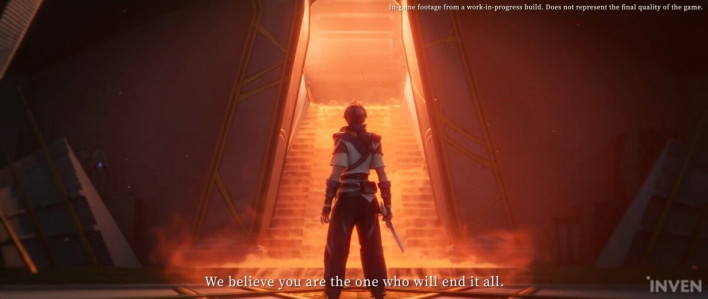
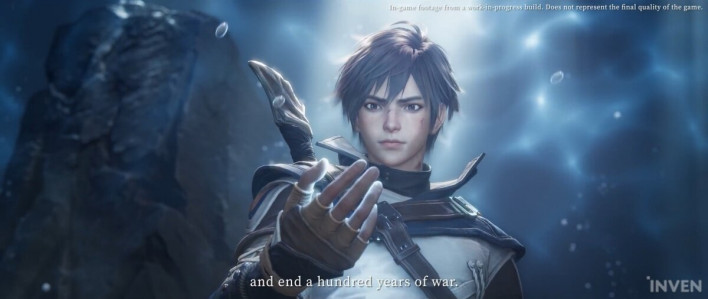
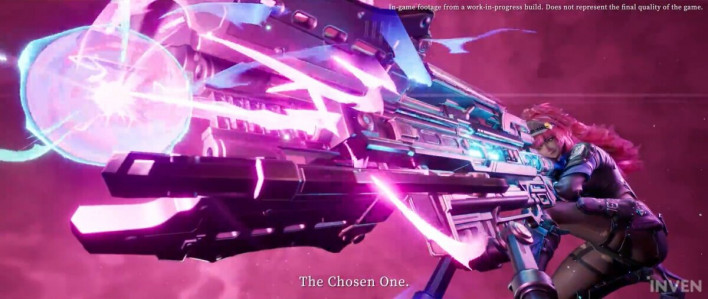
However, Bringer takes a different path from this typical anime-style presentation. While it shares a general framework with anime-style games—such as attractive characters and small, cute characters—it possesses a distinct feel. As the studio's track record suggests, it brings out a Chinese animation style, which on-site observers described as feeling closer to Korean 3D animation direction. In addition, certain depictions and lighting give off a vibe similar to the lighting and texture work seen in Western 3D animation.
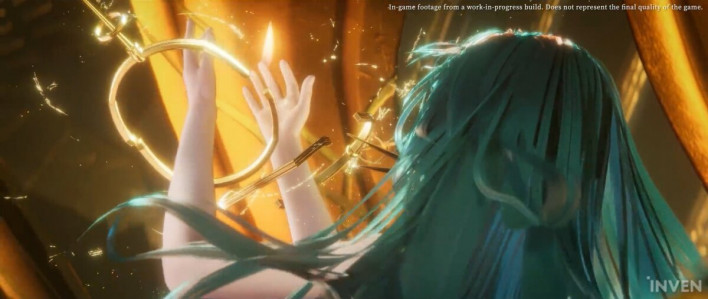
Due to this fundamental difference in art direction, the feel of the game comes across differently despite similarities in overall gameplay, systems, combat mechanics, and target audience. On top of that, it goes without saying that the graphics themselves are quite polished.
While its visual direction diverges from the norm, the combat plays out with a fairly familiar feel. In this demo, play begins with a single protagonist facing off against a boss. Left-click is the basic attack, right-click is dodge, E is the skill button, and there is one ultimate ability button. As the overall button layout suggests, combat itself revolves around switching between characters while utilizing each character's core skills.
In the early stage where you control only one character, gameplay inevitably feels somewhat monotonous. Fortunately, the ultimate ability—which fills its gauge as you attack—does not have a cooldown attached to it, allowing players to use ultimate abilities relatively freely while sustaining attacks.
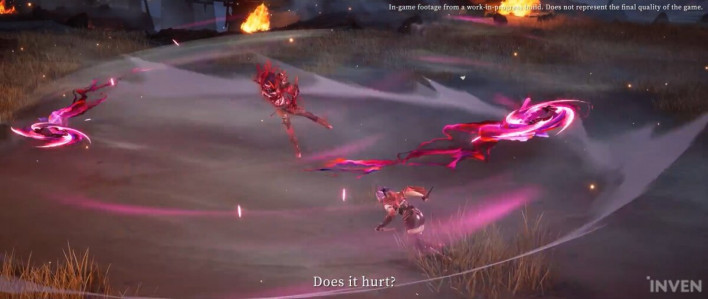
Of course, combat does not remain entirely monotonous. The aforementioned dodges and attacks are executed quite swiftly. Dodging attacks and seizing openings to continue striking creates a simple yet intense rhythm. There is also a timing-based parry mechanic. Rather than parrying as a defensive skill to directly counter enemy attacks, a button prompt appears during specific enemy attacks, allowing input with (keyboard) R only at that moment.
Naturally, you don't have to block parriable attacks; dodging them remains an option. However, parrying creates opportunities for follow-up strikes, and continuously succeeding at parries triggers a groggy kill prompt. Pressing the F button accordingly executes an even more powerful attack.
In short, rather than letting players freely block every attack with defense, the design encourages dodging some attacks and parrying others. This allows players to choose whether to dodge and take a more measured approach or act quickly to land follow-up hits.
These combat concepts deepen further in Phases 2 and 3 of the boss fight. From Phase 2 onward, Luohua, who previously only appeared in cinematic sequences, joins as an active party member. Pressing number keys 1 and 2 switches between characters, each operating with separate skills and ultimate gauges. This expands both attack options and skill utilization, allowing for greater freedom in combat chaining.
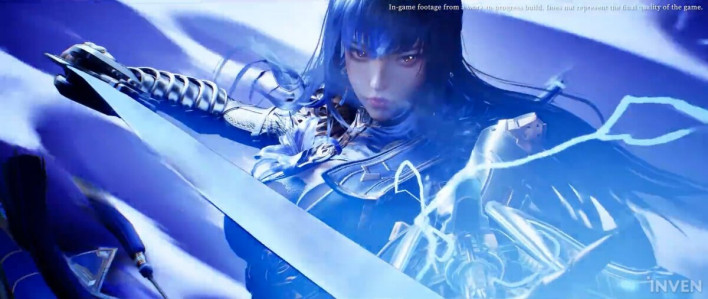
In Phase 3, Luohua leaves the party, and the boss launches attacks that require aggressive use of parries and dodges. The boss unleashes continuous attacks with its long legs, requiring consecutive parries with the R key, while off-beat attack timings occasionally make a perfect counter difficult.
Thus, Phase 1 teaches the combat fundamentals, Phase 2 introduces party combat with a companion, and Phase 3 teaches advanced actions built around parries and groggy kills. In practice, while Phases 1 and 2 could be cleared quite easily, Phase 3 is designed to make clearing difficult through simple dodge-and-attack tactics alone.
After a lengthy back-and-forth battle, defeating the boss restores Nyx from monster back to human, followed by a brief dialogue sequence. Players can move around the arena where the boss fight took place, interact with characters, and select dialogue choices. During these conversations, the camera zooms in close on character faces, making the stylistic distinction from traditional anime art even clearer.
Because the demo took place in the B2C hall rather than the business hall, the playtime was relatively short. Nevertheless, within that brief period, both the intuitive, snappy gameplay and the emphasized visual identity made a clear impression.