A few days ahead of Gamescom 2026, an interview with the development team of Total War: Warhammer 40K was held for Korean media. The interview included Attila Mohacsi, Game Director at Creative Assembly; Joey Day, Tutorial Lead; and Kieran Rooney, PR Lead, and lasted approximately an hour and a half via an online meeting platform.
Prior to the interview, a hands-on session with a demo build of Total War: Warhammer 40K was also conducted. The demo was an early build that offered a partial hands-on experience focused solely on controlling Space Marines in battle against Orks, with the preview published in a separate article.
Below is the full transcript of the interview with the CA development team.
How many playable factions (including sub-factions) will be available at launch?
Attila Mohacsi: At launch, four main factions will be playable, and each faction will feature two playable sub-factions. For example, the previously revealed Ultramarines are one of the Space Marine sub-factions, and there is one other sub-faction alongside them.
On top of that, this title allows players to create their own avatar warlord and custom faction for the first time in the Total War series. All four previously mentioned races allow you to create your own faction—if you play as Space Marines, for instance, you can create your own successor Chapter. Other races can likewise create and customize their own factions, such as clans or Astra Militarum regiments.
To what extent have elements from the original miniature tabletop game been incorporated?
Attila Mohacsi: There is so much that I hardly know where to start. Many members of our dev team have played the tabletop game, so naturally, the tabletop game serves as our primary reference.
For example, elements like how Drop Pods and reserves function, as well as Deep Strike used in battle, were influenced by the tabletop game. The way units are composed, each unit's role, and how weapons work are the same. Doctrines, which you rightly pointed out, were also heavily influenced by the source material. The same goes for all factions, including the Orks you will encounter later. Even Marneus Calgar's abilities in battles you haven't seen yet were inspired by tabletop rules.
Of course, we don't bring them over verbatim. While the tabletop game is a major source of inspiration, we have to adapt it into a format that fits Total War. Tabletop games deal with a relatively small number of units, whereas Total War operates on a vastly larger scale. Therefore, we had to adapt tabletop rules and concepts to match Total War's scale.
Another important point is that we didn't just reference the rules. Another core source of inspiration for us is the Warhammer 40K lore itself. The books and the stories unfolding within them greatly influenced how we shaped the look and feel of each faction.
What we are trying to recreate is not just the tabletop game, but the entire universe of Warhammer 40K. From the start, our long-term goal was to realize all factions, characters, and this universe as a whole. This includes grand strategy and faction management elements unique to Total War that go beyond the scope of tabletop games. You'll find countless references to the source material in those aspects as well.
Many fans have been waiting for Total War: Warhammer 40,000. Why are you making it only now?
Attila Mohacsi: I've wanted to make this game since I was 14 years old. Personally, it's been a 30-year journey, so I agree with the sentiment that people have waited a long time.
One reason it took time was that we first had to finish the Total War: Warhammer trilogy. I see this title as a natural evolution stemming from that trilogy. For us, the next evolution of the Total War franchise was heading into the grim darkness of the far future in the 41st Millennium and taking Total War into space.
There were technical challenges as well. To make this a reality, we had to build a new engine, because we are literally talking about a galactic scale. This is the most ambitious project we have ever undertaken.
So many people invested immense effort and time to get us to this point. At the same time, it was made possible by the experience we accumulated over the past decade developing Total War: Warhammer and the relationship we built with Games Workshop.
How are campaign systems like planet-scale resource management, politics, and diplomacy implemented?
Attila Mohacsi: We plan to reveal more details soon. Going forward, we will introduce campaign mechanics in greater detail.
The question of "what is diplomacy" in the 41st Millennium keeps coming up, and when we started this project, our conclusion was that in this universe, diplomacy is effectively war.
That doesn't mean there is no interaction at all, however. For instance, within the Imperium of Man, you can interact with planetary governors. You likely saw a very basic form of this in the demo shown at the event. You can issue edicts, which in practice is closer to enforcing them on local governors. Actions like these affect your influence and your relationships with the governors.
What you saw was the Space Marine version, and it works a bit differently for the Astra Militarum. And given the nature of the Warhammer 40K lore, Orks and humans will never be friends. Anything you could call diplomacy between them is just a matter of how efficiently they can kill each other.
However, in other cases, more subtle relationships can exist. Options like striking an uneasy truce for a limited time are possible. We will share more details on these aspects in future reveals.
Joey Day: I'd like to add to resource management as well. Because each faction has a different playstyle and focus, some factions will focus more heavily on resource management than others. While there are resources you'll recognize from previous Total War: Warhammer titles, a considerable number of new resources will also be introduced.
Is Space Marine fire support a system replacing magic from previous Total War: Warhammer games?
Attila Mohacsi: No, it isn't. Magic exists in this galaxy as well, but it is implemented quite differently from previous titles.
I don't know if you tried the Librarian in today's demo. The Librarian has an ability called "Vortex of Doom," which is extremely powerful. If you haven't used it yet, I definitely recommend trying it when you get the chance.
Magic in this universe is a bit more brutal—and saying "a bit more brutal" is putting it very mildly. At the same time, it is much more unpredictable. For example, when you cast Vortex of Doom, you cannot fully control it. The vortex pulls enemies in and tears them to shreds, but because you can't control where it moves, it might drift toward your own allies.
That unpredictable nature of the Warp is precisely what we wanted to capture from this IP. So fire support doesn't replace magic. Magic still exists as its own separate element, but functions differently from magic in Total War: Warhammer.
What is the scale of the campaign? Does each planet feature distinct characteristics?
Attila Mohacsi: The campaign is one of the biggest changes in this game, and it was also why we had to build a new game engine.
Starting from the smallest unit, on a single planet, you can recruit units, build structures, fight battles, and conquer territory, similar to traditional Total War.
If you're asking whether each planet has unique resources, the answer is yes. Landmarks also exist. As you might have seen in the tutorial, a crash-landed ship on a planet can serve as a landmark.
And it doesn't stop at a single planet. Within a star system, you can travel across multiple planets, each with its own distinct characteristics. This was also heavily inspired by the Warhammer 40K IP. For example, Agri-Worlds appear, responsible for feeding a star system or even multiple systems. You'll also see Hive Worlds, densely populated hubs that offer advantages for recruiting troops.
When we said we were taking Total War into space, we meant that literally. The initial campaign—or more accurately, a series of connected campaigns—becomes a journey spanning multiple star systems. The star system at the end of that journey is Armageddon, where our story begins. Over the next 10 years, and perhaps beyond, we want to bring as much of the 41st Millennium to life as possible through future content.
Additionally, each time you conquer a star system, you receive unique rewards that affect gameplay. For example, conquering a Forge World grants your faction access to specific units. We call this the "Escalation Tree," which, simply put, can be thought of as similar to the tech trees in previous games.
Progression elements like these carry over between campaigns as well. You have to think about how to reach Armageddon across multiple campaigns and win a war on a galactic theater scale.
Joey Day: In short, there is progression within each individual campaign, as well as overarching progression that carries across individual campaigns throughout the game as a whole.
Are Space Marine Chapters implemented like Legendary Lords in previous Total War: Warhammer games, or are they treated as separate factions?
Attila Mohacsi: It's a bit too early to speak in detail about other Space Marine Chapters. However, there is another Chapter besides the Ultramarines.
I wouldn't compare them directly to the Lord Packs from Total War: Warhammer, because the way we handle lords and characters themselves is different. Warhammer Fantasy is a setting where individual characters are paramount, whereas Warhammer 40,000 places a much stronger focus on factions.
People rarely say, "I play as Marneus Calgar." They usually say, "I play as the Ultramarines." We are likewise focusing on delivering what it truly means to play as the Ultramarines.
Naturally, playing a different Chapter will change how you play. You're rewarded for different playstyles and gain access to different mechanics, all while preserving the fundamental feeling that they are all Space Marines.
Characters certainly appear and remain an important component. However, rather than having characters drive everything, the emphasis is placed more heavily on the faction itself.
How do the four factions differ in terms of playstyle?
Attila Mohacsi: In developing the Total War: Warhammer trilogy, we learned that asymmetry works extremely well. That experience heavily influenced our development direction moving forward, and we plan to lean into it even more aggressively. Warhammer 40,000 is a fantastic IP for executing that kind of asymmetry.
The Space Marines are an elite faction that strikes the enemy's core with devastating firepower. They operate like a scalpel—hitting hard, severing the enemy's core like cutting off the head of a Hydra, and disengaging quickly.
The Astra Militarum is the exact opposite. They are a faction that slowly grinds the enemy down. We describe them as both the cannon and the cannon fodder. You build up your economy and continuously funnel troops onto the battlefield. Sending wave after wave of forces, you play with an expectation of casualties along the way. While every single casualty is a critical loss for Space Marines, that isn't the case for the Astra Militarum.
The Aeldari take a completely different approach. They are a dying race seeking to contain the spread of Chaos and protect the galaxy in their own way. To do so, they operate from the shadows and the spaces between them, manipulating their opponents. You won't know where they will strike until they reveal themselves.
Orks are the complete opposite once again—a massive "Green Tide" that revels in war for its own sake.
Thus, it isn't just their combat styles that differ. We aim to make everything asymmetrical, down to what each faction wants in the campaign, their objectives, and their goals.
Why was Chaos not included among the initial launch factions? Did recent narrative developments in the lore influence the selection of the Orks?
Attila Mohacsi: We maintain a fantastic relationship with Games Workshop, working together even on some recently revealed characters.
We knew that Armageddon was going to be a crucial focal point in the galaxy moving forward. So we decided to begin Total War: Warhammer 40,000's journey on Armageddon. As you mentioned in your question, it aligns closely with current ongoing lore.
Armageddon has a long history and is a landmark location in this universe. In particular, it symbolizes the war between humanity and the Orks. That's why we chose to focus on it.
Naturally, Chaos is also a vital part of Warhammer 40K, so it will inevitably make an appearance down the line. But that is something to talk about in the future. For now, our focus is on the beginning of this journey centered around Armageddon.
What are the biggest strategic and tactical differences compared to previous Total War games?
Attila Mohacsi: Starting with the campaign, key differences lie in how distinct each faction is and how different their motivations are.
When we framed the narrative around Armageddon, who controls Armageddon naturally becomes a major objective for both the Imperium of Man and the Orks. The Aeldari, however, have entirely different goals—though it's too early to discuss those details.
In other words, even campaign victory conditions are asymmetrical across factions. Another strategic distinction is how you approach the war theater as a whole, which is also an element absent from traditional Total War titles.
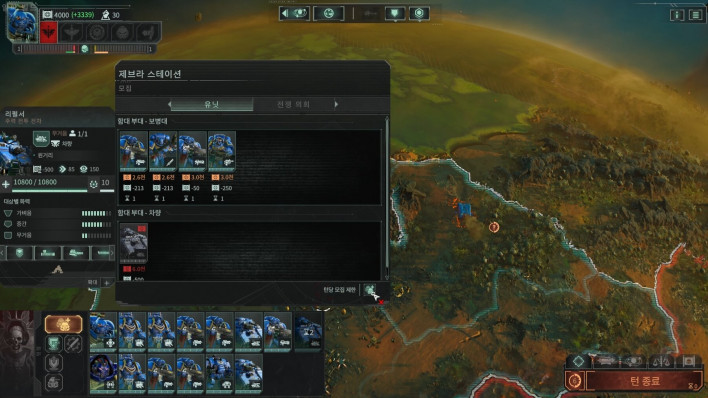
Joey Day: To add on the campaign side, previous Total War games featured a single map. This time, the map is split across multiple planets. That calls for entirely new planetary-level strategies, as well as fleet management strategies, and those fleets link directly into real-time battles as well.
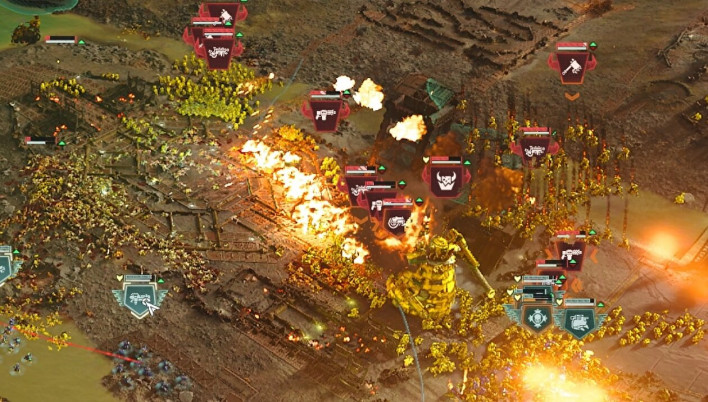
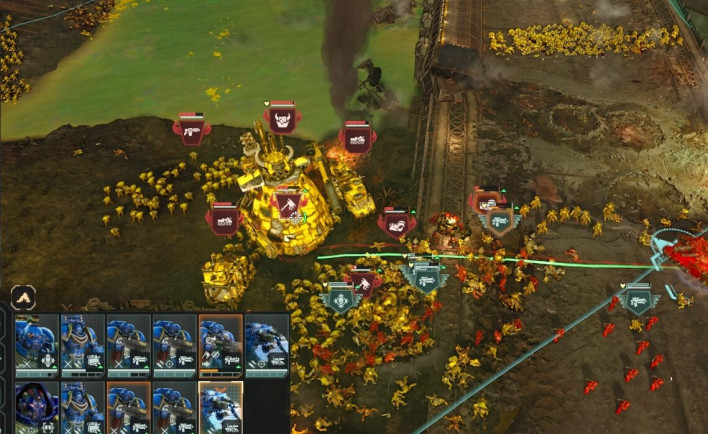
Attila Mohacsi: In combat, dynamic destruction is a core feature. You can forge your own paths across a constantly evolving battlefield. Delivering a spectacle that captures the sheer brutality of the 41st Millennium is also a huge part of it.
One more thing worth highlighting is the ability to create your own custom faction. It's a first for the Total War series, offering an unprecedented level of customization. Through this, you can define your own playstyle and project yourself directly into the 41st Millennium.
Kieran Rooney: I'd also like to emphasize the faction distinctions. Because every faction is fundamentally asymmetrical and plays differently, you will need entirely different strategies depending on which faction you play.
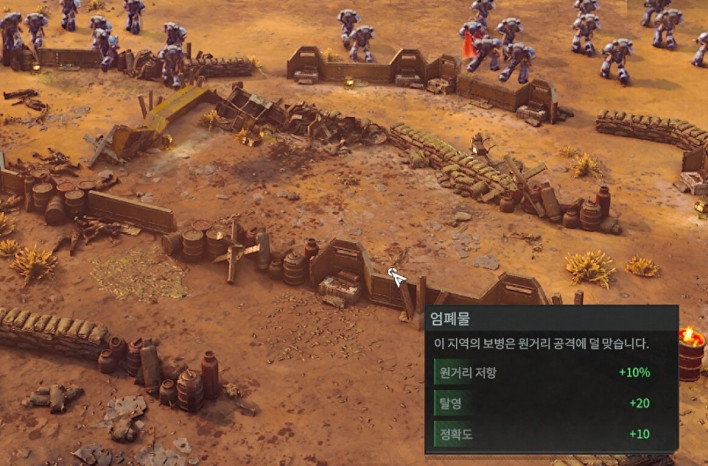
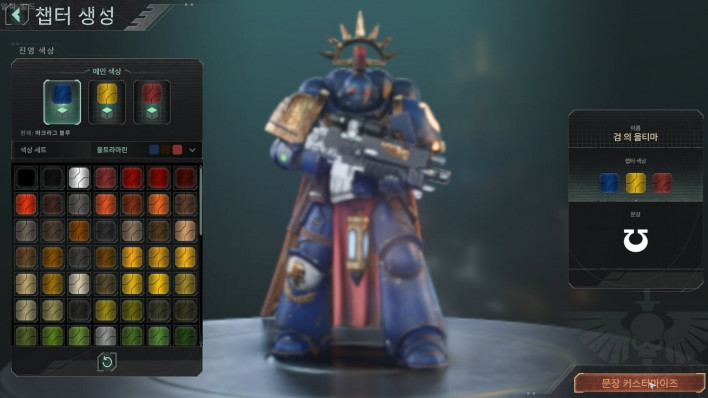
We saw color scheme presets for Ultramarines, Salamanders, and others. Is this customization available for other Chapters or factions as well?
Attila Mohacsi: The short answer is yes—there are many more presets. As mentioned earlier, we plan to prioritize color presets at launch for factions tied to ongoing events around Armageddon.
Kieran Rooney: One reason for providing presets is to allow players to express their desired faction even if we haven't fully implemented every sub-faction in the game yet.
For example, even if the Salamanders aren't implemented as a full sub-faction, you can apply their color preset, equip a bunch of flamers to burn your enemies, and roleplay as the Salamanders.
Ultimately, however, the primary goal of customization is to enable players to express a faction that is entirely their own.
Attila Mohacsi: Ultimately, I think there are two choices. As Kieran mentioned, if you want to roleplay a faction that already exists in the lore, you can match their colors as closely as possible and enjoy that fantasy until we implement them as a full sub-faction.
But for many of us, what's even more important is giving players choices. You can create a story that is entirely your own. That journey begins very early, starting right from the onboarding phase. From the get-go, you can build your own custom faction and decide what kind of power fantasy you want to experience.
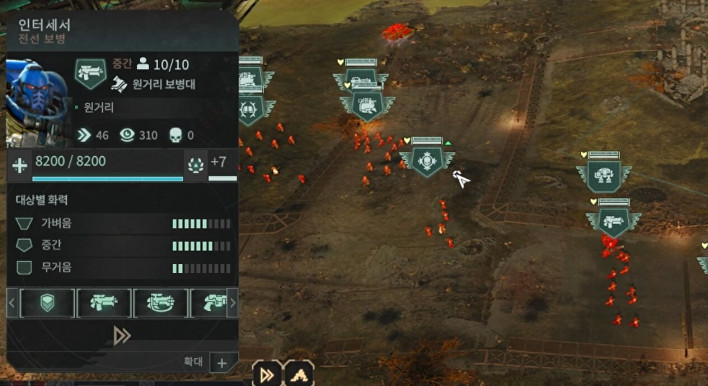
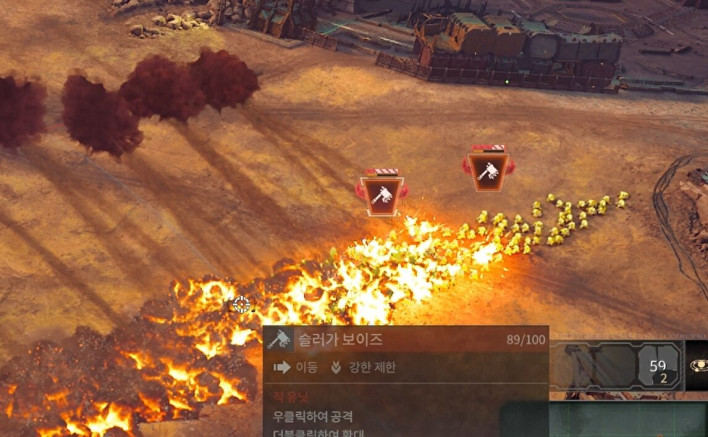
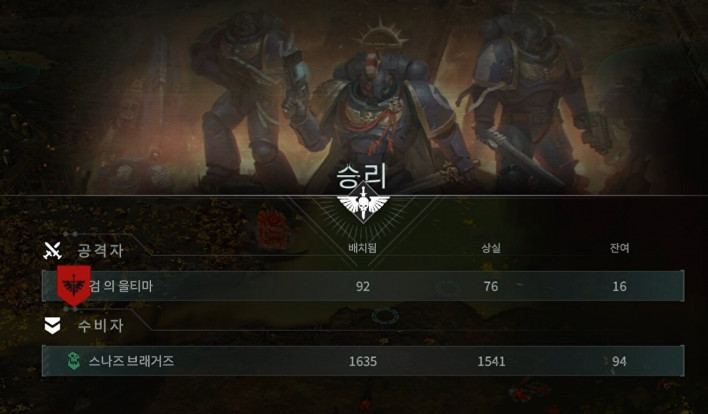
In the demo, around 100 Space Marines were able to take on nearly 2,000 Orks. How do you balance such extreme faction asymmetry?
Attila Mohacsi: This is something I feel very passionate about as well. Making sure players can truly feel what Space Marines are is crucial. It also happens to be Joey's favorite faction.
Losing even a single soldier should feel devastating for Space Marines. Losing a Dreadnought, especially one that has fought alongside you for hundreds or even thousands of years, should feel like a monumental loss.
From a balance standpoint, there is a system we haven't shown in the demo yet. In the demo, you only saw Space Marines falling in battle, but the actual game distinguishes between casualties and injuries. Space Marines are relatively more likely to be wounded rather than killed outright, and injured troops require time to recover.
That's because losing even a handful of Space Marines is a massive blow, and replacing them takes an extraordinarily long time.
Conversely, from the Ork perspective, this presents an opportunity. You send wave after wave of the Green Tide to gradually grind the Space Marines down.
An Ork player's goal shouldn't be killing hundreds of Space Marines in a single battle to wipe out 10% of a Chapter—that wouldn't be faithful to the source material. Instead, it's about relentlessly pressuring them, inflicting injuries, denying them time to recover, and slowly wearing them down, because Orks can replenish their numbers far faster than Space Marines.
That is how we approach balance. Playing Space Marines requires minimizing casualties while hitting critical points hard. Playing Orks requires constant pressure to grind the enemy down.
To summarize, Space Marines have lived for hundreds—sometimes thousands—of years, making them take an incredible amount of time to develop. Therefore, we cushion the impact of losses by increasing the chance of injuries over outright deaths.
Conversely, Orks are lucky if they live for even a few years. They fight with numbers. We balance both sides by highlighting those differences.
Space Marines appeared to suffer no morale loss. Is this a faction-unique mechanic?
Attila Mohacsi: Yes. What we wanted to capture through Space Marines is that they are highly trained, elite forces. They do not flee.
However, we didn't want them to simply stand ground and fight mindlessly until death either. So we enabled them to move rearward, capturing a form of "tactical withdrawal."
Morale-wise, Space Marines are virtually unbreakable. Tactically, however, they can continually fall back to maximize firepower and maintain distance from the enemy.
Through systems like this, we aim to deliver the signature Space Marine power fantasy of a small, ultra-elite force taking on an army far larger than themselves.
Are there plans for a massive combined campaign comparable to Mortal Empires or Immortal Empires?
Attila Mohacsi: Comparing it to Immortal Empires, the short answer is yes.
However, the approach to building this game is fundamentally different. Total War: Warhammer 40,000 is a single title. All future content releases will merge directly into this one game.
In a sense, we are continuously building an Immortal Empires equivalent. As mentioned earlier regarding moving between star systems, the galaxy we are crafting will expand continuously. With each new content release, new sectors will be added to the initial theater, growing larger over time.
It's similar to Total War: Warhammer, but with the key difference that it is built as a single title from day one. Players won't have to wait for separate combined map releases whenever new content drops. Every update is added directly to the single game, and the game evolves alongside new content.
What is the lore background behind the term "Angels of Death" in the trailer and Chapter Master "Septim" in the tutorial?
Kieran Rooney: First, there is one thing to clarify: Space Marines as a whole are referred to as the "Angels of Death" within the Imperium. It isn't specific to a single Chapter, but rather an epithet given to all Space Marines.
Attila Mohacsi: That question is tough on me, because my personal favorite Chapter happens to be the Blood Angels! Septim is a character in the onboarding campaign, and I think Joey can expand on that.
Joey Day: Septim is the Chapter Master featured in the tutorial. Specifically, he is the Chapter Master of the custom faction created by the player, guiding you through the tutorial experience.
Attila Mohacsi: The tutorial you experienced in the demo is only a tiny slice of the full onboarding campaign. In the actual game, you define your Chapter right from the start. From the moment you begin the onboarding campaign, you are living out your own power fantasy.
So the answer to "which Chapter Septim hails from" is determined by each player as they play. The answer will be different for every player. It's your personal power fantasy.
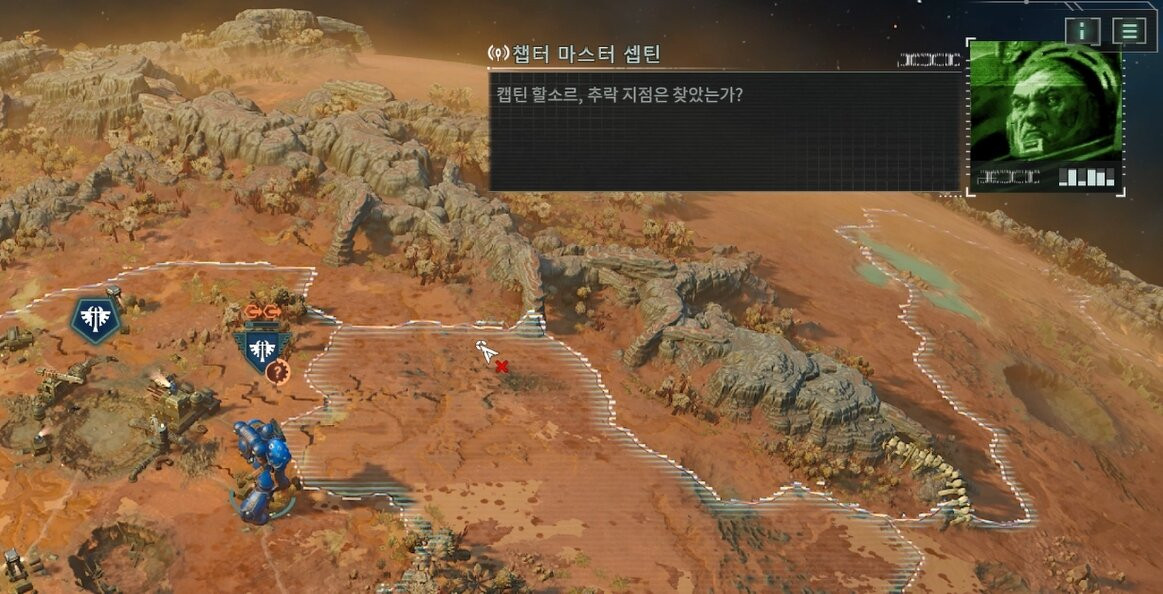
Can players use ships to travel between planets in the campaign?
Attila Mohacsi: Yes. Fleets exist in the game. As Joey mentioned earlier, fleets also impact battles. Depending on where you position your fleet, you can gain line-of-sight on the campaign map, and certain factions can unleash orbital bombardments via their fleets.
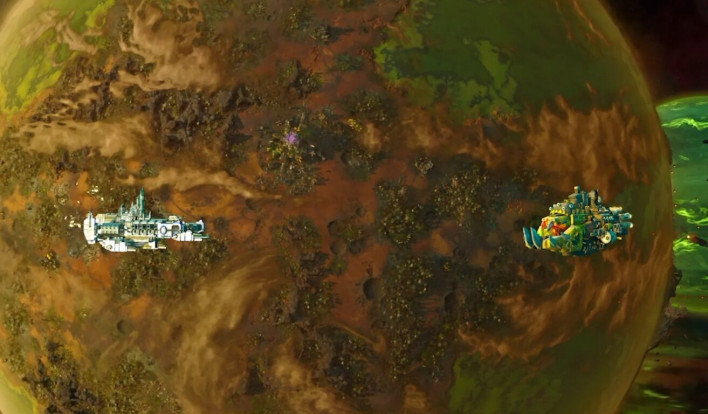
Factions handle fleets differently as well. If you zoomed out during the demo, you might have caught a glimpse of Ork ships. They look almost like floating rocks with engines strapped on, defying all laws of physics as they fly—very Ork-like.
The Aeldari have fleets too, but they also possess other means of transit. We lean heavily into each faction's flavor and asymmetry even in how they move between planets.
And when two fleets encounter each other, engagement occurs. We call these "Void Conflicts."
Fleets themselves can be upgraded over time—think enhancing the bridge or weaponry. Upgrades unlock abilities like the aforementioned bombardments, as well as far more powerful superweapons fitting for the 41st Millennium.
Even Exterminatus makes an appearance. Naturally, reaching that point takes a tremendous amount of time and is an extremely rare option.
Fleets are a critical bridge connecting the campaign map to combat.
Joey Day: I see fleets as a core element of campaign victory strategy. They aren't just a transport method between planets. They feature a distinct upgrade system and can actively support real-time combat.
Attila Mohacsi: I forgot to mention one thing: you can also conduct bombardments directly on the campaign map using your fleet.
For instance, when you spot an area occupied by enemy forces, you can choose whether to bombard it. Of course, it comes with a price, including civilian collateral damage. But you can weaken the enemy ahead of time that way. Fleets are essentially connected to every facet of the game.
How detailed can color scheme customization get?
Attila Mohacsi: The primary goal we want to achieve through customization is giving players a way to genuinely express themselves. Self-expression is the core.
Of course, you can make Angry Marines. During internal testing, we saw people creating rainbow-colored Space Marines and all kinds of bizarre, creative combinations.
What we've revealed so far is merely the most basic level of customization. We plan to showcase much more in the future. Customization isn't just important to us—it's a core pillar of the Warhammer 40K IP itself, which is why we are committing heavily to it.
Kieran Rooney: Could you give a few examples of what advanced customization will allow that isn't possible in the current build?
Attila Mohacsi: For example, you can customize the patterns on Space Marine shields, setting a foundational pattern for your heraldry system.
You can also configure cloak colors separately and assign helmet colors individually.
Customization will reach a far more granular level than the basic version in the current build. Ultimately, all of this comes back to self-expression—our goal is to let players project themselves and their desired power fantasy into the game.
Out of the vast lineup of units and vehicles in the source material, what criteria do you use to select which ones appear in the game?
Attila Mohacsi: That was one of the hardest challenges during development, because Warhammer 40K has so many units.
First, we look at the IP and source material to identify the most iconic and recognizable units. For Space Marines, for instance, you need Intercessors, Hellblasters, and Terminators.
When picking vehicles, we also evaluate what gameplay roles are needed. We debated for a long time on which vehicle to include and ultimately chose the Repulsor.
Unit loadout flexibility was another important factor. The Repulsor fit our needs well because its weapon loadout can be tailored to handle various situations.
Ultimately, the two primary criteria are: first, fidelity to the IP—the iconic elements anyone would associate with Space Marines must be present. Second is gameplay. These two serve as the main benchmarks for deciding which units join each faction's roster.
And I'd like to emphasize gameplay a bit more here. While we've discussed faction and warlord-level customization extensively, customization exists at the individual unit level as well.
Depending on what weaponry you equip on a unit, that unit's playstyle itself can change fundamentally.
Take the Dreadnought, for instance, which I consider emblematic of the 41st Millennium's grimdark universe. Equipping it with an Assault Cannon makes it extremely effective against light-armored targets. Alternatively, you can fit weapon loadouts specialized against anti-vehicle combat.
In this way, we want to deliver the depth of customization provided by the original IP down to the individual unit level.
Will future content follow the model of previous Total War: Warhammer titles with numbered sequels and DLC, or will it continuously expand a single game?
Attila Mohacsi: That's a great question. We learned a lot while developing the Total War: Warhammer trilogy.
To state the conclusion upfront: Total War: Warhammer 40,000 will exist as a single game. All post-launch content will be added to this base game, allowing all players to experience it simultaneously.
So there won't be a Total War: Warhammer 40,000 2 or Total War: Warhammer 40,000 3. Instead, content will continuously be expanded within Total War: Warhammer 40,000 as a single ecosystem.
It is too early to discuss paid content specifically, but the core idea is that it remains one single game. All future content will be continually added directly into it.
In the past, players had to wait for new titles to drop and then merge into combined experiences like Mortal Empires or Immortal Empires. That won't be necessary this time. It is a single game from the start, expanding endlessly as all new content gets added to it.
Do you have any final words for Korean players?
Attila Mohacsi: Thank you for setting up this opportunity. Personally, I am really excited about the Korean community. We also developed Total War: Three Kingdoms, and we hope every Korean player joins us on this journey.
We also welcome those interested in Warhammer 40K who might be trying Total War for the first time through this title. I think now is a great time to jump in. We put tremendous effort into the onboarding experience so new players can learn the game with confidence.
We hope to share our immense passion for Total War and Warhammer 40K with all of you. Thank you so much, and we hope you join us on this journey.
Joey Day: Thank you for spending time with us today. There were so many great questions.
I'd like to take this opportunity to place special emphasis on the tutorial. We expect a lot of new players to join through this game, and there are many new systems added for existing players as well.
So I encourage everyone to play through the tutorial. You can learn both the new and familiar mechanics, and the process itself unfolds within an engaging story. Warhammer 40K fans will also spot a few famous characters in the tutorial.
Kieran Rooney: I'd also like to express my thanks. We know how much Korea loves great strategy games, and we want to make this title our deepest and most immersive experience yet.
Many of the journalists here today have been following Total War for a long time, and I've met several of you at past press events. It's a genuine pleasure to introduce our new title to you. As mentioned earlier, this is the most ambitious project we have ever built.
Attila Mohacsi: I'd like to add just one more thing. Thank you once again for this opportunity. This game marks the start of a new era for everyone working on Total War.
With Warhammer 40K, we are bringing Total War into space. At the same time, we are introducing Total War to an entirely new audience, including console players, which is why we crafted a fresh onboarding experience.
What matters to us is that veteran Total War players unmistakably feel that familiar Total War DNA when playing. For Warhammer 40K fans, it must feel authentic to the source material. And for first-time players, it needs to be an approachable and welcoming experience.
Thank you once again for taking the time today.