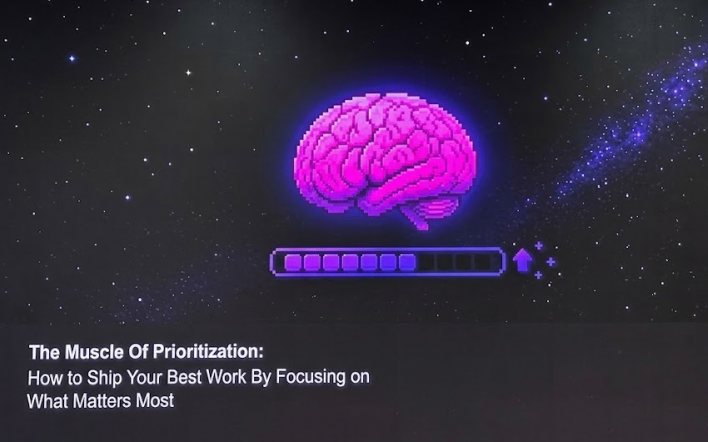
Topic: Work Prioritization Methods for Overcoming Burnout and Boosting Productivity Speaker: Matthew Strasser (Senior Dialogue Coordinator, Insomniac Games) Category: Game Development Productivity & Project Management Summary: A three-step framework for prioritization to overcome burnout was presented: slow down to select three key goals (Zoom out), let go of personal attachments to negotiate for the bigger picture (Negotiate), and dive deep while seeking feedback at 80% completion instead of striving for perfectionism (Zoom in). The speaker emphasized setting clear constraints and continuously training one's "prioritization muscle" even amid workload overload.
At gamescom dev, Europe's largest game developer conference currently taking place in Cologne, Germany, Matthew Strasser, Senior Dialogue Coordinator at Insomniac Games, took the stage on August 25 (local time), the second day of the event.
Titled "The Prioritization Muscle: How to Focus Better, Ship Faster, and Create Impact," the session provided practical guidelines to overcome burnout and the feeling of being overwhelmed that developers frequently face in fast-paced production environments. Matthew emphasized the importance of a mindset that goes beyond simple time management, urging developers to take control of their focus and dedicate energy to results that truly matter.
As a member of the audio team, Matthew candidly shared his personal experiences and struggles working on Insomniac's major AAA games, including Marvel's Spider-Man 2. He pointed out that when everything seems important amidst a deluge of tasks, no task can be completed successfully, explaining that developers must strictly limit priorities to filter out unnecessary "noise" and find the meaningful "signal."
He then introduced a three-step action framework: "Zoom out," "Negotiate," and "Zoom in." Adding vivid real-world examples of crises faced during the development of Marvel's Spider-Man 2 and how they were overcome, he shared practical lessons on effective prioritization with the audience.
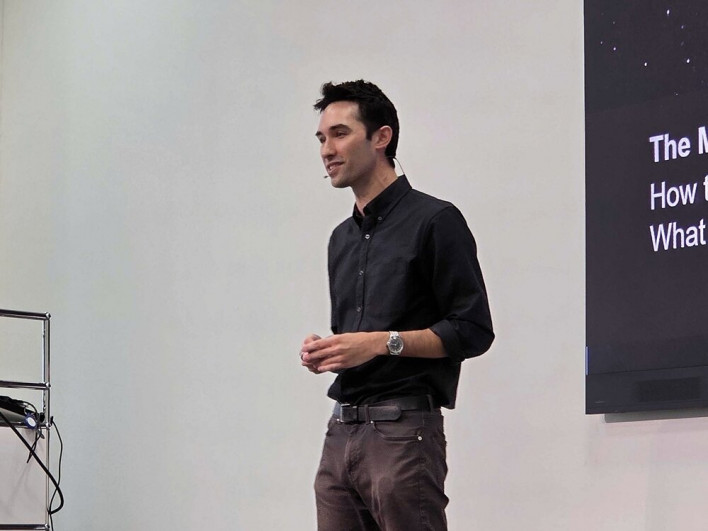
Overwhelmed by Work: "Slow Down to Speed Up"
Whether in game development or any other field, working at a company often means being inundated with requests from bosses or other teams while constant messages pour in from all directions. In such an environment, focusing entirely on a single task becomes exceptionally difficult.
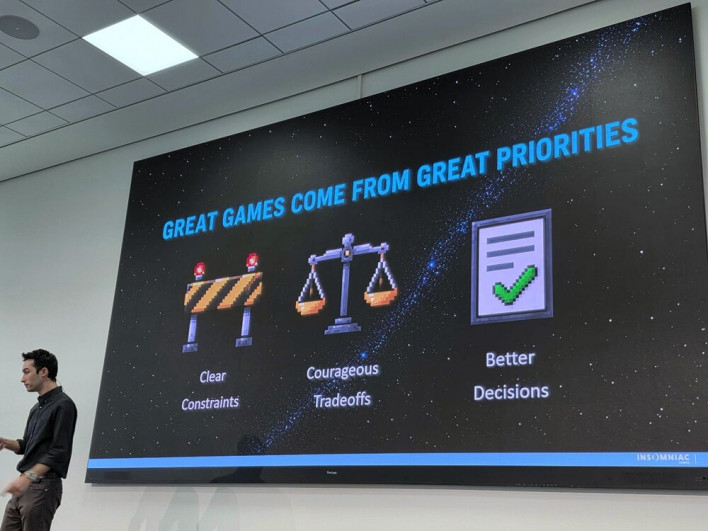
Consequently, every task in front of you feels urgent and critical, placing everything at the top of the priority list and creating an environment devoid of actual priorities. Matthew warned that this mindset is a direct shortcut to burnout.
"When everything seems important, you quickly get trapped in the noise," Matthew warned. "With so much noise, you lose the ability to find the true 'signal' that matters and end up feeling overwhelmed. If you frantically dive in thinking, 'I have no time! I need to rush in and get everything done right now,' and start knocking tasks off one by one, you lose sight of the big picture, suffer a massive loss in productivity, and ultimately burn out."
Matthew explained that when overwhelmed by work, instead of immediately rushing through tasks, you should paradoxically slow down and step back from the problem. Taking just a brief 10-minute walk activates the brain's Default Mode Network, unleashing suppressed creativity and bringing solutions to light.
He added that Insomniac Games has established a culture of taking walks in nature when hitting a wall at work. Matthew shared a story of leaving his desk to walk along a forest path to step away from a problem, running into teammates by chance, having one of their most productive work discussions right on the spot, and returning to his desk with a refreshed mind. He emphasized that even when every minute feels critical, intentionally taking 10 minutes to slow down is the most reliable shortcut to untangling complex issues and moving faster.
Step 1: "Zoom Out" and the Constraint of 3
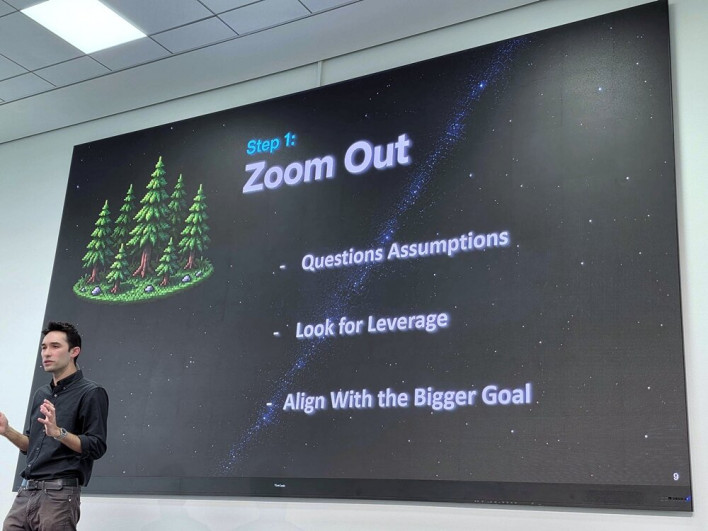
Once peace of mind is restored by stepping back, it is time to move to Step 1 of the prioritization framework: "Zoom Out." When you are too deep in the details to see the forest, taking a step back helps you single out the three priorities that truly demand your focus. He noted that having more than three priorities effectively means having no priorities at all.
"If you have more than three priorities, you don't have priorities," Matthew said. "By slowing down and zooming out to see the forest instead of the trees, you can much better identify your true three priorities. Ask yourself, 'Do I really need to do this?' or 'Can this one task act as a domino that unlocks ten tasks for my team?' You have to ask these questions to separate the real signal from the surrounding noise."
To condense priorities, Matthew recommended challenging assumptions and looking for "domino effects." He advised continually asking questions like "Do I really need to do this task?" or "Am I the right person for this job?" to guard against the impulse to take on everything personally. As an example, he recalled spending hours wrestling with a problem alongside a colleague, only to realize later that it was not a design issue but a complex engineering problem; handing it off to the correct department immediately alleviated mental overload and freed up cognitive capacity.
He also emphasized prioritizing high-impact tasks that boost the productivity of the entire team—identifying whether a single task can serve as a "domino" (leverage) that unlocks doors and sequentially resolves ten other tasks. Finally, if there are ten minor animation tagging tasks scattered across your workload, he explained that you should group them under a single major theme like "Animation Tagging," strictly keeping your overall goals to three or fewer.
Step 2: "Negotiate" and the Courage to Let Go
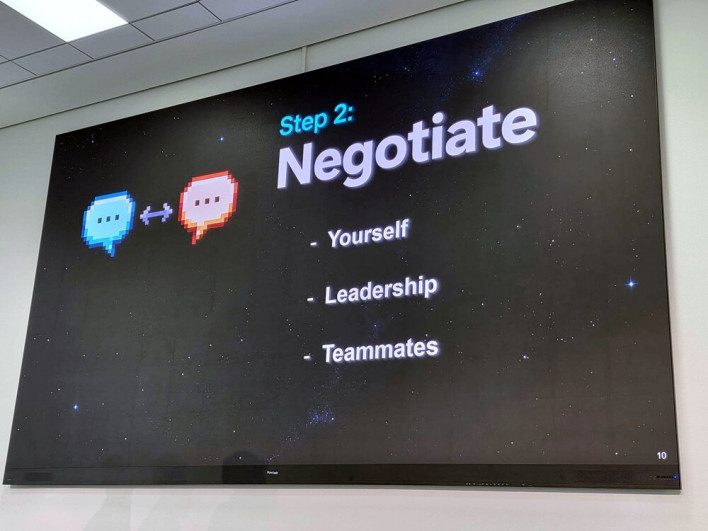
The second step is to "Negotiate" with leaders and teammates based on the three established priorities. Rather than holding vague discussions from scratch, this process involves collaboratively editing an existing plan with colleagues to align on what matters most. At this stage, having the courage to give up tasks you hold dear is essential.
He shared a detailed story from the development of Marvel's Spider-Man 2 involving the character "Breathing System." Because syncing character breathing animations with audio was a complex task, work was falling heavily behind as deadlines approached. A colleague who was assisting with sound engine implementation offered to take over the entire system implementation, forcing Matthew to decide whether to hand off a task that felt like his personal expertise and identity.
"At the time, the Breathing System felt like a huge part of my identity, so handing it off to a teammate was honestly very difficult," Matthew reflected. "But in that moment, I asked myself, 'Am I trying to protect my ego right now, or am I helping the whole system?' By boldly letting go of the priority I was holding onto and entrusting it to my colleague, we got the delayed work back on track. True prioritization is completed through the courage to let things go."
He also shared another compromise from Marvel's Spider-Man 2 when the game entered its late-stage Beta phase. Originally, he wanted to apply a detailed breathing system to every character, but a technical lead gave him sobering feedback: with the remaining timeline, continuing as planned yielded only an 8% chance of success.
Ultimately, through a painful compromise, he negotiated with the team to drop the system for numerous super-powered characters and concentrate all resources exclusively on the breathing sounds of Mary Jane (MJ), the game's sole non-superpowered main character. In the end, this decision brilliantly highlighted the tension and vulnerability MJ experiences in the game, resulting in a far more compelling and successful execution than the original plan to add breathing audio to everyone.
Step 3: "Zoom In" and Escaping the Perfectionism Trap
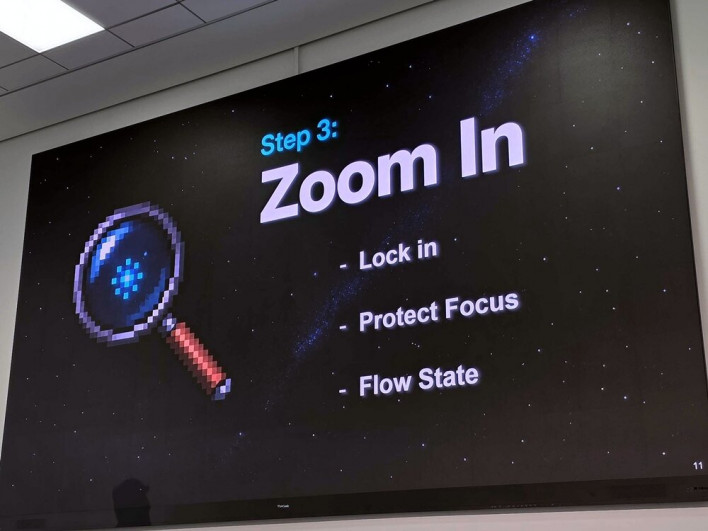
Once goals are clear and aligned, the final step is to "Zoom In"—fully immersing oneself in the agreed-upon priorities. Matthew pointed out that multitasking is merely an illusion, and frequent context switching only disrupts the "deep work" required for peak performance.
He illustrated this with an example of being deep in script work in the recording booth with directors and writers, only for a casual glance at Slack to shatter focus and incur immense cognitive costs to return to context. To prevent this, he advised turning off notifications and setting status messages to "In deep focus, replies may be delayed" for 40 to 45 minutes of deep concentration—giving oneself permission to focus on a single task as if diving deep under water.
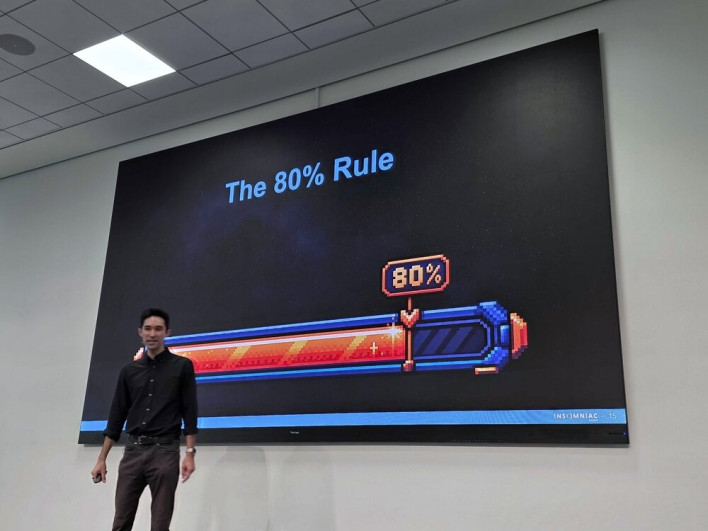
However, when focusing on a single task, knowing where to stop and feel satisfied is equally critical. Otherwise, striving for perfection risks burying you indefinitely in a single assignment. Matthew warned against the "trap of perfectionism" that hinders efficient progress, proposing the "80% Rule" as an alternative. He shared this lesson from his own painful experience of holding onto breathing audio assets until he felt they were 100% perfect, only to face major revision requests from leadership late in the process.
"People tend to delay reviews until their work feels perfect," Matthew said. "Don't wait until it's 100% perfect. I use the 80% Rule—bringing work to an 80%, 'good enough' state and sending it to my manager for review. While my lead reviews it, I can focus on my second priority task. As a result, through continuous feedback, we achieve higher quality output much faster."
Navigating the Final Crunch: "Train Your Prioritization Muscle"
This framework proves its true value during the most sensitive periods right before a game launch or project deadline—the final push. Leading up to the release of Marvel's Spider-Man 2, during a period of high-intensity crunch, Matthew's team held syncs twice a day, morning and afternoon, constantly sharing workloads and recalibrating priorities. Even amidst a marathon where over 150 bug fixes arrived daily and pressure hit peak levels, they managed the crisis using their trained "prioritization muscle."
Matthew also recalled a late Friday night near the end of development. Exhausted from overtime, a teammate approached him and said, "I have some extra capacity in my workload. Is there anything I can take off your plate?" offloading his remaining tasks. It was a moment where tight-knit teamwork shone—immersing deeply in individual roles while stepping back to renegotiate priorities when hitting limits.
"Do you know why I specifically call it a 'prioritization muscle'?" Matthew asked. "Because prioritizing isn't magic that happens overnight. Just like a muscle, it requires continuous strain, tearing, and conditioning before true prioritization becomes natural." He advised that to protect one's mental well-being alongside producing great work, developers must make a habit of pausing whenever overwhelmed to pare down their goals to three key priorities.
"Game development is the ultimate team sport," Matthew concluded. "When you reach the final stretch before launch, it's screams from every direction. You're two weeks out from release and 150 tasks cascade down like a waterfall. But if you've trained this prioritization muscle beforehand, you won't flinch. 'Pause and take a deep breath. Zoom out. What are the three things that really matter? Negotiate with the team. Zoom back in.' You repeat this every day. These clear constraints and priorities we place on ourselves ultimately yield the clear result of a great game."