
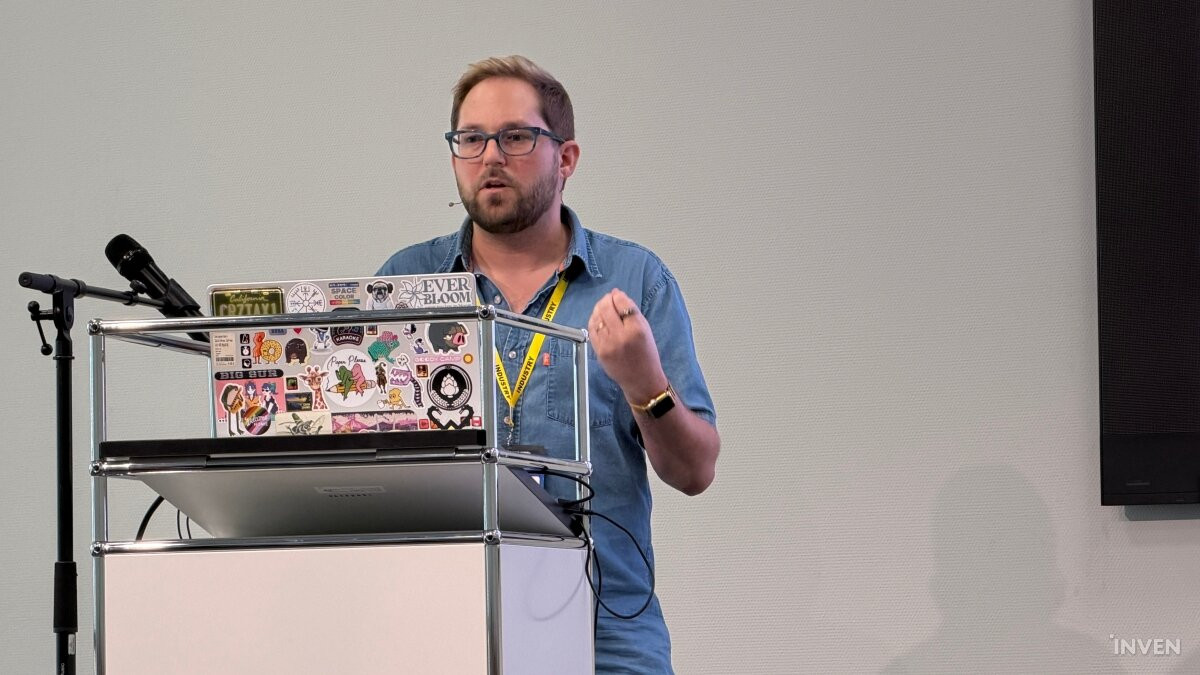
Adam Dolin, Creative Consultant at GameDevDolin, delivered a talk at gamescom dev titled "Write Between the Lines: Writing Games for a Polarized, Distracted, Media-Illiterate World." Dolin worked as a writer and narrative designer on God of War, God of War Ragnarök, and Horizon Forbidden West.
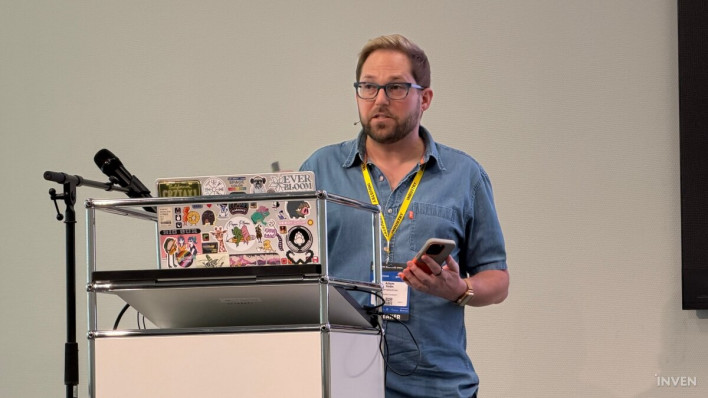
The talk began with the question, "Why are we here?" Dolin noted that in times of growing cultural instability and sociopolitical uncertainty, what audiences seek in games is not merely escape, but meaning. While the industry faces many problems, game developers are problem solvers; thus, the starting point is to first distinguish between what can be controlled and what cannot.
He quoted actor Harrison Ford's acceptance speech at this year's Screen Actors Guild Awards: "Sometimes we make entertainment, sometimes we make art. If we're lucky, we do both at the same time. If we're really lucky, we can make a living doing it." In today's political landscape, he followed up, there is a "gap between the stories you want to write and the stories you're allowed to write," and an increasing number of developers cannot even land those jobs.
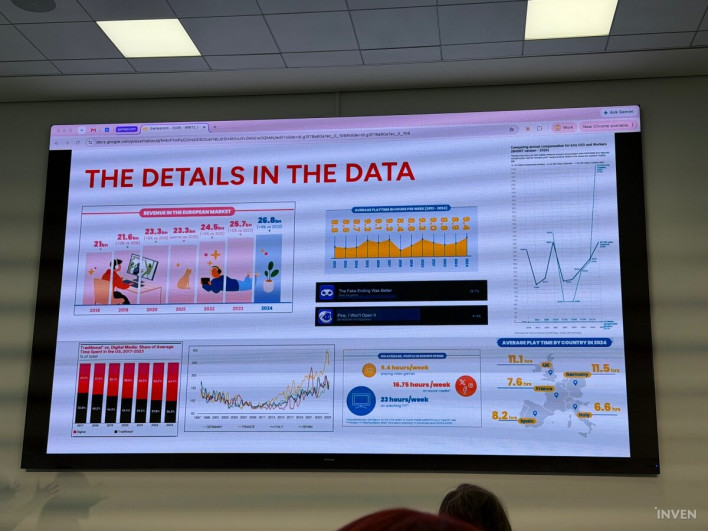
Dolin presented an industry report by Matthew Ball alongside the European Games Developer Federation (EGDF) 2024 Key Facts Report. According to these data, European users average 9.4 hours per week playing games. By country, Germany plays about 5 hours more per week than Italy. Although the average has fluctuated, it has stayed in the 9-hour range for 14 years. In contrast, social media usage is about double that of gaming, while TV and streaming consumption exceeds double. Consumer spending is also increasing every year.
Dolin pointed out, "People aren't playing fewer games, nor are they spending less money," yet "studios are closing every week and layoffs continue." Behind this disparity, he cited rising labor costs and development scales, alongside competition from digital media platforms armed with algorithms and artificial intelligence.
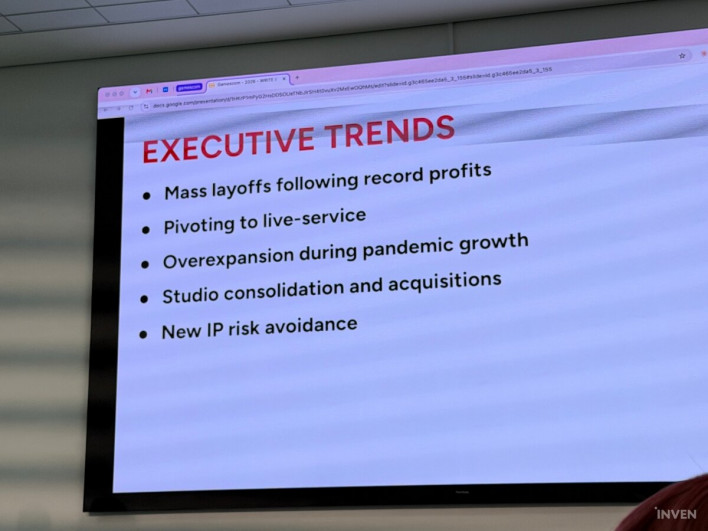
He asked the audience to engage in a thought experiment: imagine being an executive responsible for the livelihoods of over 1,000 employees. Dolin explained that from that position, the question driving every decision is not "How much can the company make?" but "How do we keep these people employed?" Viewed through that lens, risk aversion becomes a language not of irresponsibility, but of responsibility.
He drew the line by clarifying that he was not defending post-COVID management decisions. Pointing to CEO compensation that reaches 66 times that of average employees, he acknowledged that many decisions deserve criticism. However, he stated that "curiosity is a more productive emotion than anger," and that understanding the context behind decisions allows one to see how those decisions restrict creative freedom. Risk-averse strategies reach creators in forms such as "I have thoughts on the tone" or "Can we make this character a bit more likable?"
Values Are Revealed When Something Is at Stake
Dolin framed audiences, creators, and executives as three axes, each valuing different things. Audiences know what they like with pure motives, while creators balance the desire to speak through art with making a living. Executives hold decision-making power and have clearly set priorities. He remarked, "If we underestimate the audience, we pay the price."
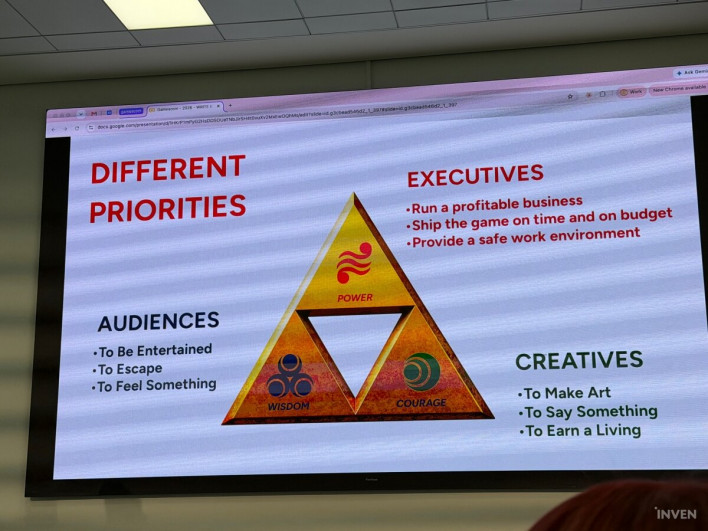
The word repeated here was "values." This refers not to moral superiority, but to creative priorities. Someone who values stability is not morally inferior to someone who values risk and ambition. He noted that "values are revealed when something is at stake," citing examples such as when budgets go over, when discourse surrounding a game turns hostile, or when leadership asks creators to soften a tone they believe in.
Dolin named curiosity, empathy, and fun as his own three values. He added the advice that setting individual values at the team level and sharing the results reveals where values overlap or clash, making difficult conversations easier.
Companies have values too. He cited the detailed mission statements that Riot Games and Netflix publish on their websites as examples. How well those companies uphold those values remains a subject of internal debate, and he noted that the very ability to have that debate is the point. When values are public, there is a basis to hold leadership accountable.
His point was that personal values and company values can clash, and understanding that tension—even if it doesn't completely resolve conflict—helps one judge when and how to raise issues.
Polarized Players: Can Games Change Attitudes?
The talk moved on to the topic of polarization. Dolin presented figures showing that the proportion of people in the U.S. who get news from social media was low in 2008 but reached 70% by 2019. He explained that as the structure dominated by a few media outlets adhering to standardized reporting practices collapsed, users chose news sources aligned with their worldviews, which algorithms then reinforced.
Regarding Europe, citing data from the European Money and Finance Forum (SUERF), he reported that political polarization rose similarly in Germany, France, Italy, and Spain starting in the early 2010s. The metric used was the frequency of articles addressing the topic in major daily newspapers. He added the caveat that while not perfect, it is a measurable metric, and explained that the timing coincides with the 2009 financial crisis, the refugee crisis, and the rise of populism. He also highlighted the distinction that in Europe's multi-party systems, this does not translate directly into American-style legislative gridlock.
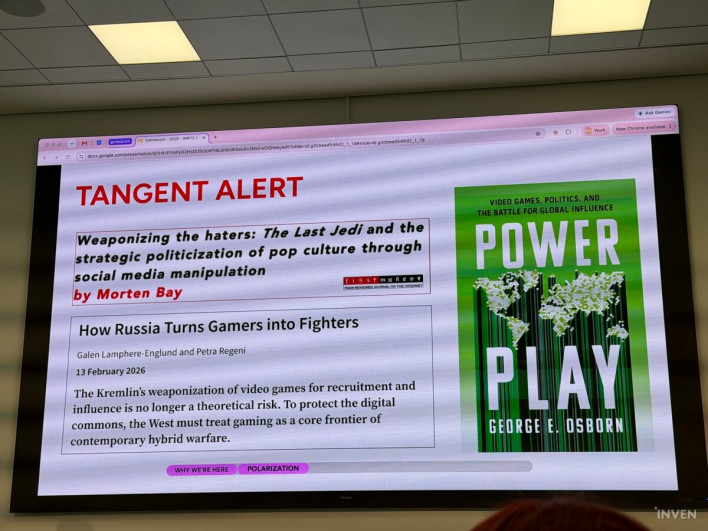
The discussion returned to creators: "This is the environment your players live in. They approach your game already belonging to ideologically sorted camps." George Osborn's book Powerplay, which explores how social spaces are weaponized in policy, culture, and warfare, was cited as reference material.
Research pointing in the opposite direction was also presented. In a field experiment involving approximately 37,000 participants, people exposed to news conflicting with their viewpoints showed reduced hostility toward the opposing side. Their opinions themselves did not change, but the temperature was lowered.
He also cited two studies on the effects of games. A 2025 study by the Amsterdam School of Communication Research (ASCoR) focused on the domestic violence chapter in Detroit: Become Human. The results showed that playing directly rather than watching increased empathy for the character, which translated into empathy for real-life domestic violence victims. Implicit bias decreased, with no difference in effect between men and women. The other was Path Out, made by an Austrian studio. Participants who played this game—based on the true story of a boy fleeing Syria in 2015—for 30 minutes showed reduced prejudice and increased empathy toward Syrian refugees.
Dolin remarked, "Social media feeds cannot do this the way games can," stating that stories requiring players to embody someone different from themselves may provoke strong backlash, but it is a risk worth taking.
Safe Stories and Dangerous Stories
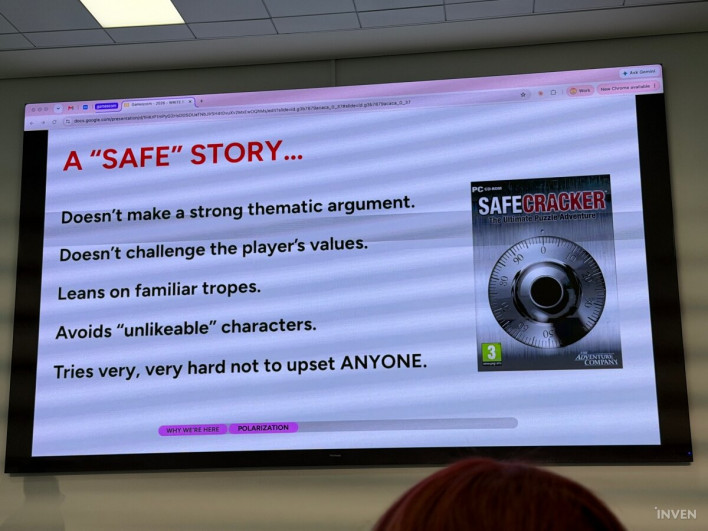
He termed stories designed not to provoke anyone as "safe stories." These are stories that make no thematic argument, do not test the player, and do not make players reflect on their own values. While stating that this is not inherently a wrong choice, he warned that "there is a risk of generating zero reaction, zero conversation, and zero longevity." In a crowded market, harmlessness easily turns into irrelevance.
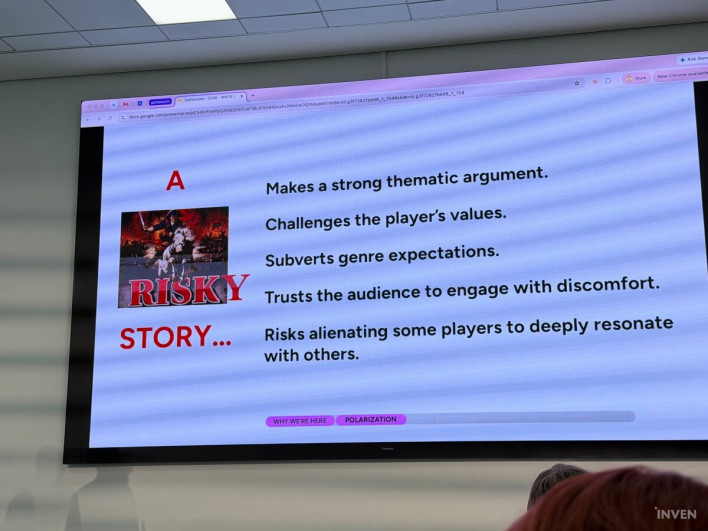
"Dangerous stories" are the opposite. They make thematic arguments, subvert genre conventions, and trust the audience to tolerate discomfort. They accept the churn of some players—not because the writing failed, but because the story's values and those players' values do not align.
As an example, he cited the ending of Clair Obscur: Expedition 33. Describing how the ambiguous ending sparked online debate, he appraised it as an instance of trusting the audience to sit in ambiguity. While expressing regret over debate devolving into mockery, his assessment was that "an intense reaction, even if negative, is better than lukewarm or no reaction."
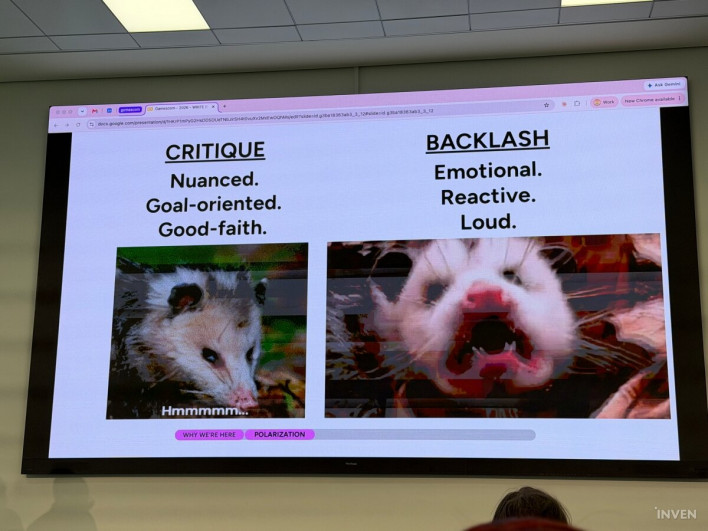
Dolin divided feedback into critique and backlash. Critique contains nuance. Thoughtfully articulated criticism indicates reflection following a strong emotional reaction, coming from people who want to make the work better. Backlash is loud, knee-jerk, and can be delivered in bad faith or as part of an organized campaign targeting creators.
The first example was the controversy over the initial character design in the film Sonic the Hedgehog. Both critique and backlash poured in over the risky choice to alter a beloved character's design, leading the production team to ultimately redesign it. He noted, "You don't have to act on every critique. But if you see a lot of both coming together, it's worth reflecting on."
The second example was the Disney+ series The Acolyte. The show was review-bombed even before airing and was canceled after a single season. Placed on the left side of the screen was real critique—pointing out issues with pacing, episode length, and unpolished dialogue, which the showrunner herself acknowledged as valid. On the right was backlash. He noted that much of it consisted of content that could not be publicly shown.
He asked, "Disney didn't cancel this show because they were loud, but because it didn't perform. But how is performance measured?" When legitimate critique and pure bigotry tangle online into a single wall of noise, executives evaluating performance through data may fail to separate the two. Backlash hurts performance, not just feelings.
In the end, trying to please everyone pleases no one, and safe products don't sell. Say something meaningful through your work, but draw that message from your own values. Engaging players rather than lecturing them on meaning leaves a far greater impact. Once a work is released into the world, control over its interpretation vanishes, and he added that creators must learn to separate their personal values from commercial success.
13 Hours of Media a Day; Gaming's Share Is 1 Hour and 6 Minutes
The topic of the second half of the talk was the attention economy. Dolin defined it as a business model that treats human attention as a commodity. According to a 2025 study he cited, American adults spend about 13 hours a day consuming media—with the caveat that watching Netflix while scrolling Instagram counts as two hours. Of that total, gaming accounts for 1 hour and 6 minutes per day.
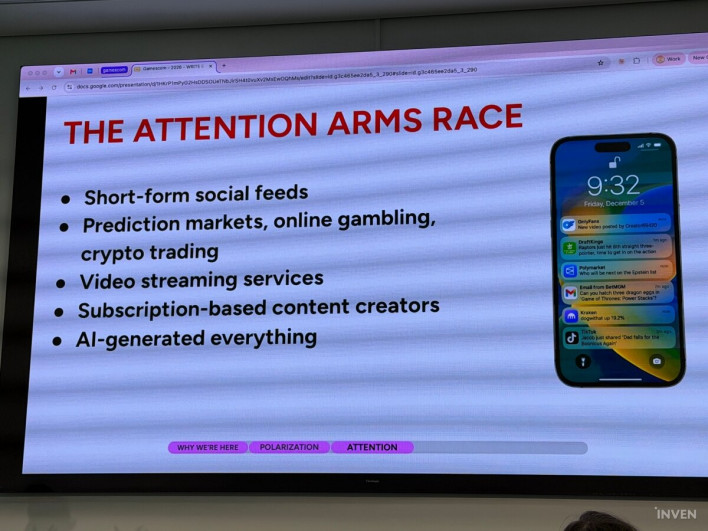
As competitors, he named short-form content like Instagram and TikTok, prediction markets and online gambling, cryptocurrency trading, and streaming and subscription content. He predicted that artificial intelligence would intensify this competition even further.
As the operating principle, he cited experiments by 1930s behavioral psychologist B. F. Skinner, which showed that animals repeat a behavior far more stubbornly when given unpredictable rewards than predictable ones. After asking the audience to "please use this information responsibly," he explained that slot machine-like mechanics are embedded in feed refreshes and short-form swipes. It is not a matter of resisting with willpower, but a structure built by designers leveraging a century's worth of behavioral psychology research.
He presented three strategies for narrative delivery in this environment.
First is layered narrative—or cross-departmental collaboration. It is an ensemble approach where every discipline contributes to the story. The method is simple: visit colleagues in other departments, ask how they view the story, and explain how you built the characters and narrative. He urged developers not to mystify the narrative process, noting, "Writing isn't rocket science. It's hard, but it's not mysterious."
Good story ideas can come from anywhere, and the narrative designer's role is to refine those ideas using their expertise. He also emphasized that dialogue cannot fix everything. For example, dropping a hint through dialogue immediately after a puzzle may be ignored by players, so rather than repeating dialogue, he advised finding expressive tools from other disciplines.
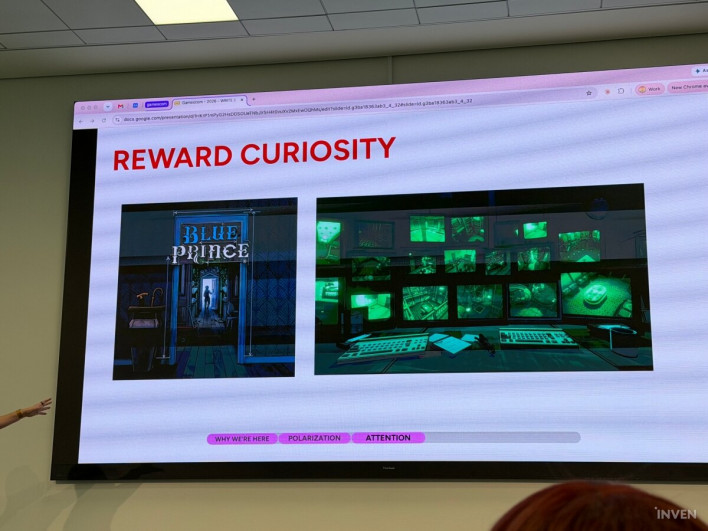
Second is rewarding curiosity. Sabotage Studio's 2018 platformer The Messenger was cited as an example. In the shop cabinet, there is an interaction icon; clicking it brings up text reading "Do not touch." The icon remains. Clicking it again triggers dialogue reading "I already told you," and clicking further issues a warning that "You'll have to listen to a boring story all the way through. I'll even disable the skip feature." Interacting 16 times unlocks a lecture sequence by the Shopkeeper. What Dolin highlighted was that more players unlocked the achievement for discovering this lecture than actually finished the game.
Third is strategic brevity. He cited the text design of Disco Elysium, which was featured in a 2021 talk. Although the total amount of text is vast, it is broken down into short formats, prompting players to engage in conversation rather than passively read paragraphs.
A contrasting example was the Active Time Lore feature in Final Fantasy XVI. This function allows players to pause during cutscenes to read a page worth of information on characters, factions, and regions. The development background was that with dozens of proper nouns introduced in the prologue alone, even the developers found it difficult to keep track of their own lore.
The two games solved the same problem differently. Disco Elysium lets lore seep in naturally through short, repeated dialogue exchanges, whereas Final Fantasy XVI pulls expository information out of spoken dialogue and places it behind a single button. Asked which approach is better, he answered, "It depends on the game." A CRPG can assume an audience with a tolerance for reading, whereas a story-driven action RPG cannot.
He clarified, "It doesn't mean writing less text. How you present text is a design decision, and it's something novice game writers often miss." He added the qualifier that these strategies are intended to engage players more deeply, not lock them into compulsive behaviors.
Media Literacy Starts with Yourself
Dolin defined media literacy as "the ability to critically analyze content produced and consumed across various media—including games, TV, film, the internet, literature, and social media—from the perspectives of accuracy, reliability, evidence, and bias."
He explained that including many charts and data points in this talk was intentional, as infographics are media as well. He then deconstructed the very data he had cited. A chart showing annual increases in European game revenue was accurate in terms of raw data, but it failed to adjust for inflation; adjusted, revenue was essentially flat. He also pointed out that consumer spending does not equal studio profit, and that it is unclear which platforms received that spending.
He also revealed that he had intentionally omitted the methodology of the Path Out study cited earlier. The participants were 76 students from the same university, with a median age of 21.5. "I want to believe games can change minds, but this sample isn't definitive proof. It's just a good starting point," he said, stating that follow-up studies with larger samples and broader demographics are needed, which ultimately comes down to research funding.
He urged the audience to build a habit: for every chart and headline encountered online, ask where the data comes from, who funded it, and what their motives and values are. He advised taking 3 to 5 minutes to verify sources before sharing an article or headline, and if that isn't possible, to not share it at all. "If you aren't sure what an article is saying or what conclusion it's drawing, it's better not to spread misinformation."
He also offered advice for development teams: do not write down to your audience, trust players while also trusting data, playtest story comprehension early alongside usability testing, and re-verify those results through the lens of media literacy.
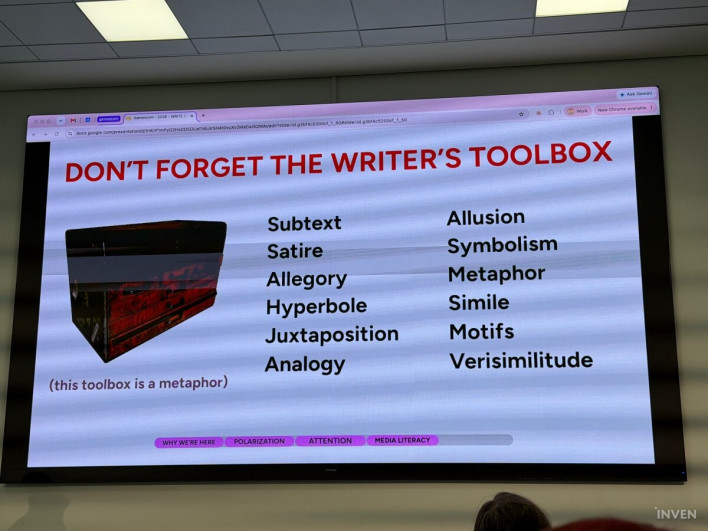
When a team lead says "The dialogue is too on the nose," a communications team blocks certain words, or a publisher warns "This topic is political," he defined those moments as requiring craft. Literary devices that convey what you want to say without stating it outright are a writer's toolbox. He remarked, "That is the difference between a writer who compromises their values and a writer who adapts to their values."
As examples, he cited color symbolism in Blue Prince, the satire of late-stage capitalism in The Outer Worlds, and existential motifs in NieR:Automata. The example he highlighted was UFO 50. On the surface, it is a collection of 50 games created by a fictional game company, but he explained that it is actually an allegory unfolding across 50 games about a game studio where creative ambition conflicts with corporate compromise.
Clashing with Your Lead
The talk concluded with practical communication strategies. When a lead requests revisions that conflict with your values, Dolin outlined the following steps:
First, move to a private conversation (1:1) rather than a public channel. He joked, "Don't do it on Slack. Learned that the hard way (laughs)." Next, define the actual nature of the clash. Creative disputes often turn out to be angry repetitions of the same points or arguments over two completely different issues.
Next are data and alternatives. Bring rationale and solutions rather than simply saying "I don't like it" or "There's a problem." Last are curiosity and respect. Understanding that the other party's priorities differ from yours makes persuasion far more likely when approached from their perspective.
When turned down, he recommended taking a breath, reminding oneself that it isn't a personal judgment, and asking why it was rejected and whether alternatives exist. He said, "You might not reach an agreement, but both sides want the same thing: shipping a good game."
His closing remark returned to curiosity, one of his own core values. He urged, "ABC: Always Be Curious. And be the change you want to see in the industry."