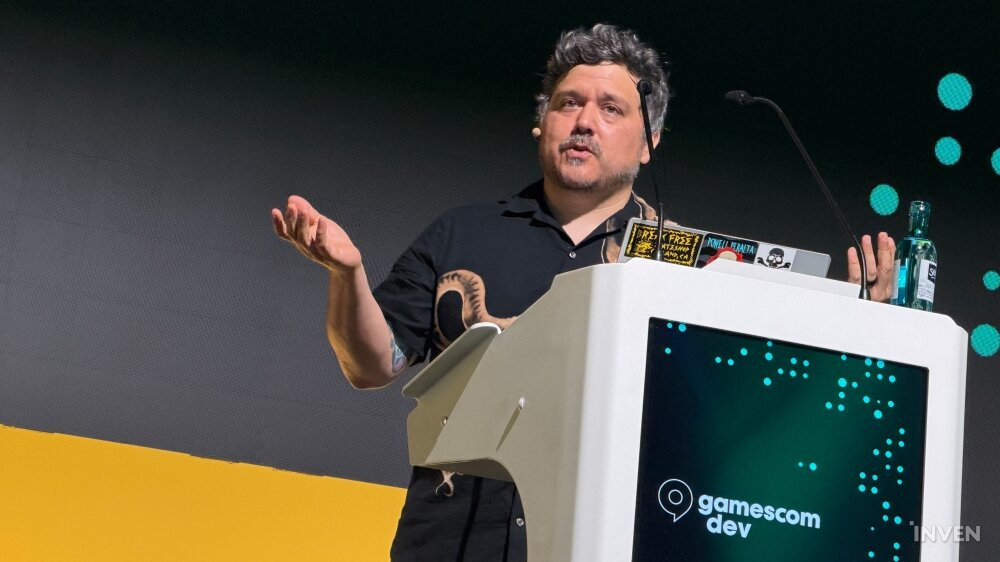
Anthony Gallegos, Creative Director at Unknown Worlds, shared the development process of 'Subnautica 2' during a keynote presentation at gamescom dev on August 25. gamescom dev is a developer conference held over two days, Monday and Tuesday, ahead of gamescom's main opening, with this talk serving as the opening keynote for the second day.
The takeaway of the presentation was that the order of sequel development needs to be reversed. Gallegos concluded his talk by stating, "Before asking what a sequel should add, first figure out what it cannot afford to lose." He presented several early prototype videos never before shown to the public, explaining scrapped features and the reasons behind their removal.
Why 'Below Zero' Wasn't a Sequel
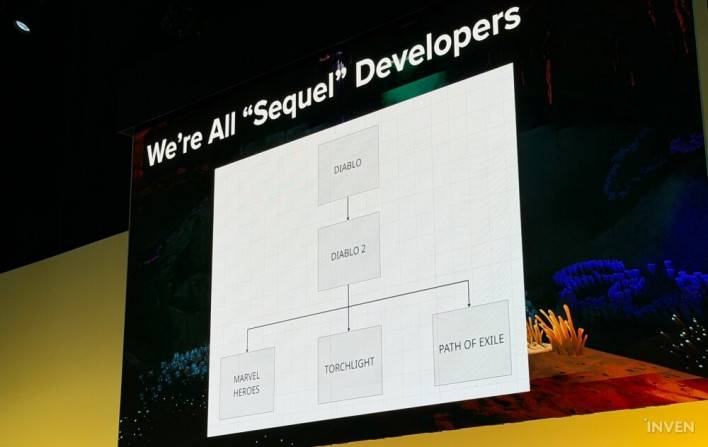
Gallegos opened his presentation by asking how a sequel is defined. He noted that, in a sense, all developers are sequel developers—even across different IPs, both developers and fans learn from, copy, and build upon other titles. He referred to these as "cousin games."
He cited his own career as an example. After the team that created 'Diablo' and 'Diablo II' at Blizzard North dispersed, titles like 'Marvel Heroes' and 'Torchlight' emerged, with their influence extending to 'Path of Exile.' 'Marvel Heroes,' which he worked on, shared a different IP but served as a direct spiritual sequel to 'Diablo II.' David Brevik, lead designer of 'Diablo,' led the team, and even the health bar and skill bar setups mirrored 'Diablo.' Later, when 'Diablo II' veterans departed and younger developers took over, the game shifted toward borrowing from 'Diablo III' to target a broader audience.
This perspective also explained why he does not view 'Subnautica: Below Zero' as a sequel. He outlined three elements that gave 'Below Zero' sequel-like qualities: it was a new entry in an existing franchise, featured a new story, and offered new environments, unlockables, and gameplay systems.
Nevertheless, the studio classified it as a spin-off. It originally started as an expansion, relied heavily on the original game's lore, engine, and systems, and was smaller in scope. His diagnosis was that what fans were waiting for after 'Below Zero' was not another spin-off, but the return of a mainline title.
Internally, the studio debated whether to call the new title 'Subnautica 2' or 'Subnautica 3.' Gallegos himself advocated for '3,' and online search results at the time showed fans talking about 'Subnautica 3.' Ultimately, the decision was '2.'
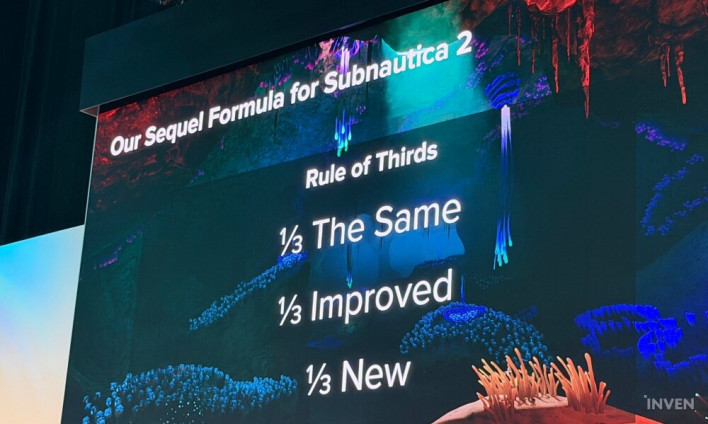
From this debate emerged the "Rule of Thirds": one-third should remain identical to the original, one-third should be improved, and one-third should be entirely new. He clarified that this was not math, but a framework to periodically evaluate the game.
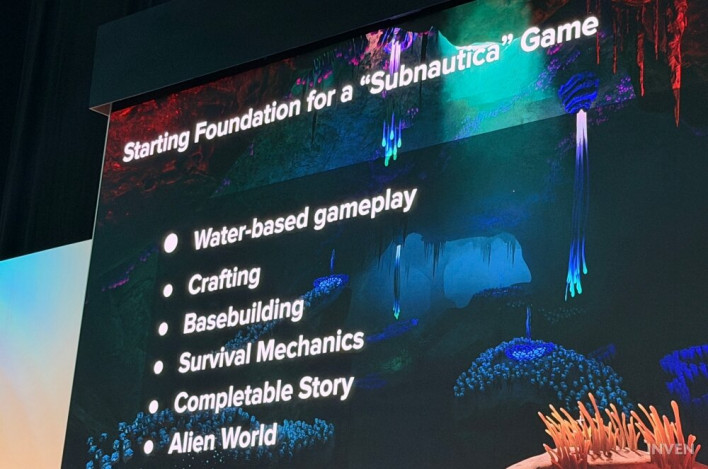
Additionally, he outlined six foundational pillars that serve as the starting point for a 'Subnautica' game: water-based gameplay, crafting, base building, survival mechanics, a conclusive narrative, and an alien planet.
The Price of Jumping into Innovation First
The problem was the sequence. Gallegos expressed that the team had suffered from "sequelitis"—a state where three simultaneous demands pulled at the game: make it different, make it bigger, but keep it familiar. He summarized the core challenge of this phase as "how to balance these competing influences."
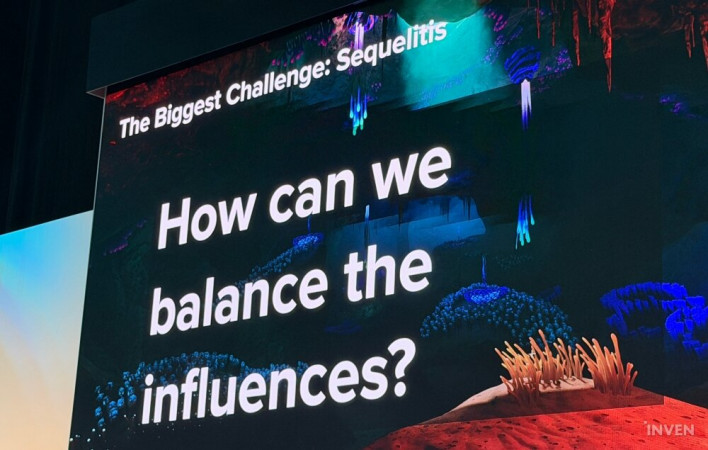
The three demands did not carry equal weight. On Discord, fans repeatedly asked whether specific creatures would return, and some wanted the game to remain on Planet 4546B from the original. The development team considered this option but ultimately decided against it. Familiarity was a low priority in early stages, taking form only as a coral reef biome reminiscent of the original's Safe Shallows. This coral zone served another purpose: because previous 'Subnautica' titles were built on Unity and Unreal Engine was new to the studio, a familiar environment offered a safe baseline for building proficiency in Unreal.
To scale up, the team considered interconnected undersea crater structures. This layout allowed new content to be continuously added during Early Access, and discussions even touched on shifting toward an endlessly replayable game instead of a story with a definitive conclusion.
The push to make things different came from within the team. After wrapping up 'Below Zero,' developers who had been making underwater games for 12 years felt burnt out. Since it was an internal IP, there were no constraints. He noted, "Because we were the sole stakeholders, there were no real rules," adding that rewriting the universe's entire lore from scratch was on the table.
Concept art from this period depicted a surface base standing beneath a massive tree beside a river, with flying vehicles hovering nearby. He posed the question: "Going different is tempting. But is it the right choice for a franchise sequel, and is it what players actually want?" Studio founder and original director Charlie Cleveland proposed a structure where players traveled between multiple planets, fundamentally altering resource gathering. For instance, titanium—a key material for base building—might be mined from the ground on one planet and extracted from fish scales or organs on another.
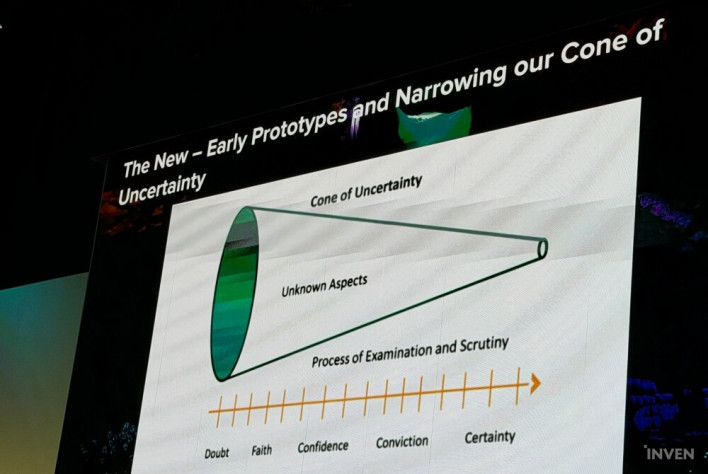
Gallegos described this period as a phase where the "cone of uncertainty" failed to narrow. It meant taking time to identify the core components and understand how new elements could reinforce them.
First among the prototypes shown was an ecosystem simulation. In this system, kelp forests spread seeds as they matured to expand their territory, sea urchins multiplied while feeding on kelp, and apex predators kept urchin populations in check in later iterations. While the team found the output intriguing, they had no intention of making a simulation game. Crucially, helping players digest what was happening required heavy UI with numbers and graphs, none of which felt like 'Subnautica.' However, the underlying theme of healing and restoring environments survived the experiment, evolving into the "corrupted roots" mechanic where purifying areas brings them back to life.
The second prototype was the "Void Expedition." In the original, the Void served as the edge of the map and a virtual death zone, but fans had long expressed a desire to explore it. The dev team interpreted this demand as a call to give the Void actual content to explore. They experimented with a loop centered around a massive submarine base that repeatedly ventured into and retreated from the Void, which aligned with the concept of an endlessly playable title.
At the time, the team could not achieve multiplayer synchronization for moving submarines, so they used a method where piloting the sub on a 2D map loaded the corresponding region below. They spent about six months developing this system, using it to master world-loading techniques. Ultimately, they concluded that it felt closer to a co-op sailing game and did not match the direction of the project.
There was a reason every prototype looked unrefined. Founder Cleveland emphasized the principle that "ugly is fast." Spending time polishing visual assets builds attachments, making it difficult to discard ideas when needed.
Multiplayer was an exception, developed from day one. The studio viewed it as essential for onboarding new players and reasoned that adding multiplayer later while adapting to Unreal Engine would be extremely difficult. Gallegos revealed that around 40% of current players engage with the game in multiplayer mode.
Re-aligning around the Original as a North Star
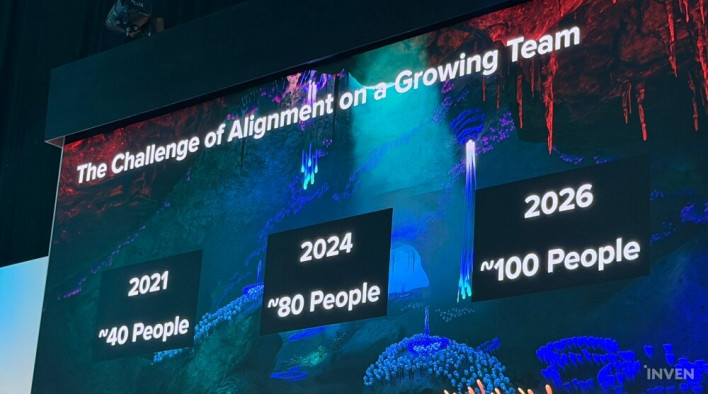
As radical ideas were discarded one by one, concerns arose that the game was becoming too similar to the original. Founder Cleveland worried that fans would react with "it's just the original game."
Gallegos attributed this issue to shifts in team composition. The studio grew from roughly 40 staff members when he joined in 2021 to around 80 in 2024, and to about 100 in 2026. With varying levels of familiarity—ranging from veterans who built the original 12 years ago to developers who joined two months prior—there was an underlying assumption that the team inherently knew how to build 'Subnautica.' "That assumption simply wasn't true in an environment where we kept adding people," he said.
The solution was to dig back into the original game. When questions about oxygen tank balance arose, standard practice became booting up the original game and 'Below Zero' to check how they handled it. Playtests of the older games were conducted as regularly as those for the new sequel.
In this context, he highlighted "knowledge loss and the passage of time" as a distinct issue. "Memories are unreliable," he noted. "While veteran team members are invaluable assets, when it comes to the final product, it was often better to treat the game itself as the single source of truth rather than relying on human memory." In practice, long-tenured employees remembered scrapped features as having shipped, while others reacted to original features as if hearing about them for the first time.
Instead, the studio queried veteran staff about the reasoning behind past decisions rather than the outcomes, aiming to avoid repeating failed attempts. The ecosystem system was a key example: founder Cleveland noted that it had been tried during the original game's development and dropped due to UI overload, but Gallegos believed they could pull it off this time—only for it to fail again.
Criteria for handling player feedback were also established during this period. For many team members, this was their first Early Access project and their first time developing with a passionate, dedicated player base. One slide read: "Players can voice demands that directly conflict with your core. Staying true to the essence of the franchise in the face of contradictory feedback is essential." He reflected that immediately after announcements or when external partner playtest data began rolling in, it was easy to place excessive weight on minority opinions.
A contentious topic was onboarding and player guidance. Early testers reported feeling lost about what to do next. While adding quest logs and signposts was the instinctive reaction, the team declined to do so. The original was a game built on minimal guidance, and allowing non-linear progression was an intentional design choice. He drew an analogy, noting that had FromSoftware run focus group tests on its early titles, feedback would have urged them to "make it easier because it's too hard"—and following that feedback would have been the wrong move for the IP.
Decisions relied on metrics rather than gut feeling. The dev team tracked time spent achieving "story goals," which unlock upon reaching specific milestones. Securing copper—the gate for the first tech upgrade—took an average of 30 to 45 minutes, matching the team's intended pacing. Conversely, silver had a target time of 1 hour and 20 minutes, but players actually took over 4 hours on average. In that case, the team acknowledged player feedback as valid and made adjustments.
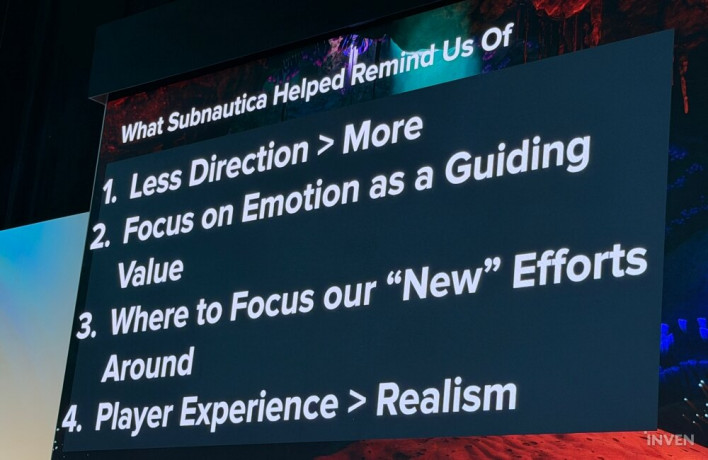
Through this process, he summarized four core principles reinforced by the original game: less guidance is better than more; aim for emotional impact; decide where to focus innovation; and player experience takes priority over realism.
A New World, Narrative, and the Pitfalls of Quality-of-Life Improvements
As the release schedule approached and focus returned to the core experience, the requirements for novelty and improvement became simpler than expected. He highlighted three key aspects of novelty.
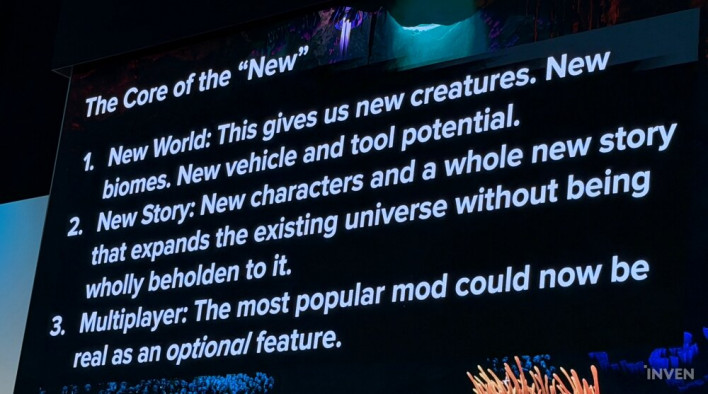
First is a new world. A new planet replacing the original's 4546B spawns new creatures and biomes, opening up possibilities for new vehicles and tools. He noted that exploration is not merely a matter of physical space—the entire process of relearning which creatures are passive, which are aggressive, and where resources lie had to feel fresh.
Second is narrative. The goal was to establish new characters and a new story that expand existing lore without being entirely tied down by it. Unlike many survival games, 'Subnautica 2' features a definitive ending with end credits, establishing it as a self-contained title.
Third is multiplayer. He framed this feature as "turning what was once the most popular mod into an official, optional feature." Though it initially sparked controversy among players who viewed the original as a game of isolation, implementing it as an optional mode yielded strong results.
Areas targeted for improvement were defined as graphics, quality-of-life (QoL) features, and base building. For graphics, the goal was a generational step up compared to the original. Because the original launched into Early Access in 2014 and began showing its age, simply constructing a new world fulfilled a significant portion of the visual overhaul.
He noted that QoL features were drawn from "cousin games." Automatically sharing inventory with crafting benches was inspired by 'Grounded,' and the hotbar was expanded as well.
However, there were instances where QoL improvements compromised the game experience. Item stacking was one such example. In the original game, items possessed distinct volumes and did not stack. Drawing inspiration from modern survival games, the team removed item volume and introduced stacking. Consequently, players could carry hundreds of items, which shattered the core gameplay loop of venturing out, gathering resources, and returning to base. The dev team tried to balance it through numerical tweaks before ultimately reverting the change. The original game had already solved this puzzle: the tension created by limited inventory space was fundamental to holding the core loop together.
Base building was cited as an area of successful improvement. Data revealed that a significant portion of players only play Creative Mode, and the new system improved upon the original considerably. Here too, player experience won over realism. While changing base structures by pulling or pushing walls without flooding water is unrealistic, proposals to simulate flooding were ultimately rejected. The team also removed the base reinforcement system present in the original game; while realistic, it diminished the overall enjoyment of the system.
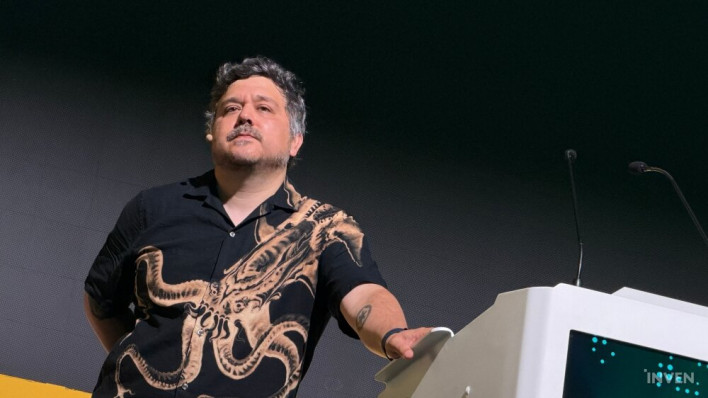
A Q&A session following the talk addressed questions on development principles and studio management.
Regarding shifts in gameplay pillars, Gallegos explained that pillars evolved not only between the original and the sequel, but also throughout the development process itself. As an unrevealed pillar, he cited "survival through adaptation." Where the original was a story of humans reshaping a planet to suit themselves, the sequel focuses on players adapting themselves to the world. However, the core principle of exploration remained paramount. He shared a success metric scenario: a player ventures out to gather a specific resource, fails to find it, but stumbles upon two intriguing alien elements and returns home to tell a friend about it.
As a metric for deciding whether to keep or scrap a feature, he cited founder Cleveland's phrase "undeniable." If the entire team lacks conviction, the feature is put on hold; however, given the Early Access format, another option is releasing rough, unpolished builds to players for feedback before committing art resources.
He identified multiplayer as the primary technical hurdle, as the game must handle four players swimming in completely different directions simultaneously across all platforms, including Xbox Series S. Because there is a cap on the maximum number of simultaneous AI actors, fish visible to a solo player drop from 40 down to around 10 per person in a four-player session. He noted that the team is still addressing the issue where the world feels less alive as players scatter into different biomes.
For visual challenges, he pointed to physically based rendering (PBR). While having the environment grow darker at deeper depths is realistic, whether that serves the player experience best is still under review. The original game made a choice opposite to real ocean physics: it limited visibility in shallow waters while expanding line of sight as players dove deeper.
As examples of rejecting fan requests, he cited map support and predator killing. Maps are a recurring debate whenever a new designer joins the studio, but he stated, "We made the decision not to include a map." The choice to prevent players from killing predators drew even stronger pushback. Although killing predators was possible in the original, it was removed to maintain tension, referencing titles from Frictional Games such as 'SOMA' that feature invincible enemy AI. He even shared seeing a Chinese review claiming this design choice violated the Constitution of China, but reiterated that the decision will stand.
Regarding Early Access feedback processing, he admitted that the team has yet to perfect a method. Sentiment analysis reports alone are insufficient, requiring individual feedback to be read directly, while data analysts and publisher representatives collaboratively filter key items. Combining Discord bots with Reddit monitoring leaves the sheer volume of information overwhelming to handle, he noted.
Addressing questions on expectations and pressure, he acknowledged that fan anticipation weighed heavily on the team. While the studio operates under a strict no-crunch policy, preventing team members from voluntarily putting in extra hours was challenging. He shared that during development, he had to observe contrasting reactions—from claims that it would be the best game ever to claims that legal issues would render it terrible. He added, "'Subnautica 2' has sold more than all the previous games I've worked on combined," noting that realizing such opportunities rarely come twice in a career heightened the pressure.
He attributed the studio's ability to avoid crunch to its leadership setup. Key personnel who had suffered burnout at previous companies—including Development Director Mike Ferrette—founded the studio with a shared commitment not to repeat those practices. A high proportion of parents on staff and a remote-first work culture also contributed. When extra hours occur, they are compensated with paid time off, alongside separate budgets for education and wellness. He highlighted the annual studio retreat—where all employees gather in one place for a week each year—as a cornerstone policy, explaining that during intense debates, it helps team members see one another as colleagues rather than external contractors.