
Gamers love stories as much as movies or TV shows. Indeed, beloved games share much in common with stories that people love. From early classics like Myst and Broken Sword to text-based adventure games, story has been alongside gaming since its inception. However, games that combine both good storytelling and good gameplay are rare.
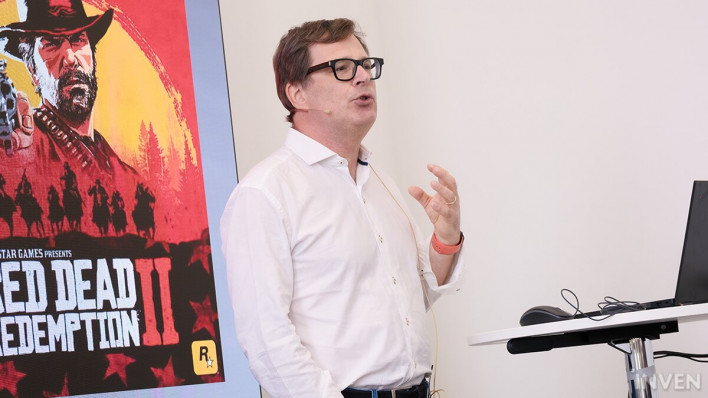
In action-heavy games, story is often reduced to a device that merely justifies level design, while games with outstanding narrative frequently suffer from weak gameplay. Taking the stage that day, Pascal Luban aimed to demonstrate that the two do not need to be in opposition and can, in fact, coexist.
With over 30 years in the gaming industry, Luban has worked as a creative director, designer, and consultant on various AAA titles across console, PC, mobile, and indie games. Drawing from that experience, he shared his insights on narrative in game development.
Mystery, Danger, and Emotion — How to Build a Good Theme
Luban noted that when writing a good story, the very first thing to decide is the theme. A good theme must incorporate mystery and danger. He illustrated this with an example: taking a plain premise like "a high school student who is late every day" and simply adding two conditions—"because he stops by an abandoned building and stays there for a long time"—completely transforms the story.
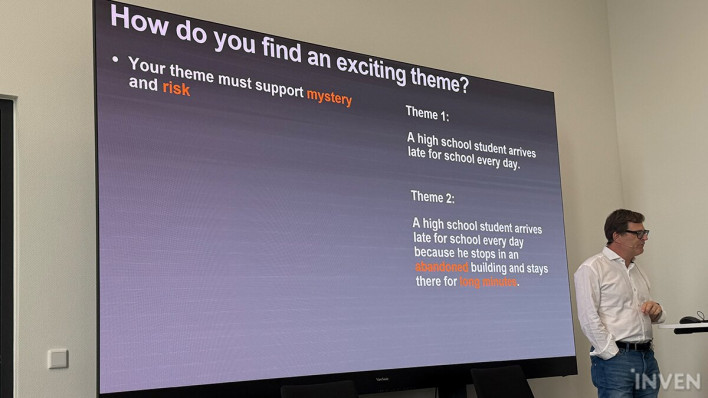
The setting of an abandoned place immediately creates danger by stepping outside a safe zone, while staying there for a long time establishes that whatever he is doing matters deeply to the character. With just these two elements, a dull premise turns into an intriguing story.
In addition, he listed novelty, audience interest, and above all, strong emotion as key conditions for a good theme. Unfamiliar subject matter that hasn't been explored before draws the audience in, but it is useless if no one cares about it. The most important factor is emotion.
He emphasized that "emotion is humanity's first language and the force that drives our intentions and motivations," warning that if creators themselves do not feel strong emotion toward their theme, the audience won't either. Conversely, a theme in which creators are genuinely invested brings authenticity to the writing and translates directly to the audience.
Characters, Plot, and Setting — The Three Pillars Supporting a Story
Once the theme is decided, Luban explained that three core components are needed to build the story: characters, plot, and setting.
Starting with characters, the protagonist does not need to be perfect; in fact, they should have flaws. He cited Robert Downey Jr.'s Sherlock Holmes—portrayed as a genius lacking social skills—Frodo, a small figure entirely unprepared to be a hero, and Tom Cruise's character in War of the Worlds, who becomes a hero despite being selfish and indifferent. The reason these characters feel like heroes lies in their proximity to us.
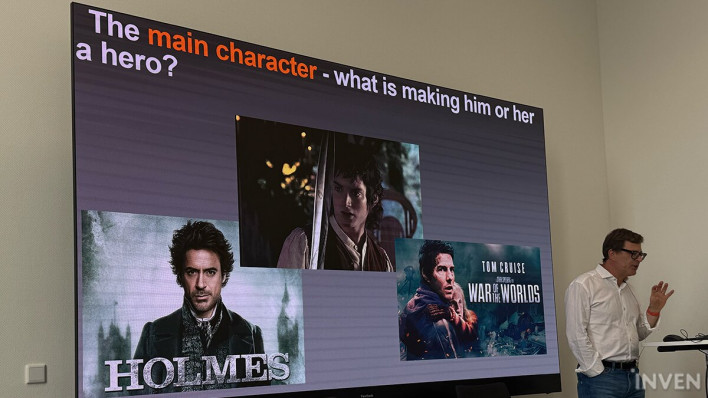
Audiences empathize with stories where an ordinary person is thrust into becoming a hero by circumstance, like Jack Shephard in Lost, who never wanted to be a leader. He also pointed to Mel Gibson in Mad Max 2, who suffers from physical flaws, and Lara Croft in the 2012 Tomb Raider reboot, suffering as she is forced to hunt and kill, noting that seeing a protagonist suffer as they face an unexpected personal drama is precisely what draws audiences in.
Finally, he added that heroes are beloved because they demonstrate through their actions the values that the audience holds dear.
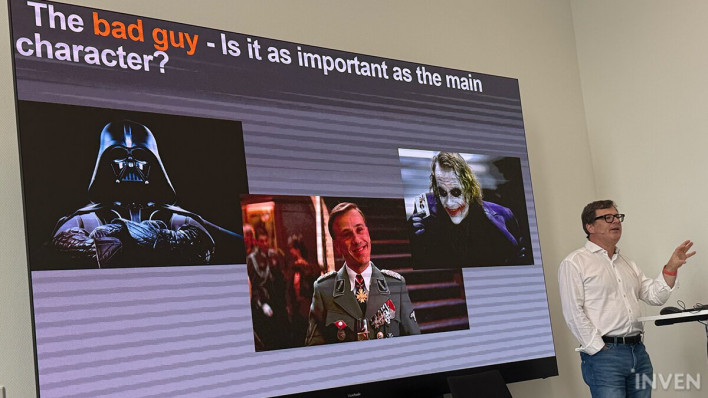
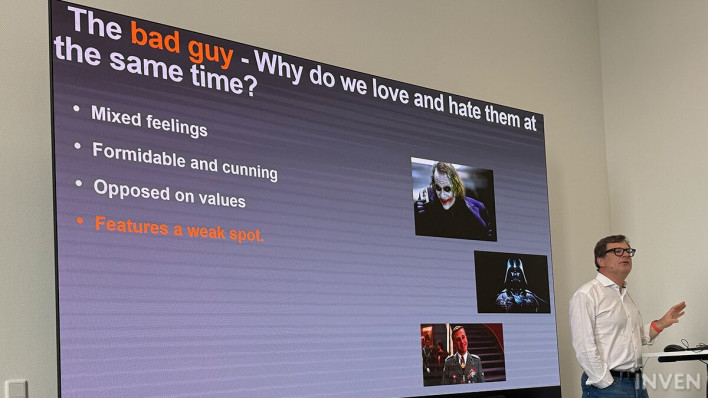
As for villains, Luban stated that while they are not strictly necessary, if they do appear, one should keep in mind Alfred Hitchcock's principle: "The more successful the villain, the more successful the movie." Just as Darth Vader is the first character audiences encounter in the original Star Wars, a villain can sit at the very center of the plot.
A good villain must evoke repulsion and fascination simultaneously; they should be a formidable opponent with great intellect who opposes the values cherished by the audience, while also possessing a flaw that the hero can ultimately exploit. He also mentioned the role of supporting characters who highlight the protagonist, serve as conversational partners, and sometimes provide comic relief to give the narrative breathing room. Supporting characters like Dr. Watson who complement the protagonist's weaknesses are not strictly required, but serve as a useful tool for a writer.
Regarding plot, the second core component, Luban introduced five general stages, though there are various ways to divide them.
First, there is a short, peaceful initial stage that introduces the protagonist and their environment. While not inherently exciting, this stage is essential as it sets the stage for the coming drama. Next comes the inciting incident, where an event suddenly thrusts the protagonist into the drama. This disruption must be abrupt, turning a peaceful situation into one full of problems in an instant.
The third stage is the actual drama—the core of the story—a phase where the protagonist barely hangs on without being able to overcome the situation. Luban likened this to being caught in a rapid, barely keeping one's head above water to breathe without being able to swim to the riverbank.
The fourth stage that follows is the opportunity, where a single chance arrives to break this vicious cycle, whether through the protagonist's own actions or external factors. The final stage is a new equilibrium, where the protagonist escapes the drama and reclaims peace, but has transformed and learned something along the way.
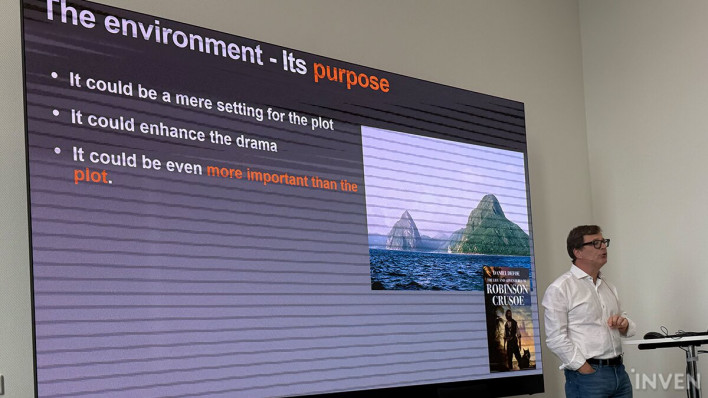
Setting, the third component, serves two functions. One is simply as a backdrop where the story takes place, serving merely as a background whether in New York, Paris, or anywhere else. The other is as a device to heighten the drama. For instance, placing a castaway story at sea rather than in a mountainous region is not only technically harder for survival, but also because mountains subconsciously evoke vacation spots, whereas the sea feels threatening.
Furthermore, there are cases like Robinson Crusoe where the setting itself becomes more important than the plot. Most of the novel is dedicated to the process of the protagonist transforming a deserted island into his own paradise, while meeting Friday and escaping are treated briefly at the very end.
Summing it all up, he stressed that a good narrative is ultimately a real or fictional story focused on an interesting protagonist, and that a powerful story can be built around an ordinary "Mr. X" who loses a child, rather than a hero saving the galaxy. What makes a story interesting is not grand spectacle, but the spectacle of an unprepared, ordinary person confronting the drama thrust upon them.
Why Good Storytelling Is Rare in Games
If techniques for writing good stories exist, why are games with great narrative so rare? Luban pointed to several reasons.
First is technical challenges. Authors of books or screenwriters for movies have total control over when and how events unfold, but in games, because players progress at their own pace, controlling pacing is much harder. Moreover, while players spend time on gameplay, narrative elements naturally become diluted.
Second is budget limitations. Beyond the cost of hiring screenwriters, good storytelling demands far higher expenses—such as cutscene 3D models for facial animations and multilingual voice acting—while also impacting level design. Luban noted that publishers often look at these costs and ask, "Do we really need a story?"
Third is the industry's complacent assumption that gamers are not interested in good storytelling. He pointed out that many designers assume gamers only want muscle-bound superheroes saving the galaxy, and tend to follow along simply because others do.
Fourth is practical resistance within the industry. Games with great gameplay and weak storytelling still sell, but the reverse is rarely true—and publishers know this, making their resistance not entirely unfounded. It is no coincidence that major publishers rarely produce adventure games anymore.
Luban recalled his experience working with a French publisher that specialized in narrative-driven games, sharing how he watched funding for narrative titles decline year after year until the studio eventually went bankrupt. He explained that this does not mean interest has disappeared completely, but rather that reaching an audience has become far more difficult.
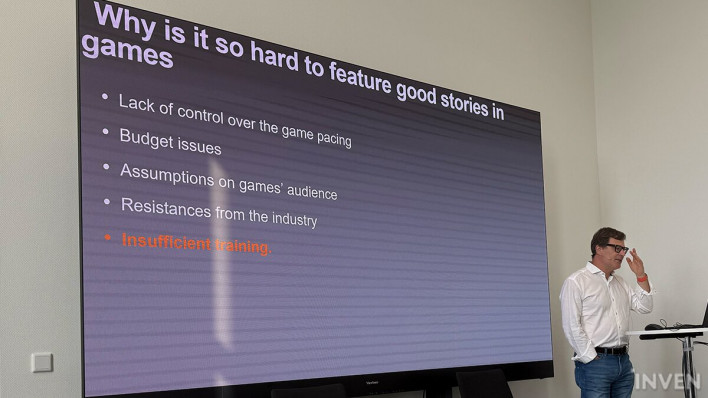
The final reason is a lack of talent. Game designers trained in screenwriting are rare, and screenwriters who understand level design are even rarer. As a result, when designers without screenwriting training write stories, narrative quality suffers; conversely, when good screenwriters write without understanding level design requirements, their stories inevitably end up chopped down to fit the game.
Pairing designers and writers as a team can be a solution. Luban recalled his experience as creative director on Wanted: Weapons of Fate, where he collaborated with a talented screenwriter sent by publisher Universal. Because the writer understood the demands of level design, the collaboration went smoothly with mutual respect.
However, he added that better screenwriters often have stronger pride, and the moment one side tries to unilaterally force their story or gameplay, the collaboration can easily break down.
Five Strategies for Uniting Gameplay and Storytelling
Despite these practical constraints, Luban presented five strategies that have proven effective, drawing from his own experience and various examples. He emphasized that to convince publishers, one must approach them through gameplay rather than narrative. Being able to say, "We have a solid action game, and on top of that, an intriguing narrative layer," is what makes publishers see investment value.
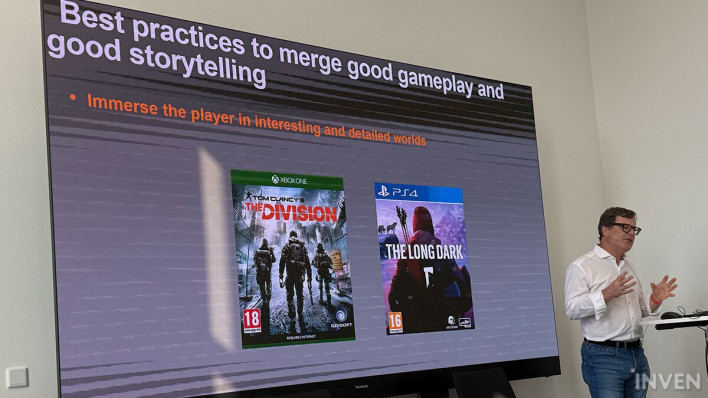
The first strategy is to immerse players in an intriguing and detailed world. Ubisoft's The Division took a sandbox approach, offering only a brief intro without plot or characters, allowing players to live by their own rules.
The Long Dark similarly lacks a story in its base mode, but through the simple premise of being left alone after a plane crash combined with a highly believable atmosphere and detail, the environment itself takes the place of narrative. He noted that indie title Dear Esther follows the same logic, effectively giving birth to the walking simulator genre with virtually no gameplay beyond walking.
The second strategy is leveraging characters that evoke empathy or repulsion. He cited Pagan Min, the ruthless dictator in Far Cry 4, as an example. Initially appearing approachable, his cruel side is soon revealed as torture sounds echo from the next room, yet he maintains an overly polite demeanor, evoking both repulsion and fascination.
Trico, the dog-like giant creature in The Last Guardian, was cited as an example where its sheer presence drove desire to purchase. Luban also shared his personal experience playing Ethan Mars, a father crushed by guilt over losing his son in Heavy Rain. Having children himself made the empathy intense, confessing he felt emotionally overwhelmed even before starting the game ahead of the scene where the child disappears.
He also cited protagonists in recent titles who appear tough on the outside but possess depth, explaining that in such games, fascination with or repulsion toward a character becomes the driving force to keep playing.
The third strategy is introducing moral dilemmas. The action game Army of Two appears on the surface to be pure action, but occasionally presents moral choices, such as whether to kill an employer, adding a completely different layer to the game. Luban rated such mechanics as effective because they are relatively simple to implement while instantly raising emotional immersion. As a further example, he cited Fahrenheit, Quantic Dream's second title.
In a scene where the protagonist, framed for murder and pursued by the police, must choose under a time limit whether to save a drowning child or abandon the child and flee, most players choose to save the child; however, that moment of choice itself grants players the feeling of becoming a true hero.
The fourth strategy is allowing players to experience real-world events. Using work he had participated in as an example, he noted that grounding a game in actual historical or tragic events removes the need to invent a new story from scratch, as it builds directly on an existing narrative.
He cited This War of Mine, the first major hit from Polish studio 11 bit studios, as the most effective application of this strategy. While it is a management game where players manage a group of survivors in a besieged city, the mere reality that such situations exist—such as in Ukraine or Sarajevo—evokes intense emotion even without a plot or specific characters.
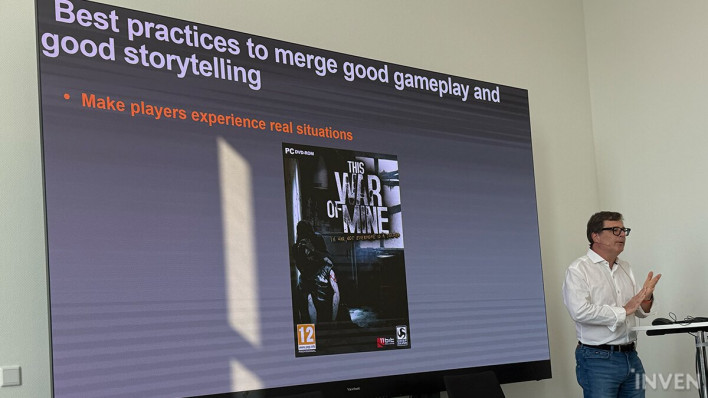
The fifth and final strategy is designing the game around a deep scenario. Mentioning Naughty Dog's The Last of Us, Luban remarked that those who made such games ultimately chose to take risks. To tell a good story that leaves a lasting impression on players, one must sometimes take those risks.
Concluding his talk, Luban summarized that what he wanted to show today was that realizing better narrative in games is possible, while stressing that gameplay—the very heart of a game—must never be sacrificed.
He emphasized that while technology and resources are needed to achieve this, above all, what is required is determination.
"What we need is the will to speak to players, to express our beliefs, and to convey hope for a better world. That is what masterpieces are made of."

Q&A
Q. Can AI serve as a technical solution to bridge the gap between narrative and gameplay?
A. For those without screenwriting training, AI can be a tool to help write better stories. However, that applies strictly to writing the story itself. The challenge of combining good gameplay with a good story is far too complex for current AI to handle, and it remains uncertain whether AI can be a solution on that front.
Q. Why do studios still insist on making narrative-driven games despite their low profitability?
A. There are two reasons for this. First, passion-driven studios often achieve remarkable results. A narrative-driven game that didn't look interesting on paper can turn out to be a massive success because there was a dedicated team behind it with a story they truly wanted to tell.
Games with virtually no gameplay that ended up creating the walking simulator genre itself are prime examples. In such cases, the final result can be overwhelmingly impressive. The second reason is that some teams simply jump in without understanding the market, believing their game will work.
A long time ago, I worked with a French publisher specializing in narrative-driven games, and I watched funding for this market shrink year after year until the studio eventually went bankrupt. It's not that interest disappeared entirely, but rather that finding an audience became much harder.
Q. What advice would you give to aspiring narrative designers looking to enter the industry?
A. First and foremost, you must learn to speak the language of the industry. You need to understand what level design and game design are, and how games are made. Second, you must prepare your own project. This means building a portfolio-worthy proposal that proves you can write a story and understand what a game is.
For example, even a somewhat typical action game concept is fine; you should prove what value you can add by layering good storytelling on top of it to enhance the experience. Ultimately, in any case, you need a process of proving yourself through your portfolio.

Q. How does combining gameplay and storytelling apply differently to mobile games compared to console games?
A. My examples are limited since I haven't played every mobile game, but a mobile game about Alzheimer's disease comes to mind. The developers prioritized the story they wanted to tell with that theme over gameplay, and it was a commercial success as well.
However, the fundamental problem with mobile games is short play sessions. People generally seek brief sessions on mobile, which doesn't fit well with narrative-driven games that require time to get to know characters and recall plots. Even as someone who loves storytelling, when I tried a few mobile narrative games and paused mid-story, I found myself forgetting what happened earlier when I returned. The session structure simply doesn't suit such games.
Q. That experience doesn't seem much different from reading a book bit by bit over several days. Even on PC, there are short yet excellent narrative games like Firewatch that run about four hours.
A. Technically, it's not impossible. The key is whether there is an audience searching for such games. The mobile market is so vast that there is always room for niche genres, but the real issue is discoverability—letting people know that such a game even exists. The core problem remains the same in that people forget the contents when picking up a book again after several weeks.
Q. Still, people continue to read books.
A. That's true. However, because mobile games are mostly consumed as casual leisure for relaxation, players move on to something else if there's no immediate gratification. This might just be a bad habit of mine. That said, it doesn't mean it has to be this way. I hope that one day we'll see high-quality narrative games on mobile as well. By the way, I'm currently writing a novel.
Editor's Note: Pascal has published Udemy courses, Indie Game Design: Build Your Game’s Core System, and Game Design in Production: From Idea to Release.