
"Creating a setting and building a world (World Building) are two different things."
At gamescom dev, Jarory de Jesus filled an hour-long presentation on this single premise. He strictly distinguishes between 'setting' and 'world,' terms that might sound identical at first glance. If the setting is the total time and space of a universe crafted by its creator, the world is the specific moment within it where players actually set foot and experience it.
The distinction between setting and world. De Jesus stated firmly that while most people think only of setting when considering world-building, what truly immerses players is not the setting itself, but the way that setting is gradually revealed. With a long and varied career as a technical designer, character designer, and narrative designer on titles like Madden NFL, Marvel Strike Force, and Star Wars Jedi: Survivor, he spent his talk on the first day examining whether this same principle applies regardless of scale or genre—from indie games that build a world through pure text to AAA titles spanning hundreds of hours.

Setting and World: Two Concepts Separated by Definition
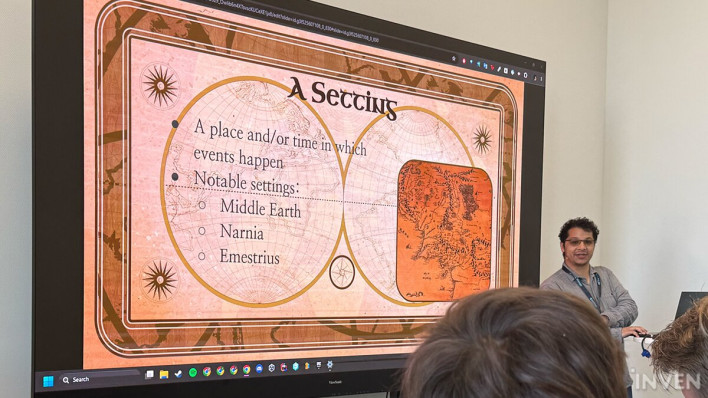
The starting point of the talk was definitions. He defined setting as 'the place and time where events happen.' A setting can exist at any point on a timeline; even if a creator has forged a thousand years of history for a universe, that is merely setting, and players have no way of knowing its entirety firsthand. He cited Middle-earth, Narnia, and 'a galaxy far, far away (Star Wars)' as primary examples of settings.
In contrast, a world is 'the place and time experienced by the player at a specific point.' Where a setting encompasses an entire era, a world is a single moment within that setting—the here and now where the player is actively standing. He pointed to Eorzea after the king's death, the Outer Rim during the Galactic Empire era, and Hyrule during the Age of Calamity as examples, explaining that these moments are the events taking place around the characters, and that is precisely where we become immersed.
Ultimately, world-building is the work of gradually peeling back the information contained in the setting to reveal it to the player. As an example illustrating this principle, he cited Undertale. In the section leading up to the castle before confronting Asgore, a series of short dialogue windows pop up in succession, revealing step by step how monsters came to be trapped underground, why they support Asgore, and what happened to the previous humans. He explained, 'By the time you reach this moment of confrontation, the player has complete context on why they are fighting.'
BioShock operates on the same principle. A prime example is the sequence where the player descends into Rapture listening to Andrew Ryan's speech, and subsequently witnesses firsthand the horrors wrought by that ideology.
Three Ways to Gradually Reveal Information
He organized this step-by-step disclosure along three axes.
The first is the past. Asking 'what happened?', this axis gives context to ongoing events. He cited the Force Echo system in Star Wars Jedi: Survivor as an example. By having players encounter brief visions near broken machinery or corpses—such as witnessing a raider group murder an explorer—it allows players to immediately feel the threat posed by the hostile faction they will encounter later.
The second axis is the present. Answering 'who are we, and why are we here right now?', he shared how in Saros—a project he contributed to—the protagonist's past is gradually revealed through memory gates that transition into the space known as Carcosa. Regarding these sequences, he explained that because they directly connect to why the character moves forward, they are all part of world-building.
The third axis is an expanding setting. 'What do we know, what don't we know, and what will we learn going forward?' To illustrate this, De Jesus explained the Law of Equivalent Exchange introduced early in Fullmetal Alchemist. This law becomes the foundation for understanding the entire world later on. He emphasized that this expansion must ultimately lead to a point where players can actually intervene.
In Marvel's Spider-Man 2, Avengers Tower in the middle of New York merely hints at the presence of other heroes, never allowing players to meet or interact with them. In contrast, the letters exchanged between Otto Octavius and Norman Osborn detail their rift, leading to Octavius becoming Doctor Octopus. This heightens the contrast by making players experience the consequences directly. Avengers Tower merely expands the setting, whereas the letters between Otto and Norman build a world where that expansion connects to the events we live through.
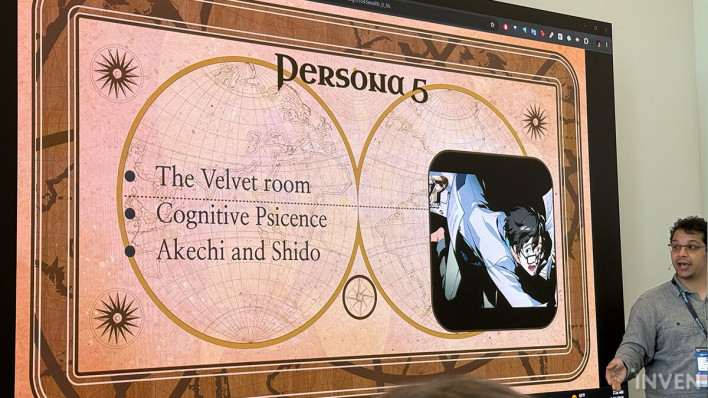
He went on to list examples of great world-building. In Persona 5, one of his personal favorite examples, the Velvet Room is a prime case. Appearing repeatedly from the start of the game, its true nature is revealed only in the late game after breaking out of the prison where the player was held. Realizing that the Velvet Room, which seemed to exist only as a construct of the mind, was actually a passage connecting Mementos and the Metaverse leads directly into the game's final climax.
The concept of 'Cognitive Psience' follows the same pattern. Mentioned by several characters from early on, its true substance is revealed only after meeting Futaba. How Futaba's mother lost her life, how that triggered the awakening of Futaba's Persona, and why she joins the party are all unveiled through this concept.
In addition to the previously mentioned Asgore example from Undertale, he cited its successor Deltarune as another stellar case. When the shopkeeper cat character Seam drops various hints, players follow them to encounter secret bosses, gradually deepening their understanding of the world. Though the story is not yet complete, whenever Seam mentions something, it leads into an actual battle and adds more information about the world. The journals in Expedition 33 were also mentioned again as one of the best executions of world-building. Discovering a journal hidden somewhere reveals what a previous expedition went through, and in most cases, the player immediately confronts the exact situation that expedition failed to resolve.
Good Worlds and Flawed Worlds
After finishing the positive examples, he also highlighted a few counterexamples. While prefacing that he 'does not like putting down other games, and every game released into the world is a miracle in itself,' he pointed to Honkai: Star Rail as a primary counterexample. Although it is one of his favorite games, once players reach the Xianzhou Luofu region, they learn vast amounts of history and warfare but rarely encounter the direct consequences. Because unlocking related side quests requires pulling specific characters through gacha, he noted that the extent to which a player actually connects with that history depends purely on luck.
As a second counterexample, he pointed to the books in Skyrim. He explained that while he loves Skyrim, it is also one of his favorite counterexamples. De Jesus acknowledged that Skyrim is a game that builds a rich setting, but pointed out that books on bookshelves like A History of Tamriel have virtually no impact on the player's journey, unlike a journal randomly discovered inside a dungeon. They contribute to enriching the setting, but contribute very little to world-building itself.
After pointing out these two counterexamples, De Jesus added that the 'show, don't tell' rule can be the worst advice for young writers. He argued that in worlds where rules need to be clear, 'telling' is actually essential. He highlighted the original Star Wars opening crawl—summarized as 'this is the Empire, the Empire is evil, and we fight back'—as the most iconic success story of 'telling.' He added that Metaphor: ReFantazio operates on the same principle, explaining the rules of royal magic directly at its climax so that players can comprehend the aftermath of subsequent events much faster.
He drew a line, clarifying that arguing for 'telling' does not mean 'don't show.' Rather, he summarized it as 'using telling as a shortcut to reach showing faster.'
Invisible Design and the First Steps of Collaboration
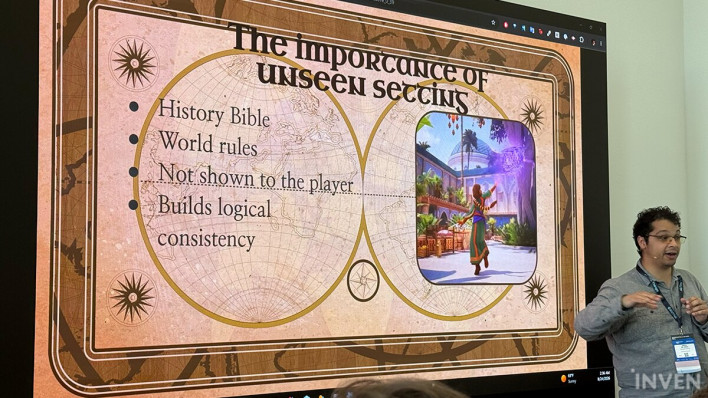
At this point, he introduced the concept of the 'unseen setting,' borrowed from fellow writer Jen Svedberg-Yen of Clair Obscur: Expedition 33. On an indie title where he served as lead, the team created a 'history bible' organizing the rules governing the world and the events that had transpired up to that point. However, a significant portion of it was never shown to the players.
As an example, he cited how this project was set in an Islamic cultural setting, making it impossible to use the concept of 'ghosts' directly. They needed the protagonist, Miya, to commune with her deceased father, but according to what the team was informed, there was no concept of ghosts in that cultural context. Instead, the team drew upon the dream world to devise a mechanism called 'scaffolding.' The narrative mentions a figure referred to as 'the Widow' who never appears on screen; her corrupting the scaffolding out of grief for her late husband becomes the catalyst for the creation of the game's final antagonist.
Players never meet the Widow, but for the developers, having this unseen design allowed them to give consistent logic to the events players actually encounter.
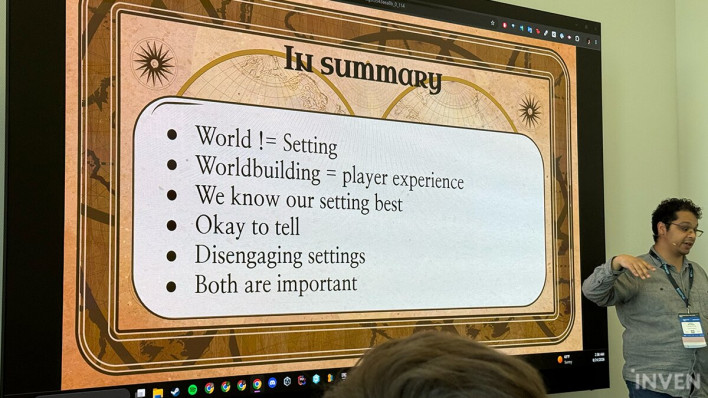
He then brought up a slide summarizing the core message of his presentation, defining world-building as follows:
The world is not your setting. World-building is the player's experience. We know our setting better than anyone, and sometimes it's okay to tell in order to show faster.
Q&A
Below is a summary of the Q&A session that followed the presentation.
Q. How do you approach creating a setting? Do you write vast pages of text and draw maps?
= Honestly, I'm a lazy writer who doesn't really like writing much. The method I actually use is creating a 'one-page summary' for specific points in time. A bulleted list stating what happened during those 100 years is enough. That's all the rest of the team needs to know, and they can participate in world-building based on that.
The exception, however, is character bibles. For characters, I detail everything down to speech patterns and personal tastes, because ultimately, a world is built around characters. In fact, when creating a story, I decide on the character before the world, and then build an interesting world for that character to live in on top of that.
Q. In working on a setting with so many intertwined dialogues and environments, especially on large teams, how do you make sure everyone stays on the same page? Doesn't it ultimately come down to details on every individual asset?
= This also comes back to the one-page summary. If there's one thing I've learned from 10 years in the games industry, it's that nobody wants to read long text—not even other narrative designers. So I use tools like Notion or ArtStation to compile all information into a 'single source of truth' document. Anything that doesn't come from there is treated as non-existent.
I also recommend separating communication channels. Keep one history channel and one separate channel covering current ongoing events. If you dump everything into a single channel, information gets buried in the conversation. Those interested in the world's history can check the history channel, while those who want to focus strictly on their current task need only check the present channel.

Q. How do you balance narrative and design? Taking Honkai: Star Rail as an example, many people working in the games industry don't actually enjoy in-game narratives. When a narrative section that took two months of work is reduced to a request for a single cutscene, how do you balance the reality of limited time and budget with building a beautiful setting?
= If you need more budget or time, the justification must appeal even to people who don't care about the story, rather than being for the story itself. For example, a cutscene introducing a new ability is justified because that ability connects directly to actual gameplay. On the other hand, a cutscene purely meant to explain setting flavor is very difficult to justify unless it was in scope from the planning phase.
When working on Star Wars Jedi: Survivor, we planned every cutscene from the beginning, so even when edits were needed, we could adjust simply by cutting a single scene. Ultimately, if you define the scope early on, you'll find yourself cutting content rather than adding more later. So it's crucial to map out a clear scope with senior leads before entering production.
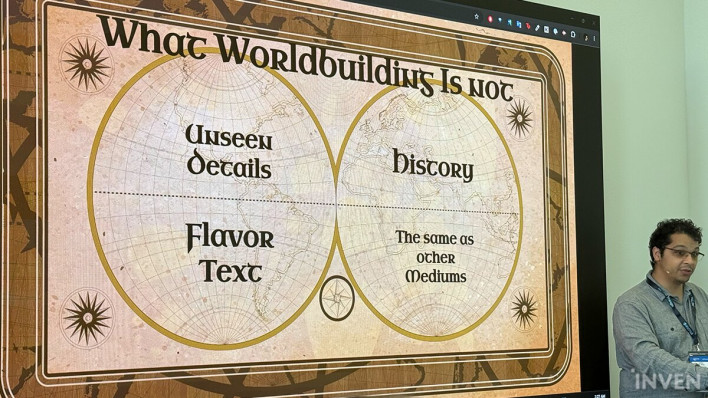
Q. You mentioned that world-building is not pure flavor text (text that dresses up the world convincingly without the player ever encountering its consequences), but later cited examples like the journals in Expedition 33 and the books in Skyrim. What is the difference between pure flavor text and text-based world-building?
= The core difference lies in whether you actually face the consequences of that text immediately upon discovering it or nearby. In Expedition 33, players discover the journal of an expedition team late in the game, revealing that the only team to discover the truth failed to return—and at that very moment, the player is about to face the exact same real enemy. That connection between the journal and what happens next is what makes the difference.
In contrast, even if you read A History of Tamriel in Skyrim, that knowledge has zero impact on your actual journey. Martin Septim in Oblivion is important because he is a main character; why his great-grandfather founded the empire does not matter.
Q. Following up on the previous question, do you think it's still fine to include text that fleshes out the setting as a small reward, like the books in Skyrim, or is it better to focus more on world-building?
= It depends on the nature of the game. For games focused on building a setting like Skyrim or Cyberpunk 2077, extensive text makes perfect sense. But for games pursuing a tight, linear narrative like Expedition 33, such text becomes a burden. Imagine putting in an entire book series on playing the piano. You don't have the time or budget for that, nor is there any reason to.
When budget for voice acting, cinematics, or animation is tight, text-based world-building can be a useful tool. However, it must be used thoughtfully and intentionally—otherwise, it simply wastes both the developers' and players' time.
Q. How do you understand the difference between lore-building and world-building?
= I view it through the lens of scale and longevity. For games like Magic: The Gathering that expand their universe over a long time and want players to uncover hidden secrets, deep lore is entirely valid. A 100-hour series like Persona also possesses deep lore. When you have that much time and resources, building thick lore makes sense.
On the other hand, while games aiming for a short, dense experience still need a minimal amount of lore to establish mystery, it must be designed intentionally and very carefully.