
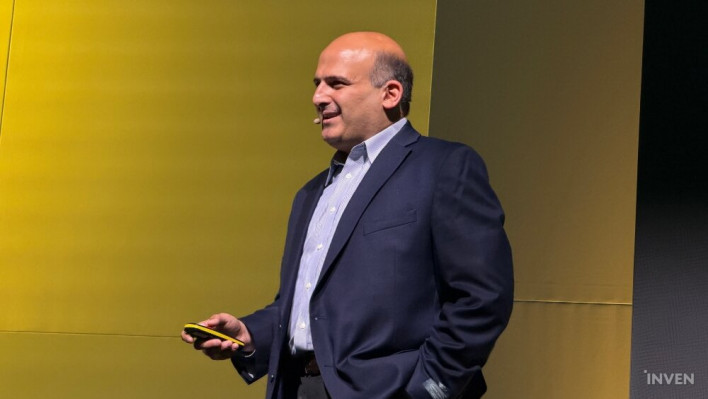
Amir Satvat, Business Development Director at Tencent Games, delivered the opening keynote address at the gamescom dev conference in Cologne, Germany on August 24. The theme of the keynote was careers, taking a close look at the current state of employment and layoffs in the global games industry.
Satvat has established and operated Always Supporting the Games Community (ASGC), a free career support community, since November 2022. The database of job listings, layoff tracking data, and job-seeker consultation records accumulated by the community over four years served as the foundation for this presentation.
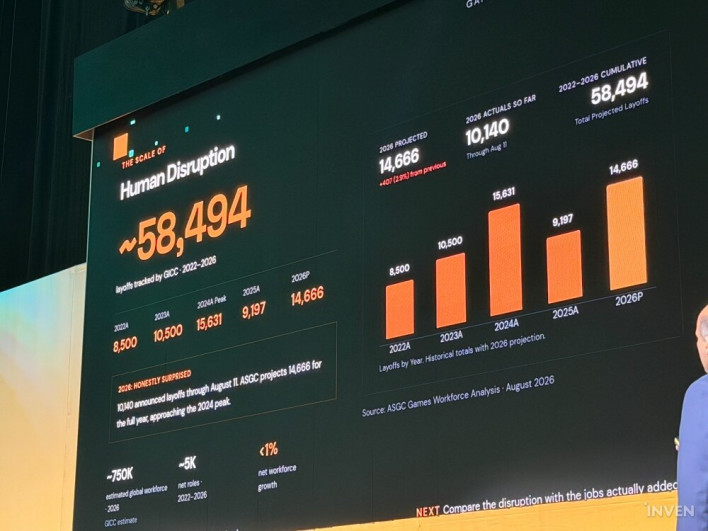
The first figure presented in the keynote was 750,000. This figure represents the total direct and indirect employment scale of the video game industry, calculated by aggregating estimates across countries and trade associations after deduplication; Satvat cited estimates from Games Industry Coffee Chat. He pointed to the undercounting of employment in China and India as the reason this figure is larger than the commonly cited 300,000 to 400,000.
By this metric, industry workforce has seen a net increase since 2022. However, he immediately put this figure into perspective, noting that while the industry added 150,000 people over the five years from 2017 to 2022, the subsequent five years have essentially been stagnant.
Revenue metrics exhibit a similar pattern. In mobile, the top 20 games account for 50–60% of total revenue, while 80% of playtime on PC and PlayStation is concentrated in around 70 titles. Satvat remarked, "The surface numbers look good, but looking beneath reveals figures that are far more harsh for new entrants."
Satvat cited 15 to 20 variables explaining this reset, identifying "geographic job migration" as the dominant trend. He explained that this is the result of not just labor costs, but also government incentives and talent availability in different countries working together.
Of the 115 layoff cases recorded in 2026, more than two-thirds occurred at North American-headquartered companies. North American game industry headcount shrank by 15%, with 25,000 jobs disappearing. California alone accounted for over half of global layoffs over a 12-to-18-month span at its peak.
Looking at job listings makes the directional shift even clearer. Between 2024 and Q1 2026, the Asia-Pacific region's share of job postings rose by 10 percentage points, with China accounting for the vast majority of that increase. Europe remained flat, while North America declined. Remote job listings dropped to around 10% of the total.
4% Hiring Probability for Entry-Level, 4% After Age 50
The gap between educational supply and employment outcomes was the section where the presentation provided the most specific figures. Since 2010, the number of game-related degree and certification programs has increased tenfold, with 400 universities in the US alone offering related courses. Over 14 years, the number of graduates in game and interactive media majors quadrupled. More than half of these students are concentrated in fields with narrow job entryways, such as game design.
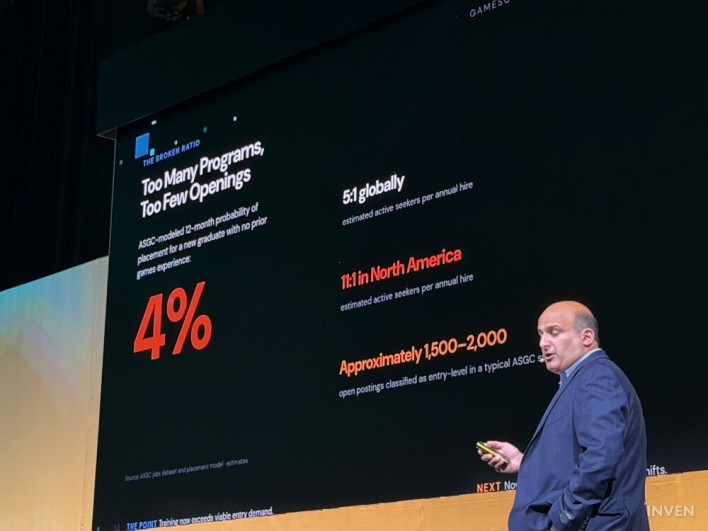
Satvat estimated that applicants without prior experience in the games industry have roughly a 4% chance of securing employment within 12 months. On his slide, he summarized this as "The problem is not ambition, but the ratio of yield to input." The ratio of job seekers to open positions was calculated at 5 to 1 globally and 11 to 1 in North America. The job-hunting duration observed by ASGC was typically 8 to 10 months, with over a third exceeding one year.
The required years of experience for the same roles also rose by an average of three years over a three-to-four-year span. Positions that previously required no experience or 1–2 years are now being applied to by candidates with 3–4 years of experience, pushing entry-level applicants out.
A similar pressure is observed at the opposite end of the spectrum. Reaching age 50 or equivalent experience drops the 12-month hiring probability back down to 4–5%. The diagnosis is that a structure has formed where hiring is concentrated almost exclusively in the early-career band and the 15-to-20-year experience range.
Securing 1–2 years of experience causes the probability of re-employment within 12 months from unemployment to jump from 4% to 30%. Applicants who have connections with hiring managers or recruiters were observed to have more than 20 times higher hiring probabilities than those who do not. While presenting these numbers as personal prescriptions, Satvat added a reserved evaluation, noting that they "increase exclusionary pressure between those who are already established and those who are not."
Game Design Pushed Out of Top Job Categories for First Time in Four Years
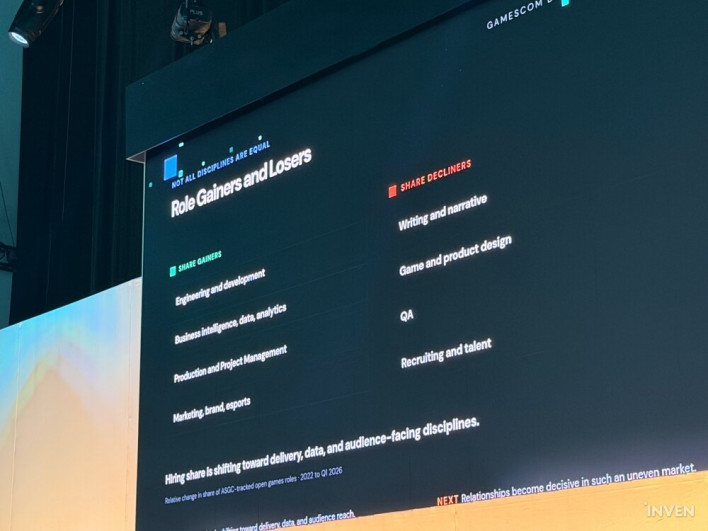
The breakdown of job roles has also shifted. Four disciplines—Art & Animation, Engineering, Game Design, and Production—have historically accounted for around 70% of job listings. Satvat revealed that for the first time in four years, Game Design dropped out of the top four roles, replaced by Marketing & Advertising.
In terms of job listings relative to job seekers, conditions were also found to be relatively better for Business Intelligence, Marketing, Brand, and Esports roles. He speculated that changes in development methodologies and discoverability challenges were behind this, though he refrained from making a definitive conclusion.
Shifts in studio structure were also presented through data. When data collection began in mid-2022, over half of industry job postings were for AAA titles. Currently, that figure stands below one-third. Pure external development and contract work account for 10–15% of postings, while the remaining half comprises indie, tools, and other areas.
Satvat drew a clear line, stating that this represents a shift in the center of gravity rather than the demise of AAA. Studios with strong teams, dominant IP, and manageable cost structures will continue to play a role. However, he pointed out that as the share of external development and contract work expands, standards for fair treatment—such as proper crediting and support for career continuity—must rise accordingly.
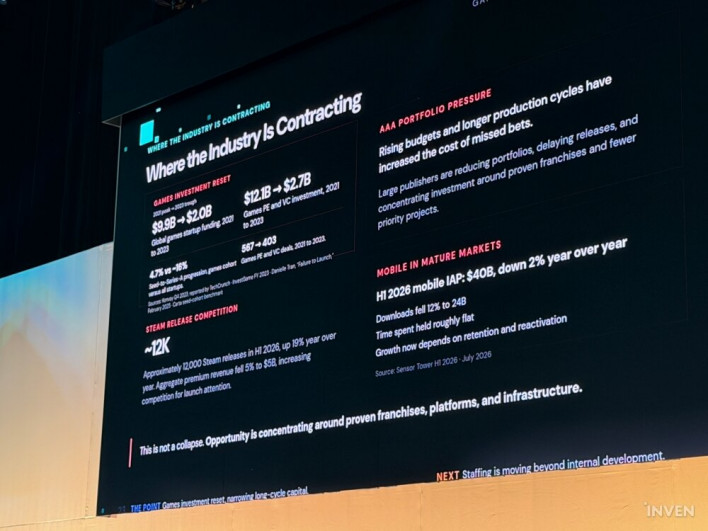
Signs of recovery in the investment landscape remain limited. Game startup investment volume has fallen from its peak of $10 billion in 2021 down to $2 billion. The transition rate from Seed to Series A is roughly half that of other tech industries. Citing his experience in investment banking, Satvat stated, "Most investment vehicles are fundamentally incompatible with gaming." He explained that comparative valuation models—which assume predictable revenues and stable margin structures—do not align with the volatility of the gaming business.
He broke down the discoverability challenge into two layers. While 20,000 games are released on Steam in a year, only 3%—around 600 titles—reach a peak concurrent user (CCU) count of 100 or more. Even among those 600 titles, they compete again within the revenue concentration framework outlined earlier. Although influencer marketing and data-driven targeting capabilities have improved over the past two to three years, he noted that very few people can claim a predictable relationship exists between execution and performance.
China Accounts for 42% of PC Revenue Growth
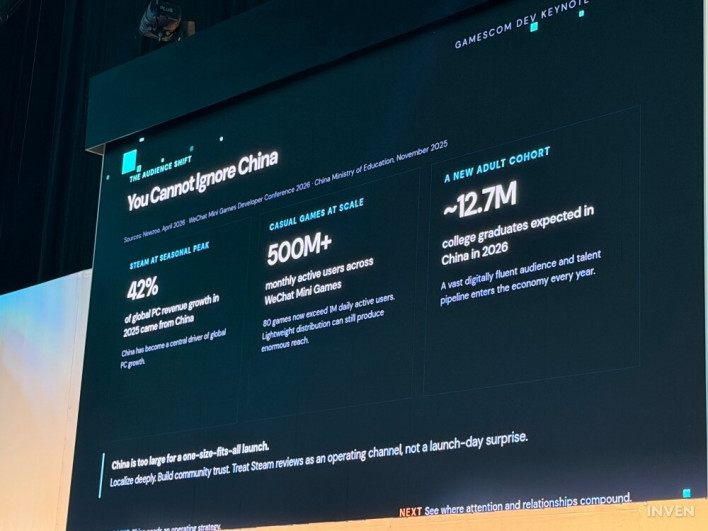
The Chinese market was addressed as a separate topic. China accounted for 42% of PC revenue growth, and WeChat casual games reach 500 million monthly active users (MAU). During Lunar New Year periods, there were years when more than half of Steam's global MAUs came from China. He added that with the rise in university enrollment, the PC-owning population expands by more than 10 million people every year. Satvat framed this as both an opportunity and a global competitive pressure.
He expressed caution regarding UGC platforms. While encouraging people to directly experience ecosystems like Roblox and Fortnite's creation tool UEFN, he maintained distance from a full pivot toward them, pointing out that revenue distribution is heavily concentrated among a small minority. Regarding consoles, he cited upward pressure on memory component costs and diagnosed that the revenue model is increasingly leaning on existing user engagement rather than new user acquisition.
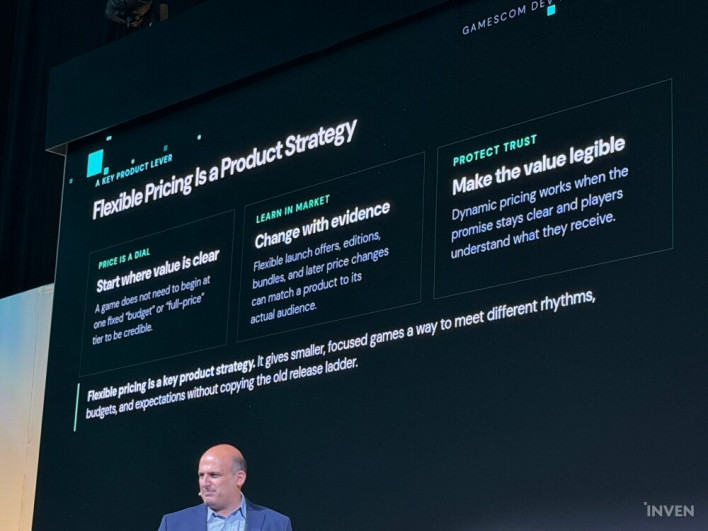
He called for greater flexibility in pricing strategies. He cited an example on Steam where the newest entry in a franchise was priced at $70, the previous entry at $30, and the game from two generations prior at $10—yet concurrent players were ranked in exact reverse order. The point was that as players accumulate larger backlogs of unplayed games, adhering to a rigid, single-tier pricing structure becomes difficult to maintain.
8 Recommendations: From Fair Treatment to Team Continuity
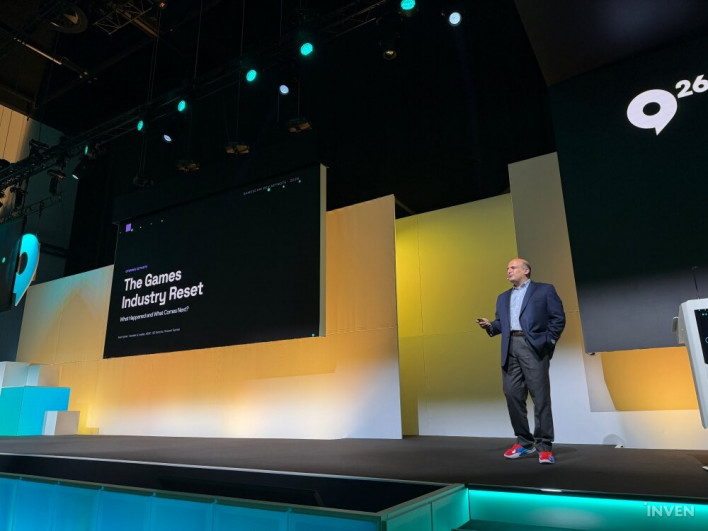
The second half of the keynote outlined eight actionable recommendations. Prefacing the list, Satvat stated, "The benchmark is not what seems possible today, but where we need to get to."
The first recommendation is improving fair treatment for game workers. As supporting evidence, data was cited from the GDC State of the Game Industry 2025 report, UK games trade body Ukie's employee wellbeing report 2025, and the mental health charity Safe In Our World.
There are three detailed action points: honestly plan workloads, disclose expectations, and prevent retaliation to establish channels for raising issues before pressure turns into harm; proactively provide clear notice, reference letters, transition support, and opportunities for redeployment or retraining when positions move or end; and support protected learning time, access to training courses, mentorship, and transferable skill credentials during employment rather than post-layoff.
He shared community reports of offboarding processes consisting merely of a phone call with an anonymous representative after notice, followed by returning equipment. He also presented an estimate showing that since tracking began in 2022, the combined industry experience lost from workers permanently leaving gaming totals 120,000 years.
Regarding continuous learning and support, he emphasized, "Support should not be a crisis response, but a constant presence." This involves offering short, job-relevant courses throughout one's career, and connecting coaching, mental health support, portfolio feedback, peer mentorship, and introductions to other industries so workers can access them at any point before or after a career transition. The proposal also included voluntarily sharing aggregate data on skills demand, training outcomes, and career pathways without colluding on prices, hiring, or market access.
Satvat stressed that instead of selling job titles, programs should teach production, engineering, data, business, and communication skills that carry weight both inside and outside games; require students to complete a playable artifact or project report every semester; and place industry practices like team production, source control, scoping, playtesting, budgeting, and post-mortems at the heart of the curriculum.
Another item called for publishing 12-month employment rates, entry rates into adjacent industries, and student debt levels instead of enrollment numbers so that students can compare institutions. Satvat stated, "When hiring odds are in the single digits, the responsible answer is not better marketing, but changing what we teach and what we disclose." As supporting evidence, he noted that over 60% of the 5,000-plus individuals placed through ASGC moved into non-gaming roles this year.
The fourth recommendation is smaller teams and disciplined budgets. He noted that market segmentation data usually yields the conclusion to "target 10 to 15 promising areas," but he interprets it in reverse. It is more realistic, he argued, to return to a structure where selling 400,000 to 1 million units targeting a specific niche is recognized as a success.
A realignment of relations between investors and studios was also called for. Specific items included establishing product goals, budgets, milestones, and runway together before funding deployment while rejecting plans reliant on implicit growth assumptions; encouraging studios to surface risks early while investors prevent scope, schedule, and strategy shifts from snowballing into crises; and securing time and capital for iterative learning rather than optimizing for a single launch. Satvat directed these demands more toward studios than investors, urging developers to share contract terms and negotiation experiences among themselves to weed out disadvantageous terms.
The sixth recommendation is building transferable careers. Show finished output rather than ambition; add at least one complementary skill in data, software, or business; build relationships before needing a job; and keep multiple pathways open. The slide summarized this as: "Do not let your identity depend on a single title, a single city, or a single company."
The seventh recommendation is where to invest next. Listed areas included massive participatory ecosystems and UGC, short and focused AA titles and indies, talent pools in APAC, Eastern Europe, and Latin America, social/community discovery via Discord and streaming, and tools and external development support. On distribution, figures were presented showing that H1 2026 Steam releases rose 19% year-over-year, while premium revenue declined 5% to $5 billion. Stating that "a distribution plan beyond a single Steam page is needed," he summarized the common thread as "smaller bets and faster learning."
Lastly is team continuity. The rationale is that teams learn how to make decisions together, carry accumulated knowledge from each release into the next, and share history that enables them to take bigger creative risks under pressure. Citing Elden Ring and Baldur's Gate 3 as examples, Satvat noted that breakthroughs happen when teams reach their third, fourth, or fifth title.
Two Futures to Avoid
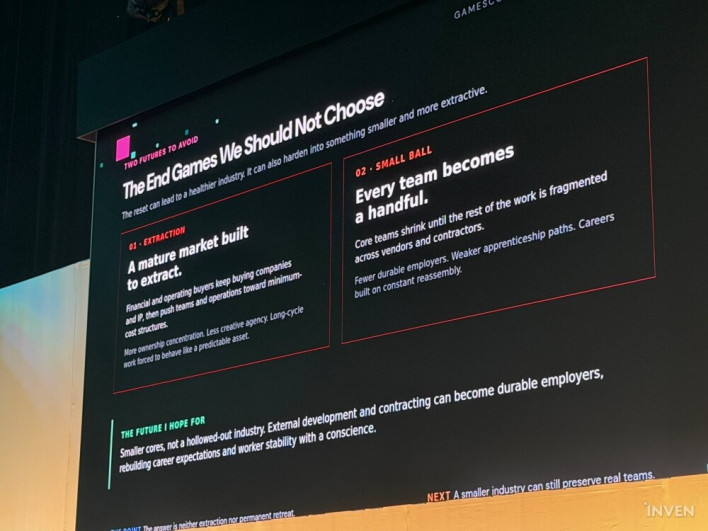
The two scenarios highlighted in the talk were "Extraction" and "Small Ball." The former scenario describes a path where financial and strategic acquirers buy up companies and intellectual properties in mature markets, pushing them into minimum-cost structures, concentrating ownership, and treating long-cycle development as predictable assets. The latter scenario represents a path where core teams shrink continuously while remaining work is fragmented among vendors and contractors, resulting in the simultaneous loss of stable employers and apprenticeship growth pathways.
The alternative presented was "a small core rather than a hollowed-out industry"—a direction where external development and contract work serve as stable employers, rebuilding career expectations and labor stability. On his concluding slide, Satvat laid out all eight recommendations on one screen and declared, "Don't wait for one or two magic solutions; choose where you can make a move and get to work."
The final anecdote touched on the early 1990s. He recalled a company newsletter memory of Sierra On-Line co-founder Ken Williams holding a celebration for King's Quest V selling 400,000 to 500,000 copies and planning a move to a new headquarters. The intention was to reconsider today's benchmarks for success, where games can sell millions of copies and still be branded as failures. Satvat concluded, "We are never going back to normal. We are evolving into something else, and what that is has not yet been decided."