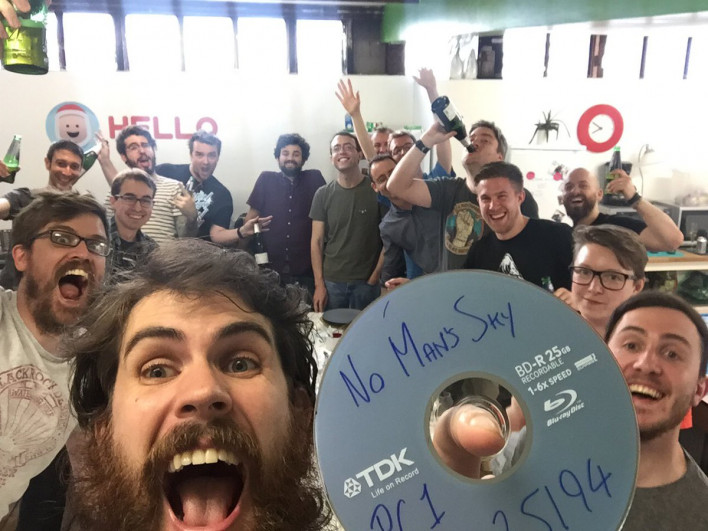
Do you remember the photo of people cheering with a disc in their hands, wearing innocent, joyful expressions? It is the 'Gone Gold' photo for No Man's Sky, a game that transformed its reputation from a failed project into a masterpiece.
"Gone Gold"—this short phrase is one that any console gaming fan has likely encountered at least once. This process, known as going gold, signifies that a game's development is fully complete and the final version is ready to be pressed onto discs.
It is becoming increasingly likely that physical discs will disappear from consoles starting in 2028. Sony has already signaled this shift through official statements, and industry rumors suggest that Microsoft is also considering omitting a disc drive for its next console, Project Helix.
The disappearance of the disc also means the end of the physical 'Gone Gold' moment. While teams might still take group photos to celebrate, the traditional image of developers holding a package or cheering while clutching a disc will become a thing of the past.
The loss of the physical 'Gone Gold' milestone affects more than just production; it signifies a redefinition of the 'weight' and 'responsibility' inherent in game development. It is true that without the pressure of producing a physical product, the burden on companies and developers is reduced. In the past, once a disc was manufactured and distributed, there was no turning back. While 'day-one patches' can now address issues found in disc versions, developers previously strove to ensure the disc contained a complete, polished game.
The existence of a disc—which cannot be altered once it enters production—undeniably instilled a sense of caution and duty in developers. While no company or developer would likely admit to it, the absence of a physical 'Gone Gold' milestone could embolden some to release unfinished products. Unlike a disc, which demands perfection, digital formats can be updated at any time, potentially strengthening the trend of 'release first, fix later.
In a way, the physical 'Gone Gold' moment may have been the final, tangible sense of responsibility imposed upon companies and developers. We have yet to see what trends and outcomes this shift toward a fully digital landscape will bring to game development, but one thing is certain: in the traditional sense, 'Gone Gold' has disappeared from the industry.

Sort by:
Comments :0