At the time of Civilization VII's launch, the biggest talking point was the civilization transition system. The idea that a player would change their civilization across three eras—Antiquity, Exploration, and Modern—was an unprecedented attempt in the series. It was a change driven by specific goals and reasoning. However, the reception to this massive shift was not entirely positive. Now, a year later, FIRAXIS has reached out to players who longed for the traditional experience without rolling back the experiment itself.
This is the 'Test of Time' update. It has completely overhauled the 'Legacy Paths,' which were criticized for standardizing gameplay, and introduced the 'Societies That Withstood the Test of Time,' allowing players to play through all three eras with a single civilization. Changes to the victory system and the introduction of 'Great Successes' have also enabled more flexible gameplay. Where did this massive overhaul begin?
Supporting Both Civilization Transitions and Single-Civilization Runs
Although 'Test of Time' is a free update, it brings the most significant changes since the game's launch. It originated from the 'FIRAXIS Feature Workshop,' a community program where developers test features and gather feedback. Through this, fundamental changes to the feel and playstyle of Civilization VII were decided, with the goal of providing the ultimate civilization experience.
The first change is the 'Societies That Withstood the Test of Time.' Instead of changing, the player's civilization now continues into the next era, experiencing the passage of time while remaining the same. When playing through eras with a single civilization, players can use the new 'Syncretism' mechanism to adopt unique units or infrastructure from other civilizations currently in their peak era to create new builds. Conversely, it is also possible to maximize one's own civilization's unique strengths through 'Accommodation.'
These changes provide continuity to the experience of playing with a single civilization within the existing era-transition system. Naturally, since the era system remains, changing civilizations as before is still possible. As Civilization VII was built around the core of era transitions and the civilization-switching system, the question naturally arises: can sticking to one civilization actually be a competitive choice.
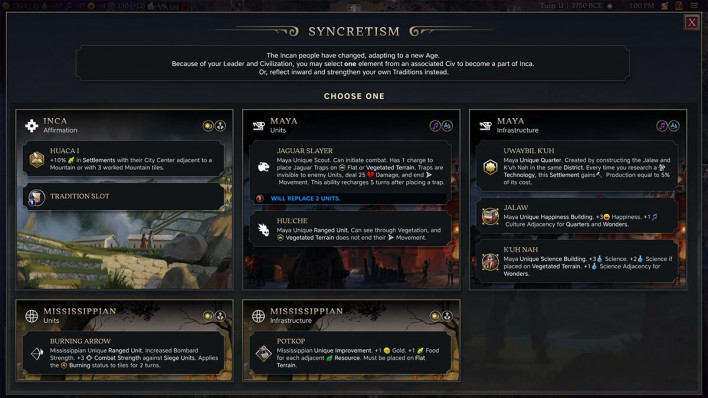
Regarding this, the developers acknowledged that civilizations in their peak state are somewhat powerful, but emphasized the advantage of maintaining a consistent experience and focus by sticking with one civilization. The addition of the aforementioned Syncretism and Accommodation systems also serves to compensate for the weaknesses of a single civilization during periods outside its peak. The developers believe that through numerous tests in the FIRAXIS Feature Workshop, they have created a balanced and enjoyable experience. They specifically noted that their goal was not perfect symmetry in every aspect of gameplay, but a balance where different approaches remain viable.
Great Successes: Making Infinite Possibilities Feel Real
The 'Great Success' system, which replaces the Legacy Paths, is considered the part of this update the developers put the most effort into. Many pointed out that the previous Legacy Paths lowered gameplay diversity by encouraging standardized play. The developers cited this as a reason for the overhaul, noting that some players did not feel enough 'infinite possibilities' or motivation to replay the game under the old system.
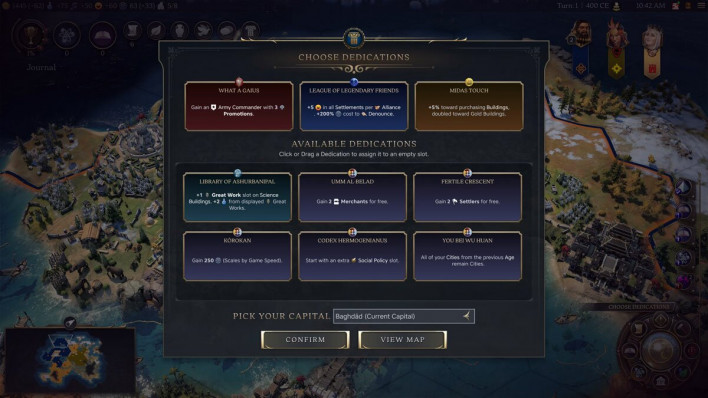
The design direction for the new system was to create an environment where players can think strategically according to their playstyle during the 100 turns of each era. Great Successes act as intermediate goals within each era, offering various choices linked to six attributes: Military, Culture, Science, Economy, Diplomacy, and Expansionism. Players can choose their own set of Great Successes, allowing for a different experience every time. In practice, the sense of achievement from the immediate Reward of lower-tier Great Successes is noticeably different.
Great Success sets will continue to be added in the future, and the game is open for the modding community to create their own new Great Successes.
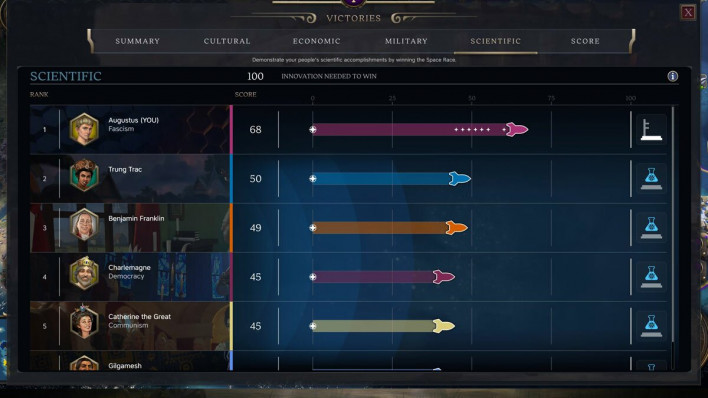
The overhaul of Legacy Paths—which defined game goals—and the change in gameplay direction naturally led to changes in the victory system. It is now a structure that rewards dominance across the entire game, where various player actions accumulate as points to determine victory or defeat. Games that previously required reaching the Modern era to win can now be concluded earlier.
While this is true in theory, it is rare in practice. The design intent is that players do not have to drag out a game that is already decided, such as when they have easily conquered a significant portion of the map on a lower difficulty or a small map. It is essentially a mechanism to end finished games faster. Of course, it also allows for a more intuitive experience by quantifying the player's efforts and experience more clearly.
Not Just a Regression, But an Expansion of the Series' Essence
Before launch, the developers proposed a 1:1:1 rule for balancing new elements, improvements, and maintaining tradition. A year later, the result has shifted toward the series' traditions, leading some to view this as a regression to the past.
The developers self-assessed that 'Test of Time' found an excellent balance between innovation and flexibility. By supporting both the civilization-switching method and the sandbox-style approach of sticking with one civilization to the end, any playstyle can find its own path. Players who enjoyed the innovative era system can continue as before, while a familiar path has been opened for those who want a more traditional civilization experience.
An interesting point is that the developers themselves admitted that their perspective on the 'essence of the series' has broadened. The civilization community has grown more than ever, and they had to expand the scope of what needed to be preserved to encompass the vast number of players with diverse playstyles.
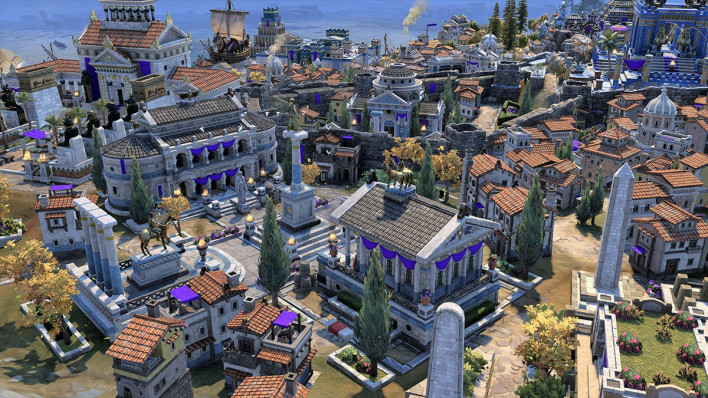
A civilization's identity is not completed by numbers alone. How well the music follows, and whether buildings and units look like they belong to that civilization, determine immersion. Civilization VII was originally structured to change civilizations midway, and the music and visuals were designed accordingly. With the ability to maintain one civilization now possible, these areas were also addressed.
The music has been changed to evolve gradually over time, with new instruments added. This ensures that even when playing in an era that is not a specific civilization's peak, the atmosphere of that era is naturally reflected. Given the deep musical history of the Civilization series, special attention was paid to this. On the visual side, additional building sets for each culture were created to ensure all cultures are appropriately represented, providing architectural styles befitting each civilization.
An Expansion-Level Free Update, With More Support to Come
FIRAXIS stated that they have personally experienced how crucial continuous post-launch support is to a game's success through Civilization V and Civilization VI. However, they also acknowledged that the areas requiring such support change as the series progresses. This means that sometimes, core mechanisms themselves need to be adjusted, as was the case here.
Accordingly, further support for Civilization VII is in the works. While specific details are not yet available, they promised to share more news soon. If 'Test of Time' is not the final form of Civilization VII but rather one step in the process, there seems to be plenty of reason to keep watching what else will emerge this year.