
Released in 2020, 'Coffee Talk' made a truly sensational debut. While it was difficult to call it an entirely new concept given the existence of the cyberpunk bartending game 'VA-11 Hall-A,' its well-crafted narrative featuring charming characters and the various details that bolstered the protagonist's presence as a café barista were enough to instantly elevate the obscure Indonesian developer Toge Productions into a studio worth watching.
Six years later, its sequel, 'Coffee Talk Tokyo', has arrived. While the 'Hibiscus & Butterfly' DLC exists, it is essentially an expansion of the original. This new title is a completely fresh entry, from its setting to its cast of characters.
Personally, I had been looking forward to this game immensely. In a visual novel, the story is what matters most, and the story of 'Coffee Talk' was incredibly compelling. The progression took the form of an omnibus where various characters' lives intertwined; while it unfolded in a somewhat static rather than dramatic way, the flow was never boring. The various problems of New Seattle, where all sorts of fantasy races coexist, felt like a form of social commentary because they were so deeply rooted in our own reality.
Having enjoyed that so much, it is only natural to wonder what the story of 'Tokyo' has in store.
Your story, my story, our story
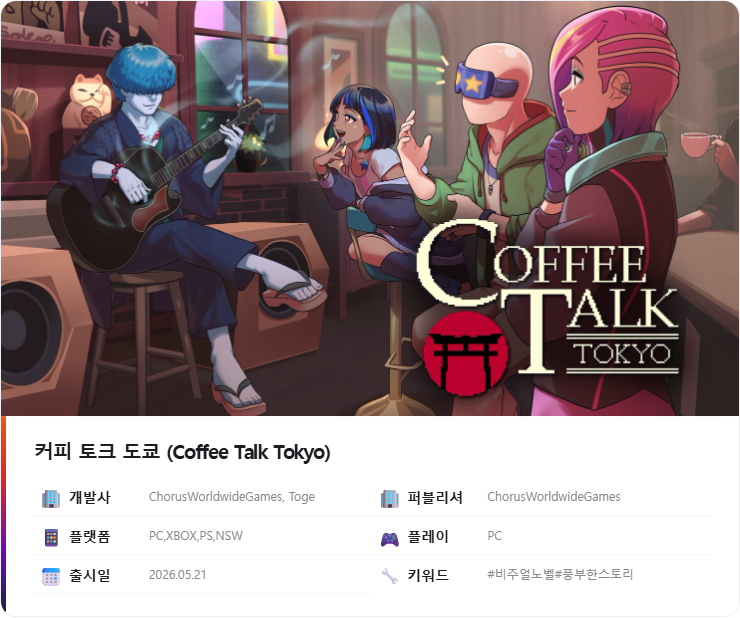
The barista protagonist in 'Coffee Talk Tokyo' is a different person from the one in the previous game. They share a similar vibe and philosophy on running the café, but they are entirely separate individuals. Through the words of Hendry—a character who appeared in the first game and serves as the first customer here—players realize that 'Coffee Talk Tokyo' is a new story taking place in a new space, distinct from the last.
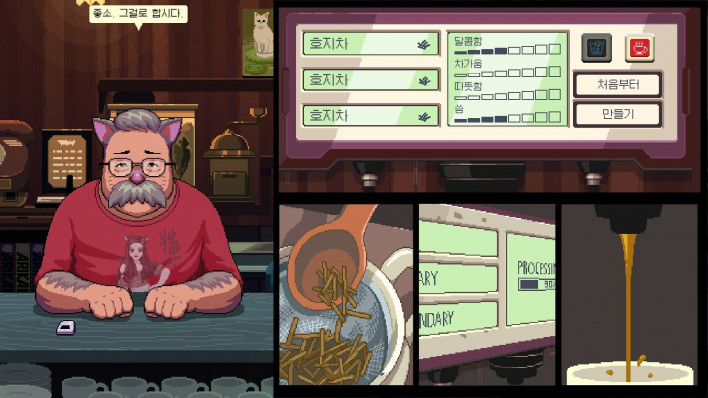
The game's system is not significantly different from its predecessor. Various customers visit a small late-night café in a corner of Tokyo, opening up about their inner thoughts amidst the calm, lo-fi music and tranquil atmosphere. The player's role is to listen to their stories and, occasionally, use their intuition to craft the right drink based on somewhat ambiguous orders.
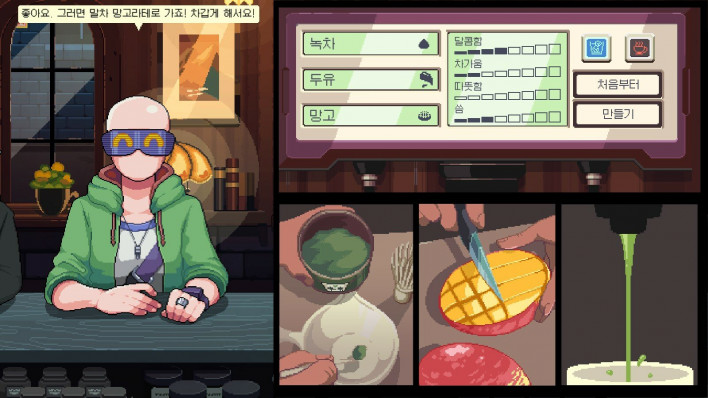
There are minor changes in some areas. Unlike the previous game, which only featured hot drinks, you can now make cold drinks, add whipped cream, or create ice cream floats. However, as before, the drink-making remains uncomplicated, and listening to the characters' stories after serving them remains the core of the game.
And, just as people are the same everywhere, this strange version of Tokyo also features characters with all sorts of worries. However, the 'texture' of the stories is slightly different.
The story of the original 'Coffee Talk' was heavily influenced by its 'world-building.' The main themes were the inevitable conflicts arising in a world turned upside down—Elves leaving the forest to start corporations, Dwarves working in heavy industry, and Orcs entering the IT sector—and the stories of those facing these changes.
The stories in this game are similar yet slightly different. Most of the narratives in 'Coffee Talk Tokyo' deal with 'me' as an individual and as a family member. It doesn't really matter what kind of city Tokyo is or what the state of the world is. We see a child who doesn't want to be a burden to their parents, parents who wish their child would rely on them more, a ghost who has lost their sense of self and ponders their existence, a male stay-at-home husband who isn't recognized by his family but is becoming a social trend, and a retired office worker watching their child struggle between parenting and a career gap. The stories in 'Coffee Talk Tokyo' are deeply grounded in reality and touch upon issues that any adult living today has likely pondered at least once.
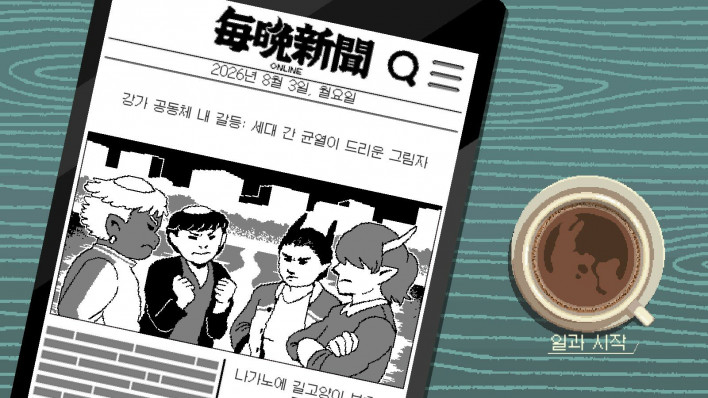
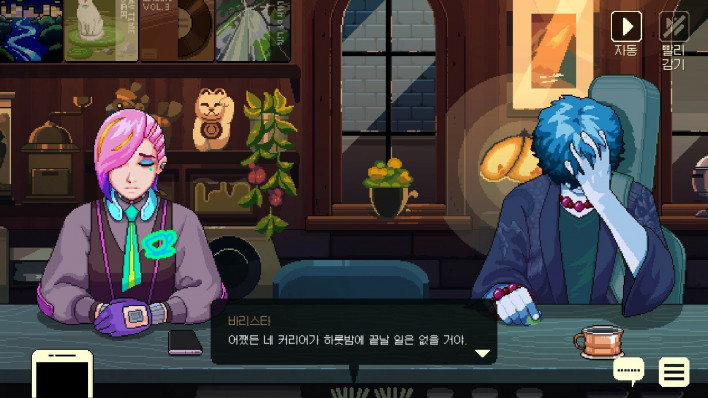
While the story of the original 'Coffee Talk' was very interesting and felt like a metaphor for reality, it wasn't something I could fully empathize with. It was more like the pleasure of watching details being added to an unimaginable world, much like the stories in the 'Dune' universe where spitting is considered a sign of respect. The 'realistic' stories in that world certainly added vitality, but they weren't my stories.
However, the stories in 'Coffee Talk Tokyo' reach much deeper into our actual lives. There's the 'me' who is a spouse considering having a second child while wanting to maintain a career; the 'me' who feels the ennui of a job held for over a decade and tries to deny it; and the problems between parents and children whom we love more than anyone, yet find it hardest to be honest with. There is even the gap between how others see me and how I see myself—a concept that brings to mind a line from author Lee Young-do: "I am not a singular."
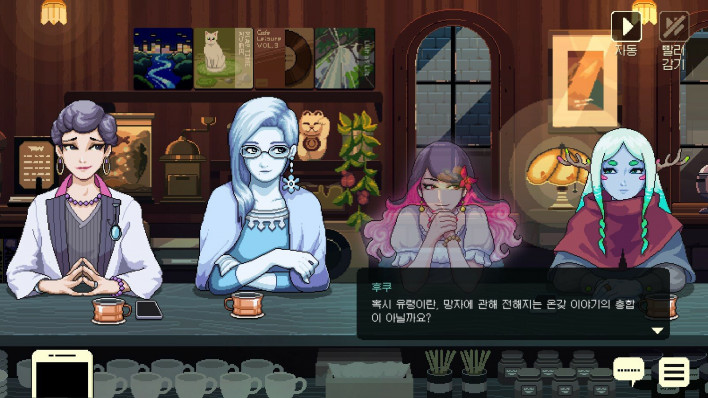
'Coffee Talk Tokyo' expresses the anxieties of modern life so explicitly that it might even feel exhausting at times. Of course, for someone like me—an ordinary office worker and head of a household juggling many of these same worries—it was also a deeply comforting story. Much like the sentiment often used for consolation, it made me realize, 'I guess I’m not the only one struggling.'
Making drinks is by no means easy
In the space where these stories unfold, the barista protagonist makes drinks and listens. They don't offer opinions rashly. Rather than asserting themselves as a speaker, the protagonist maintains the stance of a listener, watching as these characters realize and overcome their own troubles, sometimes alone and sometimes through conversation with others.
Of course, the protagonist has their own troubles, too. Making drinks is harder than it looks. Seriously.
The characters in 'Coffee Talk Tokyo' sometimes don't know exactly what drink they want. Occasionally, they will ask for something specific like 'cold hojicha' or 'a drink with coffee, ginger, and honey,' but at other times, they give vague orders like 'something spicy and sweet' or 'a caffeinated drink.'
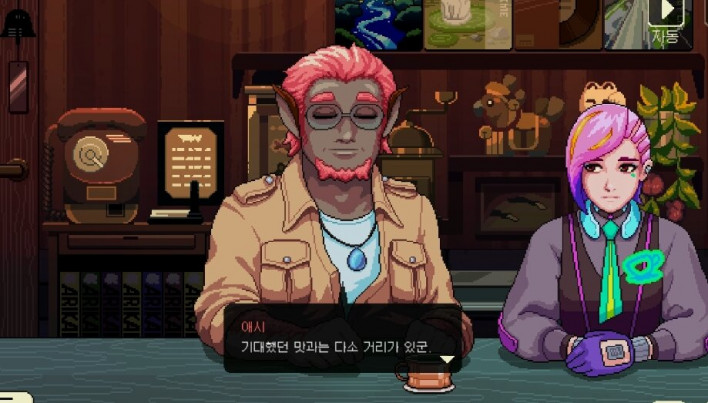
At these moments, the player must guess their feelings and desired drink to combine the right ingredients. You have a total of five attempts per day. It's great if you get the right drink within those five tries, but if you use them all up without success, you have no choice but to serve an unfinished drink. The customer's somewhat strange reaction is just a bonus.
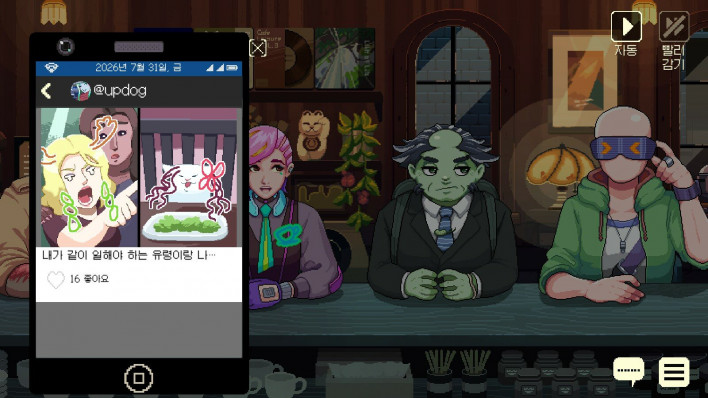
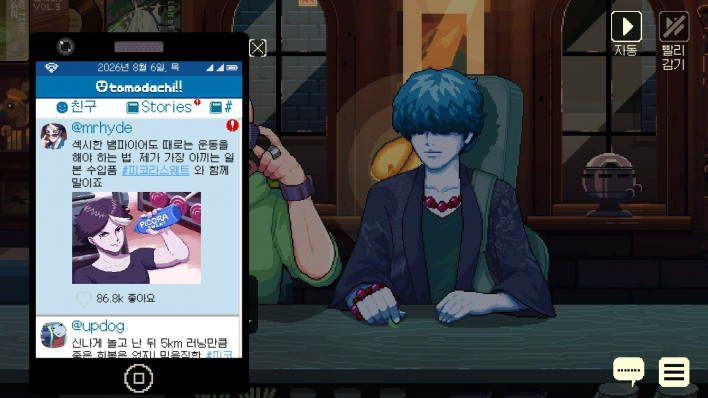
The system supporting this is 'Tomodachill,' the social media app used in the previous game. Its functionality has been significantly enhanced; you can not only peek at the characters' statuses but also follow their posts and hashtags to uncover more information, sometimes even finding recipes for new drinks. Of course, these recipes aren't always useful, and since the feed disappears after a day, you'll need to jot them down somewhere.
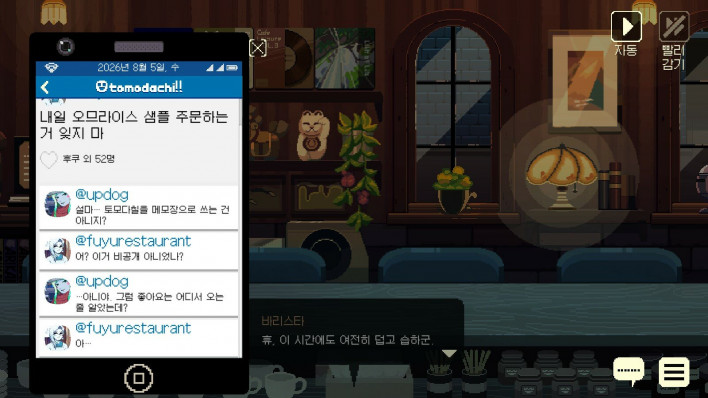
Since I haven't played through multiple times yet, I don't know how 'serving a failed drink' affects the ending, but for a player aiming for perfection, it is quite stressful. You could look up recipes on the internet, but that inevitably breaks the immersion.
However, if you accept this 'failure' as part of the narrative, it's not really a problem. Serving the wrong drink doesn't result in a game over. Conversely, one could consider it a somewhat challenging form of content. While I felt disappointed when I failed to make the right drink, I never once thought, 'What kind of game is this.'

The 'handing over items' feature, which existed without much purpose, has been removed. Thanks to this, players can focus more on the core of Coffee Talk: making drinks and listening to the characters' stories.
The late-night café is still thriving
'Coffee Talk Tokyo' is that kind of game. For players who have experienced the original, the design will feel familiar. While the art style has changed slightly, it's a detail most players will likely overlook without issue, and everything else is no different from the Coffee Talk we know and love.
However, there is room for debate regarding character design. 'Vein,' the character who talks to the protagonist the most—much like 'Freya' in the previous game—is the protagonist's assistant. They are a character who replaced all four limbs with prosthetics due to an accident, and with pink hair, cyan blue eyeshadow, and a non-binary gender identity, they come with a set of traits that can be quite polarizing. While these settings don't significantly impact the game, they are a point of contention among players.
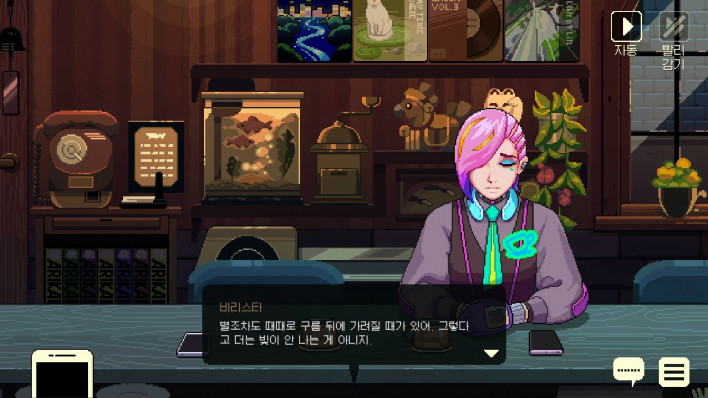
Another hurdle is the 'translation.' Actually, the Korean localization of Coffee Talk Tokyo is quite excellent; it handles everything from wordplay and poetic expressions to the use of various memes in great detail. However, at the same time, there are instances where personal pronouns are confused, informal and formal speech are mixed, or parts are left untranslated, making it confusing whether the localization is good or not. There are no mistranslations that cause major issues, but these are unfortunate lapses that can break immersion when noticed.
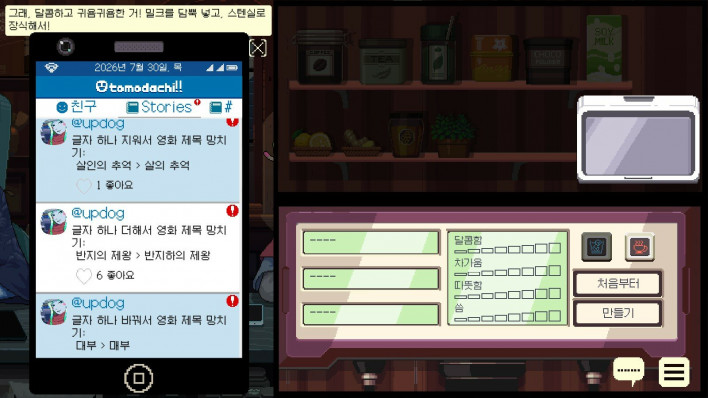
Nevertheless, the game is solid. 'Coffee Talk Tokyo' is very similar to its predecessor, and while it is indeed a similar experience, it contains a different, highly polished story. This fact—that 'the story changes'—is the greatest value a sequel can have. After all, the original game was not one that aimed for a uniquely superior game design or an unrivaled visual revolution; it was a game built on the combination of an interesting story and a cozy atmosphere.
Therefore, 'Coffee Talk Tokyo' is well worth investing a day into. Some will see themselves in the stories, and others will see someone close to them. Your story, my story, and our story, unfolded over a cup of coffee. Just for the fact that it maintains that essence, this game is worth playing.

- A story as rich as the original
- Narrative structure grounded in reality
- Enhanced social media features that add detail
- Character designs that may be polarizing
- Somewhat disappointing translation quality
- Too similar to the previous game
Review Platform: PC (Launch Build)