Unlike the legendary status the 007 franchise has established in the film industry, it has rarely seen any notable success in the gaming industry. Aside from the peerless masterpiece '007 GoldenEye,' which few even remember today, it is fair to say that there have been almost no successful 007 games.
Because of this, public sentiment was not particularly optimistic when IO Interactive announced it would take on a new 007 project. Given that every 007 game released so far has underperformed, skepticism about whether a game featuring an unknown 'young' Bond could succeed was, if anything, justified.
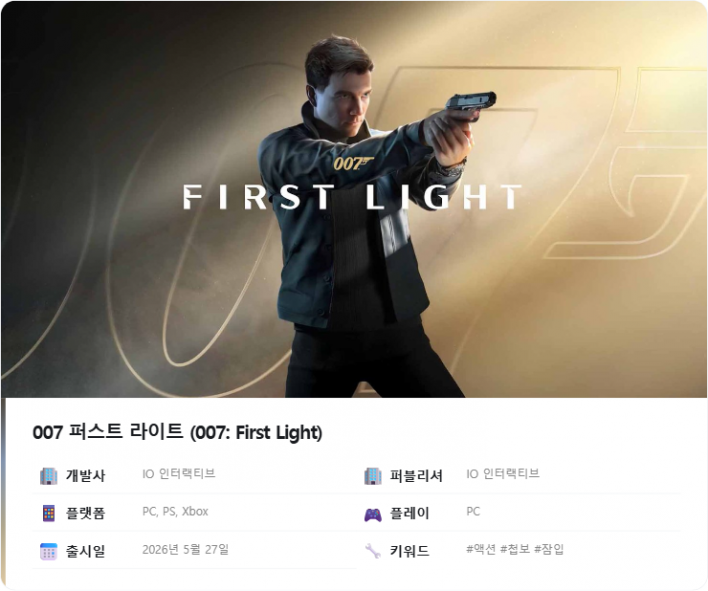
However, despite everyone's concerns, '007: First Light' is set for release on May 27, and I was able to get an early look through a pre-release review. And now, I am certain: this game truly holds the 'first light' of a 007 game that fans have been waiting for.
⚠️ In accordance with spoiler management policies, major story details have been excluded from this review.
The Story of a 26 - Year - Old Young 'James Bond'
While the 007 series has a history so long it recently celebrated its 60th anniversary, few people actually know about James Bond's younger days. In the films, we have always encountered the 'fully formed Bond'—the man in the impeccable suit, holding a martini shaken, not stirred, melting hearts with a suave smile.
In announcing the revival of 'Game 007,' IO Interactive has cast a 26-year-old James Bond as the protagonist. This does not mean the game is set 60 or 70 years in the past; it is set firmly in the modern day, aiming for a 'reboot' by introducing a younger version of the character.

As revealed in previous previews, the young Bond, not yet thirty, was serving in the British Royal Navy. While supporting an SAS operation in Iceland, his unit was ambushed by an unknown force. With all his comrades killed and he the sole survivor, he receives a secret transmission from MI6.

'007: First Light' focuses on how this young James Bond meets MI6 and the process he undergoes to finally grow into a '00' agent—and how he eventually earns the codename 007.
Without spoiling the story, in this game's universe, the '00' agent system has become a relic of the past. Instead of investing in human resources, MI6 has been conducting espionage using 'THEIA,' a quantum computer AI created by a fictional company called Webb Industries. M, the agency head, seeks to revive the '00' project, emphasizing the importance of the 'human touch' in intelligence work.
According to THEIA's predictions, the probability of the lone survivor Bond completing his mission in Iceland was less than 1%. Yet, Bond defied these odds and successfully completed the mission, which served as a reminder to M of the importance of human assets. Bond is then sent to Malta, where trainee agents are undergoing their drills, and he begins his journey to become a spy alongside them.

What was truly impressive was how much weight this 'training process' carries in the game. While most games would relegate this to a simple tutorial, '007: First Light' takes a different approach. It weaves a tight narrative, covering the jealousy of trainees toward Bond, who joins via parachute six months into the program, the bonds formed through grueling training, and the final group mission.
This process is, in a sense, similar to the opening of the film 'Kingsman.' Just as Eggsy, a London street kid, became a Kingsman candidate and recklessly passed various tests, the young Bond never performs a mission exactly as instructed. James Bond, played by newcomer Patrick Gibson, is rough, bold, and occasionally witty, leaving a strong impression of a 'young Bond' on the player.
A Narrative Like the '007 Movies' We Expect


Even after completing the training and entering the field following many twists and turns, '007 First Light' maintains the cinematic pacing one expects from a '007' film right to the very end. It is a markedly different approach from the narrative style of the long-standing 'Hitman' assassination simulator series that IO Interactive has built over the years.
This is the most distinct feature compared to the Hitman series. From the song and visuals of the opening sequence, the game is drenched in 007 flavor, and the cutscenes and dialogue interspersed between espionage and action stages are all top-tier. The hidden masterminds behind a single incident surface one by one as the narrative progresses, and there is even a surprising twist in the middle—just as we have experienced in the 007 films.

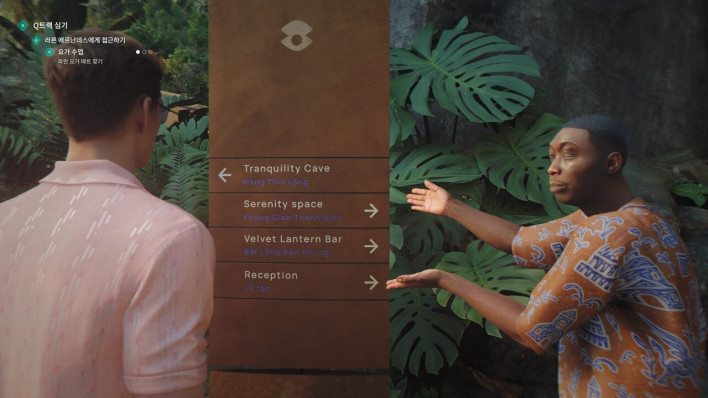
The character portrayals and dialogue are also meticulously crafted to evoke the '007 movie' experience. The game is very dialogue-heavy. The young Bond never stops his witty banter, and Moneypenny's weary reactions are just like the films. There is also Greenway, the instructor who disapproves of the hot-headed and reckless Bond; M, the thorough professional who stops at nothing for the sake of British intelligence and the Crown; and Q, who always introduces new gadgets with a smile. These cutscenes, capturing the characters 007 fans have longed for, are so precious that I couldn't bring myself to press the skip button (though the option exists)


The portrayal of the charming female characters is also impressive. The mysterious helper 'Isola,' who appears whenever Bond is in a crisis, maintains her enigmatic nature until the end, and the captivating presence of avian scientist 'Teresa Lorca,' whom Bond protects in the middle of the game, left me wishing she had more screen time.
Having played the game for this review, it was not difficult to recognize that '007: First Light' aims to be a 14- to 15-hour '007 movie.' Almost every scene, moment, and character trope we have encountered in the 007 films we grew up watching is packed into this game.


Espionage Action Completed with 'Hitman' DNA

In terms of gameplay, '007: First Light' can be called "espionage action completed with Hitman DNA." Bond is not Agent 47. You cannot indiscriminately slaughter everyone with a silenced pistol, nor can you move to the next stage just by killing the target.
The overall structure of the game can be summarized as: story cutscene - espionage phase - action phase - story progression. While some sections deviate from this, most maintain this structure. In the espionage phase, the player is dropped into a fairly large field and tasked with completing specific missions based on gathered information.
For example, if you are tasked with infiltrating a building's security, Bond (the player) will eavesdrop on conversations between various characters to find hints on how to approach. Sometimes the hint might be a document on a wall, or you might need to use physical force. In short, there are countless ways to approach a single goal, and the player can decide their route based on their playstyle and the challenges they wish to complete.

In this process, the gadgets received from Q are excellent helpers. The Q-Lens allows you to highlight and check the locations of nearby enemies or interactable objects, while gadgets like the Q-Watch, Dart Phone, or laser can create advantageous openings to reach targets. Want to pickpocket a keycard from a civilian but there are too many eyes? Use the Dart Phone to stun them and swipe it. Think there's a security facility behind this door but it's chained? Just fire the laser to destroy the lock.
Furthermore, Bond has a unique resource called 'Instinct.' Accumulated by finding clues or performing mission-related actions during espionage, this resource can be used in three ways: 'Lure,' which creates an opening to neutralize a guard from behind cover; 'Bluff,' which allows you to improvise your way out of a detected situation; and 'Focus,' which slows down time during shooting to assist with precision aiming. Instinct can be used in both espionage and combat, forcing players to decide how to allocate their resources.

Waving a gun around at an event with hundreds of civilians is not what a spy does. As such, combat sequences are usually placed differently from the espionage phases. The protagonist only gets the chance to use firearms when a 'license to kill' is granted, and it is easy to think of those moments as leading into combat sequences. The license to kill is only activated when an enemy intends to kill the protagonist and draws a weapon. This means you cannot simply pull out a gun just because you were spotted during an espionage mission.
The combat in '007: First Light' is quite intense. You cannot handle waves of enemies just by shooting from the same spot. Not only is your ammunition limited, but enemies constantly throw grenades at Bond's position. Players must periodically change positions and quickly pick up weapons dropped by enemies to compensate for the lack of ammo.
Here, too, the gadgets Q made play their part. If tools like the Dart Phone are specialized for espionage, tools like the 'Missile Pen' are specialized for combat. Choosing the right tools from the selection screen before a mission is one of the joys of '007: First Light.'



Driving sequences, which are indispensable in the 007 series, also appear frequently throughout the game. From the Slovakia mission, the first field mission after training, Bond even takes on the role of a driver. You will encounter chases driving various vehicles throughout the game, from regular cars to garbage trucks, quarry trucks, and boats.
Driving sequences generally proceed with a cinematic rhythm, giving the impression of a high-adrenaline car chase scene from a 007 film. While not every mission includes a driving segment, Bond taking the wheel at the right moments elevates the 'cinematic experience' the game pursues.
However, it is unfortunate that mission briefings can be vague, rendering the gadgets you brought along useless. Of course, it is in the young Bond's nature to never follow the plan, but it is frustrating when you bring combat tools expecting a difficult fight, only to find that stealth would have been easier. I don't know if it's the developers' way of letting players learn through trial and error in the first playthrough, but it remains a confusing aspect for a first-time player.
Countless Ways to Challenge Yourself That One Playthrough Can't Satisfy
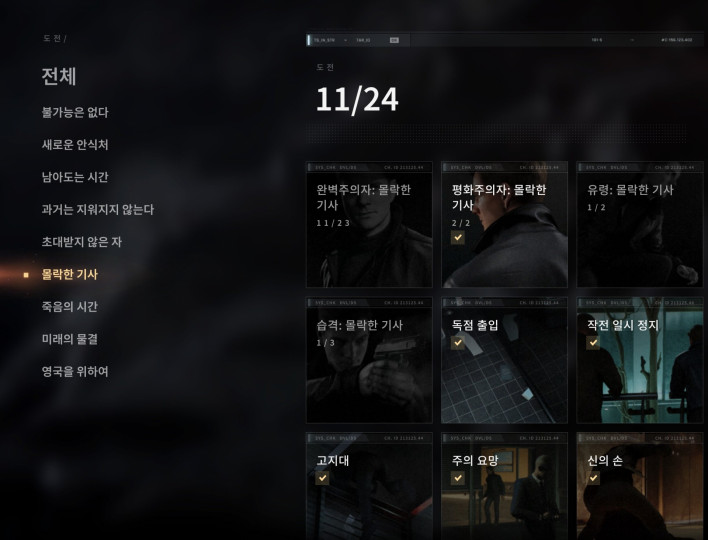
That's right. As expected of an IO Interactive game, '007: First Light' supports replayability. While it is not in the form of repeating missions by choosing targets and locations like in Hitman, each main mission has multiple objectives (challenges), making it essential to try several times to complete them all.
The missions are designed to use various 'approaches' available in that stage. It's like saying, 'If you went to the CCTV security room this way last time, try going this way next time.
Once all missions are completed, the player can earn cosmetic items for Bond to use in 'Tactical Simulation' (aka Tac-Sim). If you want to enjoy Tac-Sim wearing a dapper tuxedo, you have to complete all the main mission objectives anyway.
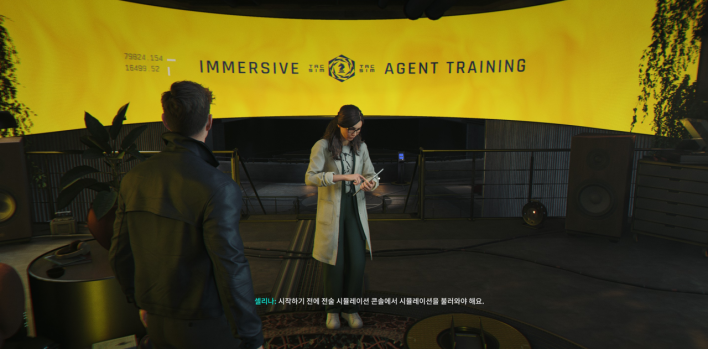

'Tac-Sim' is set as an agent training facility in Q-Lab and is a mode that can be accessed via the main menu, separate from the main story. It is closer to separate content that you can enjoy in earnest after clearing the main story. Missions that re-tackle previously played stages under more challenging conditions are composed of three difficulty levels, and there are also separate 'Operation' missions focused on exploration and adaptation.
Each mission has 7 to 10 objectives, and completing them grants experience points and a currency called 'Intel.' With the Intel earned, you can purchase new gadgets, weapons, costumes, and gadget skins, adding to the fun of customizing your own Bond.
Additionally, when a mission is cleared, a score is calculated based on time, action performance, and accuracy, which is registered on global and friend leaderboards. There is a high possibility you will repeat the same mission dozens of times to beat a friend's score.

The existence of 'Tac-Sim' and mission-specific objectives is very welcome, as it allows you to enjoy the espionage and action sequences of '007: First Light' without pressure. However, since the work is more focused on the progression of the main story itself, the replayability felt slightly lower.
The important thing is to experience the entire story as if watching a movie, and that Tac-Sim and mission-specific objectives are for players who still feel the lingering effects after the ending. And that composition wasn't bad at all.
Literally 'First Light,' a 'Game 007' that will serve as a signal flare for a revival

The most difficult part of reviewing a game where the narrative is important is 'spoiler prevention.' I have avoided mentioning content after the middle as much as possible so that the story's progression isn't spoiled, but looking at the praise I've listed, you can see how satisfied I was with the narrative of '007: First Light.'
Of course, this satisfaction doesn't just come from the story's perfection or personal preference. It is the satisfaction that it is at the level one would expect from a '007 movie' (something that hasn't been seen in a 007 game for over a decade). Bond's flashy banter, charming supporting characters, cute Moneypenny (important), unpredictable plot twists, and dopamine-filled action where everything sometimes comes crashing down—it is no exaggeration to say that '007: First Light' contains almost every scene a fan of the original would expect.
There are some disappointing aspects in terms of the game system. Since the preview video was released, there has been criticism on the internet that "the game looks too old-fashioned" or "the character facial expressions look strange." And some of those opinions are valid. However, once you actually play the game, those points will feel quite trivial.

It is true that the NPC facial expressions are awkward. However, the dazzlingly decorated spaces are filled with an uncountable number of NPCs. Not all of them are interactable, but thanks to them, the feeling that 'I am the only one in this crowd with a goal and conducting espionage' comes alive. Also, the facial expressions of the main characters are quite decent, so there was no problem empathizing with the cutscenes.
However, there is no denying that some boss fight gimmicks encountered during the game are overly repetitive. Almost every boss fight ends with hiding from the enemy and using the Q-Lens to attack them using surrounding objects. Well, considering that the only memorable boss fight(?) in the 007 films is 'Jaws,' one could say it generally carries on the movie's sensibility.

There is also a Korean translation issue. In most situations, there is no problem understanding the content, but in some scenes, shocking phrases appear that make you think, 'They translated it like this?' There are cases where 'tear' (in a photo) is translated as 'tear' (crying), and 'magazine' (for a gun) is translated as 'magazine' (periodical). Instances where characters switch between informal and formal speech are so common I couldn't even count them. It is truly a pity that after creating a great narrative, the immersion is broken by Korean translation issues.
If you can overlook these parts, '007: First Light' has enough potential to show the most 'unexpected' performance among this year's releases. I don't know how long it has been since I encountered such a high-quality 007 in the 'Game 007' market, which has been a wasteland since GoldenEye. Moreover, the young Bond played by Patrick Gibson showed a James Bond role so fitting that I personally look forward to a sequel to the 'Game 007' series.
Isn't even the subtitle perfect? Because it is a title sufficient to be the 'first light' since GoldenEye in the history of Game 007, which was as dark as it could be.

- A narrative that feels like watching a 007 movie
- Patrick Gibson's 'Young Bond' acting is excellent
- Cutscenes that have nothing to discard from opening to ending
- An immersive background completed with numerous NPCs
- Proper distribution of espionage phases and combat sequences
- Boss fights that are somewhat lackluster compared to the story progression
- Korean translation issues visible here and there
- Gadget balance where you only use what you always use
Review Platform: PC (Review Build)