This is the kind of title I have far too much to say about—along with all the anecdotes and gossip surrounding it—but the moment I sit down to begin a review, it becomes strangely difficult to decide what to start with. So let’s begin by laying out the facts, one by one.
Developer Pearl Abyss built itself on a single game, Black Desert, and Crimson Desert is the company’s first true flagship title to appear since then. There was Black Desert Mobile, and there were the as-yet uncertain projects DokeV and PLAN 8, but if we are talking about the game that plainly and unmistakably carries forward the lineage of Pearl Abyss’s development history, that game is Crimson Desert.
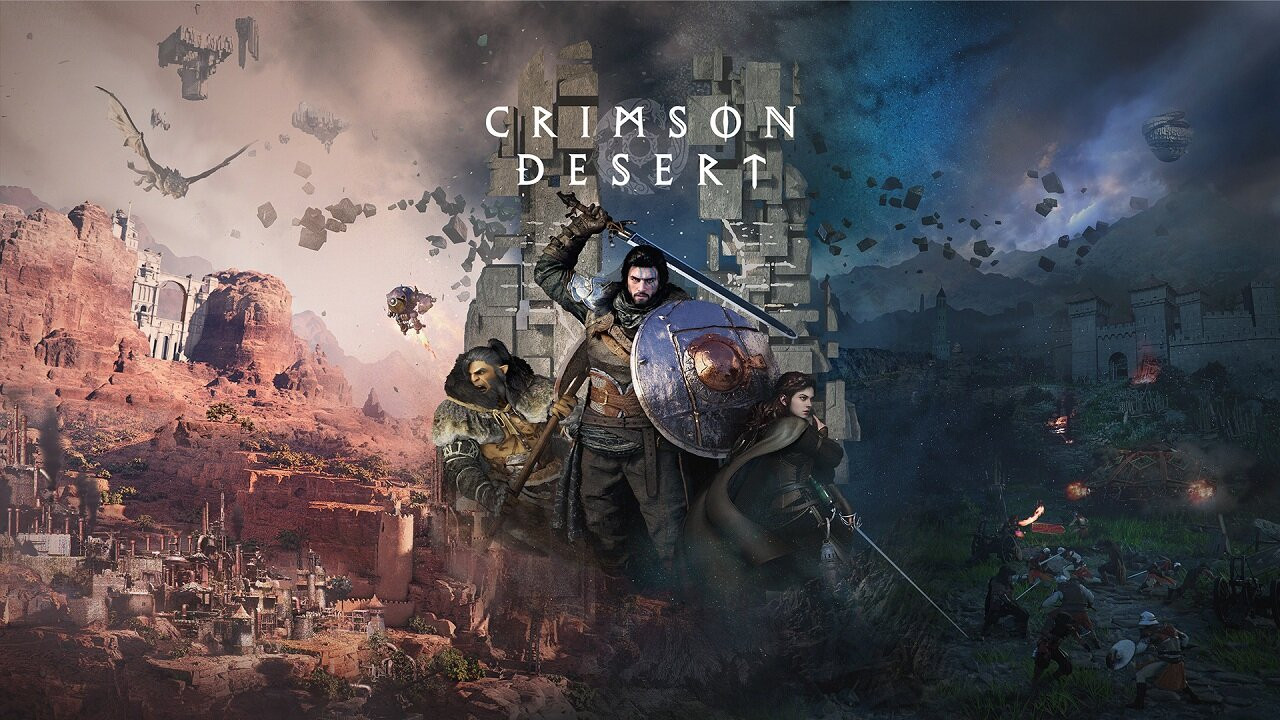
Pearl Abyss has described Crimson Desert as an action-adventure following Kliff, a member of the Greymanes, through the continent of Pywel—a game that would combine a vast open world with abundant content, intense action, and a wide variety of stories.
Those are the facts as publicly established.
And in today’s review, I want to go through, point by point, the things Pearl Abyss has not shown—or has not been willing to show—about what Crimson Desert actually feels like in play.
Editor's Note: The game was updated three times during the review period, and another update arrived even after I had already seen the ending. As a result, some aspects of this review may differ somewhat from the final retail version at launch. My total playtime was 75 hours, during which I cleared the main questline (ending) as well as a large number of side quests.
Open-world Scale and Sheer Volume of Content
In the pre-release footage for Crimson Desert, Pearl Abyss had already highlighted many facets of the beautifully realized continent of Pywel. From sprawling plains and snow-covered mountain ranges to plunging cliffs and crimson-stained deserts, from intricately carved coastlines to sunlight shimmering across the water, Pywel presents itself as an exceptionally beautiful place in its own right.
And in the game proper, that impression remains intact. Just as many open-world games deliberately employ overwhelming visuals to assert their presence to players, Crimson Desert’s continent of Pywel is built on a similarly imposing scale.
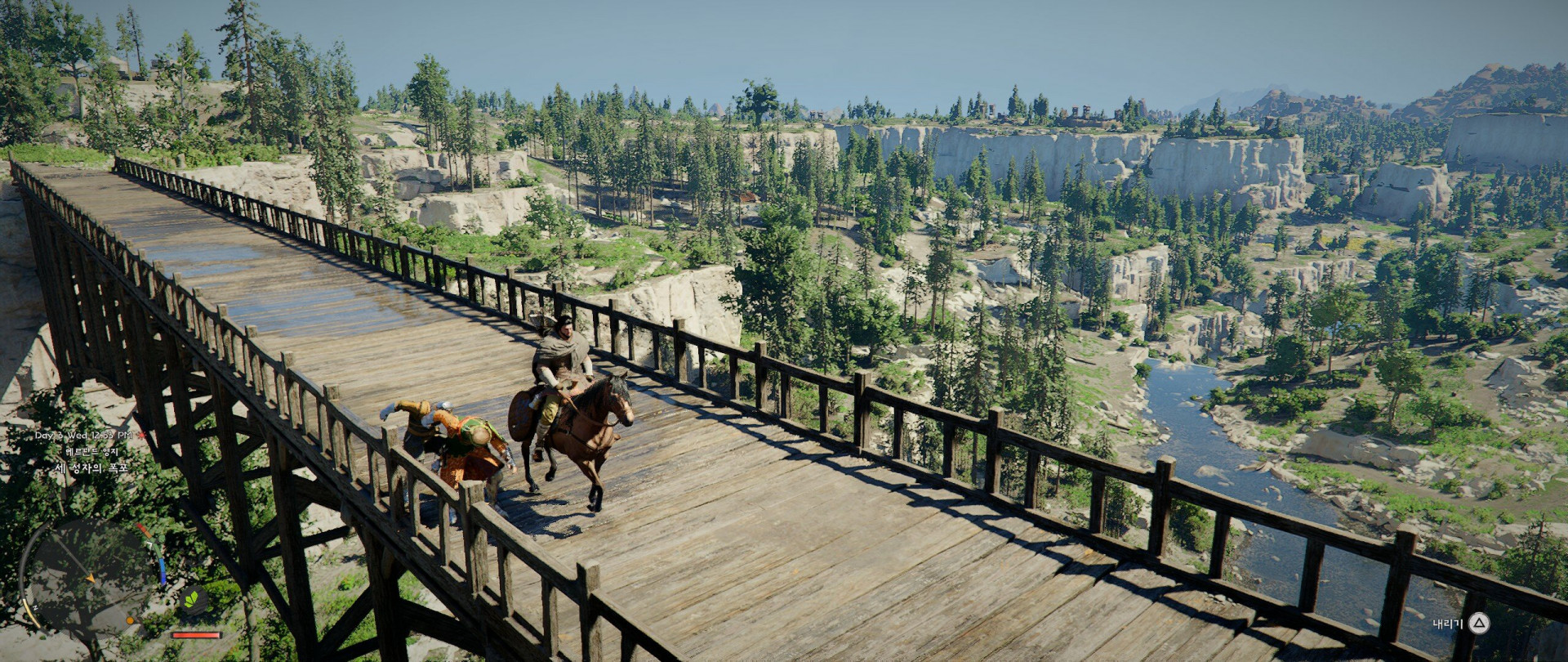
▲ The visual spectacle of the open world is emphasized from the very beginning
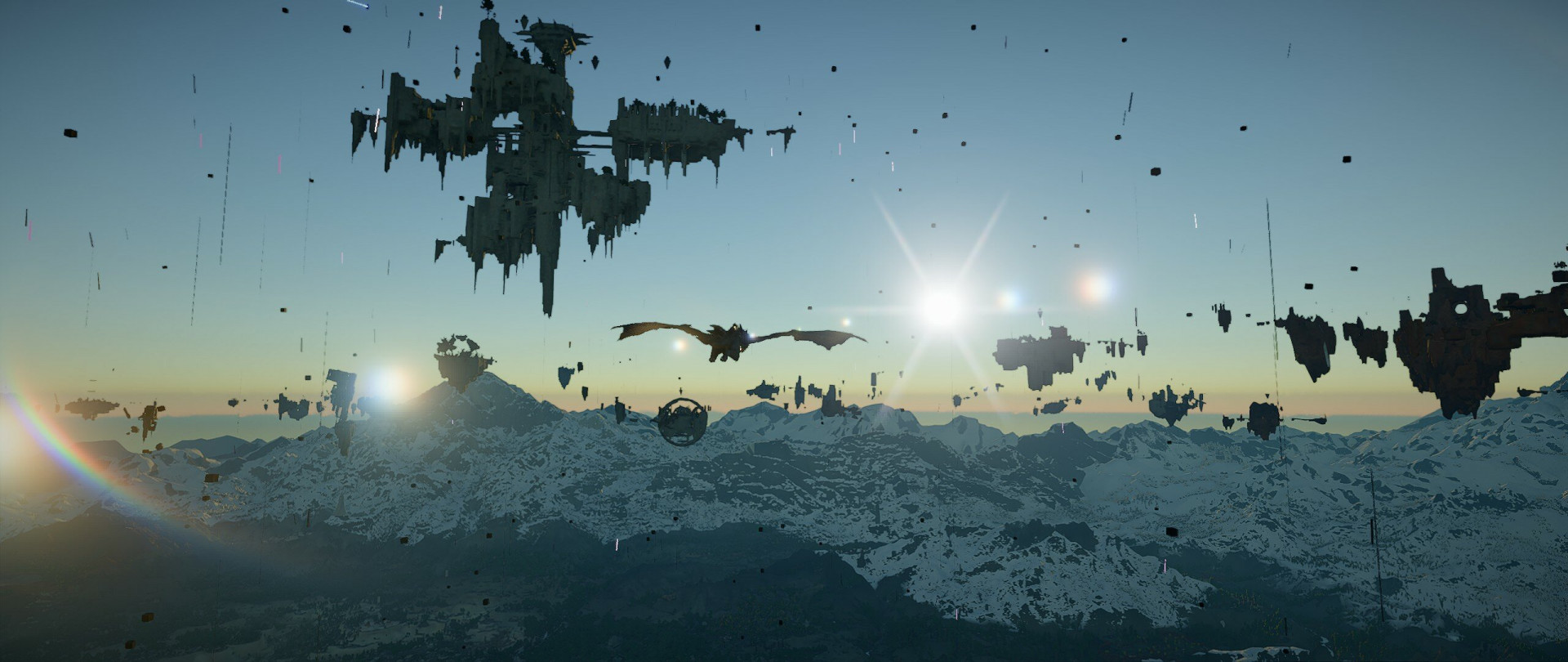
The continent of Pywel is complex. There are regions such as Ernand, Delicia, Deminis, Pailune, and the Crimson Desert itself, each with its own environment and cultural theme, and their sheer scale is vast enough to overwhelm the player. At the same time, the world of Crimson Desert is also immense in the vertical sense. As many videos have already shown, the skies above Pywel are filled with nearly 40 Abyss structures, suspended at dizzying heights.
Kliff’s journey meaningfully traverses all of these lands. Beginning in the standard medieval-European-inspired Ernand, then moving through the Nordic-flavored Pailune, the more orderly and distinctly European-feeling Deminis, the harsh Crimson Desert, and finally Delicia, where a machine civilization has flourished, he crosses every region—resolving local conflicts and liberating areas oppressed by bandits and hostile forces.
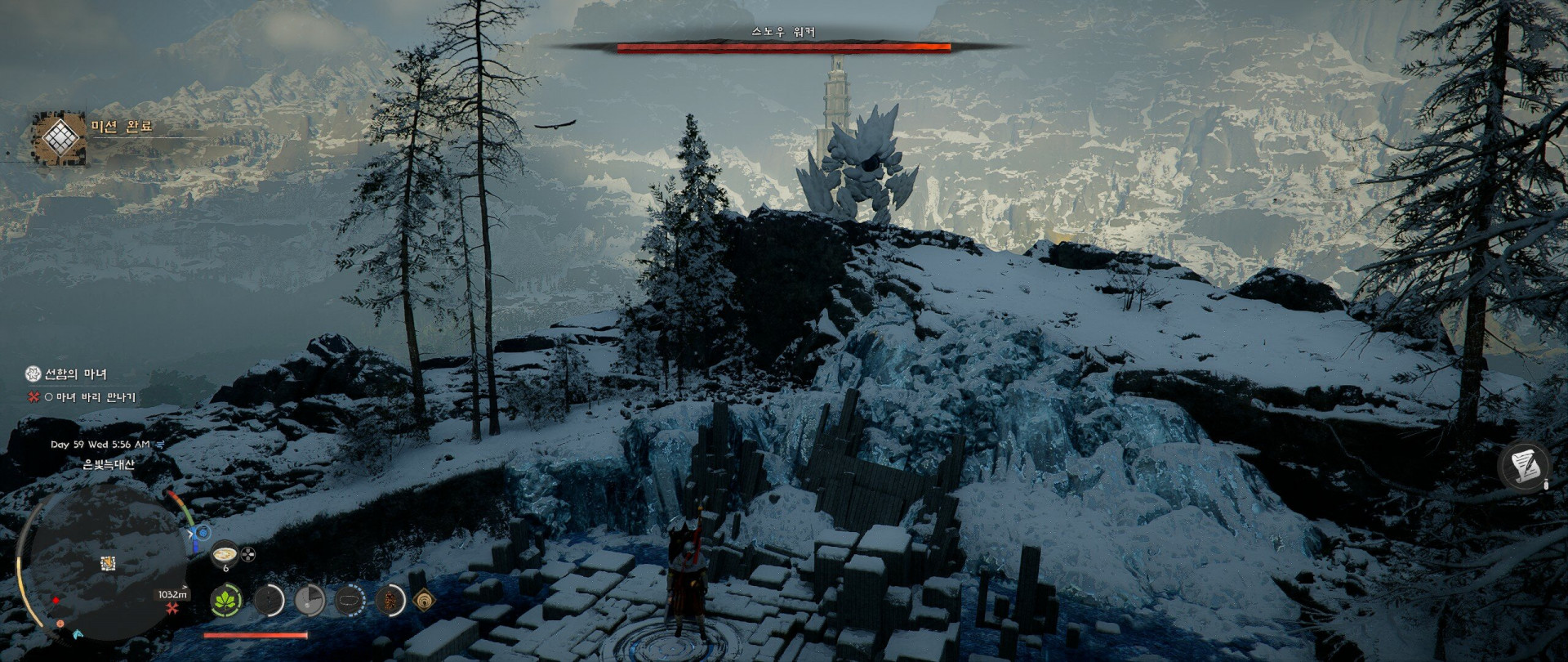
▲ Amid snow-covered mountains, too
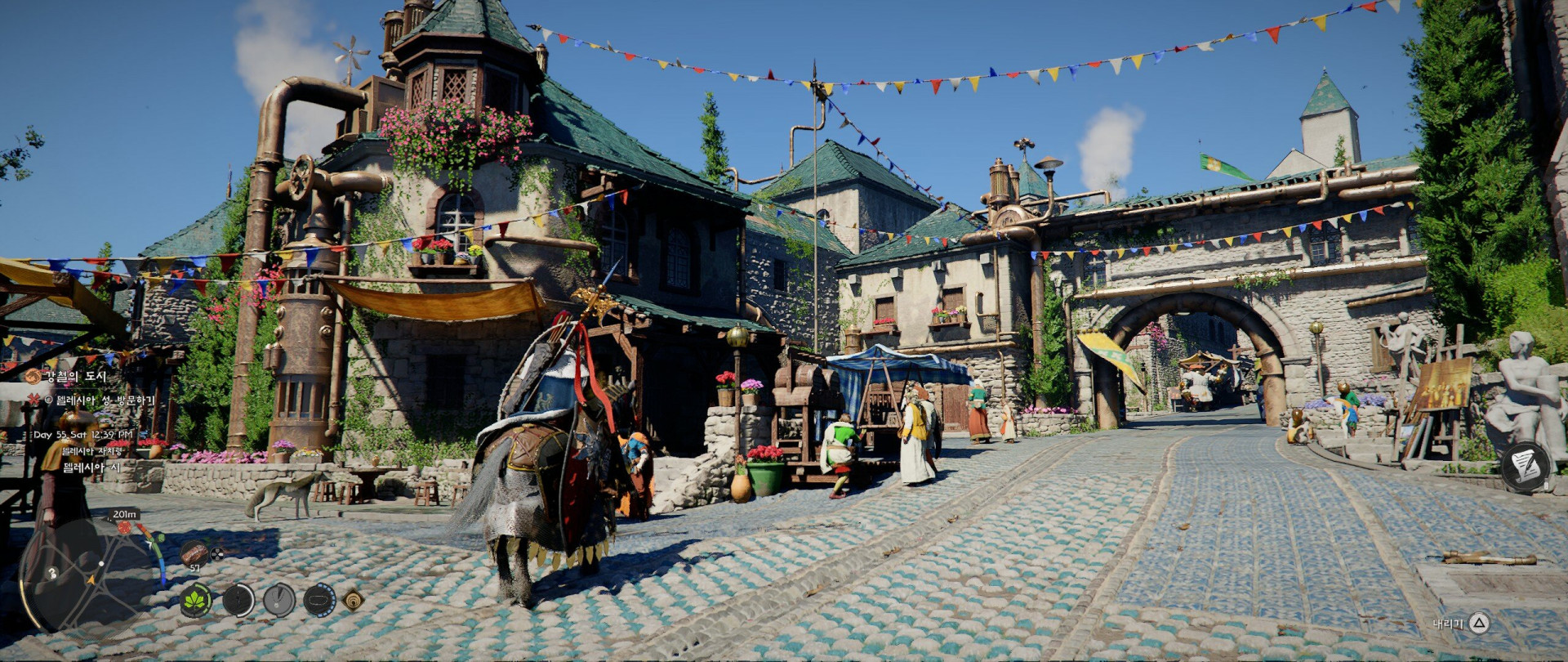
▲ Amid a steampunk machine civilization, too
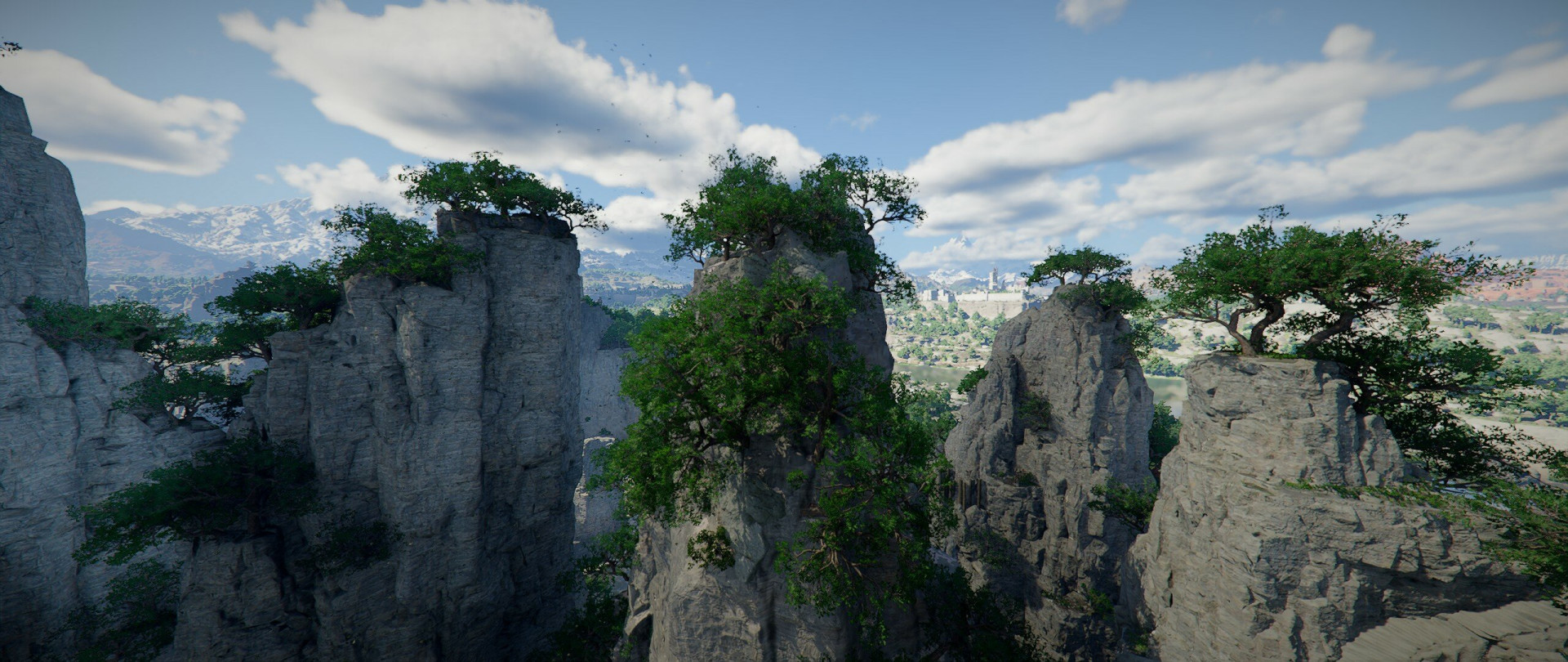
▲ Even to Zhangjiajie(?)—Kliff goes there too
And throughout this long journey, every region hides an enormous amount of quests and exploration content. Simply reaching the ending of the main quest alone takes anywhere from 50 hours on the short end to over 80 on the long end, and the number of side quests is impossible to count. Even after dozens of hours, strange new content you have never seen before will still appear in front of you, and in places where you would never expect to find anything at all, some random game-changing discovery may suddenly turn up. In other words, the game is not merely broad—it is dense.
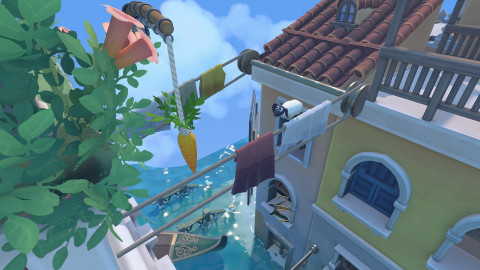
It is also impressive in terms of detail. The pets scattered around the regions can all be recruited as companions if you invest the time, and in gambling dens, a player caught cheating gets his hand chopped off. Hidden caves often contain rewards, and decorative objects and pieces of furniture that initially seem useless later become items for decorating the home you will acquire during the game.
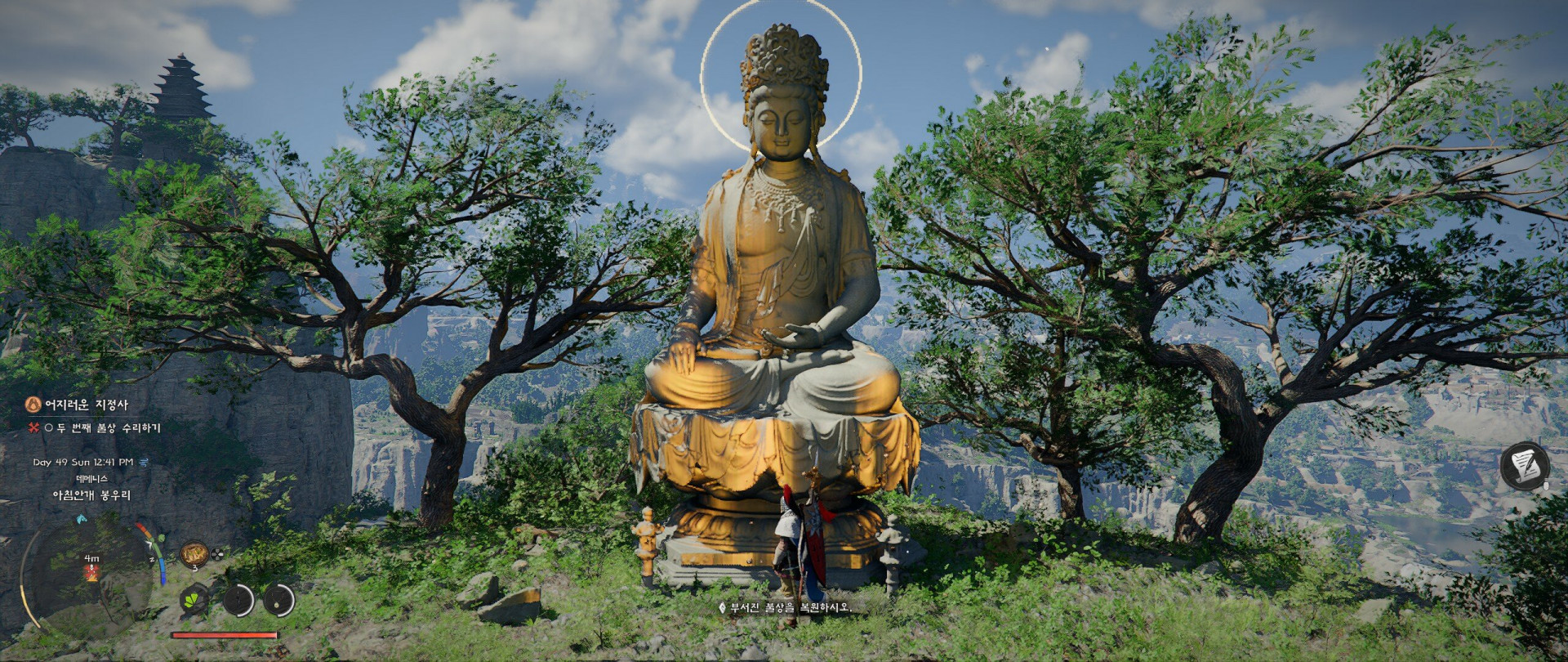
▲ You even get to see the Buddha
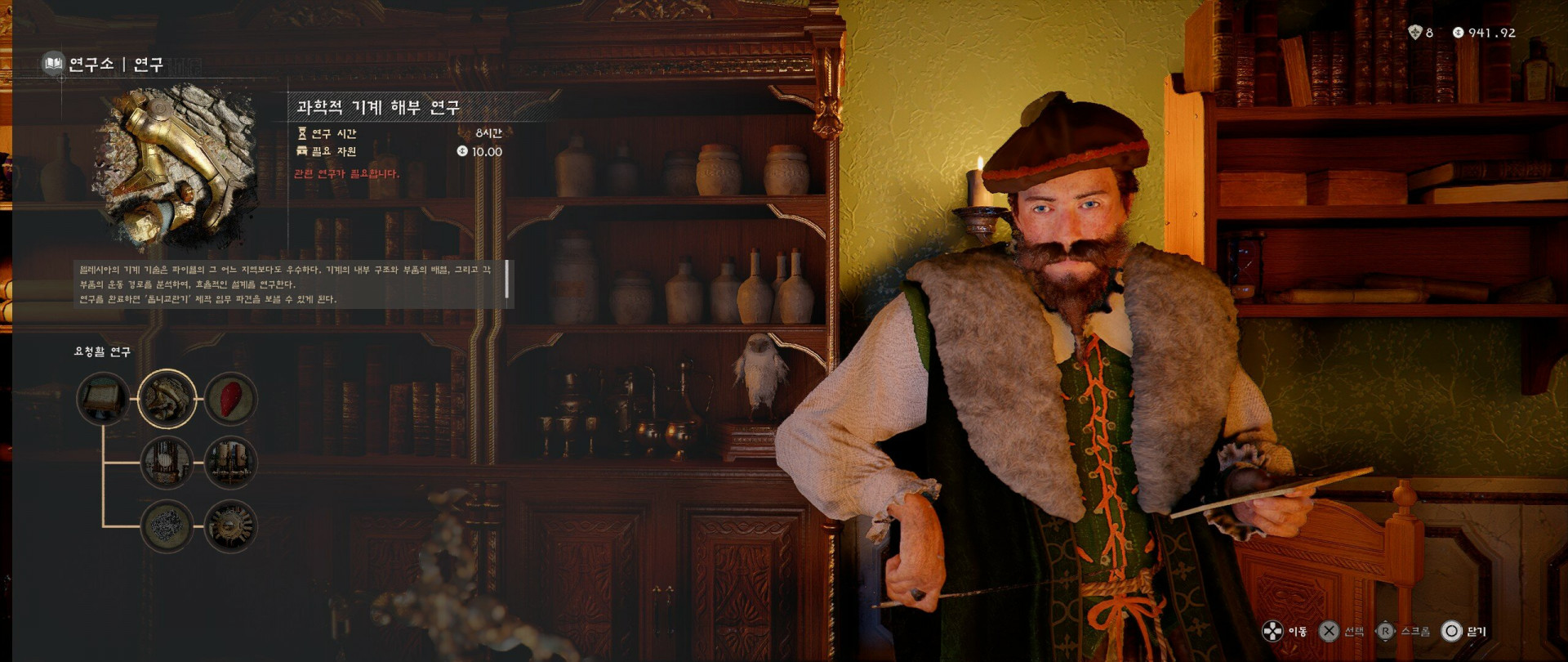
▲ You have to research each region too; the content never dries up
Content keeps pouring in during the process of gathering the scattered Greymanes and expanding your camp as well. You can dispatch workers to improve relations with local power brokers in each region, research new projects through collaboration with native regional factions, and even use bank asset-management services to seek investment returns. You can personally craft countless dishes and potions, and by watching the movements of trainees honing their techniques, you can even learn new skills.
Above all, the visual impact of the continent of Pywel is tremendously impressive in itself. The contrast between blazing sunlight and pitch-dark night is sometimes sharp enough to affect gameplay, but it is also beautiful enough to function as a piece of content in its own right.
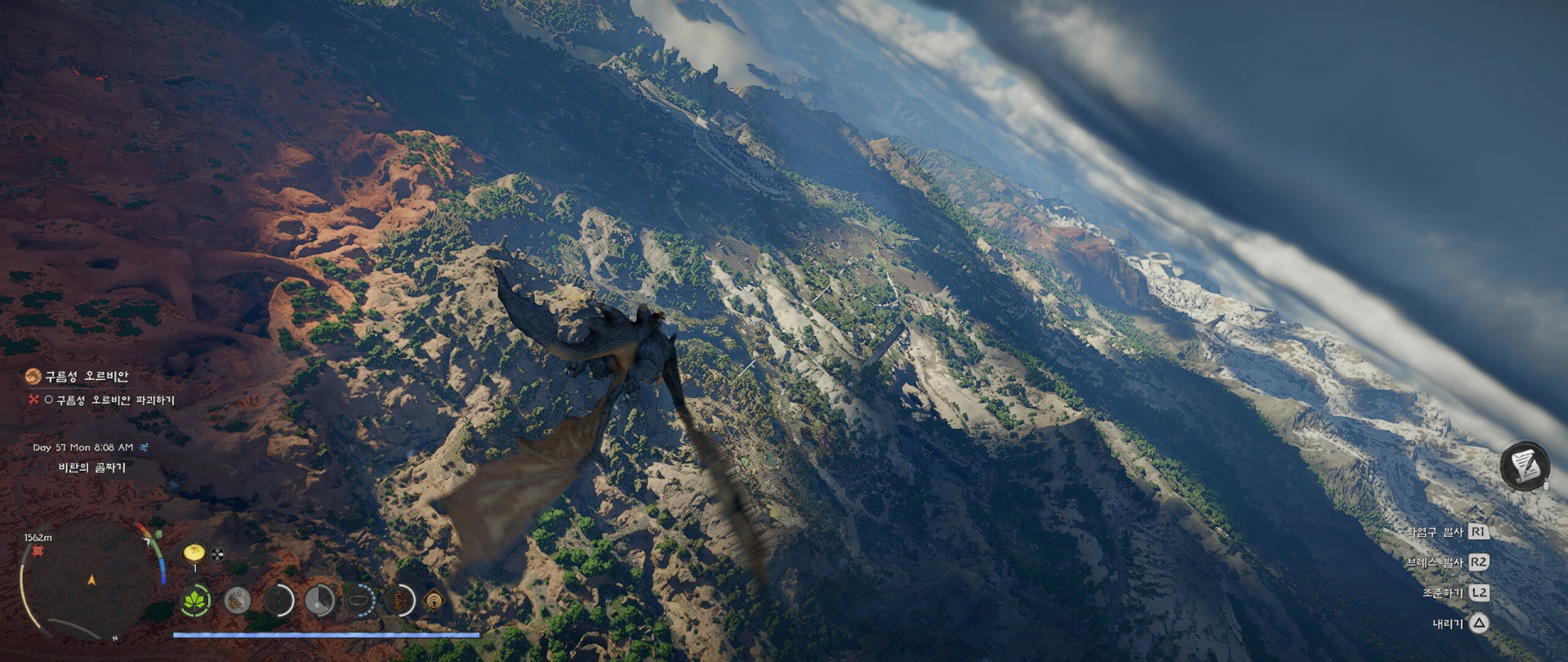
▲ There is no doubting the game’s visual impact
Action direction in a class of its own
If there is one common thread running through the many promotional videos for Crimson Desert, it is how heavily they focus on combat. That tells you Pearl Abyss itself invested major effort into this combat and regards it as one of the game’s strongest selling points—and in practice, it is immediately obvious that this is the area polished more intensely than any other.
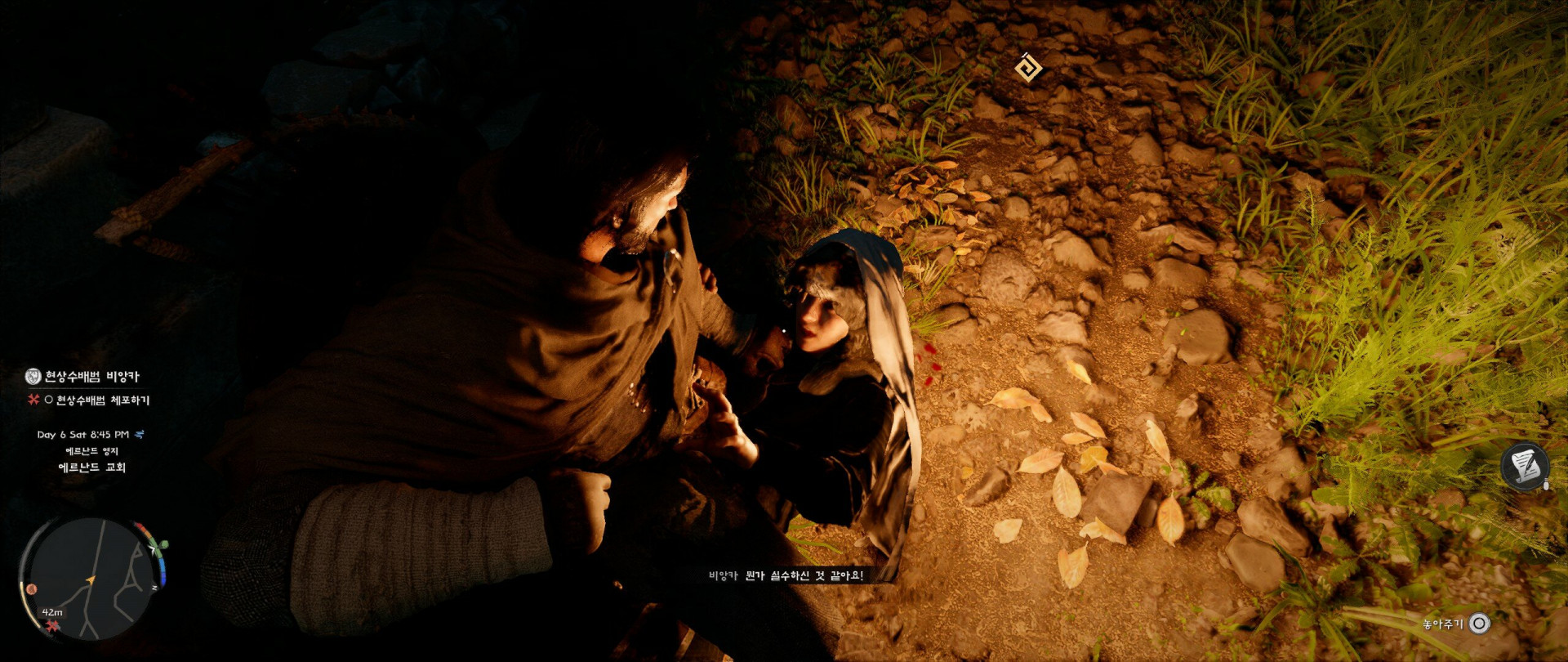
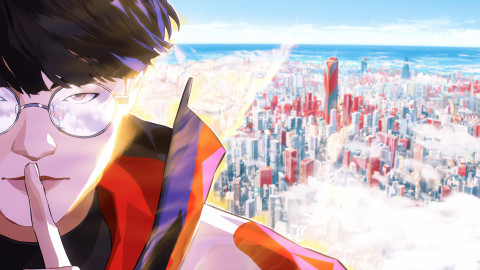
▲ Kliff, cold and aloof city guy
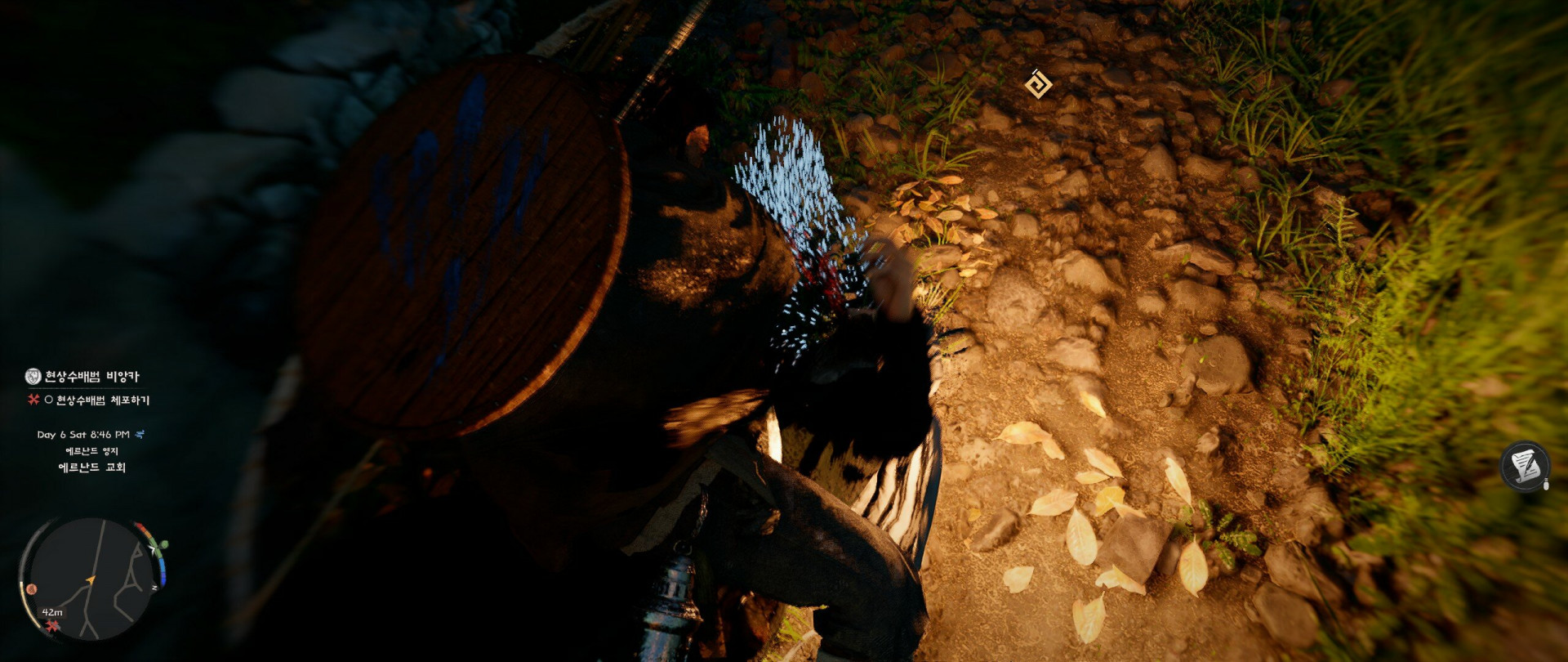
▲ He doesn’t go easy on women either
The many pro-wrestling-inspired techniques shown repeatedly in the trailers serve as the main source of impact in combat. Once you grab an enemy, the move gains area damage as well, both to keep you safe while the move plays out and to prevent interruptions—and quite literally everything around you gets smashed to pieces. If there is a watchtower nearby, it collapses; use it in a forest and trees fall over. It is far from realistic, but the sheer exhilaration of the moves is so overwhelming that it never feels especially bothersome. That said, if there are explosives nearby, you can die the instant you execute one of these techniques, so you do need to be careful.

▲ If sword strikes get blocked, hit them with a stunner
The variety within the wrestling moves themselves is excellent. From the front you get an RKO; use it while running and it becomes a clothesline; from behind it turns into a German suplex; use it repeatedly and you get a backdrop. Rush an enemy from behind while running and you trigger Natural Selection, a variant on the RKO, while enemies who are downed or knocked back with their lower bodies lifted can be hit with a giant swing. In other words, the move that comes out changes depending on the relative positions of you and the enemy, as well as your movement state.
Beyond grapples, Crimson Desert’s combat features a remarkable number of layers. It incorporates the use of blunt weapons, spears, swords, and other melee arms; close-quarters striking techniques ranging from karate chops to tetsuzanko; follow-up strings branching out from stun states triggered through precision strikes; kiting with ranged weapons; and more eccentric abilities spanning everything from rider kicks to Buddha’s Palm. Depending on how you build Kliff, a wide variety of combat scenarios can unfold, and there is real satisfaction in assembling combos from the techniques you have unlocked.

▲ Picking your main tools and playing mind games with bosses is genuinely fun
The special abilities classified as Abyss Gear are also worth close attention. Crimson Desert features a gemstone system called Abyss Gear, which can be equipped to armor and weapons, and among them are many weapon-specific Abyss Gear pieces that add special effects to attacks. Depending on which gear you use, a heavy attack might send crows flying out, slash a wave of sword energy straight ahead, summon a giant phantom knight, or add a beam attack. If you socket gems into gauntlets and the like, even your barehanded strikes can gain projectile blasts, or your grabs can acquire an area poison effect—changes substantial enough to alter the course of battle.

▲ I steamrolled Heksemari with sheer Abyss Gear cheese
And the stages where you actually get to use all of this—the game’s battlefields—show up in quantities that border on exhausting. It is not unusual to face hundreds of enemies at once, and while rarer, there are even cases where a single battle pits you against more than a thousand foes. Depending on the situation, it really does mean you can fight to your heart’s content.
This combat spectacle is not limited to gameplay, either—it shines just as brightly in the cutscenes that play during the story. Whether it is the various Greymanes fighting or Kliff smashing his way through enemy lines, these scenes are so well choreographed that any one of them could pass for a moment from an action film.

▲ The game often throws you into chaotic tangles with enemies. Watch the minimap.
A mass of colliding content—where is the direction?
Now that we have talked about the game’s impressive qualities, it is time to move on to the more painful part.
From what I have described so far, it may sound as though a can’t-miss game has arrived: a well-made open world topped off with stylish combat. But that is only the idealized fantasy. Crimson Desert is by no means a perfect game. If I had to sum it up in a single sentence from a slightly different angle, I would put it this way: “A game whose strengths and weaknesses are both far too pronounced.”
Its biggest problem is that the game’s overall direction feels severely lacking.
To put it more precisely: there are too many elements to count, but rather than complementing one another, these elements interfere with one another. In the process, they lose their reason for being—and worse, they even consume the game’s strengths. The end result is an experience filled with maddening inconvenience and ironic design choices. It is easy to see how much thought went into “What would look cool?”; it is far harder to detect any serious thought about “What would make the game difficult to play?”
The open world is enormous, but quest routes are so long and convoluted that the world’s sheer size becomes something to resent. Bounties are scattered all across each region, yet the guards who can take a captured outlaw into custody exist only in major cities, which means you often have to carry the criminal on your shoulder and simply run an absurd distance. As the game progresses, Kliff’s sphere of activity expands across the entire continent, but important quests are still handled at the camp tucked away in the southwestern corner, forcing repeated trips back and forth along the same routes. Many hidden elements in the game are placed in areas unrelated to the marked roads, so you wind up combing through this giant map with the desperation of a lice hunt.
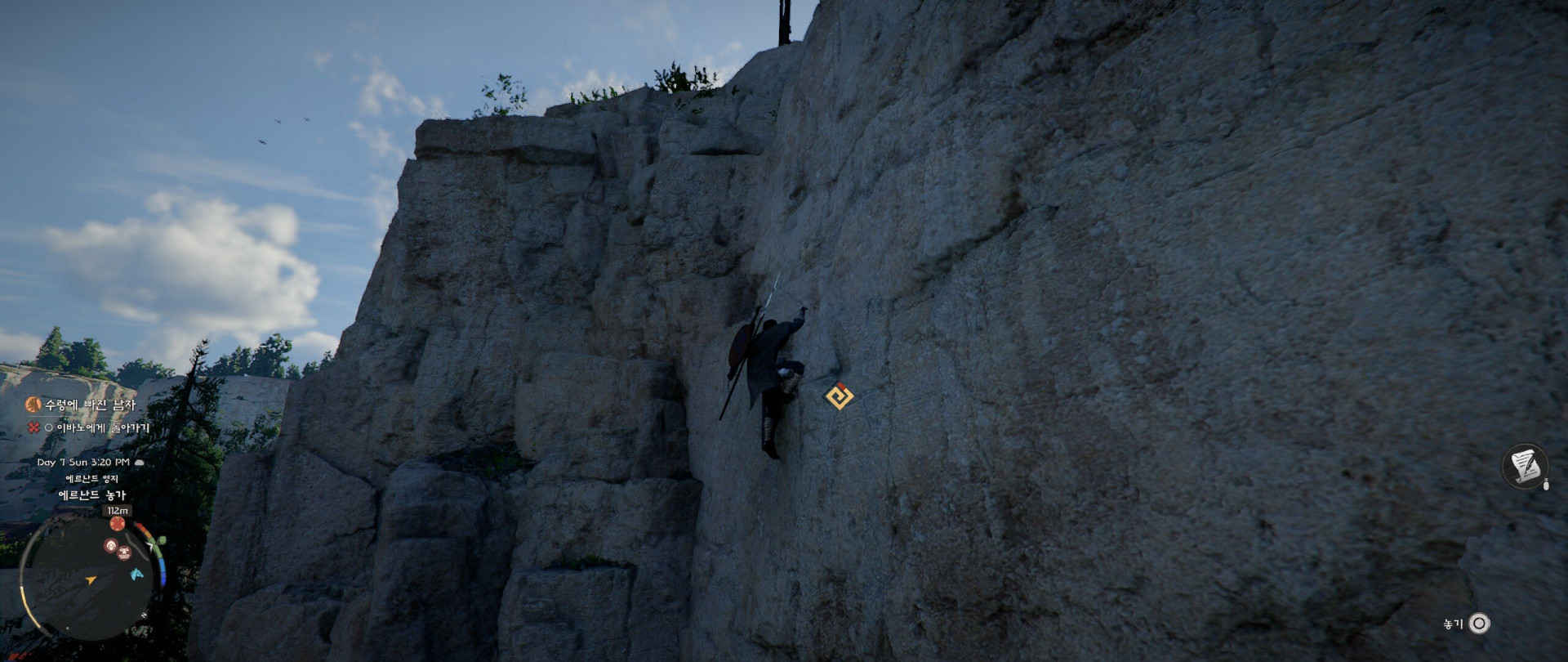
▲ The quest routes make you climb cliffs constantly
The open world itself is excellent, but because the level design disappoints, that open world often feels less like joy and more like labor.
The strengths of combat are also countered by systems that have not been properly organized. You can learn a huge number of techniques, but most of them are only effective against mobs; in boss fights, which are the real core combat of Crimson Desert, most of those techniques are essentially meaningless.
In Crimson Desert, there is no invincibility when you are knocked down or sent flying after taking a hit. In fighting-game terms, that means if you get launched, you die. One badly taken hit can pop you up into the air, and then you get comboed until death, which means that in boss fights you are forced to stay focused on reading the boss’s patterns and either dodging or blocking them consistently.

▲ The Demon-Piercing Death Beam—an instant kill in one shot. Slow moves get sealed away.

▲ In the end, it’s a game of dodging, finding an opening, and getting a hit in
As a result, most techniques with long startup animations become nearly useless. Bosses also frequently activate super armor with little warning, making it difficult to make aggressive use of precision strikes or grapples. Since you have to capitalize on the clear openings between boss patterns, combat typically ends up revolving around simple heavy attacks that can deliver immediate damage.

▲ Even with lock-on active, the camera often fails to follow the target
Beyond that, there are simply too many systems in the game that exist without serving any meaningful purpose.
For example, Crimson Desert has an assassination system. It is the standard sort of assassination system everyone already knows, and to support it, there are also systems for hiding in haystacks and bushes. The problem is that you almost never encounter situations in the game where using assassination is actually useful.
Enemy placement is not configured in an assassination-friendly way like it is in the Assassin’s Creed series, so naturally you cannot clear the game through stealth kills alone. On top of that, enemies have almost no blind spots in their vision, so unless one is isolated, assassination is usually detected anyway. Worse still, the occupation system is not structured around eliminating a pre-placed set of enemies and then completing an objective; instead, it often requires killing a set number of endlessly spawning enemies, meaning enemies can suddenly appear behind you and charge in from nowhere. And even that might be tolerable if the numbers were small—but in many cases, outposts in Crimson Desert are only considered captured after you have killed 300 to 400 enemies. In practice, the system is nearly pointless.
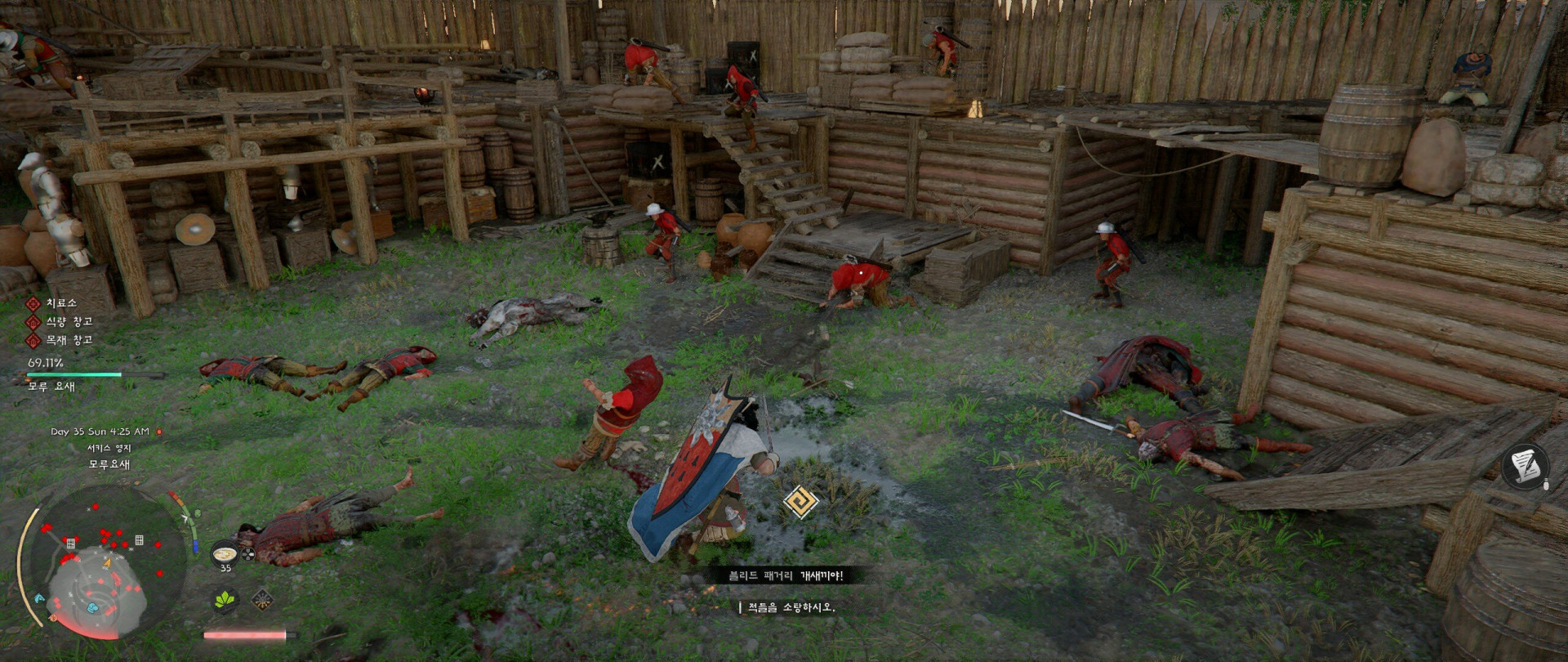
▲ You might as well assume assassination does not exist as a combat option
Likewise, the early-game special outfit for entering certain areas system loses all meaning once the opening portion is over, and the sub-characters Oongka and Damian have less mobility than Kliff, are less compatible with puzzle-solving, and even use separate growth trees, which effectively gives you no reason to use them all the way to the ending.
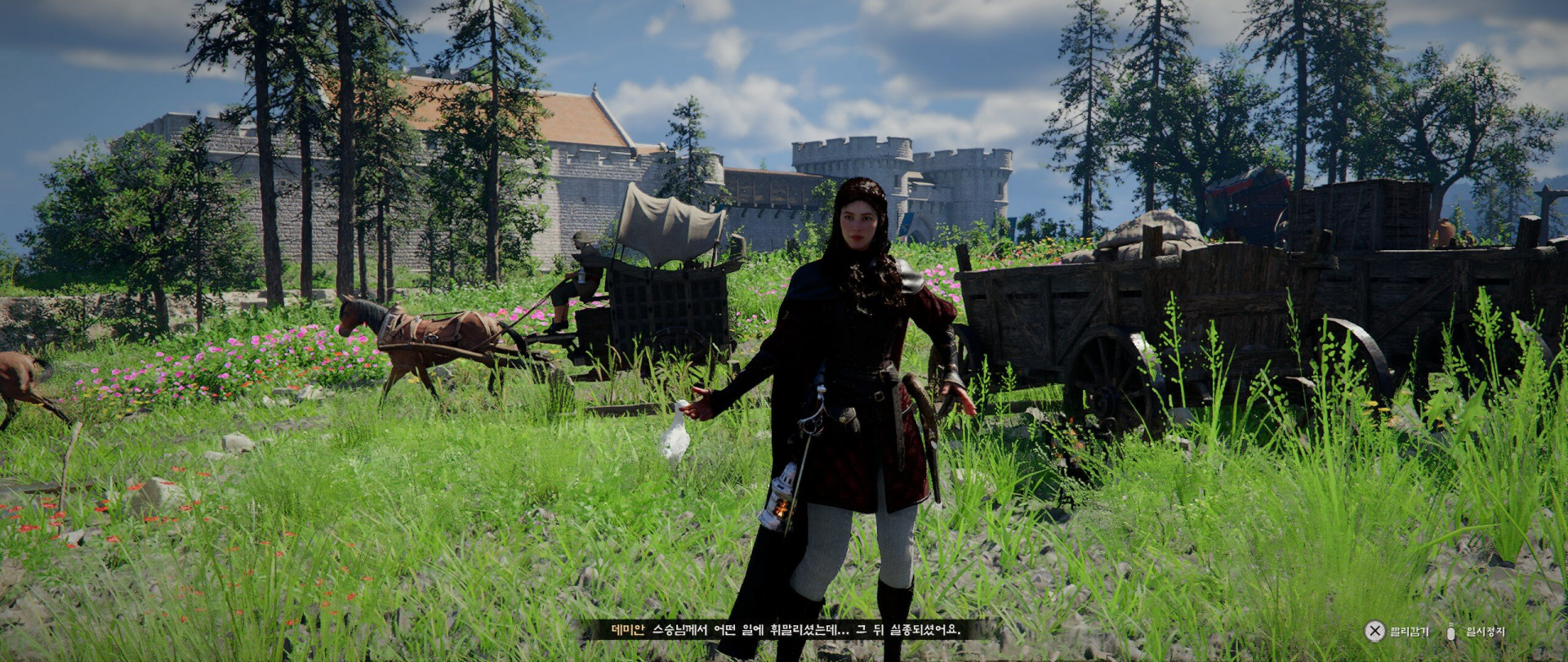
▲ Damian looks nice, but there is absolutely no reason to use her
There are return stones that let you go back to camp, but they are so rare that I only saw one a single time before reaching the ending, making them functionally meaningless. There is no compelling reason to engage with trade or farming, either. More fundamentally still, the game’s very structure creates a contradiction: unless you advance the main quest, regions remain covered by hostile forces, making other quests difficult to carry out—but once you finish the main quest, you lose the motivation to do everything else afterward. There is no clear endgame content compelling enough to make you seek out and complete all those scattered activities.
And this is only part of it. Crimson Desert contains so much that it is difficult to talk about it all, but most of those things barely affect gameplay at all and instead merely make the game more complicated for no clear reason. It feels as though a set of brainstormed ideas were simply poured into the game wholesale, without any real process of refinement or curation.
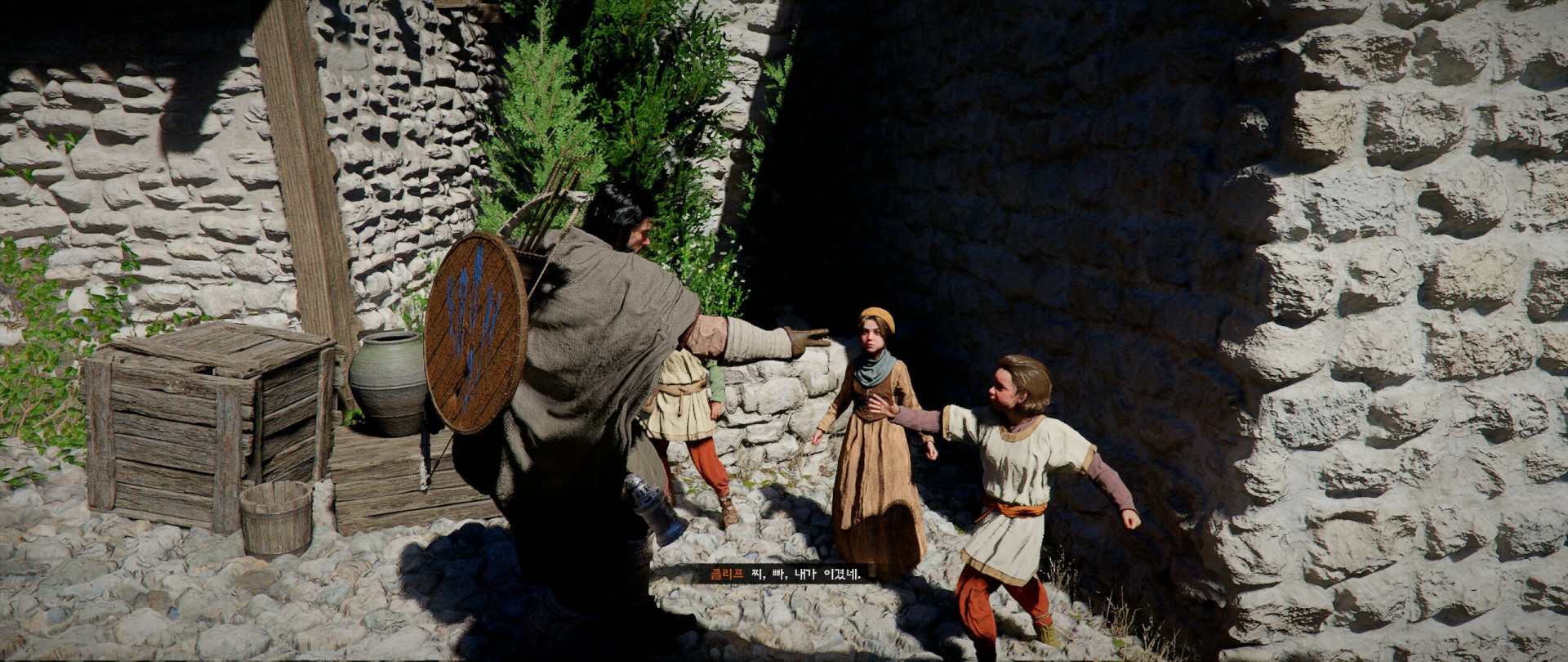
▲ I have no idea why rock-paper-scissors is even here. You cannot even bet money with the kid, either.
There is a saying that making a masterpiece is not a process of addition, but of subtraction. Crimson Desert has added an enormous amount—but it really does feel as though it should have paid more attention to what needed to be cut away.
Even after dozens of hours, the question marks never stop
As you experience all these countless components that make up the game, question marks keep flashing in the player’s mind. In fact, the dominant feeling you are likely to get while playing Crimson Desert is simple bewilderment. One could argue that meaningless elements are harmless enough—you can just ignore them. But the real problem is when these unorganized systems turn into friction and inconvenience in the game itself.
It is extremely common in Crimson Desert for progress in one side quest to be completely blocked by your progress in another without any explanation, or for combat difficulty to vary wildly between regions while the game still expects you to tackle the harder content first. Fast-travel points placed according to no discernible logic—sometimes deep underground, sometimes absurdly far from important locations—and obtuse puzzles whose rules are never explained constantly test the player’s patience.

▲ A parkour mission that brings Jump King to mind. Fall, and you have to climb back up from way down below.
Despite the game having so many systems, some things are hidden so vaguely and so completely without clues that you may never find them at all, even by the ending. In my case, even after finishing the game, I had not found a single elemental skill; Oongka was inexplicably deactivated; and I never found one of the four witches.
The inventory, which deserves to be ranked among Crimson Desert’s three great enemies alongside monsters and puzzles, is equally maddening. There is officially no storage system in the game, which means you have to carry all of the many quest items and materials you pick up over the course of your journey. Side-quest posters, bounty notices, countless quest items whose purpose you cannot even guess, a whole range of materials, and even skill points all take up inventory space.
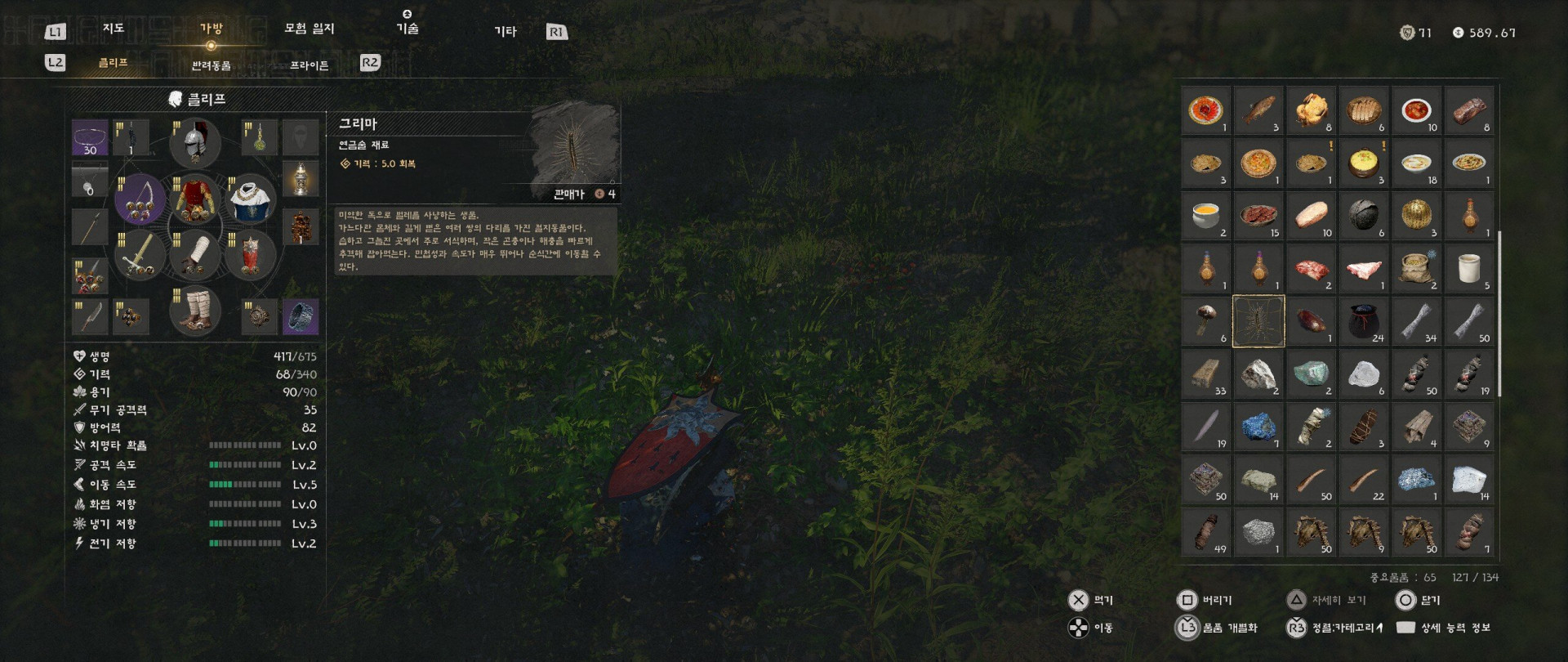
▲ The longer you play, the more dizzying the inventory becomes
The content design itself further squeezes this already cramped inventory. Gear and consumables for sub-characters you barely use still occupy bag space, and once cooking comes into the picture, even meat—which is all ultimately consumed simply as meat—is divided into five separate types: tender meat, tough meat, fatty meat, chunky meat, and lean meat. Likewise, grains that are all just treated and consumed identically as grain are split into several different items such as beans, lentils, barley, wheat, and oats.
And you cannot simply throw these materials away, because Crimson Desert is a game where you have to cook constantly. As mentioned earlier, boss fights in Crimson Desert are built on a “if you get launched, you die” structure. No matter how much you raise your health, there are far too many instant-kill patterns that can drag the protagonist to death in a single combo, so the only way to survive them is basically to eat through the damage while getting hit.
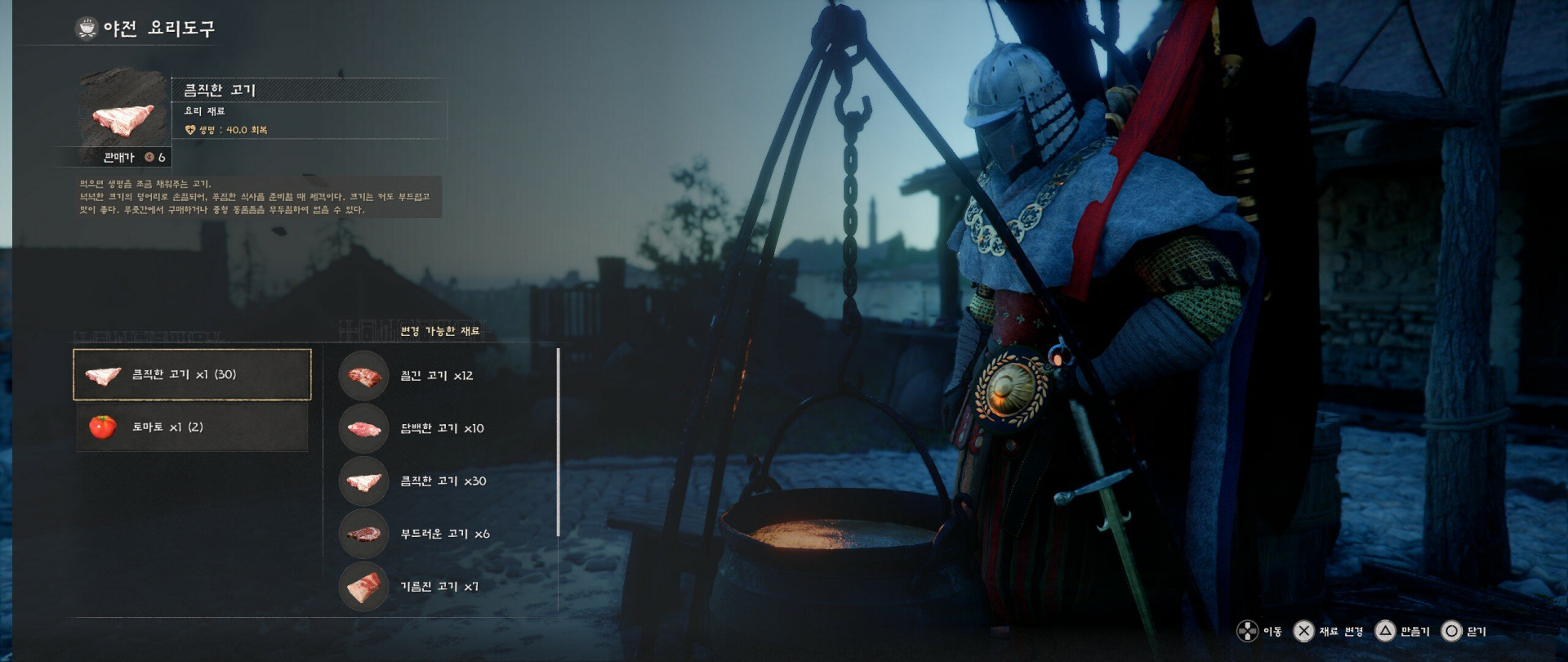
▲ In the end, it all becomes the same once you cook it, so why are there this many kinds of meat?
The problem is that you never know when or where one of these boss fights will begin. If they started only during the main quest, that would be one thing—but they can also happen while you are just walking down the road. As a result, you have no choice but to haul cooking ingredients and prepared food around with you at all times. In my own playthrough, I was constantly carrying more than 200 cooked dishes on hand. Naturally, those take up bag space too. One of the updates released during the review period did significantly expand inventory capacity, easing the pressure somewhat, but opening the inventory still feels like an exercise in vertigo.
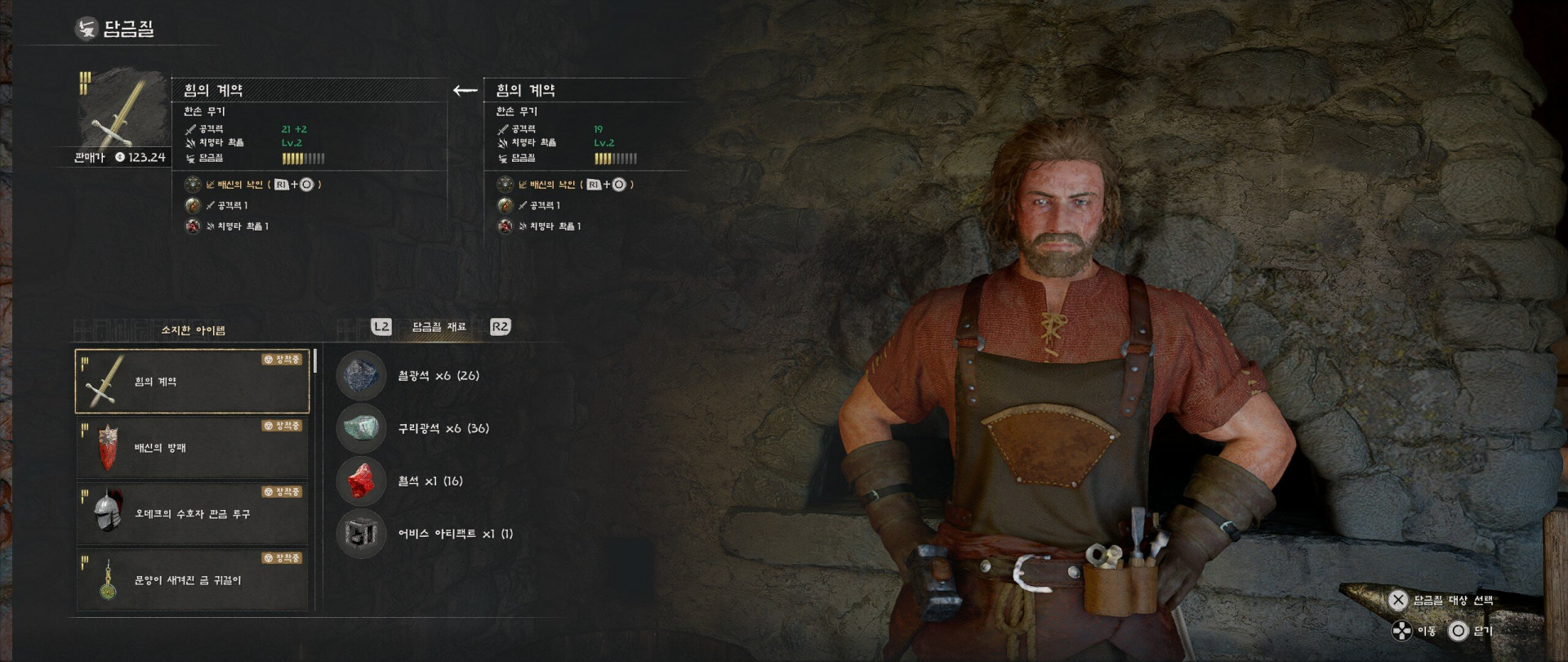
▲ And whose idea was it to make equipment upgrades consume skill points?
Taken one by one, these are petty, trivial little issues. But there are simply so many of these mildly irritating elements that they become a major problem. When you begin a game and decide on a goal, you should be able to pursue it, even if it is difficult. In Crimson Desert, outside the main quest, things too often suddenly become blocked, or something prevents progress and you cannot even figure out what the issue is—perhaps you needed to complete another quest first, or perhaps you failed to pick up a quest item somewhere. And the game does not communicate any of this in a natural or understandable way.
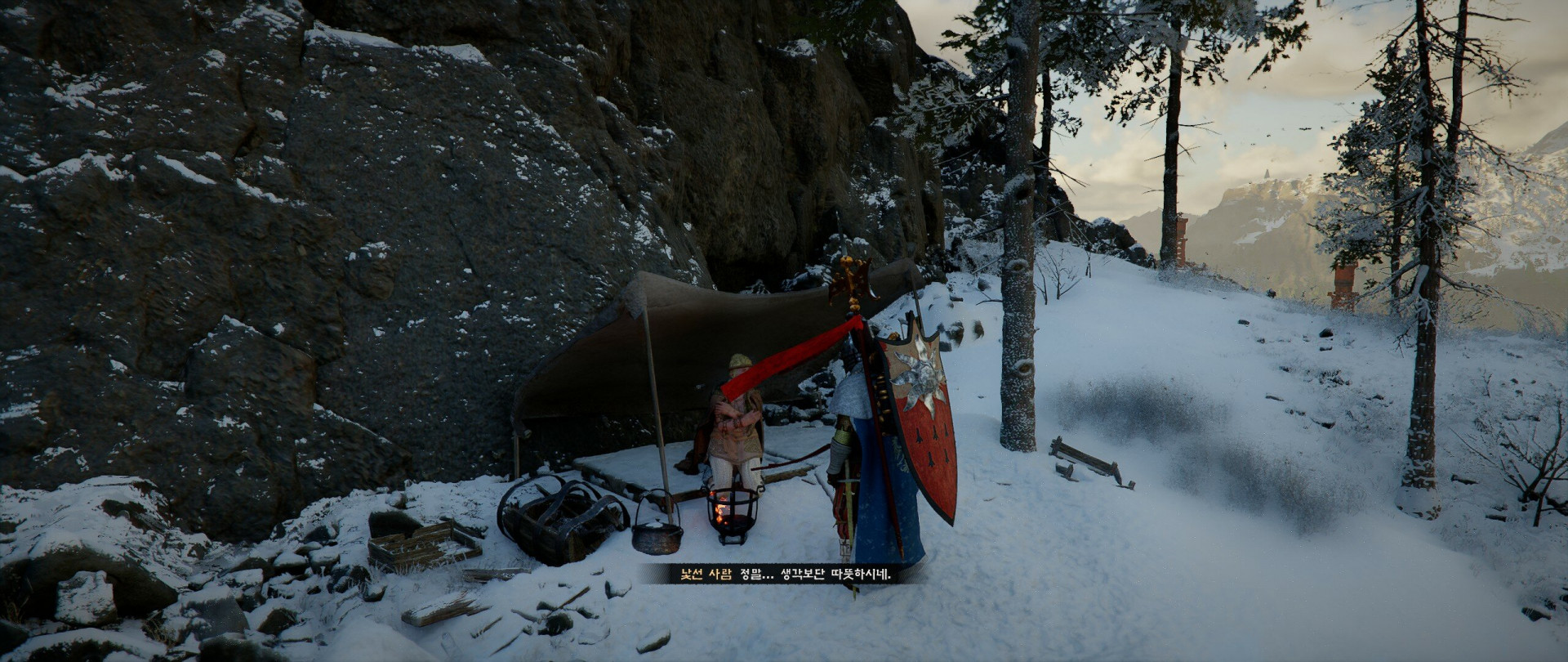
▲ The benevolent witch is somewhere in the mountains of Pailune, with absolutely no clues whatsoever
If you turn back to the main quest, the question marks only grow larger. Crimson Desert’s narrative line is incredibly strange. Setting aside whether it is good or bad, it is strange in the most literal sense. Of the 12 chapters plus epilogue that make up the main quest, Chapters 1 through 4 or 5 are understandable enough; Chapters 6 and 7 are frustrating in terms of pacing, but still possible to accept. But from Chapter 8 onward, it becomes impossible to tell what this story is even supposed to be, and there is no narrative buildup to support it. The final boss is someone who appears out of nowhere, a character never even mentioned beforehand. Perhaps that is because I had not completed every side quest, but surely the main quest should still be coherent on its own, shouldn’t it?
In the end, the player’s mind never stops filling with question marks. Crimson Desert provides no guidance for player routing. It merely scatters content haphazardly across a huge open world, without any clear sense of what kind of experience it wants the player to have or what style of play it is trying to encourage. Surrounded by countless markers, question marks, and enemies in this enormous open world, the player becomes lost. And keeps thinking, over and over:
“What exactly is the problem?”
“Why can’t I do this?”
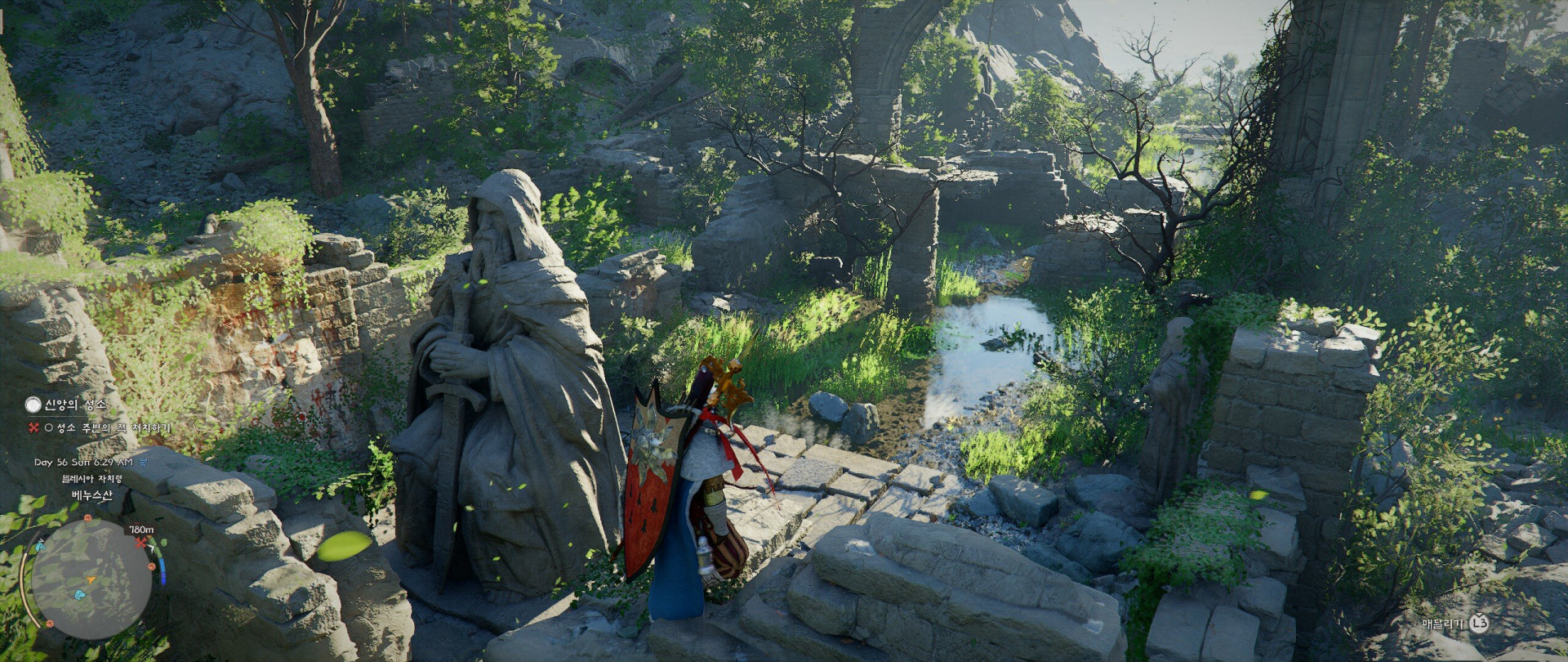
▲ After wandering around trying to find the controls for this puzzle, I eventually gave up
Even after improvements, controls still punishingly difficult
On top of that, Crimson Desert’s uniquely awkward control scheme further drags the game down. One of the game’s strengths, as noted earlier, is its wide variety of combat actions. Most open-world games prevent input confusion by classifying such actions as separate skills and assigning them to skill menus, but Crimson Desert instead tries to cram every possible command directly onto the controller. Naturally, once a single button is responsible for too many functions, complex controls and frequent misinputs become inevitable.
Take the square button on the DualSense, for example. It governs interaction actions such as picking up objects and operating mechanisms, but also jumping, assassination, and greeting. The problem is that the game’s determination of which of these actions to perform depends on the player’s camera angle and on the L1 highlight system, which leads to endless misinputs. You try to greet someone and instead swat a gnat flying in front of you; you attempt an assassination and Kliff instead does a little hop behind the enemy; you mean to pick up an item on the ground and suddenly end up bowing to the person standing in front of you. None of these are rare occurrences.

▲ Ah, no. Don’t.
The L3 button is also mapped to four different functions: hiding, Providence, hanging from cliffs, and sliding. This means that when you try to use Providence near a cliff edge to reach a higher ledge, you may instead grab on and hang below, or suddenly crouch and enter stealth. I also encountered cases in aerial platforming sections where I attempted to activate Providence immediately, only to slide instead and plunge straight off the edge of the world. (An update now at least rescues you from that.)
Even in combat, Crimson Desert’s controls boast a level of complexity unmatched by almost anything else. Every combination—L1+L2, L1+R2, R1+L2, R1+R2, L1+R1, and L2+R2—performs a different function, and once you factor in the so-called command-input equipment, the control scheme becomes even more bizarre. For example, to operate necklace-type gear on a DualSense, you have to press the menu button and touchpad simultaneously; on an Xbox controller, you have to press the central View button together with the Menu button, which can sometimes open the Steam overlay (...) instead.
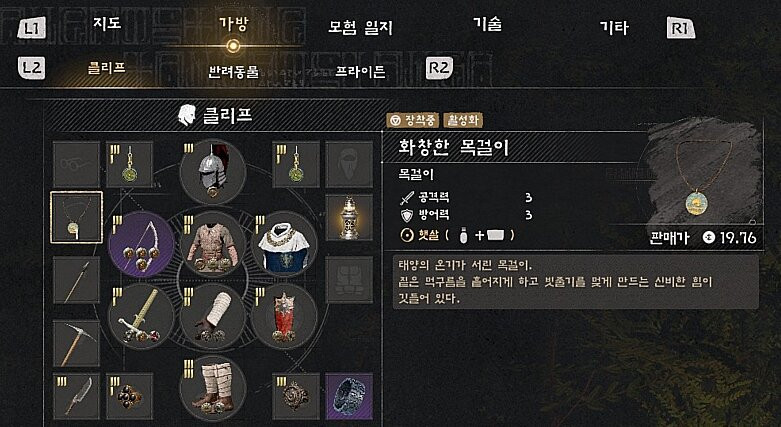
▲ A control scheme so strange I had never seen anything like it before
On top of that, subtle physical inertia and airborne state detection come into play, and the character simply refuses to move the way you intend. Double jumps trigger when you do not want them to. The crow wings sometimes deploy properly, but just as often only unfold long after you pressed the button. And precision strikes, no matter how carefully you aim at the center, keep veering off to the side instead. I was told again and again that I would get used to it over time—but no matter how familiar I became, the sense that the controls were awkward and bizarre never went away.

▲ No matter what I do, precision strikes keep hitting off to the right
In action-adventure games, controls are a kind of implicit pact between developer and player. There is a broadly shared understanding—built through the trial and error of countless games—of which button should be attack, which button should be dodge, and what arrangement allows those actions to be performed comfortably and without misinputs.
But Crimson Desert ignores that convention and forges ahead on its own path. The problem is that if a game is going to depart from the established norm like this, it has to offer a correspondingly fresh and extraordinary experience in return. Crimson Desert does not.
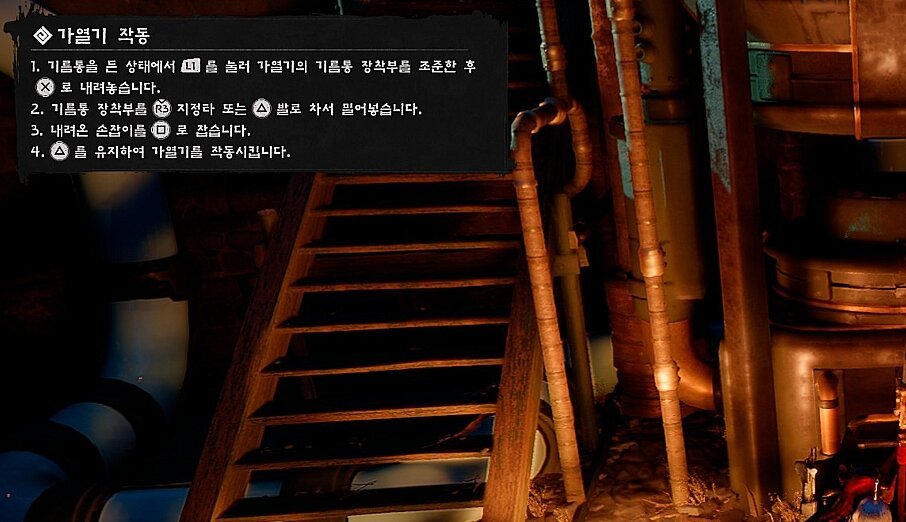
▲ Every time I look at something like this, I feel dizzy
A breathtaking exterior, a thoroughly bewildering interior
As the review embargo drew closer, I found myself in a state of considerable confusion. At this point, the expectations and excitement surrounding Crimson Desert had ballooned to an excessive degree. For a reviewer, that in itself is a huge burden. It felt a little like being the only person who had spotted an asteroid hurtling straight toward Earth at full speed. The Crimson Desert I played was a passably made open-world game—but it was not something that matched the fever pitch surrounding it.
Because of that, I spent a great deal of time second-guessing myself before completing this review. Was this really a problem only I was feeling, or was it a universal issue everyone would run into? I turned the game back on even after seeing the ending and ranged across every corner of the continent of Pywel, trying to verify that for myself.
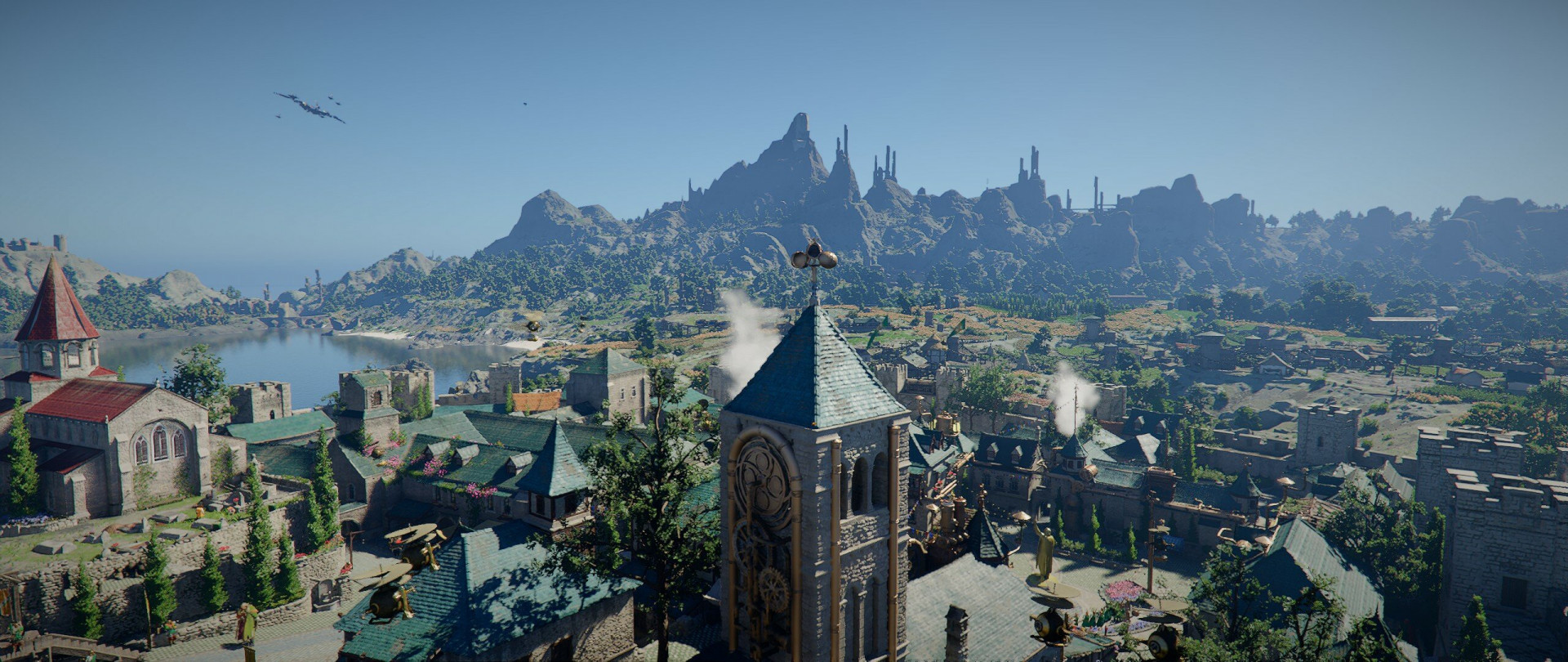
▲ If all you see are the videos and screenshots, it looks like nothing short of a god-tier game
And even after going back to it, Crimson Desert remained the same. A striking open world and fluid, stylish action—its strengths are unmistakable. The many videos Pearl Abyss has released are all designed to magnify those strengths to the utmost, which makes it difficult to grasp the mess beneath the surface. The same is true of a six-hour preview session. Crimson Desert is simply too large a world and contains too much content for six hours to do more than barely lick at its outer shell.
After repeated play and after organizing my thoughts, my conclusion remained the same. Every one of Crimson Desert’s problems lies within the game itself. Too many contradictions and collisions—things you could never truly feel or even recognize without actually playing it—remain hidden in the shadow cast by its beautifully polished open world and rousing action.
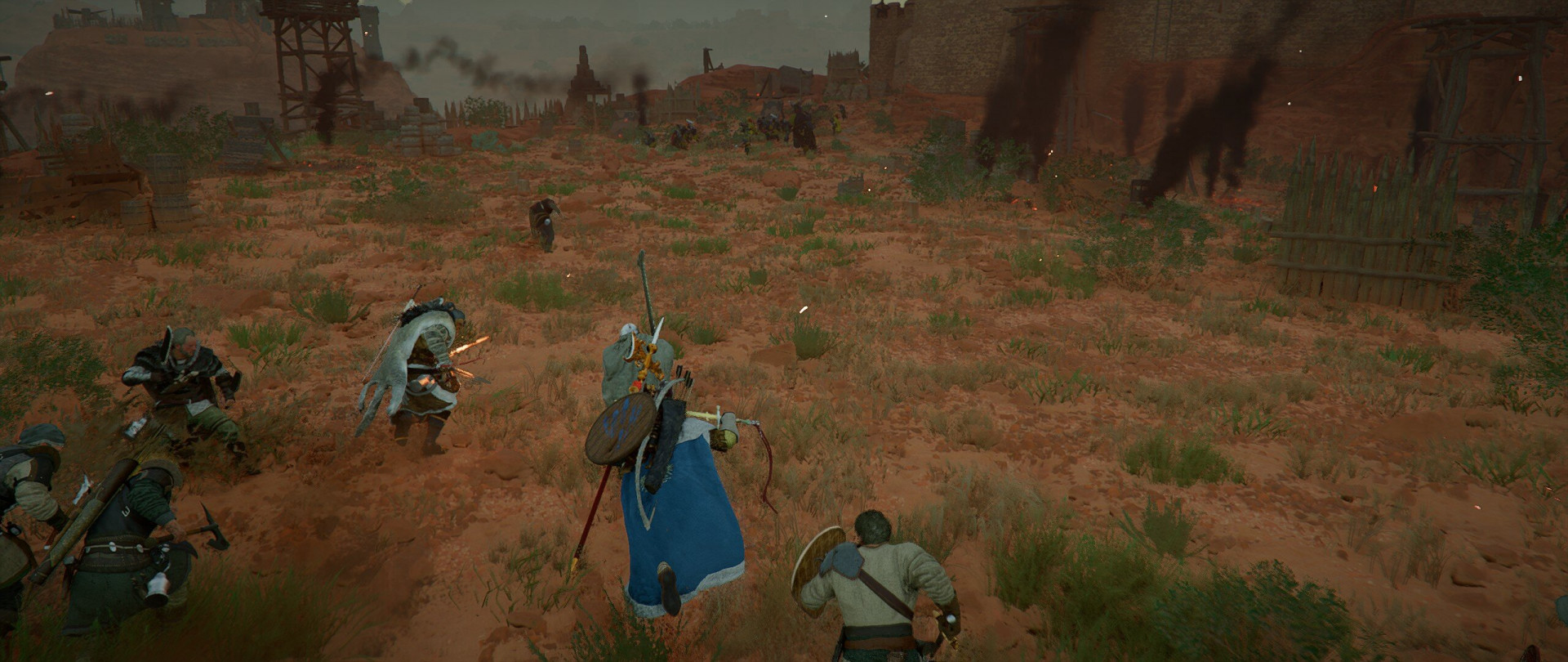
▲ A game with too many problems left in the places the eye cannot see
That is why, in its current state, I would say that although Crimson Desert possesses a striking open world and strong action, it still falls short in many ways as a finished open-world action game.
That said, the emphasis on current state also implies that the future may not be the same. Crimson Desert’s shortcomings are extremely clear. I have explained them in three parts, but in the end they all stem from the same issue: too many things have been added without being pared back, and the resulting elements are left cluttered and disordered rather than properly arranged. It would be difficult, but if those pieces could be calmly sorted out one by one and given some coherent structure, then for open-world fans who love to exhaustively dig through vast amounts of content, this could still become a highly appealing title.
Even so, the vantage point of a review is always the present. And in the present, Crimson Desert is unmistakably a game whose flaws stand out every bit as sharply as its strengths. It is still some distance away from becoming the kind of great game that can truly live up to the current level of expectation.