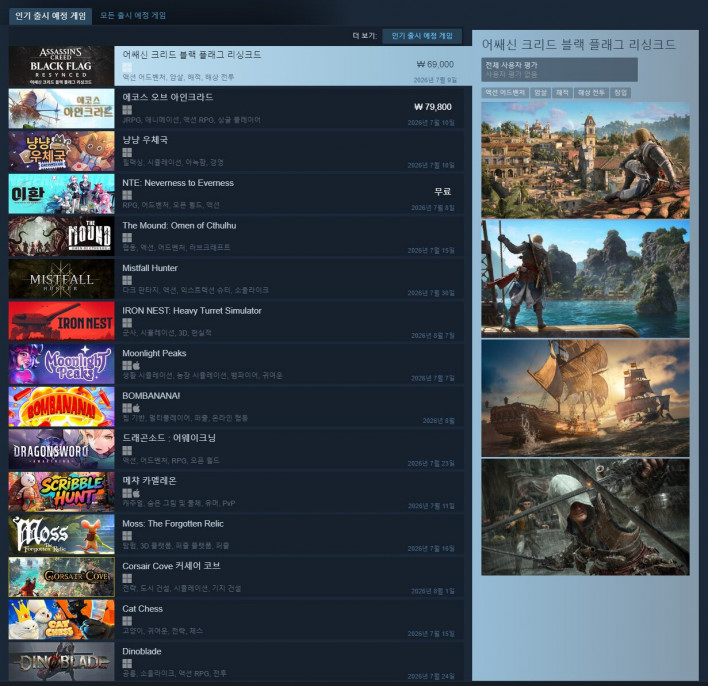
One major channel for indie games to gain visibility on Steam has significantly narrowed. In June, Valve raised the entry threshold for the 'Popular Upcoming' tab on the Steam Shop's 'Upcoming Games' page. According to game marketing analyst Chris Zukowski, while 7k wishlists were previously enough to aim for this tab, developers now need around 100k. The barrier to entry has effectively increased nearly 15-fold overnight.
The 'Popular Upcoming' tab highlights highly anticipated games nearing release. For small and medium-sized developers unable to afford large advertising budgets, it was one of the few stages available to accumulate wishlists before launch. Valve stated on the Steamworks official blog that the change was made to "better showcase the most anticipated games of the coming month, in response to user feedback." However, as the space has effectively become reserved for major titles, indie developers have voiced their frustration.
Yet, another window for indie games has opened elsewhere. Data is beginning to emerge showing that the 'Personal Calendar,' quietly introduced by Valve around the same time, is proving even more beneficial for indie games. On June 25, Zukowski published figures sent directly by developers on his blog, 'How To Market A Game,' noting that the Personal Calendar is providing unexpectedly significant support to indie developers.
From a One-Day Flash to Two Months of Constant Exposure
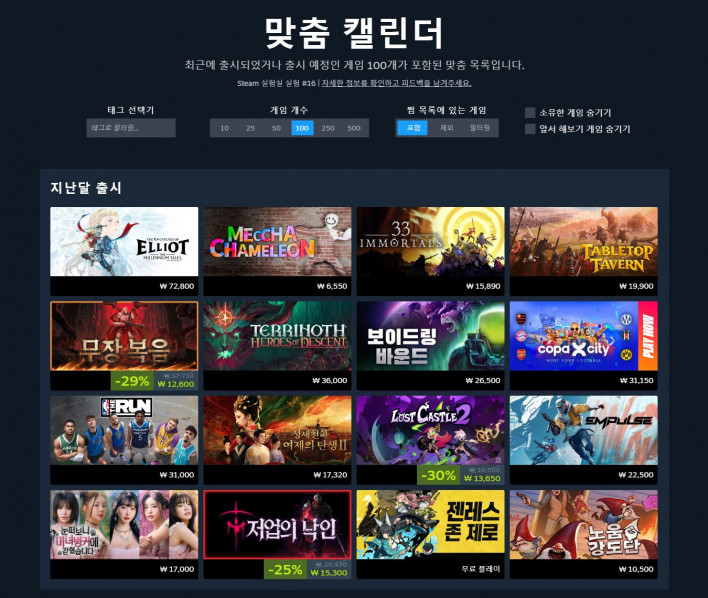
The core of the Personal Calendar is that it displays a unique screen for every user. Unlike the 'Popular Upcoming' tab, which showed the same list to everyone, the calendar selects new and upcoming releases based on each user's individual wishlist, follow list, and play history.
The duration of exposure is also vastly different. While reaching the 'Popular Upcoming' tab might have generated about 1k wishlists in a day, the game would stay on the list for only a day or two at most. In contrast, the Personal Calendar consistently generates 300 to 3k wishlists daily, with exposure lasting from two months before launch to one month after. A fleeting spot has been replaced by a long-term stage.
There are real-world examples. The developer of the indie game 'Don't Let It Starve' revealed that they were heading toward launch with 5930 wishlists, a number that nearly doubled to 11630 after being featured on the Personal Calendar. 'Arms of God,' which launched around the time the calendar was introduced, benefited from both channels; even after its exposure on the 'Popular Upcoming' tab ended at launch, it continued to receive visitors through the Personal Calendar for a month.
One-Tenth the Exposure, 30 Times the Clicks
The most notable points are the number of impressions and actual visits. The game 'Focus Grove,' which provided data to Zukowski, had about 1.3 million impressions on the 'Popular Upcoming' tab but a click-through rate (CTR) of only 0.81%, resulting in about 10k shop page visits. Conversely, on the Personal Calendar, it had only 80k impressions, but the CTR soared to 33.83%, drawing 27k visitors. Despite having 1/16th the exposure, the number of visitors more than doubled.

The game 'Starforged Legacy' showed a similar trend. Its performance shifted from 700k impressions, a 1.56% CTR, and 11k visits on the 'Popular Upcoming' tab to 100k impressions, a 31.26% CTR, and 33k visits on the Personal Calendar.
The reason is simple: it is far more effective to show a game once to someone who enjoys that genre than to show it a hundred times to uninterested people. Zukowski points out that mass exposure to random people is largely meaningless. The key is to first find people likely to enjoy your game and then accurately convey to them that "this is a game that fits your taste."
Registering for the Personal Calendar isn't easy; you need 8k to 30k wishlists
Of course, the Personal Calendar doesn't feature just any game. After Zukowski counted the followers of 100 games appearing on his own Personal Calendar, he found the bottom 30% had 804 followers (about 8k wishlists), the median had 2800 (about 28k wishlists), and the top 30% had 6600 (about 66k wishlists). Based on this, he estimates that 8k to 30k wishlists are needed to get on the calendar. While this is much more attainable than 100,000, it remains a wall that can only be scaled through diligent pre-launch marketing.
The 'Popular Upcoming' tab hasn't been completely closed off, either. When Zukowski checked the list on June 24, after the criteria change, he found small games with only 500 to 600 followers still making the cut. However, the number of new games entering the list daily dropped from 10 to 1–3, and games that do make it now stay for much longer. It was also notable that games with over 30k followers remained fixed on the front page from two months before launch.
Release dates must be set two months in advance
The biggest change Zukowski pointed out is the timing of release date confirmation. The personalized calendar features games starting two months before their launch, but games without a set release date do not appear on the calendar at all. When he expanded the calendar filters to 250 categories, he found that only one or two titles appeared per day for July and August. This means that because most indie developers do not finalize their release dates until two or three weeks before launch, their games are failing to register on the personalized calendar.
His diagnosis is that the rest of the launch formula remains largely unchanged. The fundamentals—opening the shop page as early as possible, releasing a demo, and gathering wishlists through festivals and streamers—still work. Added to this is the advice that in the era of personalized recommendations, games with a clearly identifiable genre at a glance have an advantage over games that try to appeal to everyone. For recommendation algorithms to pair games with users, the games themselves must clearly project their identity: "I am this type of genre."
His stance on 'shadow drops'—releasing a game without prior notice—has become even firmer. In a landscape where longer pre-exposure is advantageous, launching by surprise without pre-marketing is effectively throwing away the exposure channels Valve has provided. Citing the case of the sequel to the popular 'Fights in Tight Spaces,' which saw lackluster results after a shadow drop on June 7, he asserted that if even established names can't find success that way, indie developers shouldn't expect to either.
It is also worth noting that the entire Steam Shop is shifting toward personalized recommendations. Following the front-page recommendations and discovery queues, the exposure of upcoming releases has also become personalized, and there is even talk that daily deals may soon be customized as well. As it has become impossible to fit the dozens of new games released every day onto a limited front page, Valve has effectively chosen to move away from a 'one-size-fits-all' interface. For users, this increases the likelihood of finding games that match their tastes, while for developers, it opens a path to reach the people most likely to buy their games directly, rather than casting a wide net.
※ The wishlist entry figures (approx. 100k for 'Popular Upcoming' and 8k–30k for the Personal Calendar) are estimates based on Chris Zukowski's observational data, not official rules disclosed by Valve. (June 25, 2026.)


Sort by:
Comments :0