There’s something strangely funny — and a little sad — about waking up thousands of years in the future and immediately realizing you still have a job. That’s the starting point for Kent, the exhausted, mildly sarcastic protagonist of this post-apocalyptic crafting-and-automation adventure, where survival isn’t just about staying alive — it’s about turning scraps, bones, and broken machinery into a sprawling, self-sustaining ecosystem of clanking robots and glowing conveyors.
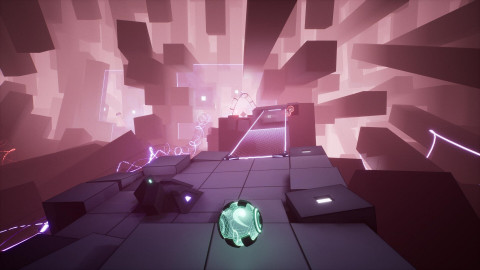
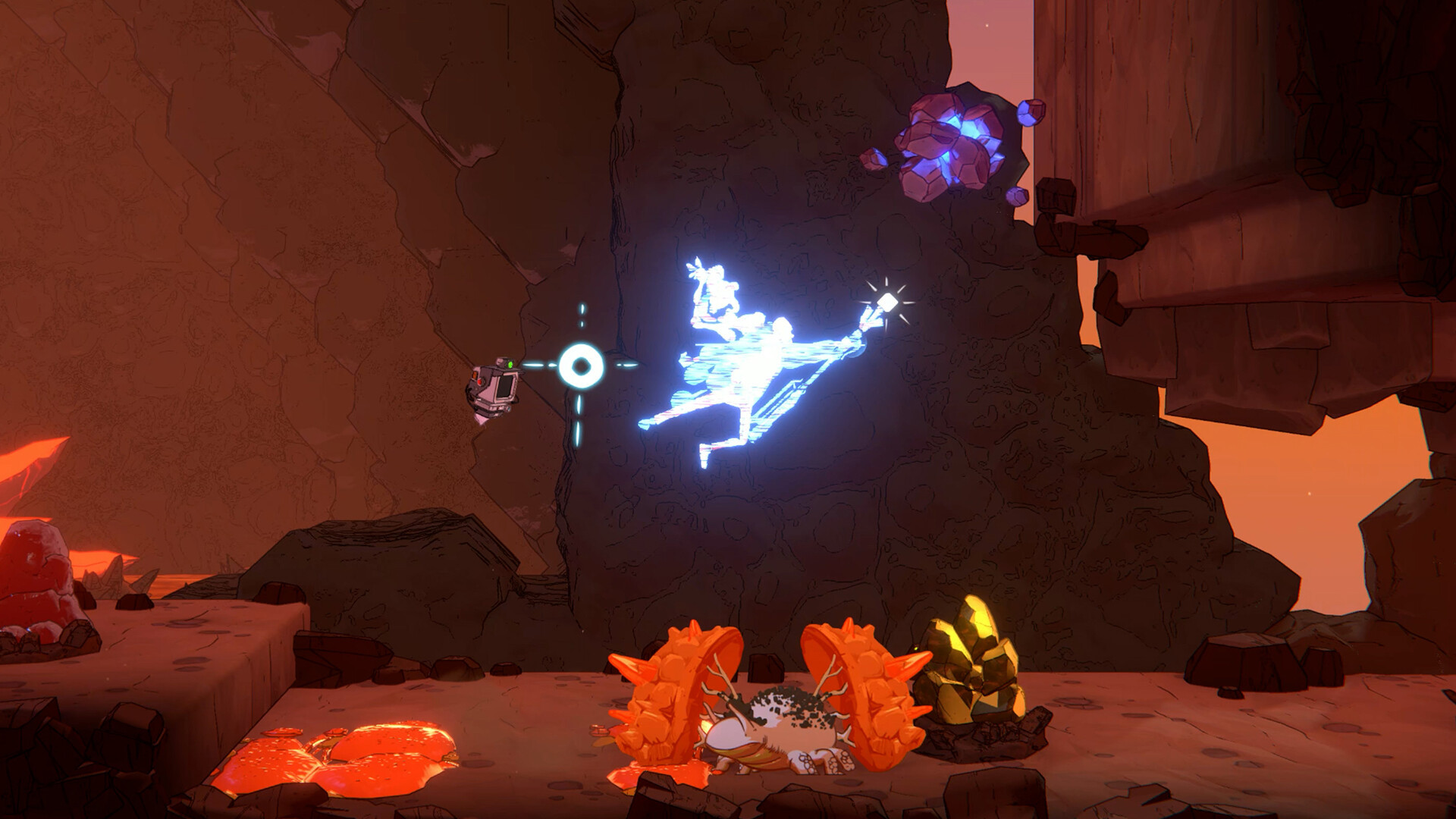
From the very beginning, the world feels alien and familiar at the same time. The landscapes stretch outward like massive, abandoned dioramas — jagged cliffs, dusty plateaus, towering ruins — while strange creatures scuttle, leap, and hover around you in ways that make exploration as much about curiosity as danger. The game leans into this mood: Not hopeful, exactly, but not miserable either. It’s a world that’s weird, mysterious, and full of small moments of humor, especially as Kent trudges forward with nothing but a stick, a backpack, and a stubborn refusal to give up.
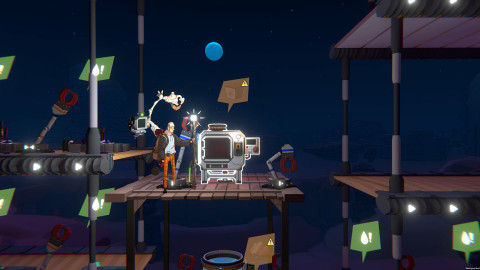
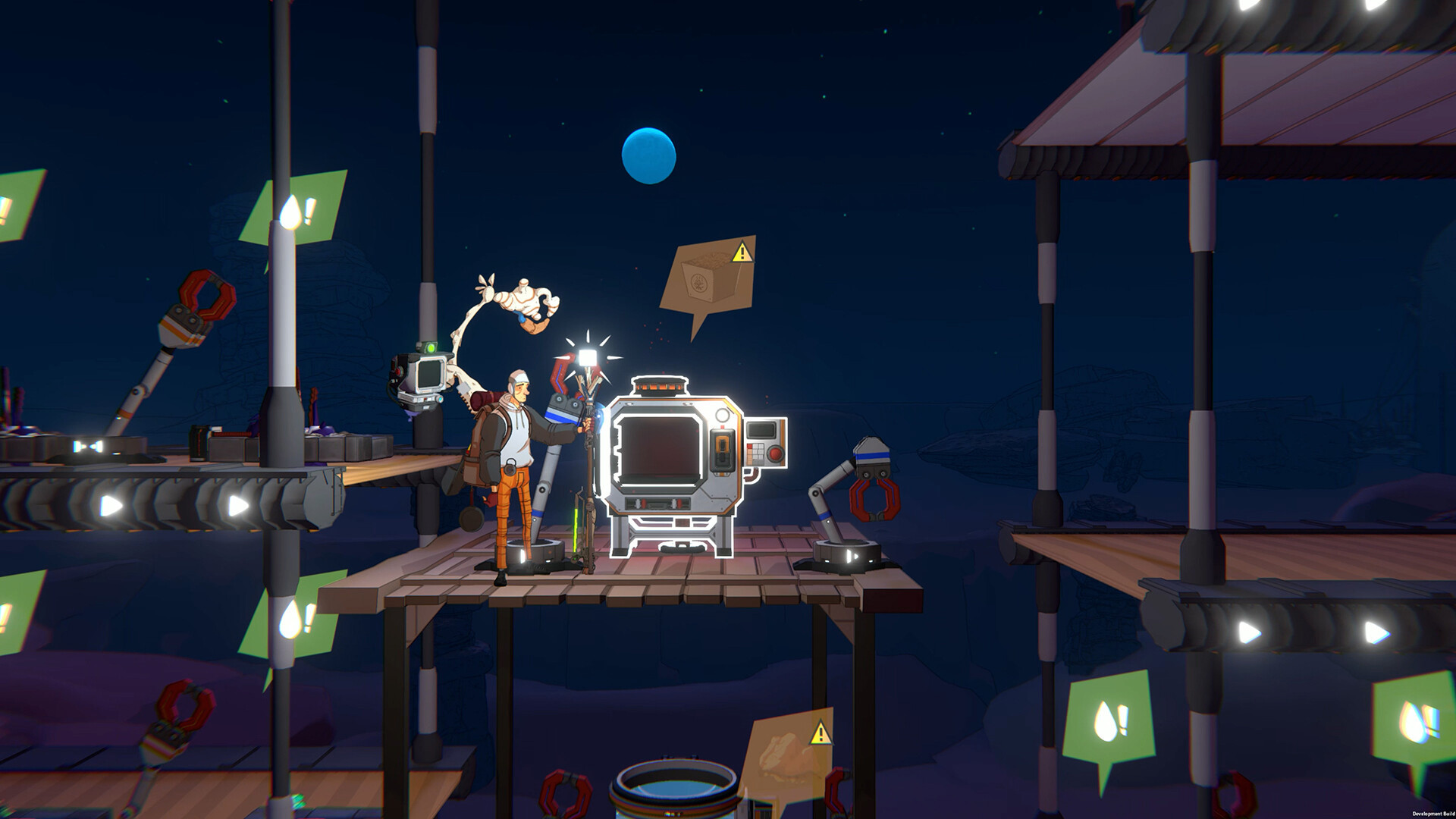
Where many survival games overwhelm you with systems right away, this one builds its complexity slowly. Early on, you’re scraping together basic resources — burning wood into coal, hammering junk into usable metal — just trying to plug the gaps in your barely-functional space module. Before long, though, the base stops being a temporary refuge and starts feeling like a living organism. Conveyor belts snake through platforms, robotic arms grab crates mid-motion, and lights blink across layered walkways like some kind of future-tech ant farm. It’s satisfying not just because you’re making progress, but because every machine represents a small story of trial, error, and eventual triumph.
Automation becomes the core loop, and it’s surprisingly meditative. You’ll venture out into the wilderness — gliding across canyon rims, grappling between platforms, or coasting along on a hoverboard — only to come back and see your carefully arranged systems still humming along in your absence. It transforms exploration from obligation into freedom. You’re not gathering out of desperation anymore — you’re scouting, tinkering, experimenting. The game quietly rewards players who think like engineers, constantly asking: What if this step could happen without me?
That’s not to say survival ever stops mattering. Food is scarce, and the process of transforming wild ingredients into actual meals gives everything a tactile rhythm. Hunting, farming, building vivariums — it all ties back into Kent’s fragile cycle of revival and exhaustion. The fact that he’s resurrected each time he dies doesn’t cheapen failure — if anything, it deepens it. Dying isn’t catastrophic, but it is inconvenient, humiliating, and always just disruptive enough to remind you that carelessness has consequences.
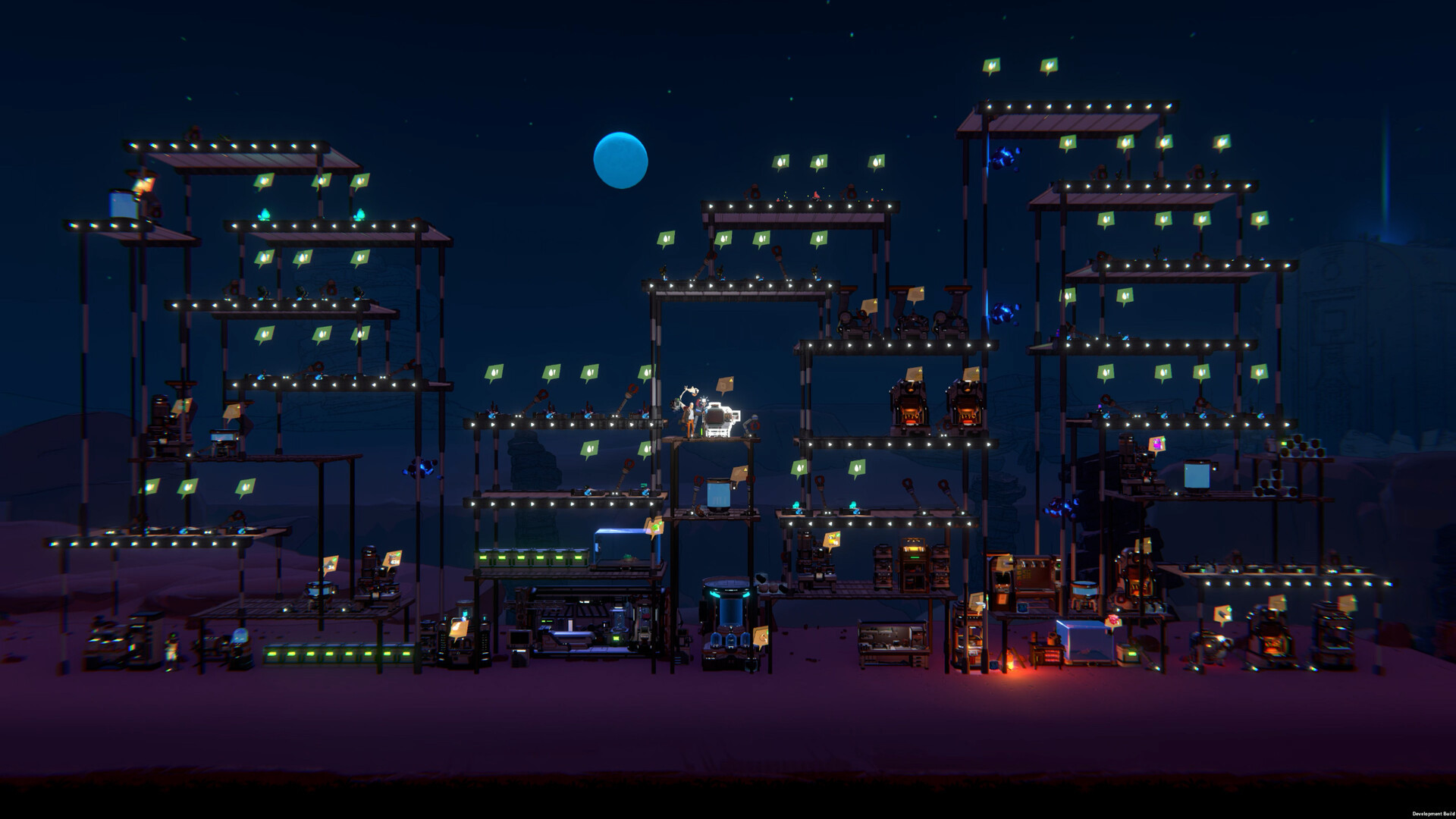
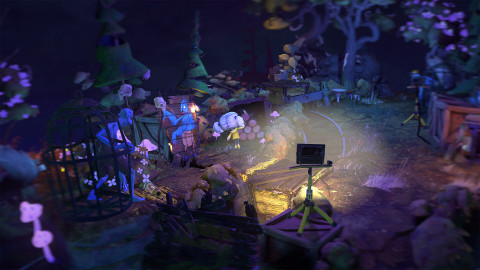
The world itself reinforces that feeling of vulnerability. The environments shift between glowing beauty and quiet menace: wind-swept cliffs under an enormous blue moon, eerie underground caverns pulsing with molten light, jagged rock formations that feel as though they’re holding their breath. It’s not just a space to explore — it’s a place to learn. Cataloging plants, minerals, and creatures feels less like a checklist and more like building a personal field journal in a world that no longer makes sense.
The game occasionally stumbles under the weight of its own ambition. The sheer volume of crafting chains can feel overwhelming, and there are stretches where optimization turns into busywork — the kind of fiddly rearranging that feels more like filing paperwork than engineering breakthroughs. But those moments tend to fade once another system locks into place or a new mobility tool completely changes how you navigate the terrain. The highs outweigh the grind.
What sticks most is how human the whole experience feels, despite all the machinery. Kent isn’t a chosen hero or a tragic icon — he’s a tired guy doing his best in a world that left him behind. His drive to automate, optimize, and push forward isn’t framed as conquest or domination. It’s persistence. It’s adaptation. It’s the deeply mundane — and surprisingly moving — act of figuring out how to live again.
By the time your base is a glittering labyrinth of humming lights and synchronized arms, there’s a strange comfort in watching it all run without you. Not because you’re unnecessary, but because your effort — every awkward death, every miswired conveyor, every half-burnt meal — has shaped something that can stand on its own.
It’s a game about survival, yes — but even more than that, it’s about the quiet satisfaction of turning ruin into rhythm.
-

I write. I rap. I run. That’s pretty much it.

Sort by:
Comments :0