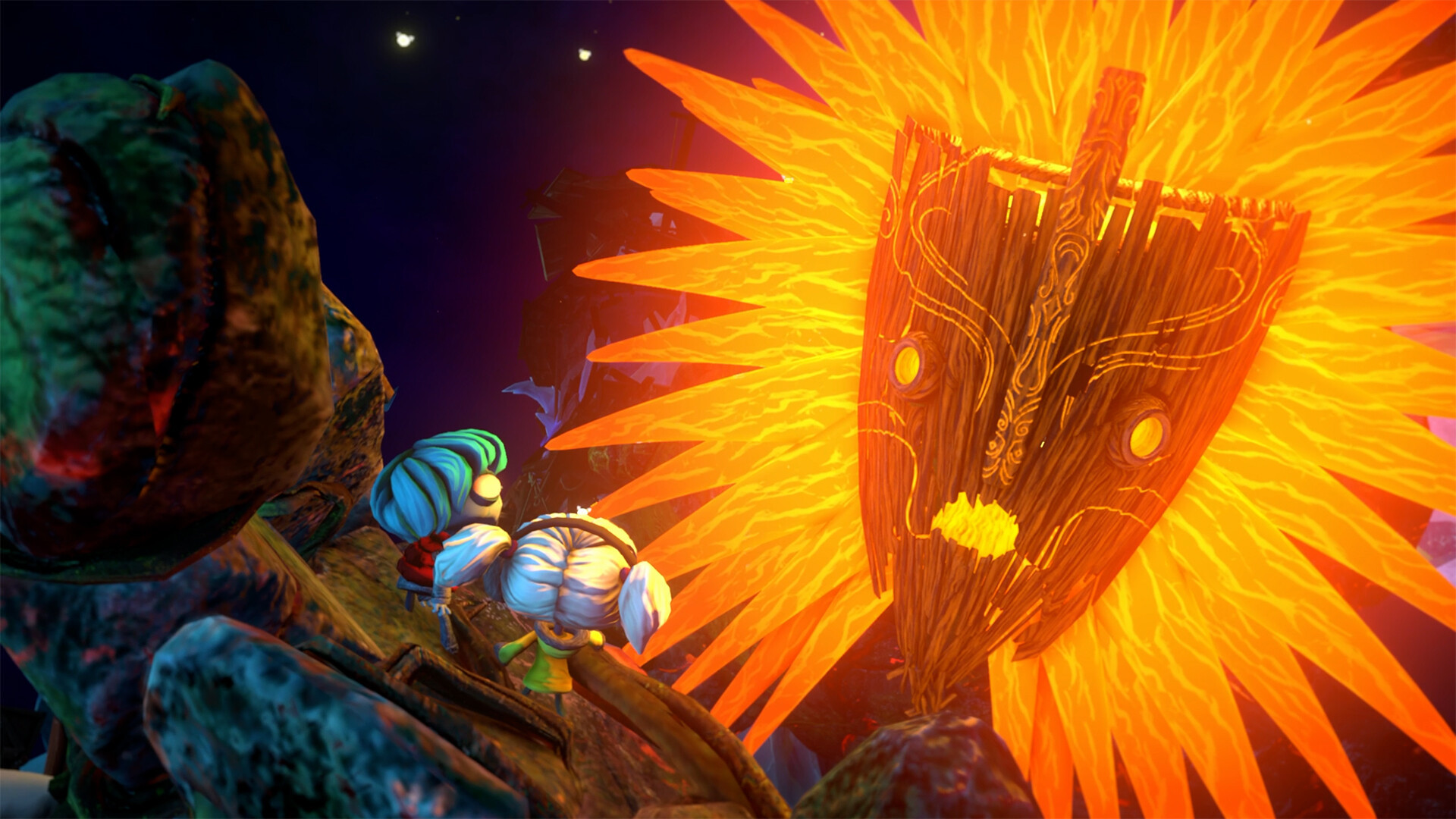
There’s a moment in Gloomy Eyes where the game’s whole pitch snaps into focus: you’re staring up at what looks like a handmade sun, all flame-petals and carved wood, like some furious theater prop that wandered offstage and decided it was going to become a god. Two tiny figures—Gloomy, a soft-looking zombie boy, and Nena, a human girl with the energy of a match struck in a tomb—stand at the edge of it, dwarfed by light that feels almost illegal in a world that’s forgotten how to do daytime. It’s the kind of image that makes you lean closer to the screen, not because you’re scared, but because you want to see how the brushstrokes work.
Gloomy Eyes is set in an eternal night where the living and the undead are locked in a long, bitter grudge match. Against that backdrop, the game tells a simple, stubbornly sweet story: two kids from opposing sides decide the rules are stupid, become companions, and go looking for the sun. The tale is framed as a fairy story—told by an old gravekeeper—so even when the world is bleak, the vibe isn’t misery. It’s more like being handed a candle and invited into a haunted diorama cabinet: “Yes, there are skeletons. No, they’re not going to jump out at you. Look at this tiny little crooked staircase.”
That “diorama” idea isn’t just marketing language. Each level is built like a miniature set you can rotate and inspect, a pocket world dense with details: cobwebbed corners, crooked planks, little props that feel placed by hand. In one scene, Nena stands in a cluttered, dusty room while a blue, hand-shaped specter claws its way out of a mirror frame—an eerie visual that still reads as storybook rather than horror-movie mean. Nearby, a skeleton slumps against a wall like it’s part of the decor, not a threat. That’s Gloomy Eyes in a nutshell: macabre, but gentle about it. “Creepy cozy” is an overused phrase, but here it fits because the game keeps choosing whimsy over shock.
Mechanically, the game’s defining hook is what it calls a “self-coop” setup: you control both characters, swapping between them to solve environmental puzzles. It’s a small thing with big implications. Instead of the game asking you to be one hero who can do everything, it asks you to think like a pair—two toolkits, two personalities, one shared goal. The puzzles lean into that duality: the feeling that progress is a conversation between two sets of abilities, and you’re translating.
That design choice also shapes the tone. Switching between Gloomy and Nena doesn’t feel like swapping weapons; it feels like toggling between two moods. Nena reads as the bolder, more mischievous half—the one who’d tug on the “do not pull” lever just to see what happens—while Gloomy’s presence brings a kind of quiet softness, the sense that even a zombie kid can be careful with the world. When the game is at its best, the puzzles aren’t just logic gates, they’re little expressions of trust: one character makes space, the other takes it; one risks, the other steadies.
The rotatable levels are the other half of the equation, and they’re where Gloomy Eyes distinguishes itself from a lot of puzzle-platformer cousins. Rotation isn’t just for sightseeing; it’s how you discover routes. A path that looks blocked from one angle becomes obvious from another. A gap turns out to be a tunnel. A “dead end” reveals a hidden ledge. This makes the game feel tactile in a way that’s hard to explain until you’ve seen it: less like navigating a flat stage, more like turning a music box in your hands until the mechanism clicks.
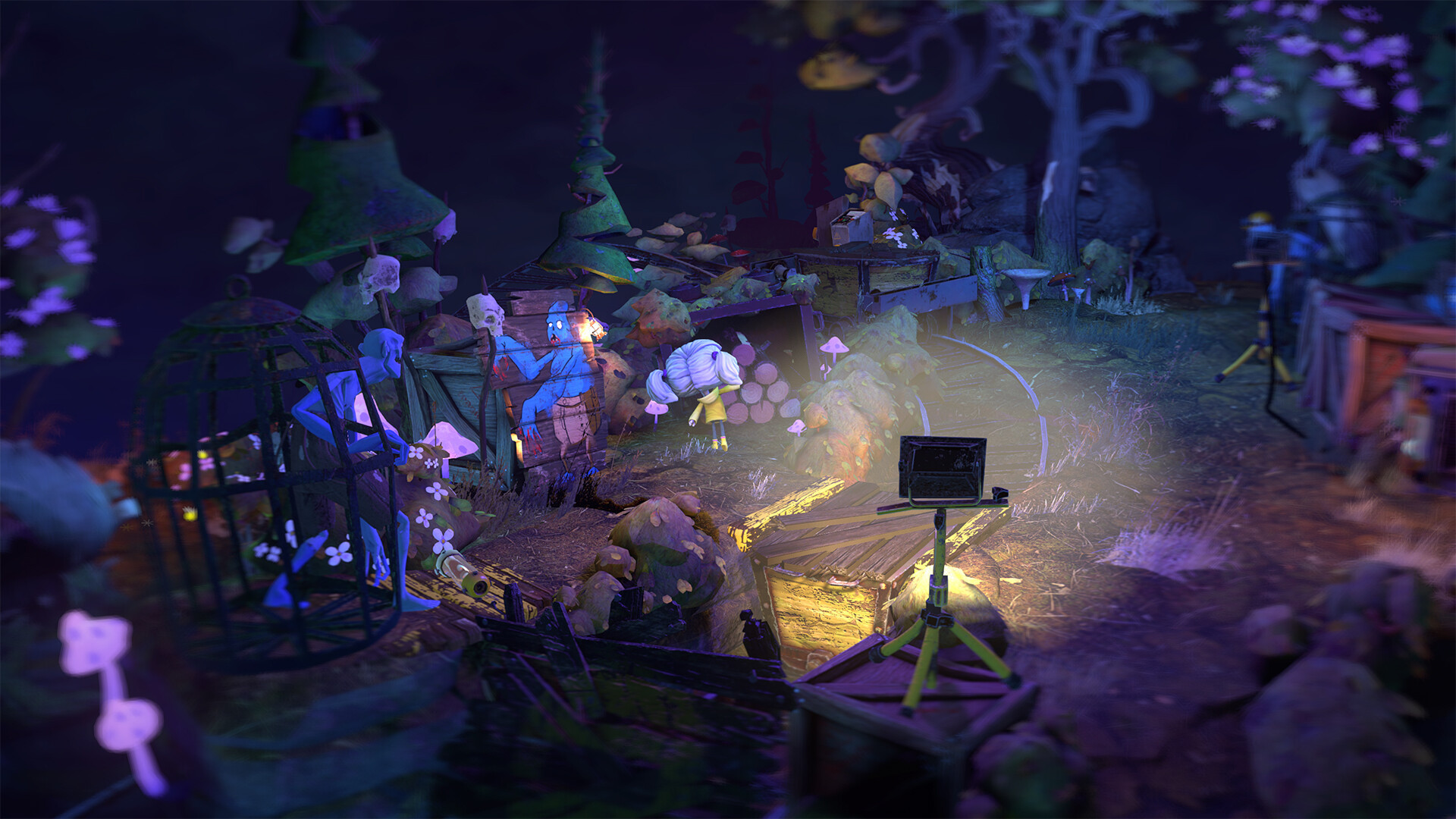
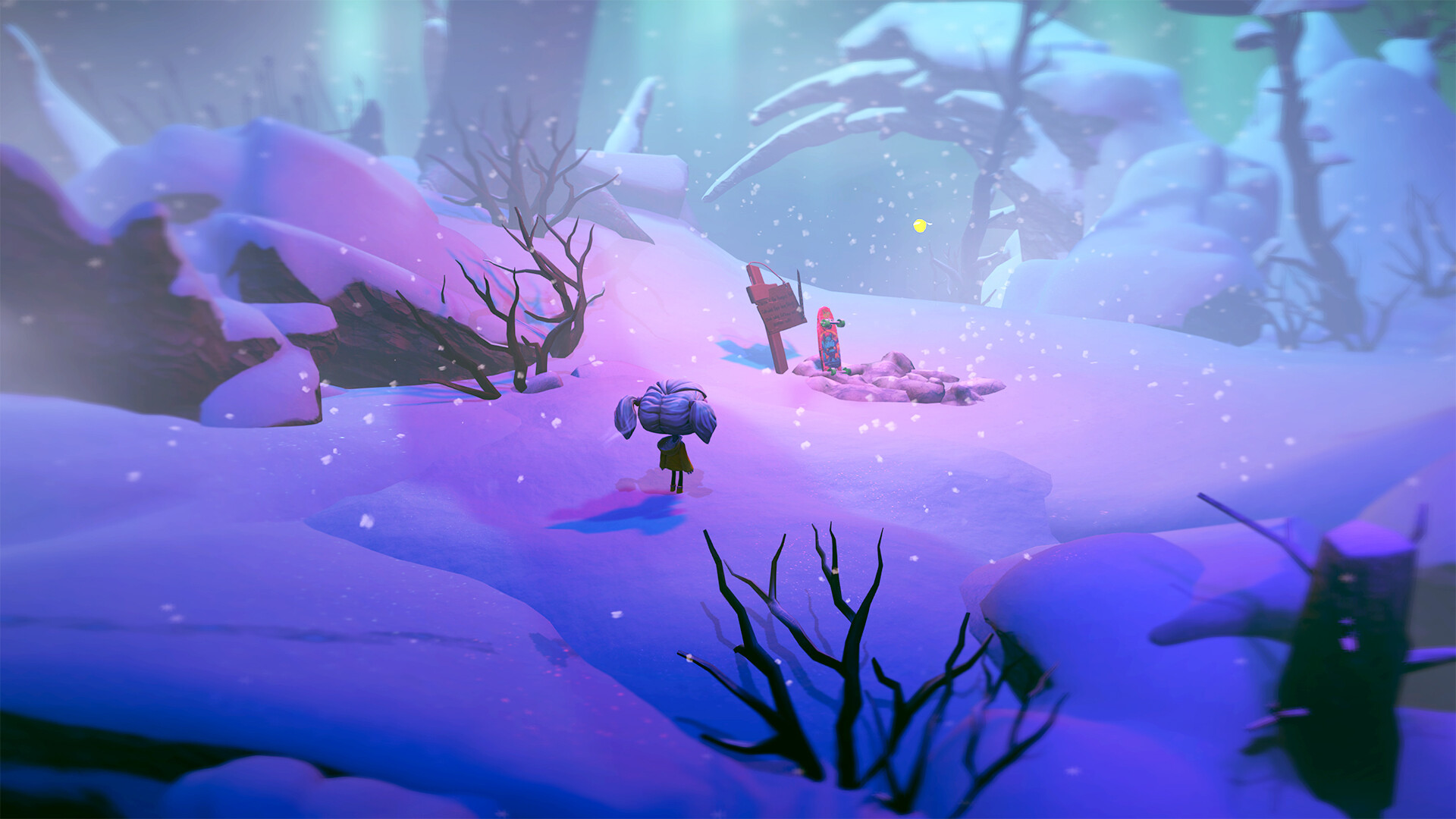
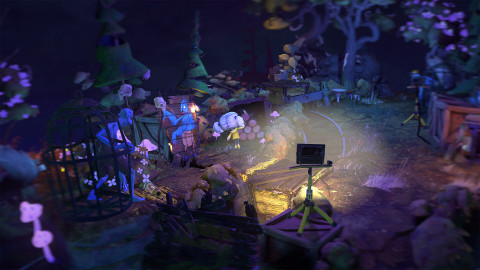
The visual design carries so much of the experience that it’s worth lingering on. The game wears its Tim Burton-esque inspiration on its sleeve, but it’s not just “spindly trees and big eyes” as a shortcut. It’s the craft sensibility—the sense that every scene is a physical object under theatrical lighting. One snowy level, tinted in soft purples and blues, looks almost serene despite the dead trees and drifting flakes; there’s an aurora-like glow in the distance that makes the cold feel dreamy instead of hostile. Another area resembles a junkyard-meets-forest stage set, with mushrooms, scattered debris, and a harsh little work lamp casting a circle of light like a spotlight on a play. These environments feel curated rather than generated, like someone wanted you to notice the shape of every shadow.
That said, the same things that make the game striking can also make it a little finicky. Rotating dioramas is a great idea until you’re rotating them because you’re not sure what the game wants from you. In puzzle games like this, clarity is everything: you want to feel clever, not lost. When a path is hidden by perspective, the line between “Aha!” and “Oh, come on” can get thin. The game’s charm buys it a lot of patience—because even when you’re stuck, you’re stuck in a place you enjoy looking at—but it’s still something you feel in your hands after a while: a little friction between the beauty of the set and the practicality of reading it.
The self-coop structure can also create occasional awkwardness, depending on how puzzles are staged. Any time a game asks you to manage two bodies in one space, there’s a risk of turning clever coordination into low-level herding: move this one here, swap, move that one there, swap back. When it’s paced well, it feels like choreography. When it isn’t, you start noticing the seams.
But when Gloomy Eyes hits, it hits in a way that’s hard to be cynical about. The story’s core idea—two “wrong” friends insisting on each other in a world that wants them separated—lands precisely because the game mechanics mirror it. You don’t just watch them cooperate; you make them cooperate, over and over, until the partnership becomes muscle memory. And the gravekeeper framing gives the whole thing that bedtime-story flavor where you already know the world is harsh, but you’re being told this particular tale because it contains a small, stubborn light.
I keep thinking about that carved, blazing sun again—the one that looks less like an astronomical object and more like a handmade promise. Gloomy Eyes is full of that kind of imagery: daylight as something fragile you might have to build yourself, piece by piece, from scraps of courage and curiosity. It’s not a game that’s trying to terrify you or impress you with brutality. It’s trying to make you feel a little haunted and a little comforted at the same time, like standing in the dark with a friend and realizing the dark isn’t winning as long as you can still see each other.
If you’re the sort of person who likes puzzle games that are more about mood than mastery, and who enjoys poking around in lovingly crafted worlds, Gloomy Eyes is an easy recommendation. It’s a gothic storybook you can turn in your hands—no jump scares, no gore, just a strange, sweet fairytale about two kids carrying a candle through the end of the world and refusing to let it go out.