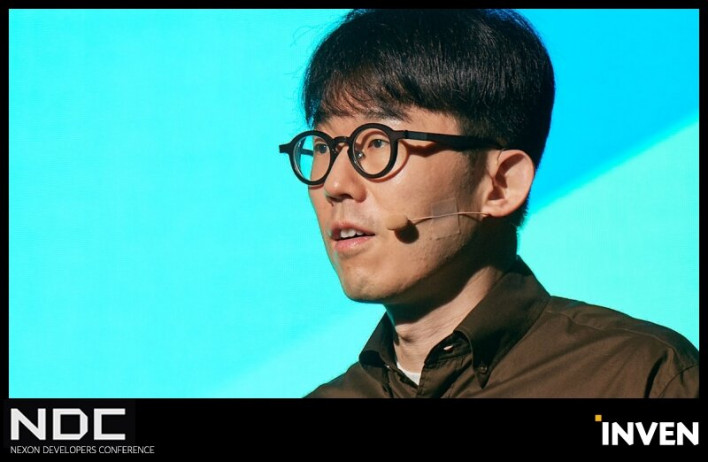
Topic: In an Era Where Implementation is Easy, What Do We Compete With Speaker: Nexon Korea Co-CEO Kang Dae-hyun Session: Keynote
Nexon Korea Co-CEO Kang Dae-hyun revisited a question he posed on the same stage eight years ago. At the time, under the title 'A Voyage Toward Fun,' he cited the example of curling—a sport once considered uninteresting—which captivated the entire nation during the 2018 PyeongChang Olympics.
The rules and the weight of the stones remained the same; what changed was the 'context.' Teams to root for emerged, dramatic comebacks occurred, and the name 'Yeong-mi' became a cultural touchstone. His conclusion eight years ago was: "The essence of fun exists even outside of implementation."
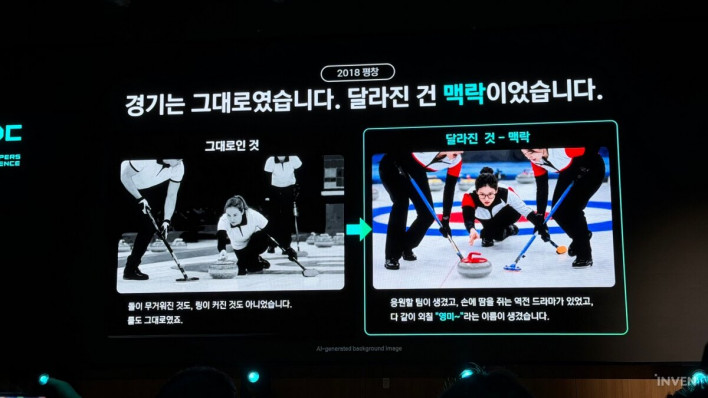
"In 2018, it was enough to discover that the essence lies outside of implementation," Kang said. "But in 2026, the barrier of implementation itself is rapidly collapsing. The question today is: where does the essence go now."
He began by using data to point out that the claim 'implementation is becoming easier' is not just a slogan, but an immediate reality. Much like the experience of scrolling through Netflix for 30 minutes because there are too many choices rather than too few, an explosion of options makes it harder to choose.
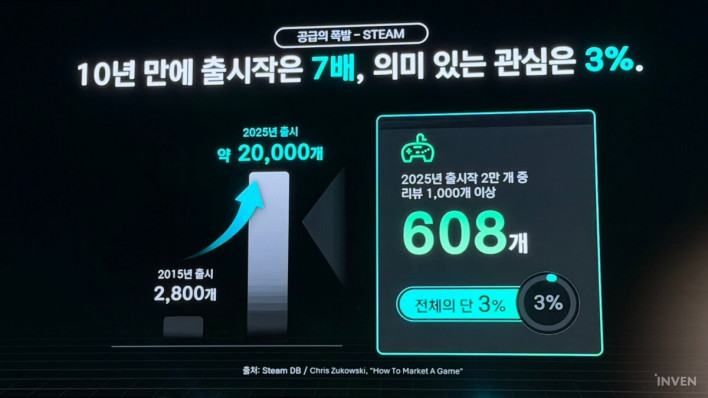
In his presentation, he noted that the number of games released on Steam grew sevenfold in a decade, from about 2800 in 2015 to roughly 20k in 2025. Of those, only 608 games—a mere 3%—received broad attention by surpassing 1k reviews. Meanwhile, a user's day remains limited to 24 hours.
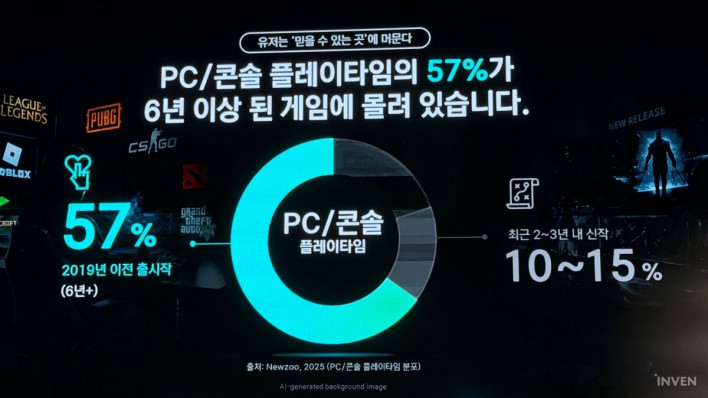
He also supported with statistics the idea that as choices increase, users stick to what they trust. Citing data from market research firm Newzoo, he revealed that 57% of PC and console playtime in 2024 was concentrated on games released more than six years ago. This means more than half of a player's time is spent on existing games, not new ones.
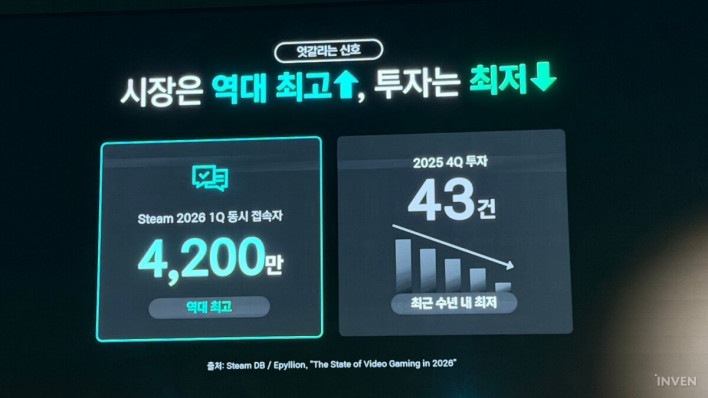
He observed that the flow of capital follows the same trend. He pointed out that while Steam concurrent users hit an all-time high of over 42 million this past March, breaking records three times this year alone, and industry-estimated revenue reached an all-time high last year, early-stage investment in the gaming sector has fallen to its lowest level in years. His diagnosis: "The market is growing, but the door to success is narrowing."
Kang added that AI is now entering this equation. While AI creates code, images, and prototypes faster, the key is that "it’s not just easier for us, it’s easier for everyone." He invoked the paradox identified by British economist William Stanley Jevons in 1865 regarding the 'Coal Question': contrary to the expectation that increased steam engine efficiency would reduce coal consumption, it actually caused consumption to skyrocket. This means that when work becomes easier, competition doesn't end; rather, the playing field expands and the center of gravity for competition shifts.
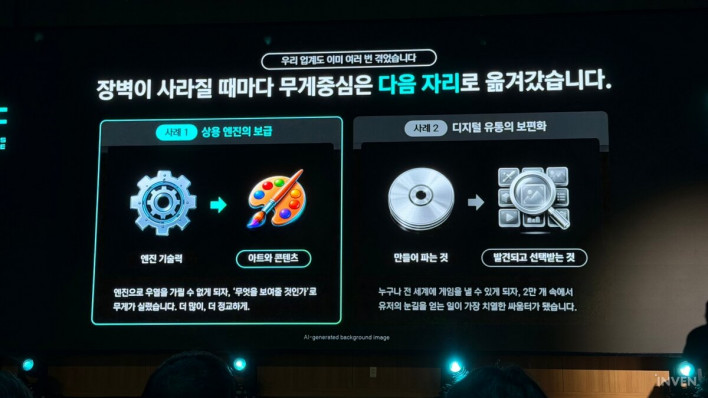
He noted that the gaming industry has experienced this multiple times. As commercial engines became standardized and no longer served as a measure of superiority, the focus shifted to art and content. As digital distribution became common and releasing games became easier, the fiercest battlefield became 'being discovered and chosen' among 20k games. New forms of competition—branding, personalization, marketing, and UA—emerged from this.
The next center of gravity proposed by Kang is 'context.' "Games must now compete not on the level of implementation, but on the depth of context," he said. If you ask a general-purpose AI to create a hat for a MapleStory character, it will produce a plausible but generic hat. However, when you add the style guide and understanding of users that MapleStory has built over 20 years, you finally get a hat that is 'MapleStory-like' and something an avatar would actually wear. He explained that context is what creates this difference.
While acknowledging that AI will become increasingly adept at handling context that can be converted into data—like style guides—he emphasized, "There is context that cannot be transferred through data alone, such as the living relationship built with users and the trust earned over time."

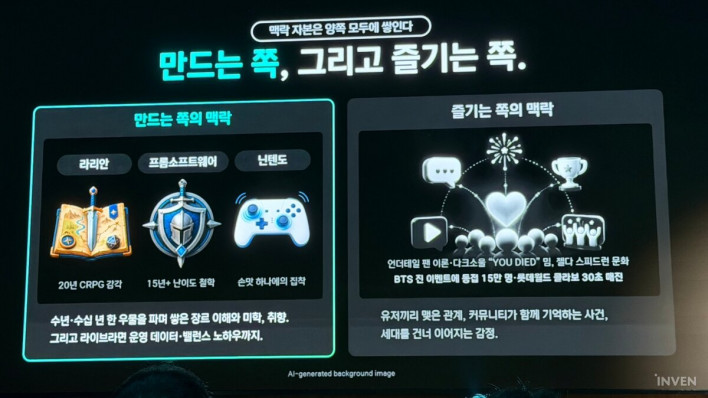
He named this accumulation of time 'Context Capital.' Context capital accumulates for both the creators and the players. For creators, it is the sense of judgment that becomes more valuable as AI takes over coding—like the sensibility Larian has built over 20 years or the philosophy of difficulty FromSoftware has solidified over 15 years. For players, it is the relationships formed between users and the emotions passed down through generations, such as fan theories for Undertale, the 'You Died' screen in Dark Souls, or speedruns in Zelda.
Citing Nexon's examples—such as the massive influx of users for the collaboration event with BTS' Jin, or the 10k tickets for the Lotte World full-day rental event selling out in 30 seconds—he said, "These are the results of 20 years of accumulated context bursting forth at once." He added, "Anyone can use an AI model, but context built over time cannot be bought with money; it can only be bought with time. This is the true capital of the AI era."
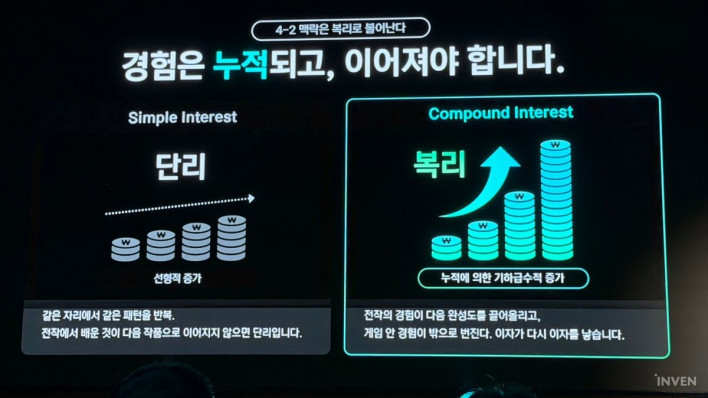
Kang then borrowed the financial concepts of simple and compound interest, noting that time alone does not automatically turn context into an asset. Repeating the same patterns in the same place is simple interest, but when the experience of a previous work elevates the quality of the next, and the experience within the game spreads outside of it, that is compound interest. It is a structure where time spent playing, watching videos, chatting in communities, and creating content all feed into one another.
He used the example of data showing users repeatedly dying to a specific dungeon boss. Looking only at the numbers, lowering the difficulty seems like the answer. However, looking at the community reveals that users are sharing strategies, showing off clear videos, and celebrating together, proving that the boss is not a nuisance but a part of the game's 'culture.' "Things invisible when looking only at data become visible when context is connected to context," he said. "AI can help with analysis, but deciding whether to maintain the difficulty and taking responsibility for it is ultimately up to the person who understands the context."
Kang viewed the connection of context as working like compound interest, where value explodes once it crosses a certain density. He cited soccer as an example. There are more people watching than playing, and many enter this world by encountering soccer through games before actual soccer.

He explained that 150 years of time have accumulated as compound interest as people who play, watch broadcasts, collect jerseys, and enjoy the game exchange experiences within the single world of 'soccer.' "The true gap arises from whether or not there is a world where experiences accumulate as compound interest, rather than the sheer size of the fun."
He believed that the 'Icon Match' hosted by Nexon last year was deeply moving because it was the result of the context carried by legendary players who had passed their prime. He said that when the moment comes that someone answers 'Dungeon & Fighter' or 'MapleStory' instead of 'games' when asked about their hobbies, it means that game has become an independent world like soccer.
As examples of worlds created by context, he pointed to Roblox, which launched in 2006 and now has over 130 million daily users 20 years later, and Minecraft, where users built a rich world on top of simple blocks. "This is not because of superior graphics, but the result of people's relationships and creations endlessly intertwining and building up," he said.
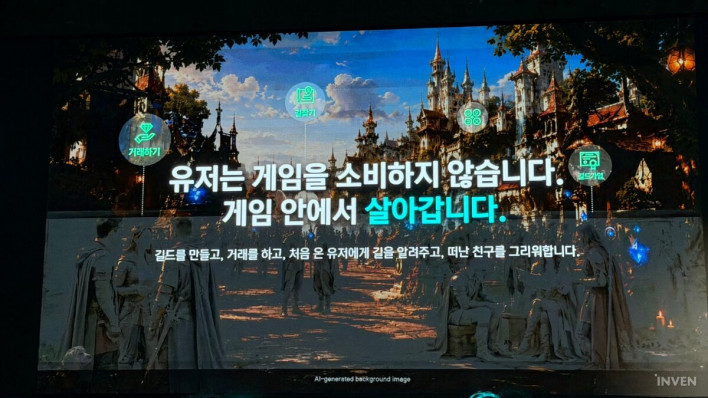
Kang also shared two scenes Nexon experienced firsthand. One was a wedding invitation that arrived at the customer service center late last year. A couple who had enjoyed a game together for five years shared news of their marriage along with memories from the game, noting that even on days when they fought and weren't speaking, they continued to talk in-game because they had to defeat a boss together.
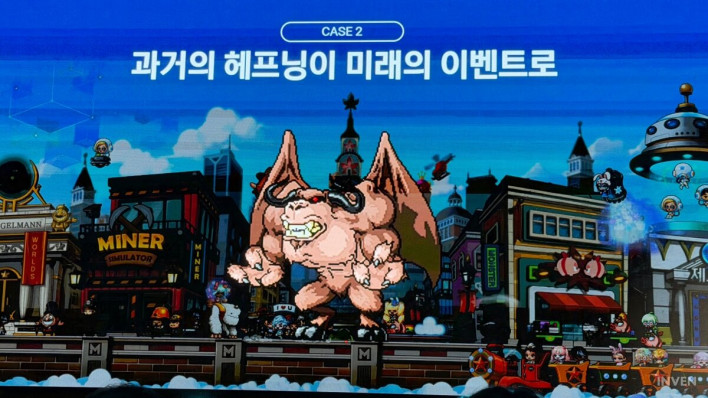
The other was the 'Kerning City Catastrophe' in MapleStory. When a user opened a gift bag received from an event in the middle of Kerning City, a Junior Balrog—a super-high-level monster at the time—popped out, turning the town into chaos. Even though it wasn't planned content, users gave it a name and it was talked about like a legend. Years later, a creative team on the user-creation platform MapleStory Worlds even made it possible to recreate this event in 'Mapleland.'
"Users don't just consume games; they live within them. What we created with code was just a stage for life to unfold; the life itself was filled by the users," he said. "Context is something built not by the developer alone, but together with the users, and this is the uniqueness of the medium of games." He explained that games are the only medium where fans enter the work to live, and that life changes the work itself in real-time.
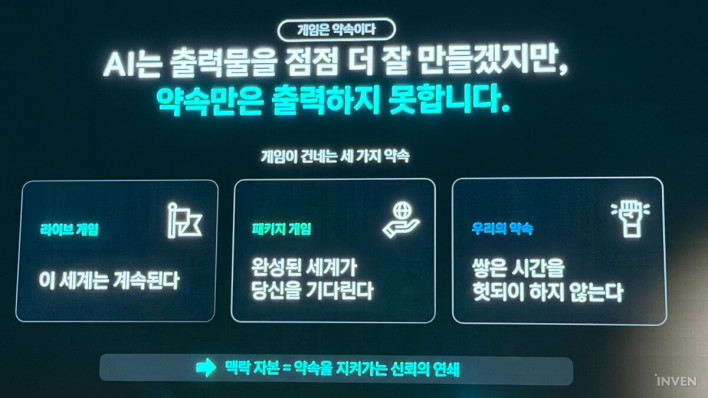
Kang also proposed the proposition that "a game is not a printout, but a promise." In live games, it is a promise that this world will continue; in package games, it is a promise that the completed world will wait for you forever; it is a promise that the time you have invested will not be in vain.
"AI will get better and better at making printouts, but it cannot print promises. Promises only accumulate when they are kept, and they collapse the fastest the moment they are broken," he said. "Yesterday's promise must be kept for today's promise to be believed, and that chain of trust is another name for context capital."
Regarding the question of whether large companies that have operated old games have an advantage if context only accumulates with time, Kang replied, "What creates the gap in compound interest is not the size of the principal, but the interest rate—that is, the method of accumulation." Larian was once a studio on the verge of bankruptcy, and Roblox didn't receive much attention when it launched in 2006, but they reached their current position because they didn't let even a single small experience slip away, connecting it to the next work and the next user.
He believed that smaller teams could actually have an advantage in 'interest rates' because their decisions are faster and they are closer to users, allowing them to reinvest what they learned today more quickly tomorrow. He added, "The 20 years of context Nexon possesses is also not a finished asset, but an asset that loses its luster the moment we stop accumulating it today."
Kang concluded his presentation with two types of 'AI.' One is the Artificial Intelligence we talk about every day, which lowers implementation costs quickly but makes it difficult to differentiate because it is given equally to everyone. The other is Accumulated Intelligence, which is context capital that connects through compound interest—the time spent with users, the judgment accumulated through operation, and the culture created with the community. It cannot be bought with money, cannot be created with prompts, and only accumulates through time.
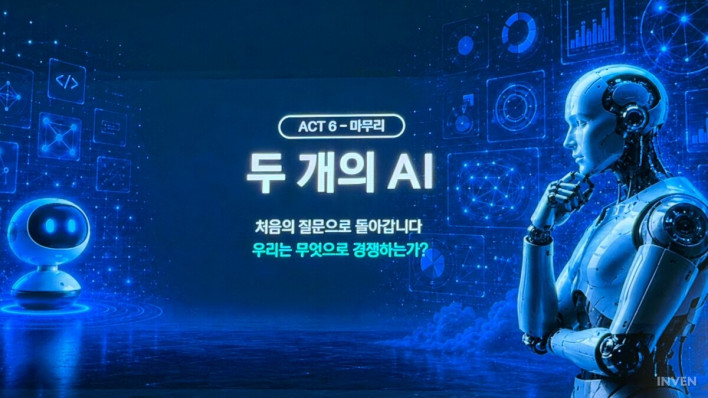
"The first AI is everyone's weapon, but the second AI belongs to those who recognize the value of context," he said. "In an era where implementation is becoming easier, the weapon we must wield is to use the first AI better than anyone else while building the second AI more thickly on top of it."
"The sum of the life spent with users cannot be replicated by any competitor or any AI," Kang emphasized. "On top of the artificial intelligence that anyone can buy and use, you must build another AI: accumulated intelligence."
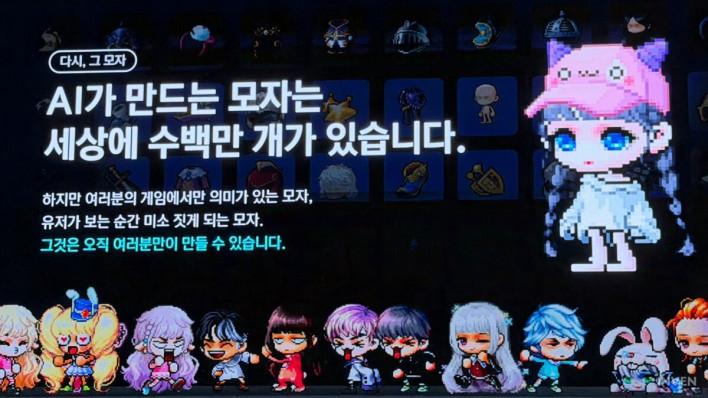
"There are millions of hats in the world made by AI, but a hat that has meaning only in your game, a hat that makes users smile the moment they see it, can only be made by you," he said. "What matters is not the size of the starting point, but whether you started accumulating today."
Recalling his appearance on stage eight years ago with his curling confession, he concluded the keynote by saying, "Even if the game remains the same, context creates a world. The moment your game becomes such a world to someone will also come from the time you start accumulating today."

Sort by:
Comments :0