
The second expert policy forum on the proposed full revision of the Game Industry Promotion Act, hosted by the Game Self-governance Organization of Korea (GSOK, Chair Hwang Sung-ki), was held on the 6th at the Korea Press Center in Jung-gu, Seoul.
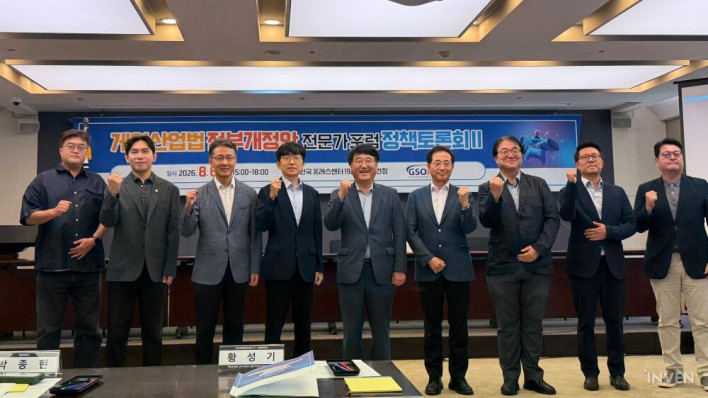
At the forum, GSOK Chair Hwang Sung-ki reviewed the key issues and achievements of the second half of the year. Following this, Professor Park Jong-hyun of Hanyang University Law School presented on game-related governance such as the proposed Game Promotion Agency; attorney Lee Byung-chan of the law firm Onsaemiro discussed the content rating system and the reporting system for content modifications; and Professor Yoo Byung-jun of Seoul National University spoke on prize regulations and anti-gambling measures.
Chair Hwang assessed the significance of the full revision as "an attempt to resolve various long-standing issues related to games, addressing criticisms that the current Game Industry Promotion Act fails to keep pace with the era of online, mobile, and global platforms."
"He added, "Changing the name of the law to the 'Act on the Promotion of Game Culture and Industry' and expanding the scope of promotion from just the 'game industry' to 'game culture and industry' acknowledges games as sound cultural content, moving away from the view that they are merely addictive or commercial products.""
Chair Hwang emphasized that the amendment could be "a significant milestone for designing the next 20 years of the Korean game industry, serving as a highly advanced legislative model that overcomes the limitations of the outdated system maintained for over two decades while simultaneously achieving user protection and industrial development."
In particular, Chair Hwang highly praised the 'redesign of the anti-gambling regulatory system.' He stated, "A prime example is applying prize regulations under the current Game Industry Promotion Act only to arcade games while abolishing them for online games. If enacted, this would be a positive step, as it would finally allow the anti-gambling regulatory system—which has stifled the growth of the entire industry—to move past the 'Sea Story trauma' or 'anti-gambling dogma.'"
Professor Park Jong-hyun pointed out that the structure of establishing a Game Promotion Agency with a Game Rating and Administration Committee inside it presents "the problem of coexisting bodies with heterogeneous duties and characteristics." He explained that since the promotion-focused agency and the consensus-based committee have diametrically opposed operational directions, practical guidelines are needed to ensure organic linkage and integrated harmony between the two.
"Professor Park also expressed concern, stating, "In a structure where an independent body is integrated into a subordinate organization of the agency, clear guarantees for budget and infrastructure are necessary to ensure the fairness of review authority is not compromised. Without carefully refining the differentiation of duties between the agency and the committee, project duplication and financial waste could worsen.""

"Regarding changes to the entities and methods of the content rating system, attorney Lee Byung-chan noted, "The current law mandates that the Game Rating and Administration Committee verify whether games submitted for rating are gambling games, but the amendment deletes this clause, raising concerns about a regulatory vacuum." He suggested, "To fill this gap, it is necessary to specify and include how the committee will monitor and correct omissions or misjudgments by self-rating providers.""
The amendment shifts the reporting of content modifications to be handled by self-rating providers. Attorney Lee stated, "Regulations are needed to ensure that modifications requiring a change in rating are either deleted or provided in their original form." He added that while safeguards for digital games simulating gambling are necessary, the current exemption scope remains too narrow given the nature of general online games with frequent real-time updates, and thus needs to be expanded.
"While evaluating the shift toward a rating system centered on self-rating providers as a "rational direction reflecting industrial reality," attorney Lee emphasized that "problems such as the regulatory vacuum for gambling-simulating digital games, the lack of fundamental reform in the content modification reporting system, and regulatory inconsistencies due to shortened appeal periods and dual classification must be addressed.""

Professor Yoo Byung-jun pointed out that there is an inherent policy dilemma in game prize regulations. Article 28, Paragraph 3 of the current Game Industry Promotion Act considers the provision of prizes as promoting gambling, with exceptions only for toys and stationery in all-ages games at youth game centers. Conversely, overseas game companies, such as those in China, are effectively exempt from domestic prize regulations, and virtual gifts (like flowers) in live streaming are effectively allowed to be converted into cash.
Professor Yoo also highlighted an economic paradox. He pointed out that as prizes were banned, reliance on Google and Apple platform advertising deepened, resulting in a structure where 30% of revenue is leaked overseas as commissions. Professor Yoo analyzed that as a result of relying on overseas advertising costs instead of prizes, the average operating profit margin of the same group fell by 16.1%. He estimated that with both commissions and marketing costs being paid to Google and Apple, more than 50% of revenue is lost to these expenses.
Regarding overseas cases, he introduced that Japan distinguishes between banning 'complete gacha' and prize events, allowing prizes within limits; the U.S. broadly allows them conditionally by distinguishing between lotteries and skill-based competition. The EU, including the UK, is strengthening gambling regulations on gacha items but allows prizes themselves, while China allows them with restrictions, though it effectively permits the cashing out of virtual gifts from live streaming. In contrast, Korea is considered the strictest by international standards, with a de facto total ban and no exception clauses.
"Professor Yoo emphasized, "We must change the question of regulatory design. Regulatory design should start not with what to block, but with how to distinguish.""
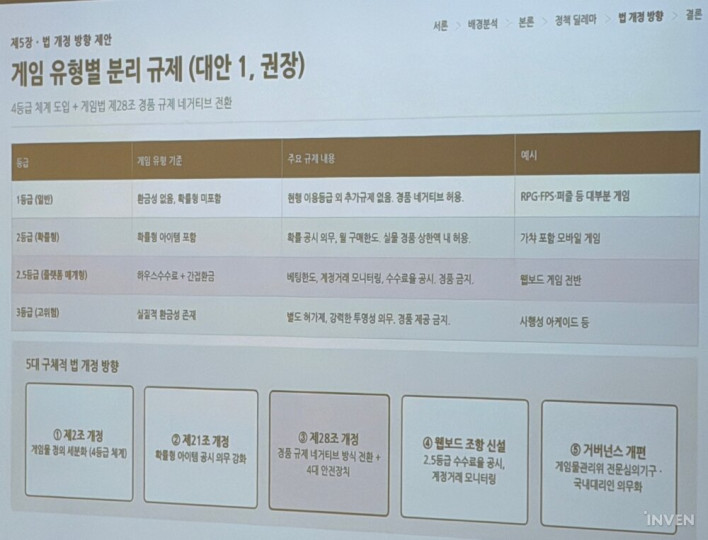
Accordingly, Professor Yoo proposed dividing prize regulations into a 4-tier Grade system and shifting to negative regulation. The plan is to categorize games into Grade 1 (General), Grade 2 (Gacha-based), Grade 2.5 (Platform-mediated), and Grade 3 (High-risk), and then allow or ban prizes based on the presence of actual cashability. He envisions allowing prizes for most games like RPGs, FPS, and puzzles (Grade 1), permitting prizes within a limit for Grade 2 games containing gacha items, and maintaining the current ban on prizes for Grade 2.5 online card and board games and Grade 3 gambling-style arcades.
"Professor Yoo explained, "Relaxing prize regulations is not simply about giving benefits to game companies. It produces the effect of returning direct benefits to domestic users and circulating marketing costs that would otherwise leak to overseas advertising platforms back into the domestic ecosystem." He emphasized, "For Representative Cho Seung-lae's amendment to achieve actual legislative results, it must shift from a comprehensive approach of 'relaxing gambling regulations' to a precise direction of 'strengthening separate regulations by gambling risk grade + shifting to negative regulation for prizes.'""

The designated discussion following the presentation included game critic Lee Kyung-hyuk (Dragon Lab), attorney Lee Yong-min of the law firm Yulchon, Lee Chul-woo, head of the Korean Game User Association (attorney), and Professor Jang Myung-gyun of Hoseo University.
Critic Lee Kyung-hyuk borrowed the biological term 'convergent evolution' to address the boundary between games and gambling. He diagnosed, "Illegal youth gambling sites are increasingly looking like game screens. In a situation where non-games keep pretending to be games, how to redefine the identity of this medium will be a battle in an area that the law has not yet covered." He also pointed out that while the law distinguishes gambling based on cashability, the meaning of 'gambling' used in society is different.
"For this reason, the critic supported the idea that the post-management body should be a consensus-based committee. This is because the boundaries of the gray zone must be continuously redrawn in a cycle where the law changes reality and that reality returns to the law. He emphasized, "Who to seat on the committee is the part that needs the most attention; what happens after the law is more important than the legal clauses themselves.""
Attorney Lee Yong-min stated that the structure of the Game Promotion Agency, which houses both promotion and regulation, "does not seem to have any particular problems." He argued that since regulation of elements that cross the line is inevitable for promotion, it is more efficient to have policies enforced with consistent standards. He cited the relationship between the Korea Copyright Protection Agency and the Copyright Protection Deliberation Committee as a similar precedent.
However, regarding the separation of game promotion tasks from the Korea Creative Content Agency, he expressed caution, saying, "We need to consider whether problems will arise when we need to organically collaborate with other fields like film and music if only games are separated." He added that the agency should also handle e-sports tasks with significant weight.
"Regarding prize regulations, he cited his practical experience. Attorney Lee expressed concern, saying, "There are quite a few cases where Korea answers 'absolutely not' when foreign game companies ask 'why on earth is this not allowed?' While domestic game companies have faithfully implemented regulations, the illegal market is growing, leading to a structure where the more you follow regulations, the more your profits shrink.""
"He evaluated Professor Yoo Byung-jun's separate regulation proposal by type as "a starting point from which concrete discussions can begin," and suggested that online card and board game regulations, which are currently based on guidelines without legal grounds, and uniform regulations on general arcade games with strong family-entertainment characteristics also need to be re-examined. Regarding appeals against content ratings, he requested improvements to guidance, stating, "You need to know the actual reasons for a decision to file a proper appeal.""
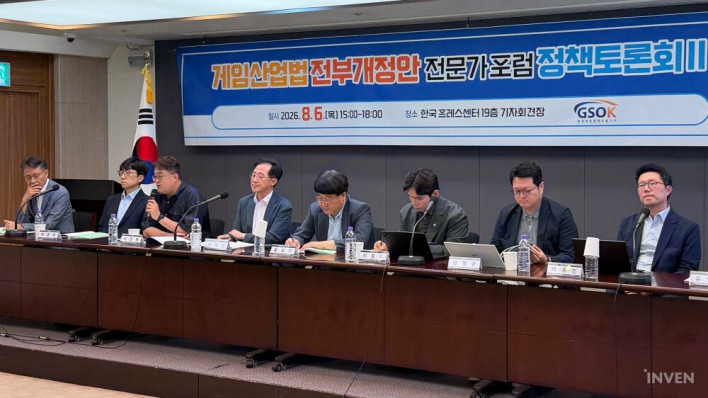
"Attorney Lee Chul-woo agreed with the purpose of the presentation regarding the structure of housing promotion and regulatory bodies in one agency, stating, "I don't understand why it would be unconstitutional; it is a matter of legislative policy choice." He suggested content for the special committee's discussion: revising clauses designating harmful media under the Juvenile Protection Act following privatization, filling gaps in regulations for re-designating self-rating providers, and dividing the consensus-based post-management body into a Digital Game Committee and a Location-based Game Committee. He argued that because the two areas are bundled together, "there are many parts where each side loses out.""
"Regarding the practice of not disclosing the reasons for rating appeals in detail, he explained that the background is the fear of so-called 'line-walking' that probes the boundaries, but suggested, "It is better to make the reasons clear in accordance with the spirit of the Framework Act on Administrative Regulations and the Administrative Procedures Act, with the exception of gambling-related parts.""
Regarding prize regulations, he expressed both empathy for user rights and a sense of déjà vu from the Sea Story incident. Citing the case where the provision of a statue commemorating the "First Kill" of the Kazeros Raid in Lost Ark was canceled due to gambling concerns, he said, "This is disadvantageous to user rights and needs improvement." At the same time, he said, "The core trigger for Sea Story was the notification on gift certificates for prizes, and its start was also a good intention to revive the book, music, and film industries," and cautioned against uniformly shifting the system in a positive direction for the sake of industrial promotion. As an alternative, he proposed delegating relevant clauses to enforcement decrees and specifying them in a negative way that allows as much as possible at the enforcement decree level.
"Attorney Lee urged the priority handling of three items: mandatory identity verification for all-ages games, mandatory legal representative consent for youth game usage contracts, and the realization of prize regulations, calling them "parts that both the industry and users desperately want.""
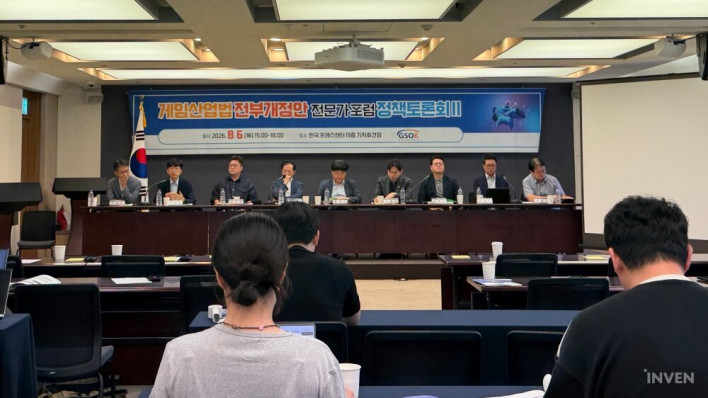
"Professor Jang Myung-gyun agreed with risk-based differential regulation, noting, "The full revision distinguishes the form of games, but Professor Yoo's presentation suggests distinguishing the typological characteristics of games." He explained that the essence of separate regulation lies in escaping from comprehensive regulations that bundle even the majority of games with low gambling risk into the same category as gambling. He cited the 2016 abolition of the Fair Trade Commission's prize notification, which set prize limits for department stores and marts, as a precedent in the distribution sector, saying, "Regulations changed to a method of opening up sales methods while only catching points of abuse.""
"Because Article 28 of the current Game Industry Promotion Act is a positive system, he said, "Even a coffee coupon for attracting customers could be caught up in gambling controversy," adding, "They say a burnt child dreads the fire, but now we need a standard to distinguish between the turtle and the pot lid.""
Professor Jang proposed four criteria for distinction: excluding highly liquid prizes such as cash, gift certificates, and virtual assets; prohibiting the facilitation of currency exchange and connection with professional money changers; blocking structures where larger payments increase the chance of winning and preventing repeated youth payments; and registering and post-verifying high-value/payment-linked prize events. He suggested that online card and board games should be managed on a separate track, distinguishing them from gacha items, casinos, and illegal gambling, with intensive management of usage limits, commission rates, and profit/loss information.
Regarding private self-rating, he said, "Autonomy is not an exemption from responsibility, but a shift in the method of responsibility," and ordered a mechanism to automatically transfer to public review when risks are discovered. Regarding the overall amendment, he requested provisions for supporting small and medium-sized/indie game companies and retraining developers in response to the spread of generative AI. He emphasized, "What is needed now is not to remove the fence of regulation, but to move and rebuild the fence where the risk actually exists."

Sort by:
Comments :0