When Blizzard launched the World of Warcraft: Midnight expansion, it heavily restricted the game client API. As a result, the addon WeakAuras, which had become an essential part of raid progression over the years, was effectively crippled. Ahead of Midnight’s release, the WeakAuras development team officially announced that it would cease development for the expansion.
Blizzard had clearly explained the intent behind that decision. In an interview conducted ahead of Midnight’s launch, Ion Hazzikostas said that the goal was to ensure that “all players can enter combat with the same level of tools,” and added that Blizzard wanted to create an environment in which “the players with the greatest skill and coordination” would come out on top. He also acknowledged that complicated addon setups had long functioned as a barrier to entry for new users, and stressed that these restrictions would help tear that barrier down.
Community reaction to the decision was mixed. Many users complained about the inconvenience, but at the same time expressed support for the broader direction of reducing dependence on addons. If Blizzard’s explanation were taken at face value, the game was now supposed to become an environment determined not by “who is better at setting up addons,” but purely by player skill and teamwork.
And yet, the actions of the top guilds competing in the Race to World First (RWF) have drawn attention. These guilds created their own internally developed assignment addons to replace WeakAuras, and openly used them on official streams. Blizzard’s response, however, was not to crack down on those addons.
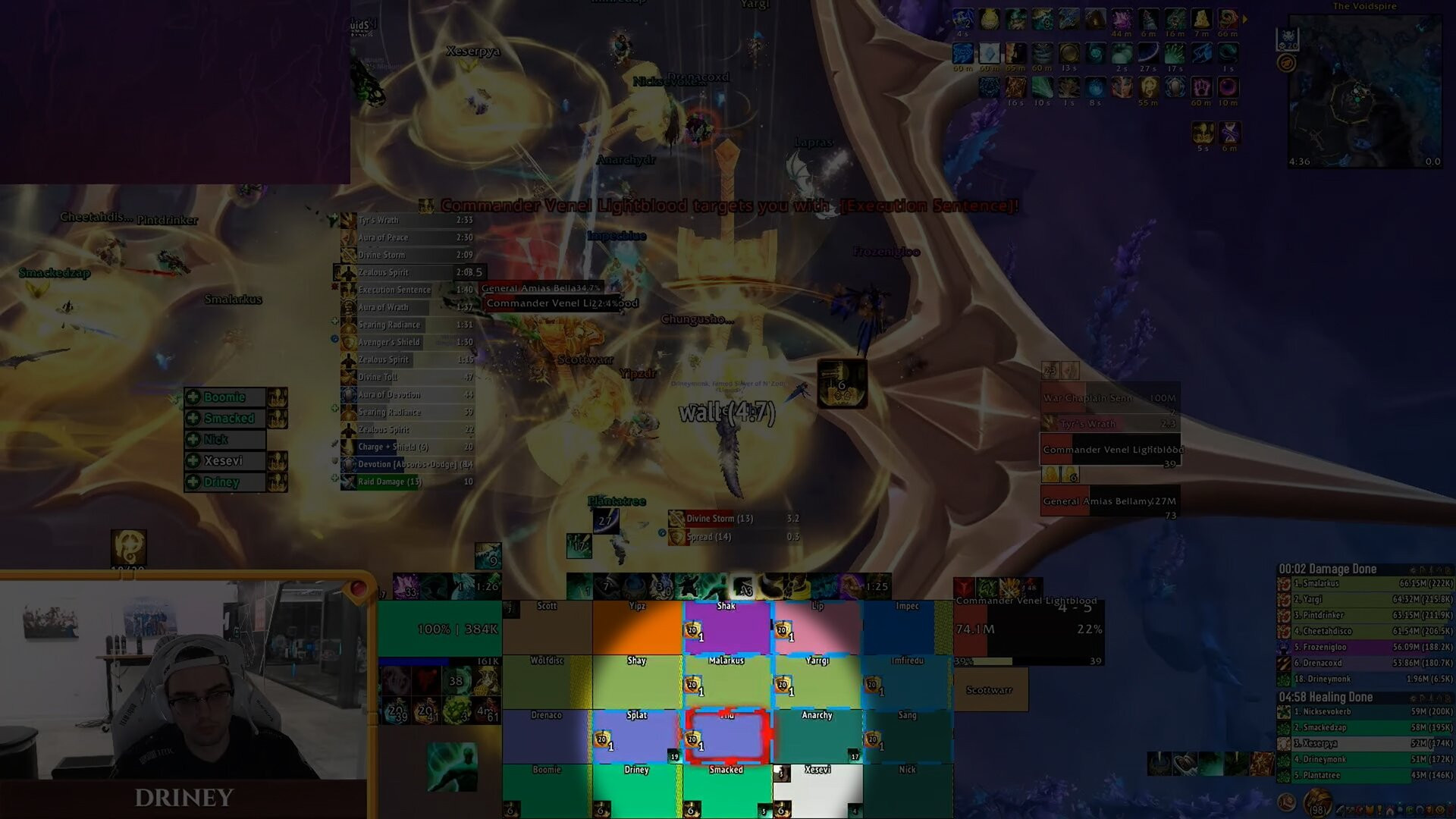
▲ Assignment addons still exist in Midnight. (Source: Team Liquid MMO YouTube)
At the center of the issue is Lightblinded Vanguard, the fifth boss on Mythic The Voidspire. After top guilds defeated the earlier bosses too quickly, Blizzard preemptively buffed the fifth boss in an apparent effort to slow the rate at which the content was being consumed. Through a hotfix, Blizzard dramatically increased the number of targets affected by Retribution Shield from four to eight. This ability is structured so that unless a dispel-capable class removes it immediately, a powerful follow-up hit lands within seconds, killing the target outright. The English boss and raid names are confirmed in current official/community usage, and Blizzard’s March 31st hotfixes also list Lightblinded Vanguard and Retribution Shield in English-language coverage.
Top guilds concluded that handling this mechanic—dealing with eight players at once—would be extremely difficult without an assignment addon. In the end, they built one themselves, openly used it on official broadcasts, and defeated the boss. Blizzard took no action against them. From the average user’s perspective, it was a bitter sight. Blizzard had directly locked down the API and neutralized WeakAuras, yet it effectively turned a blind eye when top guilds filled that gap with a new addon of their own.
As a result, top-end guilds and ordinary players are now having fundamentally different experiences against the very same boss. Those with access to addons get a highly structured combat environment in which roles are assigned automatically. Those without them are forced either to improvise in the middle of chaos or simply wait until Blizzard eventually lowers the difficulty after the fact. This is not merely a difference in player skill. The presence or absence of addons is splitting the combat experience itself, creating a reality that runs directly counter to the “same experience” Blizzard so strongly emphasized.
In the end, the familiar structure has simply returned: top players use addons, while ordinary players do not get to. The gap between Blizzard’s stated goal—that “all players can enter combat with the same level of tools”—and the actual reality is substantial. The hope that addons as a barrier to entry would finally be reduced was short-lived. In practice, addons still exist for the most influential players, while ordinary users have merely been left more inconvenienced. Under those circumstances, it is hard not to ask whom this policy was really for.
This article was translated from the original that appeared on INVEN.

Sort by:
Comments :0