※ This article contains spoilers for the Lost Ark story. Please proceed with caution if you are currently playing through the main quests.
Can You Clear It in 10 Minutes?! The Velgadin Prologue Quest
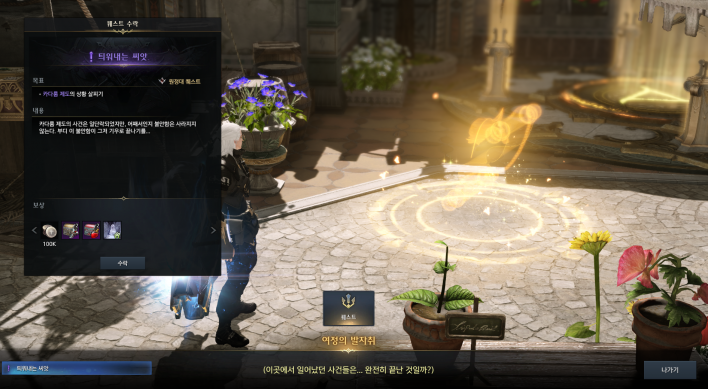
The July 29 update introduced the prologue quest for the Shadow Raid 'Velgadin.' The quest follows the investigation into the anomalies that occurred after the events at the Kardarum Islands, with a total playtime of about 10 to 15 minutes. Completing the quest rewards players with music tracks related to Velgadin.
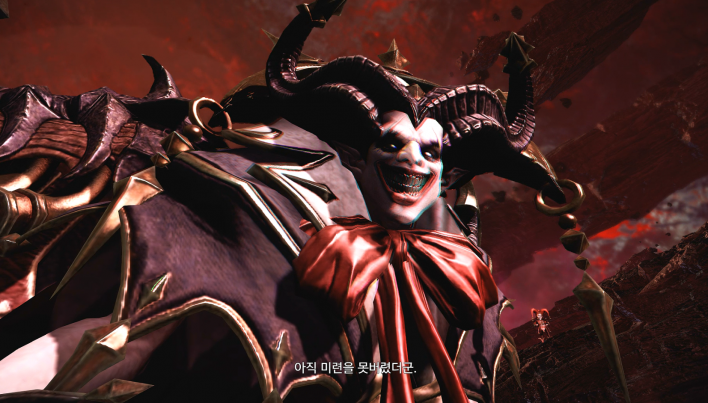
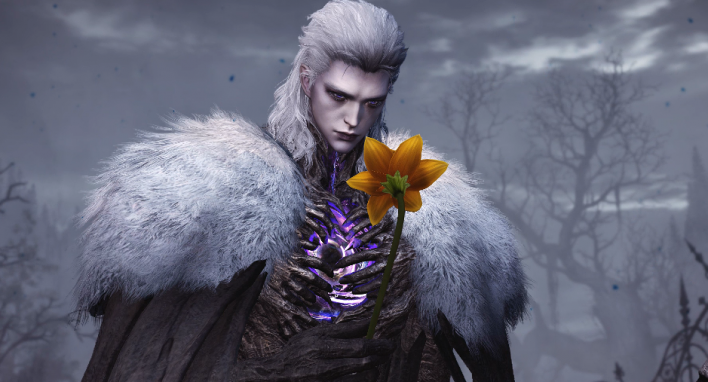
While the quest itself is short, it features several scenes that offer glimpses into Velgadin's past, the true objectives of Sacria, and the identities of the 'Primordials' (those who have existed since the beginning). In particular, the recurring emphasis on Velgadin's 'lingering attachment'—highlighted by a scene where he offers flowers to a woman—is striking.
The story picks up directly from the final moments at the Kardarum Islands, depicting Pope Kustor, Federico, and the adventurer as they work to stabilize the situation. The damage to the islands is severe due to the atrocities committed by the Order of Twilight. Amidst this chaos, the situation worsens further with the intrusion of 'Velgadin,' a Primordial who has acquired a new physical form.
Mysteries Surrounding Velgadin
- The 'Lingering Attachment' Velgadin Could Not Let Go
In the prologue quest, Kouku-Saton says the following to Velgadin:
"You still haven't let go of that attachment... even after becoming a saint." - Kouku-Saton
On the surface, this could be interpreted as Velgadin's memories and attachments persisting within his host, Foetus an Cragma. However, if the subject of "even after becoming a saint" is taken to be Foetus an Cragma, it suggests that this entity may have harbored its own separate attachment even before taking over Velgadin's body.
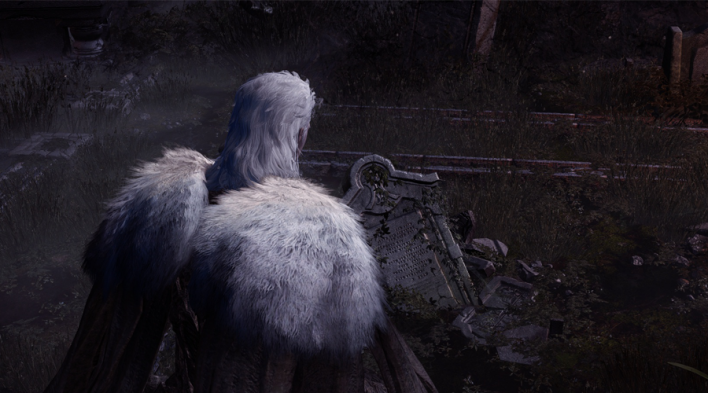
The object of this attachment appears to be a lover named 'Isabella.' In the quest, Velgadin offers yellow daffodils at Isabella's tombstone with a look of deep remorse. Who Isabella was and her exact relationship with Velgadin remain undisclosed. While one might first assume she was a lover or family member, the possibility remains that she was someone Velgadin failed to protect in the past.
Given that the Primordials have lived for eons and are described as being akin to 'amoebas' without a shell, it is crucial to determine whether this attachment belongs to Velgadin or his host, Foetus an Cragma. If the latter, it implies that even Primordials can succumb to human-like compassion; if the former, it may explain the contradictory nature of Velgadin, a saint who studied necromancy.
- The Name 'Isabella' and Yellow Daffodils
Isabella shares the same etymological roots as Elizabeth and was a common name for queens, princesses, and saints in medieval Europe. Notably, Saint Isabella of France was born into royalty but chose a religious life over political marriage, eventually founding a monastery.
Consequently, the name Isabella carries strong connotations of faith, vows, and devotion. It may not be a coincidence that this name is linked to someone connected to Velgadin, a former saint of Sacria. Much like Beatrice remained a symbol of salvation and faith for Dante in the 'Divine Comedy'—transcending her role as a real-life lover—Isabella may hold a significance for Velgadin that goes beyond a simple romantic interest. Velgadin's line, "I will protect you this time," suggests that some tragedy once tore them apart.
The flower Velgadin offers Isabella is also significant. It appears to be a 'daffodil,' characterized by six spreading tepals and a central cup-shaped corona.
As a flower that blooms early in spring, the daffodil often symbolizes 'rebirth,' 'new beginnings,' and 'resurrection,' due to the bulb's ability to survive underground and bloom again even after the leaves and flowers above ground have withered. Furthermore, linked to the myth of Narcissus, it symbolizes self-love and obsession, and in ancient mythology, it is also associated with the underworld.
- Is Velgadin a Disciple of Alisanos?
Alisanos, a saint and holy warrior, is a legendary figure known as the first human priest. As a human, he faced Lupeon directly and received the blessings of the gods. His seven disciples founded the current Sacria, and the site where he received his blessing is the Holy Land of Lasamoa, the current capital of the Sacria continent.
However, it is not yet confirmed whether Velgadin is a disciple of Alisanos. He is currently presumed to be one due to documents found in the Kardarum Islands—where these details were revealed—and the fact that he is referred to as a 'looted saint's corpse.'
The reason Velgadin is considered a candidate is that he is called a 'saint' rather than a common priest, and Sacria specifically managed his remains. The Order of Twilight branded the priest guarding Velgadin's tomb a heretic to eliminate him and handed the body over to Kouku-Saton.
Such elaborate schemes would likely not be necessary for the corpse of an ordinary cleric. Velgadin's body appears to have held special value as a host for a Primordial. If it is confirmed that Velgadin was a disciple of Alisanos, it is highly likely that the seven disciples blessed by the main god will play a significant role in the future story.
- Why Is Sacria Collecting Holy Relics?
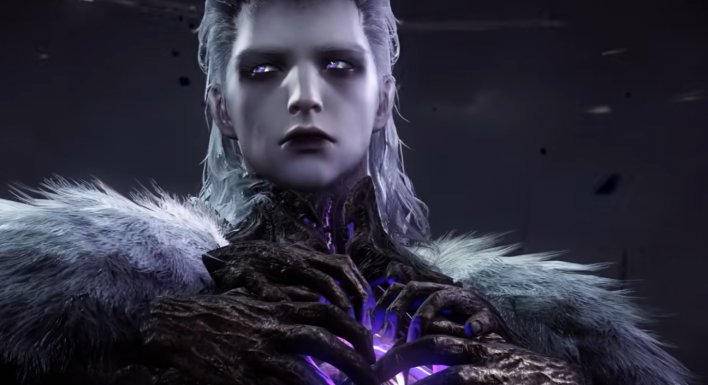
"Come and (save) us." - Krater
Excluding the Haal and the Lazernes, Sacria is one of the human factions that has come closest to the power of the gods in the history of Arkesia. Archbishop Termer III of Sacria collected nearly all the Arcs on the continent and declared war on the Sylvans to seize the Arc of Rohendel. This was the so-called 'Potunkul War,' a conflict that left nothing behind.
Though currently in decline, the Order of Twilight continues to operate in the shadows to reclaim the divine power that Termer III once sought. While Sacria is ostensibly a religious nation that preaches the will of Lupeon, it secretly researches Sylmael, the power of chaos, and holy relics. In the past, they intervened in various continents to find Arcs, monitored the Darren and Feiton, and the Order of Twilight carried out various operations under the guise of divine will.
Sacria's goal may not stop at merely believing in gods, but rather replacing the void left by their absence with human power. The relics left behind by the gods are the most direct materials for this purpose. Just as the adventurer used the relics of Giena, these are artifacts that allow for the direct use of divine authority.
Let us reconsider the message from 'Krater,' who sent his voice to the adventurer from Umbala in Voldaik. Krater used the plural 'us' rather than 'me' when asking to be saved. While speculative, it is possible that Sacria holds the secret regarding the absence of the gods and is attempting to artificially extract their power through these relics.
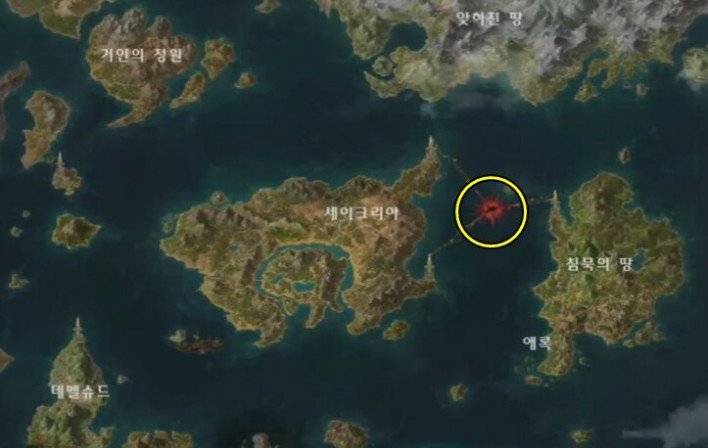
Evidence for this includes the map of Aldebaran's Sea revealed in a previous live broadcast, which shows a massive chain connecting Sacria, Aerok, and the Land of Silence. Whether this chain is merely a topographical feature or a device sealing a specific entity or region remains unknown. However, when viewed alongside Krater's message, some speculate that it might be a restraint used to bind the gods.
- A Name Meaning 'Immaturity': Foetus an Cragma
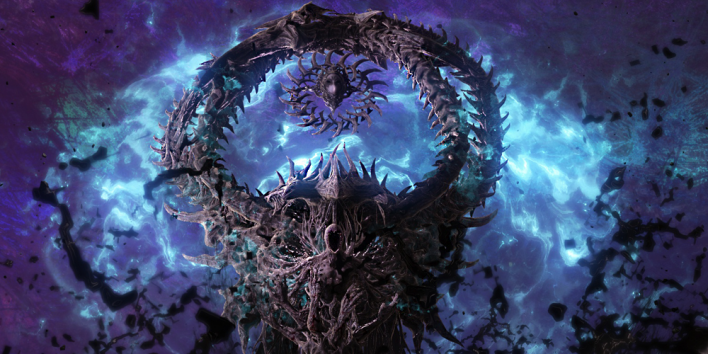
The entity dwelling within Velgadin's body is 'Foetus an Cragma.'
While the exact meaning of the words is unclear, the spelling appears to be 'Foetus an Cragma.' 'Foetus' is a Latin-derived word meaning fetus, an unborn being, or something in development. However, the full name including 'an Cragma' is difficult to interpret as a standard Latin sentence. Some argue that 'an' could be translated as 'of' or that 'Cragma' refers to bone, skull, or fragments, but there is no clear linguistic basis for this.
Therefore, this name seems more like a 'Lost Ark-style' coinage designed to sound like a classical language rather than formal Latin. Lost Ark has several such mysteries that remain as 'cool-sounding names,' such as Brelshaza's 'Dreamy Apeiron' or Kakul-Saydon's 'Barathron.' What matters is the imagery of 'Foetus.' Foetus an Cragma is not an independent being with a completed body, but an immature Primordial that must grow and be born within a suitable host. This aligns with the lore that it remained without a body for a long time before finally being born in its complete form upon merging with Velgadin's corpse.
Given that it was conceived in Cragma and resurrected by obtaining the body of a 'saint,' the name carries a strange nuance. Considering that the true name of the previous Serca raid, 'Corvus Tul Lac,' hinted at Serca's actions, it is highly likely that 'Foetus an Cragma,' which signifies immaturity, also symbolizes the ultimate fate of Velgadin or the entity residing within him.

Sort by:
Comments :0